Odoo CRM
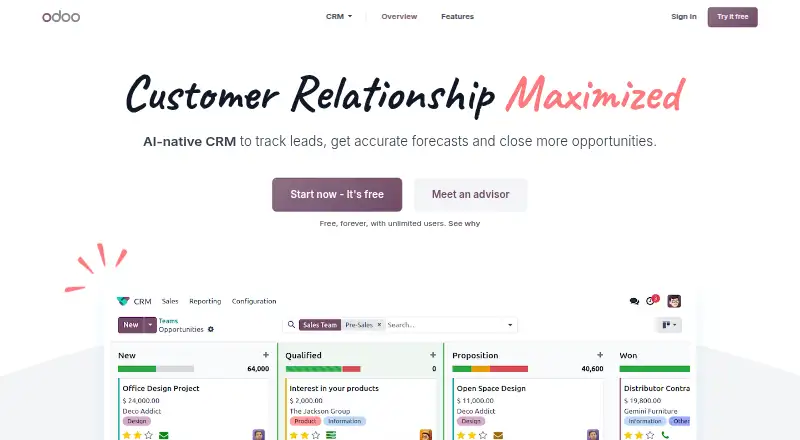
Odoo CRM helps teams manage sales opportunities through a pipeline, schedule follow-ups, and forecast sales.
What Odoo CRM is
Odoo CRM helps teams manage sales opportunities through a pipeline, schedule follow-ups, and forecast sales. Its Kanban view lets users move opportunities between stages by dragging and dropping, while predictive scoring uses criteria such as past performance to estimate the likelihood of success. Leads can come from email, VoIP calls, social media reactions, website visitors, event attendees, and support tickets. Users can automate lead creation, team assignment, and scheduled activities. The CRM lists email, live chat, SMS, and VoIP as integrated communication channels, and opportunity records can be used to create meetings with Odoo Calendar. Calendar synchronization is available with Google Calendar and Outlook; an Outlook add-in for desktop and web can create opportunities from an email panel. Reporting includes lead and opportunity analysis, cohort analysis, dashboards, and sales KPI reporting. Odoo is an open-source business app suite with AI features and mobile apps for Android and iOS. Its One App Free plan costs nothing for one app and unlimited users. Standard is $24.90 a month billed yearly, and Custom is $49 a month billed yearly. Both paid plans include all apps; Custom adds external API access and deployment options including Odoo.sh or on-premise. Odoo says all plans include unlimited email support, available weekdays around the clock in English, French, Spanish, or Dutch.
Good
- Kanban pipeline supports moving opportunities between stages.
- Predictive scoring estimates lead success probability.
- Leads can be captured from several listed sources.
- Automates lead creation, team assignment, and scheduled activities.
- Reporting includes dashboards, cohort analysis, and sales KPIs.
Watch out
- One App Free covers one app, even though users are unlimited.
- Standard and Custom prices are billed yearly.
- Odoo.sh hosting for custom developments and implementation services are excluded from plan fees.
Who it suits
Odoo CRM suits sales teams that need a visual opportunity pipeline, lead scoring, and automation for follow-ups and assignments. It can also suit businesses looking to use CRM alongside other Odoo apps, with mobile access and connections to calendars and communication channels.
Verdict
Choose Odoo CRM if your team wants pipeline management, lead scoring, automation, and reporting within Odoo's broader app suite. One App Free provides one app for unlimited users; teams needing all apps or external API access should review the paid plans and their yearly billing.
Plans and prices
From Odoo CRM's own pricing page, checked 14 Oct 2026.
| Plan | Price | What it gives you |
|---|---|---|
| One App Free | Free | one app · unlimited users · Odoo Online |
| Standard | $24.90 a month | all apps · Odoo Online · per user · yearly |
| Custom | $49 a month | all apps · Odoo Online/Odoo.sh/on-premise · Studio/Agentic AI · multi-company · external API · per user · yearly |
The facts
Each one read from Odoo CRM's own pages, with the date it was checked.
What it does
- AI features
- Yeschecked 20 Sep 2026
- API
- Odoo 20 documents a JSON-2 HTTP API at /json/2/<model>/<method> authenticated with bearer API keys.checked 14 Oct 2026
- API access limit
- External API access is restricted to the Custom plan and unavailable on One App Free and Standard.checked 14 Oct 2026
- API transition
- The documentation schedules legacy XML-RPC and JSON-RPC endpoints for removal in Odoo 22 and presents JSON-2 as the replacement.checked 14 Oct 2026
- Audience
- Odoo describes its product as an integrated suite of business apps covering needs such as CRM, ecommerce, accounting, inventory, point of sale, and project management.checked 10 Oct 2026
- Automation
- CRM automates lead creation, team assignment and scheduled activities, and supports rule-based assignment.checked 14 Oct 2026
- Calendar integration
- Odoo Calendar can synchronize with Google Calendar and Outlook, and CRM opportunity records can be used to create meetings.checked 10 Oct 2026
- Communication
- The CRM page lists email, live chat, SMS, and VoIP as integrated communication channels.checked 10 Oct 2026
- Communication integrations
- The CRM page lists email, live chat, SMS and VoIP integrations.checked 14 Oct 2026
- CRM integrations
- Features documentation describes integrations with Sales, Inventory and Email Marketing.checked 14 Oct 2026
- CRM purpose
- Odoo CRM helps track opportunities through a sales pipeline, plan follow-ups, and forecast sales.checked 10 Oct 2026
- Funding
- A 2014 Odoo press release announced $10 million in funding from XAnge, Sofinnova and SRIW.checked 14 Oct 2026
- GDPR
- Odoo states that Odoo SA and its subsidiaries are GDPR compliant and describes Odoo Cloud as acting as a data processor for hosted customer databases.checked 10 Oct 2026
- Lead capture
- Leads can be generated from sales-team email aliases and website contact forms.checked 14 Oct 2026
- Lead conversion
- Users can qualify leads, merge similar records and convert them into opportunities assigned to salespeople or teams.checked 14 Oct 2026
- Lead scoring
- Odoo scores leads using predictive criteria, including past performance, to estimate the probability of success.checked 10 Oct 2026
- Licence
- The Odoo community code repository is published under GNU LGPL version 3; bundled libraries can carry compatible separate licences.checked 14 Oct 2026
- Limit: complexity
- Reviewers repeatedly describe configuration, customization and the learning curve as demanding, often requiring technical expertise or training.checked 14 Oct 2026
The company
- Company founding
- Odoo states that it was founded in Belgium in 2005.checked 14 Oct 2026
- Company headquarters
- The registered address is Chaussée de Namur 40, 1367 Grand-Rosière, Belgium.checked 14 Oct 2026
- Company legal name
- The company identifies itself as Odoo S.A.checked 14 Oct 2026
- Company ownership
- LinkedIn describes Odoo as privately held, with company size listed at 5,001–10,000 employees.checked 14 Oct 2026
- Headquarters
- Grand-Rosière, Belgiumchecked 4 Oct 2026
Money
- Free plan
- Yeschecked 20 Sep 2026
The full review of Odoo CRM
Odoo CRM is a sales tool in Odoo’s suite of business apps, built to track opportunities, coordinate follow-ups, and forecast sales. It suits teams that want CRM alongside other business functions and need a free entry point for one app. Its strongest case is a connected workflow across Odoo; the one-app free plan is less useful to teams that need the full suite.
Overview
The CRM centers on a sales pipeline, from capturing leads through tracking opportunities and forecasting outcomes. Its Kanban board makes deal stages visible and lets users move opportunities by dragging them between columns. Predictive lead scoring estimates the chance of success using criteria including past performance, which can help teams prioritize prospects rather than treating every lead alike.
Odoo positions CRM within a broader suite that includes ecommerce, accounting, inventory, point of sale, and project management. That breadth is valuable when a business wants to bring several operations into one ecosystem. For a CRM-only buyer, however, the suite matters less, and the free plan’s restriction to one app means the appeal can narrow quickly.
Key features
- Lead capture and workflow automation: Leads can enter from email, VoIP calls, social media reactions, website visitors, event attendees, and support tickets. Odoo can automate lead creation, team assignment, and scheduled activities, helping teams manage inbound prospects and routine follow-up without manually routing every record.
- Pipeline and scoring: The Kanban pipeline provides a clear view of opportunities by stage, while predictive scoring uses past performance among its criteria to estimate success. These tools support prioritization and forecasting, though the scoring estimate is a guide rather than a guarantee of a deal’s outcome.
- Communications and calendar: Integrated channels include email, live chat, SMS, and VoIP. Odoo Calendar can synchronize with Google Calendar and Outlook, and CRM opportunity records can be used to create meetings. This is useful for teams coordinating customer conversations and sales appointments in the same workflow.
- Outlook add-in: The plugin works with desktop and web Outlook and can create an opportunity from an email panel. That makes it a practical bridge for sellers who handle much of their customer correspondence in Outlook.
- Analysis and reporting: Opportunity and lead analysis, cohort analysis, dashboards, and sales KPI reporting give managers several ways to inspect pipeline activity and results. The range is a stronger fit for teams that need regular sales visibility than for users seeking only a basic contact register.
- Security and privacy: Odoo says Cloud customer data is encrypted in transit with HTTPS and at rest with AES-256, and participates in the CSA STAR Program at Level 1. Odoo SA and its subsidiaries state that they are GDPR compliant; Odoo Cloud acts as a data processor for hosted customer databases.
Pricing
Odoo uses a freemium model. One App Free costs nothing and includes one app for unlimited users on Odoo Online. It is a meaningful way for a team to start using one part of Odoo without a per-user bill, but the one-app cap rules it out as a free route to the entire business suite.
Standard costs $24.90 a month billed Yearly; the pricing page also shows US$ 31.10 / user / month. It includes all apps on Odoo Online, with unlimited support, hosting, and maintenance. This is the relevant step up for teams that want the wider app suite without deployment choices beyond Odoo Online.
Custom costs $49 a month billed Yearly; the pricing page also shows US$ 61.00 / user / month. It includes all apps, Odoo Online, Odoo.sh or on-premise deployment, Studio, Agentic AI, multi-company support, and external API access. It suits organizations that need those deployment or integration options; Odoo.sh hosting costs extra.
All plans include unlimited email support Monday to Friday, 24/5, in English, French, Spanish, or Dutch. Plan fees exclude Odoo.sh hosting for custom developments, implementation services, in-app purchase credits, and maintenance of custom code. Standard and Custom are billed yearly, so their monthly figures are not month-to-month terms.
Platforms
Odoo offers web access, Android and iOS mobile apps, downloads for Windows, Ubuntu/Debian, and RPM, plus self-hosting options. API access is included with the Custom plan, not a stated capability of every plan. That deployment range gives businesses more choice than a web-only service, although self-hosted and custom setups may bring additional hosting or implementation costs.
Who it's for
Odoo CRM is a strong fit for businesses that want pipeline tracking, lead scoring, follow-up automation, and sales reporting as part of a wider set of business apps. Teams that will use multiple Odoo functions can get more from its integrated-suite approach than teams shopping for a standalone CRM. The free plan works for trying or operating one app with unlimited users; organizations needing all apps, external API access, or deployment flexibility should consider the paid tiers.
Pros and cons
- Pro — broad lead intake: Leads can originate from email, calls, social reactions, website visitors, events, and support tickets, covering several common entry points.
- Pro — useful sales workflow in one place: Pipeline stages, predictive scoring, scheduled activities, communication channels, calendar connections, and reporting support more than basic contact storage.
- Pro — flexible deployment: Web and mobile apps sit alongside desktop downloads and self-hosting options, while Custom adds external API access.
- Con — free access is limited to one app: The unlimited-user allowance does not remove the app cap, so it cannot serve as a free plan for the entire Odoo suite.
- Con — paid plans are annual: Standard and Custom show monthly prices but are billed yearly, which is a significant commitment for teams that only need a short-term CRM.
- Con — some costs sit outside plan fees: Odoo.sh hosting for custom developments, implementation, in-app purchase credits, and custom-code maintenance are excluded; Custom’s Odoo.sh hosting also costs extra.
Alternatives
For a free, self-hosted and open-source ERP option, consider webERP: its plan is free under GNU General Public License v2, with API, Linux, macOS, web, and Windows support. Choose it when a free self-hosted ERP is the priority rather than Odoo’s wider CRM workflow and app-suite path.
Trimble Viewpoint Vista is an alternative with cloud-hosted and on-premises deployments and pricing by contacting sales. Global Shop Solutions ERP uses tailored pricing with an upfront and ongoing quarterly cost. TimeSuite is another paid option. Epicor Kinetic offers platform-core, cloud-package, concurrent-user-license, and industry-bundle choices, with price not listed. JOBPOWER is a paid alternative from a maker that says it has worked with contractors since 1985. These are alternatives to compare when their named deployment, pricing structure, or contractor focus fits the buying brief better.
For inventory-focused needs, Katana offers a permanent free tier at no cost, with 30 SKUs, unlimited users, integrations, and inventory locations. abas ERP is a paid option whose implementation costs vary with users, process complexity, data migration, functions, and adjustments.
Browse CRM Software for more CRM options, or compare related categories including Sales Force Automation Software, Insurance CRM Software, Professional Services CRM Software, and Cost Accounting Software.
Verdict
Choose Odoo CRM if your team wants a structured pipeline, lead prioritization, and sales automation within a broader business-app suite. Its one-app free plan is an unusually open starting point for unlimited users, while Standard and Custom unlock the broader suite and, at the higher tier, API and deployment options. Look elsewhere if you need all apps without a yearly paid commitment or want to avoid the extra costs that can come with custom implementation and hosting.
Getting started
- Visit the Odoo CRM website.
- Choose One App Free for one app or review Standard and Custom for all apps.
- Select Odoo Online, or choose Odoo.sh or on-premise with the Custom plan.
- Access the service through the web or use the Android or iOS mobile app.
- Connect a calendar or use the Outlook add-in if those integrations fit your workflow.
Limits worth knowing
One App Free includes one app, although it allows unlimited users. Plan fees exclude Odoo.sh hosting for custom developments, implementation services, in-app purchase credits, and maintenance of custom code.
Questions
Does Odoo CRM have a free plan?
Yes. One App Free costs nothing and includes one app with unlimited users on Odoo Online.
What do Standard and Custom cost?
Standard costs $24.90 a month billed yearly. Custom costs $49 a month billed yearly.
Is Odoo CRM open source?
Yes. Odoo is listed as open source.
Which platforms are available?
The listed platforms include Android, iOS, Linux, Windows, web, API, and self-hosted. Odoo also offers downloads for Windows, Ubuntu/Debian, and RPM.
Can Odoo CRM connect to calendars and Outlook?
Odoo Calendar can synchronize with Google Calendar and Outlook. The Outlook add-in for desktop and web can create an opportunity from an email panel.
What is excluded from plan fees?
Plan fees exclude Odoo.sh hosting for custom developments, implementation services, in-app purchase credits, and maintenance of custom code.
Alternatives to Odoo CRM
- 1

EspoCRM
Free planOpen sourceAndroidWebAPIExtension9.4From $15 a month - 2

Frappe CRM
Free planOpen sourceAndroidiOSWebAPI9.2From $5 a month - 3

Zoho CRM
Free planAndroidiOSWebAPI9.1From $14 a month - 4

Freshsales
Free planAndroidiOSWebAPI9.1From $108 a year - 5
Attio
Free planAndroidiOSWebAPI9.0From $4,435 a month - 6
Capsule CRM
Free planAndroidiOSWebAPI8.9From $18 a month