webERP
webERP is a free, web-based open-source accounting and business management system for businesses of all sizes.
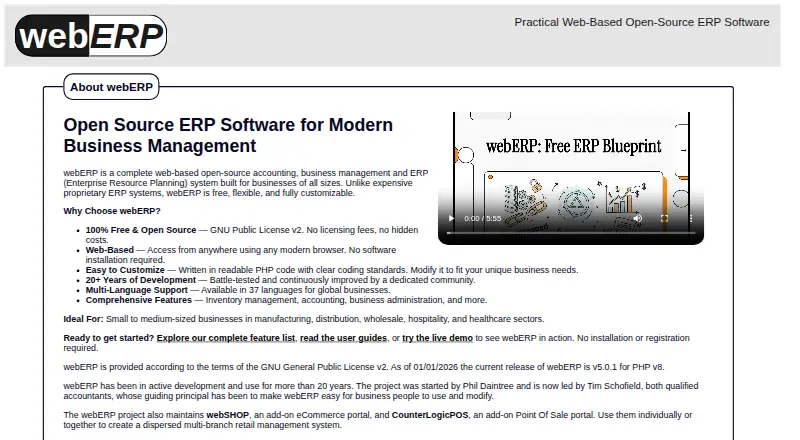
What webERP is
webERP is a free, web-based open-source accounting and business management system for businesses of all sizes. It brings together accounts receivable and payable, general ledger, bank accounts, inventory and purchasing, along with order management and multi-entity support. Manufacturing tools include multi-level bills of materials, work orders and material requirements planning; capacity requirements planning and MRP II are not available. The maker identifies small and medium-sized businesses in manufacturing, distribution, wholesale, hospitality and healthcare as suitable users. The system is available in 37 languages and runs on a PHP-capable web server, independently of operating system, but requires MySQL or MariaDB. It is designed for on-premise, self-hosted deployment. Its security features include role-based access, account lockout after three incorrect passwords, optional SSL encryption and transaction audit trails. An XML-RPC API lets external programs retrieve and update data, though it can access only one company per installation. The project also maintains webSHOP and CounterLogicPOS portals.
Good
- Includes accounts, inventory, purchasing and order management.
- Provides manufacturing tools including bills of materials.
- Available in 37 languages.
- Role-based access and transaction audit trails are listed.
- Free and open source under GNU GPL v2.
Watch out
- Requires a MySQL or MariaDB database.
- Capacity requirements planning and MRP II are unavailable.
- XML-RPC API accesses only one company per installation.
- Self-hosted, on-premise deployment is required.
Who it suits
webERP suits small and medium-sized businesses in manufacturing, distribution, wholesale, hospitality or healthcare that want self-hosted finance and operations tools. It requires a PHP-capable server and a MySQL or MariaDB database.
Verdict
webERP covers accounting, inventory, orders and several manufacturing workflows in a free, self-hosted system. Its database requirement and manufacturing omissions are important considerations before choosing it.
Plans and prices
From webERP's own pricing page, checked 10 Oct 2026.
| Plan | Price | What it gives you |
|---|---|---|
| webERP | Free | Free and open source under GNU General Public License v2; self-hosted |
The facts
Each one read from webERP's own pages, with the date it was checked.
What it does
- Accounting and inventory
- Features include accounts receivable and payable, general ledger, bank accounts, inventory, and purchasing.checked 10 Oct 2026
- Add-ons
- The project also maintains webSHOP, an e-commerce portal, and CounterLogicPOS, a point-of-sale portal.checked 10 Oct 2026
- API limitation
- The API can access only one company in a webERP installation, according to its tutorial.checked 10 Oct 2026
- Current release
- The homepage states that as of January 1, 2026, the current release is webERP v5.0.1 for PHP v8.checked 10 Oct 2026
- Database requirement
- The getting-started manual says webERP works only with MySQL or MariaDB database servers.checked 10 Oct 2026
- Deployment
- on-premisechecked 20 Sep 2026
- Finance module
- Yeschecked 20 Sep 2026
- Integration
- The maker provides an XML-RPC API for external programs to retrieve and update data, and says it should be used to preserve data integrity.checked 10 Oct 2026
- Inventory management
- Yeschecked 20 Sep 2026
- Languages
- The site says webERP is available in 37 languages.checked 10 Oct 2026
- Manufacturing
- Manufacturing features include multi-level bills of materials, work orders, and material requirements planning; the page says capacity requirements planning and MRP II are not available.checked 10 Oct 2026
- Manufacturing tools
- Yeschecked 20 Sep 2026
- Multi-entity support
- Yeschecked 20 Sep 2026
- Order management
- Yeschecked 20 Sep 2026
- Product
- webERP is a web-based open-source accounting, business management, and ERP system for businesses of all sizes.checked 10 Oct 2026
- Security
- The features page describes role-based access, account lockout after three incorrect passwords, optional SSL encryption, transaction audit trails, and sanitization against SQL injection and cross-site scripting.checked 10 Oct 2026
- Support and community
- The maker points users to GitHub Discussions, issue reporting, and user or developer mailing lists on SourceForge.checked 10 Oct 2026
- Who it is for
- The maker identifies small and medium-sized businesses in manufacturing, distribution, wholesale, hospitality, and healthcare as ideal users.checked 10 Oct 2026
Money
- Free plan
- Yeschecked 20 Sep 2026
Where it runs
- Hosting and platforms
- webERP runs on a PHP-capable web server and is described as operating-system independent; the manual names Apache, IIS, Hiawatha, and Nginx as web-server options.checked 10 Oct 2026
The full review of webERP
Overview
webERP is a self-hosted, open-source ERP system that brings core accounting and business operations into a web application. It is best suited to small and medium-sized organizations in sectors such as manufacturing, distribution and wholesale that can maintain their own server. Its wide operational scope comes without a software fee, but the database restriction and gaps in advanced manufacturing planning narrow its appeal.
Key features
Finance covers accounts receivable and payable, the general ledger and bank accounts, alongside inventory, purchasing and order management. Keeping these functions together can give businesses a shared view of money, stock and orders without a recurring software charge. Multi-entity support also suits organizations managing more than one company, although the API limitation can complicate that setup.
Manufacturing tools include multi-level bills of materials, work orders and material requirements planning. These can support production workflows, but webERP lacks capacity requirements planning and MRP II. Manufacturers that need to plan production capacity or use those more advanced controls should look elsewhere.
The XML-RPC API allows external programs to retrieve and update data, and the maker recommends using it to help preserve data integrity. It can access only one company in an installation, however, limiting its usefulness for integrations that span multiple entities. The project also maintains webSHOP, an e-commerce portal, and CounterLogicPOS, a point-of-sale portal.
Security features include role-based access, account lockout after three incorrect passwords, optional SSL encryption, transaction audit trails and safeguards against SQL injection and cross-site scripting. The site says webERP is available in 37 languages, which broadens its reach for multilingual organizations.
Pricing
webERP costs nothing. The plan is free and open source under the GNU General Public License v2, with self-hosting required. There is no free trial because the product itself is free. This removes subscription costs, but businesses must run the system on their own infrastructure.
| Plan | Price | What it includes |
|---|---|---|
| webERP | free | Free and open source under GNU General Public License v2; self-hosted |
Platforms
webERP runs on a PHP-capable web server and is described as operating-system independent, with Linux, macOS and Windows among its listed platforms. The manual names Apache, IIS, Hiawatha and Nginx as web-server options. Deployment is on-premise and self-hosted; a MySQL or MariaDB database server is required, so it is not a fit for organizations committed to another database.
Who it's for
Small and medium-sized businesses in manufacturing, distribution, wholesale, hospitality and healthcare are the maker's intended audience. It makes particular sense for organizations that want accounting, inventory and order workflows under one roof and have the technical capacity to manage a PHP server and supported database. Businesses needing more advanced manufacturing planning or an API integration across multiple companies should consider alternatives.
Pros and cons
- Pros: No software fee and an open-source license make it possible to run a broad ERP system without a recurring subscription.
- Pros: Accounting, inventory, purchasing, orders and multiple-entity support cover connected operational needs in one system.
- Pros: Role-based access, audit trails and protections against common web attacks provide useful security controls.
- Cons: Self-hosting and the MySQL-or-MariaDB requirement add infrastructure and administration commitments.
- Cons: Missing capacity requirements planning and MRP II leave a gap for manufacturers with more demanding production-planning needs.
- Cons: The XML-RPC API reaches only one company per installation, constraining multi-entity integrations.
Alternatives
Odoo CRM is worth considering for teams that want an open-source option with a free plan for one app, unlimited users and Odoo Online hosting; webERP instead offers a self-hosted ERP system with accounting and inventory built in.
Trimble Viewpoint Vista may fit organizations seeking cloud-hosted or on-premises deployment and willing to contact sales for pricing.
Global Shop Solutions ERP is a paid alternative with pricing tailored to the company, billed upfront plus an ongoing quarterly cost.
TimeSuite is another paid alternative.
Epicor Kinetic may suit buyers seeking a paid system organized around platform cores, cloud packages, concurrent user licenses and industry bundles.
JOBPOWER is a paid alternative from a maker that says it has worked with contractors since 1985.
Katana offers a permanent free tier at no cost, capped at 30 SKUs but allowing unlimited users, integrations and inventory locations. It is a different option for readers whose requirements fit those limits.
abas ERP is a paid alternative whose implementation costs vary with users, process complexity, data migration, functions and adjustments.
For more options, see our ERP Software and Cost Accounting Software lists.
Verdict
Choose webERP if your small or medium-sized business wants a broad, no-fee accounting and operations system, can self-host it on MySQL or MariaDB, and can work within its manufacturing-planning limits. Its central advantage is the scope it provides without a software subscription; its main reasons to look elsewhere are the infrastructure commitment and the missing advanced manufacturing controls.
Getting started
- Visit https://www.weberp.org/ to access the project.
- Prepare a PHP-capable web server and a MySQL or MariaDB database server.
- Deploy webERP on-premise as a self-hosted system.
- Use the project’s XML-RPC API if an external program needs to retrieve or update data.
Limits worth knowing
The manufacturing scope excludes capacity requirements planning and MRP II. The XML-RPC API can access only one company in an installation.
Questions
How much does webERP cost?
The listed webERP plan is free. It is free and open-source under GNU General Public License v2.
What deployment and database does it require?
webERP is self-hosted for on-premise use and runs on a PHP-capable web server. It requires a MySQL or MariaDB database server.
What kinds of business functions does it cover?
Its functions include accounts receivable and payable, general ledger, bank accounts, inventory, purchasing, order management, and manufacturing tools.
Does webERP support multiple entities?
Yes, multi-entity support is listed. The XML-RPC API, however, can access only one company in an installation.
Which manufacturing planning features are unavailable?
Capacity requirements planning and MRP II are not available.
What external integrations are described?
The maker provides an XML-RPC API for external programs to retrieve and update data. The project also maintains webSHOP, an e-commerce portal, and CounterLogicPOS, a point-of-sale portal.
Alternatives to webERP
- 1
Gravity Software
AndroidiOSWebAPI7.9 - 2

DMSi Agility
AndroidiOSWebAPI7.3From $0.01 a month - 3

Exact Online
Web7.1 - 4

Infor ERP
AndroidiOSWebAPI6.7 - 5
Zoho ERP
AndroidiOSWebWindows6.6From ₹999 a month - 6
Blue Link ERP
AndroidiOSWebAPI6.5