
abas ERP
abas ERP is an enterprise resource planning system for midmarket manufacturing companies.
What abas ERP is
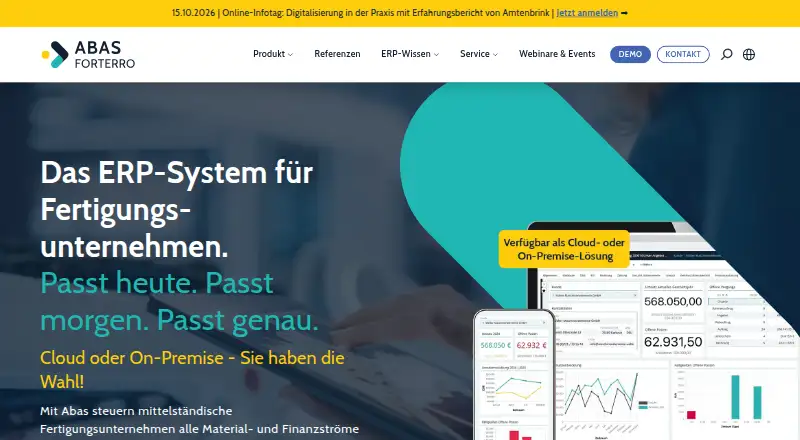
abas ERP is an enterprise resource planning system for midmarket manufacturing companies. It brings together purchasing, sales, production, warehouse, service, finance, and management processes, with production planning and control for one-off, repetitive, project, contract, and subcontracting manufacturers. Advanced planning and scheduling is also included. Teams can adapt workflows through low-code customization, which the maker describes as compatible with upgrades. Abas Connect provides graphical, low-code links to software and devices such as CRM systems, machine controls, and warehouse management systems. The REST API allows real-time reading and writing of ERP data through the core logic and company-specific customizations. Listed connectors include DMS, Microsoft SQL, and PDM, with standard PDM connections to PRO.FILE and keytech PLM. The system uses Linux as its server operating system; a cloud edition runs on AWS infrastructure. Users can access it from Windows computers and mobile devices, or through a browser. Pricing is available on request, with implementation and ongoing support costs listed; implementation costs vary by project requirements.
Good
- Covers core manufacturing, finance, and management processes.
- Planning supports several manufacturing models.
- Low-code customization is described as upgrade-compatible.
- REST API provides real-time read and write access.
Watch out
- Pricing is available only on request.
- Implementation costs vary with users, complexity, migration, and adjustments.
- Security strategy details are not published publicly.
Who it suits
abas ERP is aimed at midmarket manufacturers coordinating production with purchasing, sales, warehousing, service, and finance. It may suit organizations that need tailored processes and connections to other software or equipment.
Verdict
abas ERP spans manufacturing and broader business processes, with customization and integration options for complex operations. Buyers should request pricing and clarify project-specific implementation costs and security details.
Plans and prices
From abas ERP's own pricing page, checked 15 Oct 2026.
| Plan | Price | What it gives you |
|---|---|---|
| abas ERP | $149 a month | subscription · no free trial listed · no free version listed · starting price |
The facts
Each one read from abas ERP's own pages, with the date it was checked.
What it does
- Advanced scheduling
- Integrated APS supports finite planning, bottleneck analysis, sequencing and what-if simulations.checked 15 Oct 2026
- API
- The REST API provides real-time read and write access to Abas ERP data using the ERP core logic and company-specific customizations.checked 4 Oct 2026
- API and extensibility
- The documented architecture exposes ODBC and SQL access, language APIs, the Java AJO framework, proprietary FO 4GL and SOAP services.checked 15 Oct 2026
- CAD integration
- CAD integration transfers engineering bills of material into production structures with version control.checked 15 Oct 2026
- Client access
- Users can access Abas ERP from Windows computers and mobile devices, and the web client is described as browser-accessible from computers or devices with internet connectivity.checked 4 Oct 2026
- Cloud data location
- The vendor says Cloud Edition stores data in Germany under European data-protection standards.checked 15 Oct 2026
- Cloud deployment
- Abas Cloud Edition is single-tenant AWS hosting with operations, monitoring, upgrades, patches and backups included.checked 15 Oct 2026
- Connectors
- The product lists DMS, Microsoft SQL, and PDM connectors; PDM connections include standard connections to PRO.FILE and keytech PLM.checked 4 Oct 2026
- Core functions
- The product covers purchasing, sales, production, warehouse, service, finance, and management.checked 4 Oct 2026
- Customization
- Abas ERP offers low-code customization and is described as upgrade-compatible after customers tailor their processes.checked 4 Oct 2026
- Deployment
- Abas ERP uses Linux as its server operating system, and the maker also offers a cloud edition using AWS infrastructure.checked 4 Oct 2026
- Documentation
- Public materials include installation and upgrade guides, brochures, FAQs, videos, training resources and a customer portal.checked 15 Oct 2026
- Financial accounting
- Finance functions include financial and fixed-asset accounting, controlling, costing, valuation and reporting.checked 15 Oct 2026
- Integrations
- Abas Connect supports graphical, low-code connections to software and devices such as CRM, machine controls, and warehouse management systems.checked 4 Oct 2026
- License
- Abas ERP is proprietary commercial software rather than open source.checked 15 Oct 2026
- Limit: CRM coverage
- A Capterra review states that the product lacked a meaningful integrated CRM in that deployment.checked 15 Oct 2026
The company
- Company scale
- Abas reports more than 4,000 implementations, 120,000 users, 1,100-plus experts and operations in over 30 countries.checked 15 Oct 2026
- Company size record
- LinkedIn lists Abas as a privately held Karlsruhe software company with 501–1,000 employees.checked 15 Oct 2026
- Founded
- 1980checked 28 Sep 2026
- Funding and owner
- Crunchbase lists Forterro as backed by Battery Ventures and abas Software as a Forterro subsidiary acquired in 2019.checked 15 Oct 2026
- Headquarters
- Karlsruhe, Germanychecked 28 Sep 2026
Money
- Limit: customization cost
- A GetApp reviewer says many field names are German and substantial customization requires paying Abas.checked 15 Oct 2026
- Limit: search and planning
- A reviewer reports weak wildcard and description search plus demand-generation gaps that can omit needed purchasing items.checked 15 Oct 2026
Where it runs
- Limit: Linux administration
- Reviewers say Linux servers can be difficult for beginners and printer installation may require Linux-compatible drivers.checked 15 Oct 2026
The full review of abas ERP
abas ERP is an ERP system for midmarket manufacturers, bringing production planning together with purchasing, sales, warehousing, service and finance. It is best suited to businesses with varied production models and complex processes; its low-code customization and integration options are compelling, but implementation and ongoing support costs make it a substantial commitment.
Overview
abas ERP spans operational and administrative work, from purchasing and production to finance and management. Its planning capabilities cover one-off, repetitive, project, contract and subcontracting manufacturers, making it a stronger fit for varied production environments than for a business seeking only a narrow planning tool.
Founded in 1980 and headquartered in Karlsruhe, Germany, abas reports more than 4,000 implementations in over 30 countries and more than 120,000 users. The company says its software is certified according to ISO 9001:2015. It also says it regularly updates security protections, but does not publish details of its security strategy.
Key features
Production planning and control
Production scheduling, multi-level bills of materials, purchase planning, capacity planning and multi-site planning address the linked decisions manufacturers must coordinate across production and purchasing. Demand inputs can come from both sources. Advanced planning and scheduling adds scope for companies whose production requirements extend beyond a simple, single-workflow setup.
Customization and integration
Low-code customization lets companies tailor processes, while the system is described as upgrade-compatible after those changes. That combination matters to manufacturers whose workflows do not map neatly to standard software, though it does not remove the effort involved in implementation and configuration.
Abas Connect provides graphical, low-code connections to software and devices, including CRM, machine controls and warehouse management systems. The REST API offers real-time read and write access through ERP core logic and company-specific customizations, a useful approach when external systems need to work with tailored processes. Connectors include DMS and Microsoft SQL, plus standard PDM connections to PRO.FILE and keytech PLM.
Deployment and access
Abas uses Linux as its server operating system and offers a cloud edition on AWS infrastructure. Users can access the system from Windows computers and mobile devices; its browser-based web client works from internet-connected computers or devices. Hybrid deployment is an option, giving buyers a deployment model beyond choosing only a self-hosted or cloud setup.
After implementation, customers can use interactive training and workshops, a user group and phone support from the Abas team. Those resources can help customers get oriented, but the ongoing support fee is part of the buying decision.
Pricing
Abas ERP: custom pricing. The plan includes production scheduling, multi-level BOMs, purchase planning, capacity planning and multi-site planning. Costs include a one-time software cost, implementation cost and ongoing support fee; implementation costs vary with user count, process complexity, data migration, required functions and adjustments.
This is a paid product with no published seat price, quota or trial term to compare. Buyers should budget for more than the software license: implementation scope and continuing support are also material costs. That structure may suit a manufacturer prepared to scope a tailored ERP project, but makes it harder to assess affordability before discussing requirements.
Platforms
abas ERP supports Android, iOS, Linux, Windows, web access, an API and self-hosted deployment. Its cloud edition runs on AWS infrastructure, and hybrid deployment is supported.
Who it's for
abas ERP is most appropriate for midmarket manufacturers coordinating production with purchasing, inventory, finance and other business processes, especially those handling several production models or operating across multiple sites. Low-code tailoring and connections to systems such as machine controls and warehouse management systems strengthen the case when standard workflows are not enough.
It is a less natural fit for a small business seeking a simple, low-cost tool or for a buyer who needs a clear upfront price before scoping a project. The implementation and support costs, along with the need to plan integrations and customization, call for a buyer ready to make a considered ERP investment.
Pros and cons
Pros
- Planning breadth: scheduling, capacity, purchasing, multi-site planning and multi-level BOMs address connected manufacturing needs.
- Multiple production models: support for one-off, repetitive, project, contract and subcontracting work suits manufacturers with diverse operations.
- Tailoring with upgrade compatibility: low-code customization is described as upgrade-compatible, helping accommodate company-specific processes.
- Integration options: Abas Connect, a REST API and named DMS, SQL and PDM connectors support links to business software and equipment.
Cons
- Costs require project scoping: implementation varies with users, complexity, migration and adjustments, alongside software and ongoing support fees.
- Security strategy lacks public detail: Abas says protections are updated regularly but does not publish its security strategy.
- Not a lightweight purchase: implementation, customization and continued support make this a more involved commitment than a narrowly focused tool.
Alternatives
Cetec ERP is another paid manufacturing ERP, with a free trial and API, self-hosted and web platforms; compare it if those terms matter to your evaluation.
Epicor Kinetic is a paid option with cloud packages, concurrent user licenses and industry bundles, worth considering if that packaging better suits your deployment and licensing needs.
Odoo Manufacturing offers a free plan with unlimited users for one app, as well as paid tiers; consider it if starting with one free app is a priority.
Carbon has an open-source Community edition covering core ERP, MRP, MES and QMS under AGPL-3.0, while enterprise features require a commercial agreement. It is a relevant alternative for buyers weighing open-source access.
Exact Online offers web-based accounting plans that include CRM, bank feeds and invoicing, making it an alternative to consider when those functions are the priority.
Genius ERP is another paid option, with pricing that varies by shop size, user count, hosting model and required features.
QAD Adaptive ERP is another paid ERP option to compare.
Rootstock ERP offers tiered plans, including an Advanced option with advanced manufacturing and a focused set of add-ons; compare it if that packaging aligns with your needs.
Verdict
Choose abas ERP if you are a midmarket manufacturer that needs broad production planning, multiple production models and the flexibility to tailor processes and integrations. Its strongest case is the combination of manufacturing breadth and upgrade-compatible customization. Look elsewhere if a straightforward price, limited implementation work or a simpler standalone tool matters more than that scope.
Getting started
- Visit https://abas-erp.com/ to contact the maker about pricing.
- Request a quote; pricing is provided on request.
- Plan implementation around users, process complexity, data migration, desired functions, and adjustments.
- Choose a deployment approach: Linux server operation or the cloud edition using AWS infrastructure.
- Arrange user access through Windows computers, mobile devices, or the browser client.
Limits worth knowing
The listed plan has no stated price and requires a pricing request. Costs include one-time software, implementation, and ongoing support; implementation costs vary with the project.
Questions
How much does abas ERP cost?
Pricing is on request. Listed costs include one-time software, implementation, and ongoing support fees; implementation costs vary by project.
Who is abas ERP designed for?
It is designed for midmarket manufacturing companies and supports production-related business processes.
What platforms can users access it from?
Platforms include Android, iOS, Linux, web, and Windows. Users can also access it from mobile devices, Windows computers, or a browser.
Can abas ERP connect to other systems?
Abas Connect supports graphical, low-code connections to software and devices such as CRM, machine controls, and warehouse management systems. Listed connectors include DMS, Microsoft SQL, and PDM.
How is abas ERP deployed?
It uses Linux as its server operating system, and a cloud edition uses AWS infrastructure. The deployment model is hybrid.
What support is available after implementation?
Customers can access interactive trainings and workshops, a user group, and the Abas support team by phone.
Alternatives to abas ERP
- 1
Odoo ERP
Free planOpen sourceAndroidiOSWebAPI9.1From $24.90 a month - 2
Striven
Free planAndroidiOSWebAPI8.6From $35 a month - 3

ERPNext
Free planWebAPILinuxmacOS8.2From $5 a month - 4
WP ERP
Free planOpen sourceAndroidiOSWebSelf-hosted8.2From $160 a year - 5

Rootstock ERP
AndroidiOSWebAPI8.1From $100 a month - 6

BUSY
Free planWeb7.9From ₹5,000 a year