SAP Business One
SAP Business One is an ERP system for small and midsize businesses that brings accounting, purchasing, inventory, sales, customer relationships, reporting an…
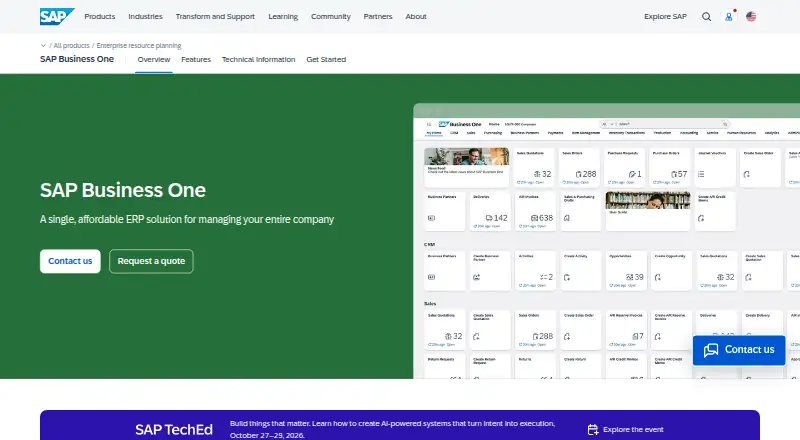
What SAP Business One is
SAP Business One is an ERP system for small and midsize businesses that brings accounting, purchasing, inventory, sales, customer relationships, reporting and analytics into one system. Financial features include cash flow and budget controls, fixed asset management, banking and reconciliation, and financial reporting. Sales and customer tools cover opportunities, marketing campaigns, customer information, service agreements, service calls and sales reports. Purchasing functions include procurement, accounts payable, and warehouse and accounting synchronization. Users can work with real-time analytics, dashboards, predefined metrics, reports and interactive analysis with Microsoft Excel functionality. The web client supports marketing documents, master data, approvals, activity tracking, charts and predefined analytics. Android and iOS apps let users manage leads and customer accounts, view stock and place orders; their available functions depend on each user's license. SAP describes both cloud and on-premise deployment. The product also includes a Service Layer API using HTTP and OData protocols. Pricing is available on request.
Good
- Combines finance, inventory, sales and customer management.
- Offers cloud and on-premise deployment.
- Web client includes approvals and analytics.
- Mobile apps support stock checks and orders.
Watch out
- Pricing is available only on request.
- Mobile functions depend on the user's license.
- Critical-issue 24x7 support requires a valid maintenance contract.
Who it suits
SAP Business One is aimed at small and midsize businesses needing a system for finance, inventory, purchasing, sales and customer management. Its listed industries include manufacturing, retail, professional services, consumer products and wholesale distribution.
Verdict
SAP Business One covers operational and financial functions in a single ERP, with web, mobile and API access options. Check the relevant license for mobile capabilities and ask for a quote based on business requirements.
Plans and prices
From SAP Business One's own pricing page, checked 12 Oct 2026.
| Plan | Price | What it gives you |
|---|---|---|
| SAP Business One | Priced on request | Pricing by quote based on business requirements |
The facts
Each one read from SAP Business One's own pages, with the date it was checked.
What it does
- Analytics
- SAP Business One provides real-time analytics, dashboards, reports, predefined metrics, and interactive analysis with Microsoft Excel functionality.checked 12 Oct 2026
- API
- The Service Layer is an extension API for SAP Business One data and services that uses HTTP and OData protocols.checked 12 Oct 2026
- Customer base
- SAP says more than 85,000 customers worldwide rely on SAP Business One.checked 12 Oct 2026
- Deployment
- SAP describes cloud and on-premise deployment options for SAP Business One.checked 12 Oct 2026
- Finance module
- Yeschecked 20 Sep 2026
- Financial management
- Features include accounting, cash flow and budget controls, fixed asset management, banking and reconciliation, and financial reporting.checked 12 Oct 2026
- Industries
- SAP lists capabilities for consumer products, manufacturing, professional services, retail, and wholesale distribution.checked 12 Oct 2026
- Inventory management
- Yeschecked 20 Sep 2026
- Manufacturing tools
- Yeschecked 20 Sep 2026
- Microsoft integration
- The Microsoft Outlook Integration add-on can synchronize appointments, contacts, and tasks and exchange quotations, emails, and documents with SAP Business One.checked 12 Oct 2026
- Multi-entity support
- Yeschecked 20 Sep 2026
- Notable limit
- SAP states that mobile app functions available to a user depend on that user's SAP Business One license.checked 12 Oct 2026
- Order management
- Yeschecked 20 Sep 2026
- Purchasing and inventory
- The product supports procurement, purchasing data, warehouse and accounting synchronization, accounts payable, and reporting.checked 12 Oct 2026
- Purpose
- SAP Business One is an ERP system for small and midsize businesses that brings accounting, purchasing, inventory, sales, customer relationships, reporting, and analytics into one system.checked 12 Oct 2026
- Sales and customer management
- Features cover sales opportunities, marketing campaigns, customer information, service agreements, service calls, and sales reporting.checked 12 Oct 2026
- Support
- Customers with a valid maintenance contract receive 24x7 support for critical issues, support tools, software upgrades and updates, and knowledge transfer through SAP and its partner network.checked 12 Oct 2026
- Web client
- The Web client supports creating, processing, and updating marketing documents and master data, approval processes, activity tracking, charts, and predefined analytics.checked 12 Oct 2026
The company
- Founded
- 1972checked 4 Oct 2026
- Headquarters
- Walldorf, Germanychecked 4 Oct 2026
Where it runs
- Mobile apps
- SAP says its iOS and Android mobile apps let users manage leads and customer accounts, view stock, and place orders.checked 12 Oct 2026
The full review of SAP Business One
SAP Business One is a broad ERP for small and midsize companies that want finance, sales, purchasing, inventory, service, and reporting in one system. It is particularly suited to manufacturing, retail, wholesale distribution, consumer products, and professional-services businesses. The trade-off is a quote-based purchase and mobile functionality that varies by user license.
Overview
SAP Business One combines accounting, purchasing, inventory, sales, customer management, reporting, and analytics rather than treating them as separate applications. SAP offers both cloud and on-premise deployment, so organizations can align the implementation with their infrastructure and operating preferences. SAP says more than 85,000 customers worldwide rely on the product, and the maker, SAP, is headquartered in Walldorf, Germany, with roots going back to 1972.
This is an operational ERP, not a narrowly focused bookkeeping package. Its value is greatest when orders, stock, procurement, customer activity, and financial control must share the same records and processes. A smaller company looking only for basic accounting may find the scope unnecessary.
Key features
Finance and operations
Financial management covers accounting, cash-flow and budget controls, fixed-asset management, banking and reconciliation, and financial reporting. Purchasing and inventory capabilities connect procurement data, warehouse activity, accounting, accounts payable, and reporting. Order management, inventory management, manufacturing tools, and multi-entity support make the system relevant to companies coordinating several operating areas or entities.
Sales, service, and analysis
Sales and customer management includes opportunities, marketing campaigns, customer information, service agreements, service calls, and sales reporting. Real-time analytics provide dashboards, reports, predefined metrics, and interactive analysis with Microsoft Excel functionality. These tools are most useful when managers need operational and financial signals together rather than exporting data between systems.
Access and integrations
The Web client can create, process, and update marketing documents and master data, handle approval processes, track activities, and display charts and predefined analytics. SAP's iOS and Android apps let users manage leads and customer accounts, view stock, and place orders. However, the mobile functions a user receives depend on that user's SAP Business One license, so mobile access must be checked as part of licensing.
The Microsoft Outlook Integration add-on synchronizes appointments, contacts, and tasks and exchanges quotations, emails, and documents with SAP Business One. The Service Layer provides an HTTP and OData extension API for working with SAP Business One data and services, giving organizations a route to connect other systems.
Pricing
SAP Business One: custom pricing based on business requirements. SAP does not publish a standard seat price or a free plan for this offering, so budget planning requires a quote that reflects the intended deployment and scope. The quote model can suit businesses needing a tailored ERP arrangement, but it makes direct price comparison harder than with per-user products.
Platforms
SAP Business One supports Android, iOS, web, Windows, self-hosted deployment, and API access. Cloud and on-premise deployment options are both described by SAP. Mobile availability is license-dependent, while the Service Layer supports programmatic access over HTTP and OData.
Who it's for
Choose SAP Business One when a small or midsize organization needs accounting, purchasing, inventory, sales, customer service, analytics, and manufacturing-related work connected in one ERP. It is a strong fit for consumer-products companies, manufacturers, professional-services firms, retailers, and wholesale distributors, especially where multi-entity operations or warehouse-to-accounting coordination matter.
Look elsewhere if you need a simple accounting tool, a transparent self-serve price, or guaranteed mobile functions for every user without license-level review. Its breadth can justify implementation effort for an integrated operation, but it is more system than a single-purpose team may require.
Pros and cons
- Pro: Finance, purchasing, inventory, sales, customer management, reporting, and analytics share one ERP, reducing the need to join separate operational systems.
- Pro: Manufacturing tools and multi-entity support extend the fit beyond basic office accounting.
- Pro: Web, mobile, Outlook, and Service Layer access support different working styles and integration requirements.
- Pro: Customers with a valid maintenance contract receive 24x7 support for critical issues, support tools, upgrades and updates, and knowledge transfer through SAP and its partner network.
- Con: Pricing is by quote, so costs cannot be assessed from a published standard plan.
- Con: Mobile capabilities depend on each user's license, which can complicate rollout planning.
- Con: Companies needing only bookkeeping or a focused departmental tool may be paying for ERP breadth they will not use.
Alternatives
ERP Software is the broader category to compare when you want to evaluate other integrated enterprise systems. For manufacturing-specific requirements, compare Manufacturing ERP Software; for intercompany workflows, see Intercompany Accounting Software. Professional-services firms can also review Professional Services Accounting Software.
Beyond Software is a paid Android, iOS, web, and Windows option with subscription pricing handled by contacting the vendor and plans that can be adjusted for growth. Deltek Maconomy is a paid enterprise ERP for professional-services firms, offered by demo request across Android, iOS, Linux, web, Windows, and API. Acumatica Professional Services Edition offers custom pricing based on applications, usage, resources, and deployment, with unlimited users and supported web, mobile, self-hosted, and API access.
Scoro suits teams seeking paid work-management plans, including Time-billing at $17 per user per month, while Workamajig offers paid in-house plans from $47 a month for 25+ users, with annual-payment terms. Productive is a paid alternative with Essential at $10 a month and Professional at $25 a month, each requiring at least three seats. Datto Endpoint Backup for Windows is a different, usage-priced backup product billed by storage consumed. Infor Learning Management System is a paid learning-management alternative with a free trial.
Verdict
Choose SAP Business One if your small or midsize business needs one system to coordinate finance and day-to-day operations across sales, purchasing, inventory, service, and manufacturing. Its main reason to choose is functional breadth with web, mobile, integration, and API routes. Look elsewhere if transparent pricing, a lightweight accounting scope, or uniform mobile access matters more than a comprehensive ERP.
Alternatives to SAP Business One
- 1

Younium
AndroidiOSWebAPI7.4From 500 SEK a month - 2

essensys Operate
AndroidiOSWebAPI6.8 - 3
Sequence CPQ
WebAPI6.6From $799 a month - 4
Kugamon
Web6.5From $65 a month - 5
 6.4
- 6

OneBill
WebAPI6.4