
KoopDesk
KoopDesk is open-source software for coworking operators managing memberships, subscriptions, invoices, and desk reservations.
What KoopDesk is
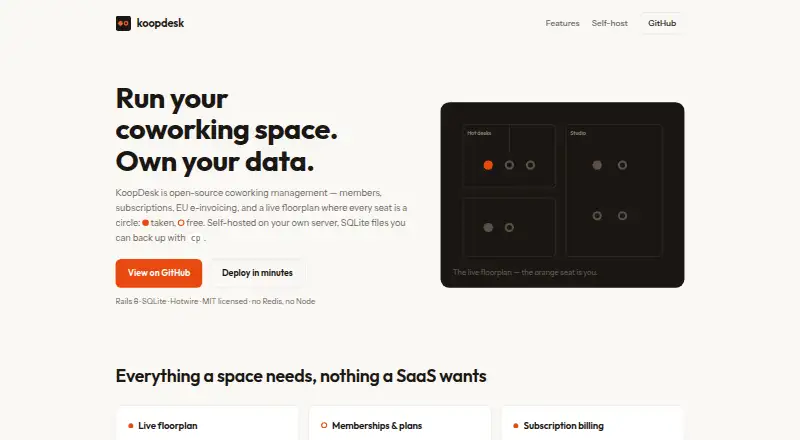
KoopDesk is open-source software for coworking operators managing memberships, subscriptions, invoices, and desk reservations. Operators can draw a floorplan, and members can book available desks from a live map. Membership types cover hot desks, dedicated desks, and private offices, on monthly or yearly cycles. Invoices can be created as drafts for review or issued automatically on each member's cycle. Exports include PDF and EN 16931 UBL XML for RO e-Factura (CIUS-RO), XRechnung, or Peppol BIS 3.0. Stripe can charge saved member cards for issued invoices once Stripe keys are configured; payments remain off otherwise. HMAC-signed webhooks cover members, invoices, and reservations, with retries and a delivery log. The maker describes deployment as one container with SQLite on a volume and TLS through a proxy or Kamal. The software is MIT-licensed and self-hosted, with each single-tenant installation independently controlled. Its listed stack is Rails 8, SQLite, and Hotwire, and it needs no Redis, Postgres, or Node build step.
Good
- Live floorplan displays seat availability.
- Supports monthly and yearly membership cycles.
- Invoices can be drafted or issued automatically.
- Exports PDF and several UBL formats.
- MIT-licensed and free.
Watch out
- Self-hosted deployment is required.
- Each installation is single-tenant.
- Stripe payments require configured Stripe keys.
Who it suits
KoopDesk suits operators who want to manage a coworking space through self-hosted software. It may fit teams needing desk reservations, membership-cycle invoicing, and specified EU e-invoice exports.
Verdict
KoopDesk brings reservations, memberships, and invoicing into a self-hosted coworking management tool. Operators should account for the single-tenant setup and configure Stripe keys if they need card payments.
Plans and prices
From KoopDesk's own pricing page, checked 15 Oct 2026.
| Plan | Price | What it gives you |
|---|---|---|
| MIT-licensed open-source software | Free | self-hosted · single-tenant · coworking memberships · desk reservations · invoicing · webhooks |
The facts
Each one read from KoopDesk's own pages, with the date it was checked.
What it does
- Automatic invoices
- Invoices are generated on each member billing cycle.checked 15 Oct 2026
- Backups
- SQLite data can be backed up by copying files or using Litestream.checked 15 Oct 2026
- Data and backups
- The maker says SQLite backups are files that can be copied or managed with Litestream.checked 4 Oct 2026
- Deployment
- The maker describes deployment as one container with SQLite on a volume and TLS through a proxy or Kamal.checked 4 Oct 2026
- Deployment model
- KoopDesk is designed to run self-hosted in one container with SQLite on a persistent volume.checked 15 Oct 2026
- Documentation depth
- The opened official product page provides deployment commands and feature descriptions but no separate API, SDK, help-centre or changelog pages.checked 15 Oct 2026
- E-invoice XML
- Invoices can be exported as EN 16931 UBL XML.checked 15 Oct 2026
- E-invoicing
- Invoices export as PDF and EN 16931 UBL XML for RO e-Factura (CIUS-RO), XRechnung, or Peppol BIS 3.0.checked 4 Oct 2026
- GitHub organization
- The KoopDesk GitHub organization lists two public repositories named landing and cowork.checked 15 Oct 2026
- Hot-desk capacity
- Hot-desk zones display seat-by-seat capacity.checked 15 Oct 2026
- Infrastructure requirements
- The stated stack does not require Redis, PostgreSQL or a Node build step.checked 15 Oct 2026
- Integrations
- The page specifically mentions Stripe and says webhooks can connect door-access or accounting systems.checked 15 Oct 2026
- Invoice workflow
- Generated invoices may remain drafts for review or be issued automatically.checked 15 Oct 2026
- Landing repository documentation
- The landing repository README describes a Jekyll site, editing index.html, running jekyll serve locally and automatic GitHub Pages deployment.checked 15 Oct 2026
- Landing repository status
- The public landing repository shows zero stars, zero forks and two commits on the opened page.checked 15 Oct 2026
- Licence
- KoopDesk is released under the MIT licence.checked 15 Oct 2026
- License and tenancy
- KoopDesk is MIT-licensed and single-tenant, with each installation described as independently controlled.checked 4 Oct 2026
- Limit: linked source repository
- The product page's documented clone target https://github.com/koopdesk/koopdesk returned a 404 when opened.checked 15 Oct 2026
- Limit: payment setup
- Card payments do not operate until Stripe keys are configured.checked 15 Oct 2026
- Limit: self-hosting
- Operators must provide and maintain the server, container, storage, TLS and backups themselves.checked 15 Oct 2026
- Limit: single tenant
- The product is described as single-tenant, so one installation is not presented as a shared multi-space SaaS tenant.checked 15 Oct 2026
Money
- Billing
- Invoices can be generated on each member's cycle as drafts for review or issued automatically.checked 4 Oct 2026
- Billing behavior
- The billing process is described as idempotent and able to catch up missed cycles.checked 15 Oct 2026
- Hosting cost claim
- The maker says a €4 VPS can run a complete space.checked 15 Oct 2026
The full review of KoopDesk
Overview
KoopDesk is a self-hosted web application for managing coworking memberships, reservations, and invoicing. It suits operators who want control over their own installation, especially those needing EU e-invoice formats. The trade-off is a single-tenant setup that puts deployment and payment configuration on the operator.
Key features
Operators can draw floorplans and let members book desks on a live map showing seat availability. That is useful when members need to choose a desk rather than simply request space, though the booking tool is part of a system the operator must host and maintain.
Memberships support hot desks, dedicated desks, and private offices on monthly or yearly cycles. Invoices can be created as drafts for review on each member’s cycle or issued automatically, giving operators a choice between a manual checkpoint and less recurring billing work.
Invoices export as PDF and EN 16931 UBL XML for RO e-Factura (CIUS-RO), XRechnung, or Peppol BIS 3.0. This makes the billing workflow a strong fit for spaces that need those formats. Stripe can charge saved member cards for issued invoices, but card payments remain off until the operator configures Stripe keys.
HMAC-signed webhooks cover member, invoice, and reservation events, with retries and a delivery log. They can support connections to other services, while the delivery record and retry behavior help operators follow events that need attention.
Pricing
KoopDesk is MIT-licensed open-source software, listed as free for a self-hosted, single-tenant installation. There is no paid plan in the provided pricing structure. The absence of a software charge does not remove the practical cost of operating a server: deployment is described as one container with SQLite on a volume, with TLS through a proxy or Kamal.
The technical stack is Rails 8, SQLite, and Hotwire, with no Redis, Postgres, or Node build step required. SQLite backups are files that can be copied or managed with Litestream. Those choices keep the described deployment compact, but this is not a hosted service that takes infrastructure and backup responsibility off the operator.
Platforms
KoopDesk is available as self-hosted web software. Its single-tenant design means each installation is independently controlled, which suits an operator managing one deployment rather than someone seeking a shared multi-tenant service.
Who it's for
KoopDesk is best for coworking operators who want desk reservations, recurring memberships, and invoicing in one self-managed application, particularly when the listed EU e-invoice formats matter. It is a weaker fit for teams that do not want to handle hosting or configure Stripe before accepting card payments.
Pros and cons
- Pros: Live floorplans show seat availability, making desk choice part of the member booking flow.
- Pros: Draft or automatic invoicing accommodates both operator review and recurring billing workflows.
- Pros: PDF and several specified EU e-invoice exports serve operators with those format requirements.
- Pros: MIT licensing and a compact SQLite-based deployment avoid a recurring software fee and several listed infrastructure dependencies.
- Cons: Single-tenant self-hosting makes deployment, TLS, and backup operations the operator’s responsibility.
- Cons: Stripe payments require configured keys and are off until then.
Alternatives
Choose Deskie if you want paid plans and broad device coverage: its Starter plan is $49 a month for spaces with 15 members or less, and it offers a free trial but no free plan.
Digicuro is a paid option with Android, iOS, and web support and an Enterprise plan on custom pricing.
Coworks may suit operators seeking a paid hybrid-workspace plan: Hybrid Workspace costs $199 a month and supports up to 150 members.
DeskOS is another paid Android, iOS, and web option; its Basic plan is $59 a year and it has no free plan or free trial.
Engage Apps offers paid plans including Start at $145 a month for 100 members and one location, for operators whose needs align with that stated capacity.
Loka has paid plans and a free trial, with its Starter plan at 599,000 UZS a month for up to 20 rentable rooms.
Optix offers paid plans and a free trial; Essentials is $229 a month, billed yearly at $197 USD/mo, with 50 active users and one location included.
Pickspace uses custom pricing tailored to the business.
For more options, browse Coworking Space Management Software or Room Booking Software.
Verdict
KoopDesk is a compelling choice for coworking operators who want self-controlled memberships, live desk booking, and EU invoicing without a software fee. Its main reason to choose is the combination of floorplan reservations and specified invoice exports; look elsewhere if you need hosted operations or a multi-tenant platform.