Haptik
Haptik provides conversational AI agents for enterprise customer service, sales, bookings, and lead qualification.
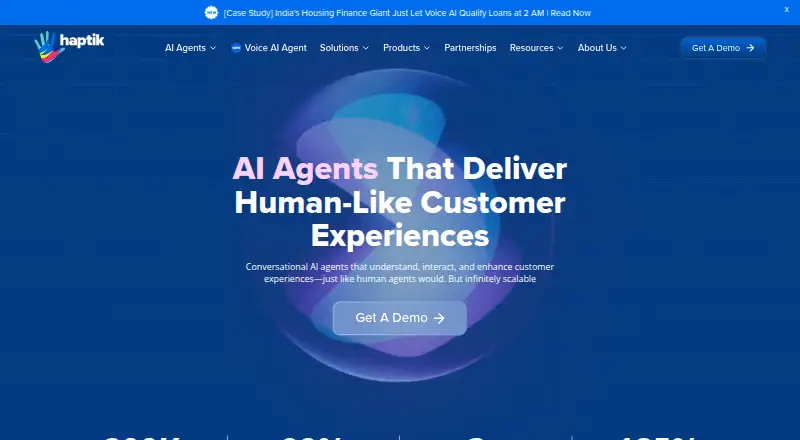
What Haptik is
Haptik provides conversational AI agents for enterprise customer service, sales, bookings, and lead qualification. Agents can be deployed across web, chat, and voice, while a visual flow builder supports agent creation. Voice agents handle phone queries using intent detection and context-aware responses, with support for more than 100 languages. Teams can select models including GPT, Llama, and Claude, and use enterprise knowledge from PDFs, DOCX, PPTX, CSV files, and websites. Multiple retrieval systems support finding information in those sources. Custom dashboards track metrics such as first-time resolution, customer satisfaction, and NPS, and human handoff is available. Listed integrations include WhatsApp, Instagram, Facebook Messenger, Shopify, HubSpot, Zendesk, Salesforce, Freshdesk, Stripe, and Razorpay. Haptik describes its platform as supporting 200,000 concurrent users and 99.9% uptime, and says customers receive a dedicated Customer Success Manager. The company was founded in 2013 and is headquartered in Mumbai, India. Pricing is on request; business inquiries can request a demo.
Good
- Agents support customer service, sales, and bookings
- Voice agents support more than 100 languages
- Uses enterprise documents and websites as knowledge sources
- Dashboards track resolution, satisfaction, and NPS
Watch out
- Pricing is available on request
- The offering targets enterprise customers
Who it suits
Haptik is aimed at enterprises in retail, e-commerce, fintech, and other industries that need agents for support, sales, bookings, or lead qualification. It may suit teams that need voice and messaging channels, enterprise knowledge sources, and human handoff.
Verdict
Haptik combines conversational agents, voice support, knowledge sources, analytics, and human handoff for enterprise use. Pricing is not published, so interested businesses need to request a demo or contact sales.
Plans and prices
From Haptik's own pricing page, checked 4 Oct 2026.
| Plan | Price | What it gives you |
|---|---|---|
| Enterprise | Priced on request | Pricing not published; request a demo |
The facts
Each one read from Haptik's own pages, with the date it was checked.
What it does
- Agent builder
- The platform supports model selection including GPT, Llama, and Claude, and deployment across web, chat, and voice.checked 4 Oct 2026
- AI bot generation
- Yeschecked 20 Sep 2026
- Analytics
- Custom dashboards track agent performance and metrics including first-time resolution, customer satisfaction, and NPS.checked 4 Oct 2026
- Deployment channels
- multichannelchecked 20 Sep 2026
- Enterprise capacity
- The company describes its platform as supporting 200,000 concurrent users and 99.9% uptime.checked 4 Oct 2026
- Human handoff
- The platform includes an omnichannel agent inbox and escalation of complex conversations to human agents.checked 4 Oct 2026
- Integrations
- The integrations page lists channels and services including WhatsApp, Instagram, Facebook Messenger, Shopify, HubSpot, Zendesk, Salesforce, Freshdesk, Stripe, and Razorpay.checked 4 Oct 2026
- Knowledge-base answers
- Yeschecked 20 Sep 2026
- Knowledge sources
- Agents can use enterprise knowledge from PDFs, DOCX, PPTX, CSV files, and websites, with multiple RAG systems for information retrieval.checked 4 Oct 2026
- Product
- Haptik offers conversational AI agents designed to improve customer experiences at enterprise scale.checked 4 Oct 2026
- Sales contact
- The site directs business inquiries to [email protected] and invites visitors to request a demo.checked 4 Oct 2026
- Security
- Haptik says its AI Agent platform complies with ISO, GDPR, CCPA, CPRA, CyberGRX, and FIPS 140-2, and is independently audited by BDO India LLP.checked 4 Oct 2026
- Support
- Haptik says customers receive a dedicated Customer Success Manager from day one.checked 4 Oct 2026
- Target customers
- The company describes its AI products as serving enterprises in retail, e-commerce, fintech, and other industries.checked 4 Oct 2026
- Use cases
- Its agents support customer service, sales, bookings, and lead qualification.checked 4 Oct 2026
- Visual flow builder
- Yeschecked 20 Sep 2026
- Voice AI
- Voice agents handle phone queries with intent detection, context-aware responses, and support for more than 100 languages.checked 4 Oct 2026
The company
- Company ownership
- Haptik says it is part of Jio Platforms Limited, which acquired a majority shareholding in 2019.checked 4 Oct 2026
- Founded
- 2013checked 28 Sep 2026
- Headquarters
- Mumbai, Maharashtra, Indiachecked 28 Sep 2026
The full review of Haptik
Haptik is an enterprise platform for deploying conversational agents over chat, web and phone. It fits retailers, e-commerce companies, fintechs and other large organizations that need automated service, sales or booking journeys connected to internal knowledge. Its broad channel, language and escalation support is persuasive, but the enterprise buying process and custom pricing will deter small teams.
Overview
Founded in 2013 and headquartered in Mumbai, Haptik is part of Jio Platforms Limited, which acquired a majority shareholding in 2019. The product is built around customer-facing AI agents for customer service, sales, bookings and lead qualification. Multichannel deployment lets a business coordinate experiences rather than operate a separate bot for every touchpoint.
Haptik describes capacity for 200,000 concurrent users and 99.9% uptime, making the stated scale appropriate for high-volume operations. It also says each customer receives a dedicated Customer Success Manager from day one. Those assurances matter to enterprises that need an accountable implementation partner, although they do not make the platform a sensible choice for a small project with modest traffic.
Key features
Agent creation and channels
A visual flow builder supports deliberate conversation design, while AI bot generation can accelerate a first version. Teams can select GPT, Llama or Claude models and deploy agents across web, chat and voice. The combination gives technical and operational teams room to choose between structured flows and model-driven responses; it also means a buyer must decide which approach and model best fit each workflow rather than expecting one setting to suit every interaction.
Voice and knowledge
Voice agents handle phone queries with intent detection and context-aware responses in more than 100 languages. That language coverage is a concrete advantage for international support desks and multilingual customer bases. Agents can draw from PDFs, DOCX, PPTX, CSV files and websites, using multiple retrieval-augmented-generation systems to find relevant enterprise information. This is more useful for policy, catalogue and account-support questions than a bot restricted to hand-written scripts.
Handoff, analytics and integrations
Human handoff provides an escape route when automation cannot resolve an issue, an important safeguard for service and sales journeys. Custom dashboards track agent performance, including first-time resolution, customer satisfaction and NPS, so managers can evaluate outcomes rather than conversation volume alone.
Listed connections include WhatsApp, Instagram, Facebook Messenger, Shopify, HubSpot, Zendesk, Salesforce, Freshdesk, Stripe and Razorpay. That mix covers major messaging, commerce, CRM, help-desk and payments scenarios. Haptik says its AI Agent platform complies with ISO, GDPR, CCPA, CPRA, CyberGRX and FIPS 140-2, with independent auditing by BDO India LLP—relevant credentials for organizations with formal security and privacy reviews.
Pricing
Haptik has one published plan, Enterprise, with custom pricing. Businesses must request a demo or contact [email protected]. No public seat, usage, renewal or trial terms are provided, so procurement teams should obtain those commercial details before committing. The plan is aimed at organizations that can justify a managed enterprise deployment; it is not a transparent self-serve option for testing a small bot.
Platforms
Haptik supports Android, iOS, web and API access, with multichannel deployment. That range suits companies combining mobile applications, websites, connected business systems and messaging or voice channels in one program.
Who it's for
Choose Haptik when a large customer operation needs chat and phone automation, multilingual voice support, retrieval from varied business documents, measurable service outcomes and a staffed escalation path. Retail, e-commerce, fintech and other enterprises with established CRM, commerce or support systems are the clearest fit. A small business seeking a low-cost chatbot, a hobby project, or a narrowly scoped voice experiment should look for a product with public, self-serve pricing instead.
Pros and cons
Pros
- Broad enterprise coverage: service, sales, bookings and lead qualification are handled within one agent platform.
- Strong voice proposition: intent detection, context-aware replies and more than 100 languages extend automation to phone support.
- Flexible knowledge ingestion: PDF, DOCX, PPTX, CSV and website sources support information-heavy customer journeys.
- Operational controls: human handoff, outcome dashboards and a dedicated Customer Success Manager support ongoing service management.
- Enterprise scale and compliance: the stated 200,000 concurrent-user capacity, 99.9% uptime and named security standards suit formal procurement.
Cons
- Opaque cost: custom Enterprise pricing prevents straightforward comparison or budgeting.
- Enterprise overhead: smaller teams may not need the breadth, integrations or managed engagement.
- Model decisions remain with the buyer: GPT, Llama and Claude options provide flexibility but no universal configuration for every use case.
Alternatives
For a voice-first shortlist, compare Voicebot Software; for broader agent platforms, see Conversational AI Platforms. Teams prioritizing agent-to-human conversations can review Live chat software, while a flow-builder comparison belongs in Chatbot Builders.
Sonalyx is a freemium API, self-hosted and web option with a free 20-minute allowance and one concurrent call, making it better for a small or early voice deployment. SoundHound is a consumer Android and iOS app with a free, ad-supported tier and a one-time $6.99 ad-free upgrade, not an enterprise agent platform. Yellow.ai offers a free web, iOS and Android tier with one AI agent and 500 monthly interactions, so it is preferable when a capped trial is more important than Haptik's enterprise scope. Guzli suits smaller API and web projects needing a free tier or a $39-per-year Hobby plan with 1,000 message credits per month. Retell AI is the more direct low-commitment voice alternative, offering pay-as-you-go pricing from $0.07 to $0.31 per minute, free credits and 20 concurrent calls. Ada is another paid customer-automation option. Chatbyte starts with an Essential plan at $45 per month (or $38 monthly when billed annually), including one chatbot and 100 conversations, which is easier to price for a smaller website. Mujib separates voice-only and chat-only deployments with account-specific quotas and rates, useful when only one channel is required.
Verdict
Haptik is a strong choice for enterprises that need multilingual voice and chat agents, enterprise knowledge retrieval, analytics and reliable human escalation across existing channels. Choose it for breadth, governance and scale; look elsewhere if transparent pricing, a free starting tier or a lightweight self-serve deployment is the priority.
Alternatives to Haptik
- 1

Rasa
Free planOpen sourceWebAPILinuxmacOS7.8Free plan - 2

Yellow.ai
Free planAndroidiOSWebAPI7.8Free plan - 3

Amazon Lex
Free planAndroidiOSWebAPI7.7$0.50 one-time - 4

IBM watsonx Assistant
Free planWebAPISelf-hosted7.5From $140 a month - 5

Botpress
Free planWebAPI7.3From $150 a month - 6

Kore.ai
WebAPISelf-hosted6.5