Ada
Ada is an agentic customer experience platform that provides AI customer service agents.
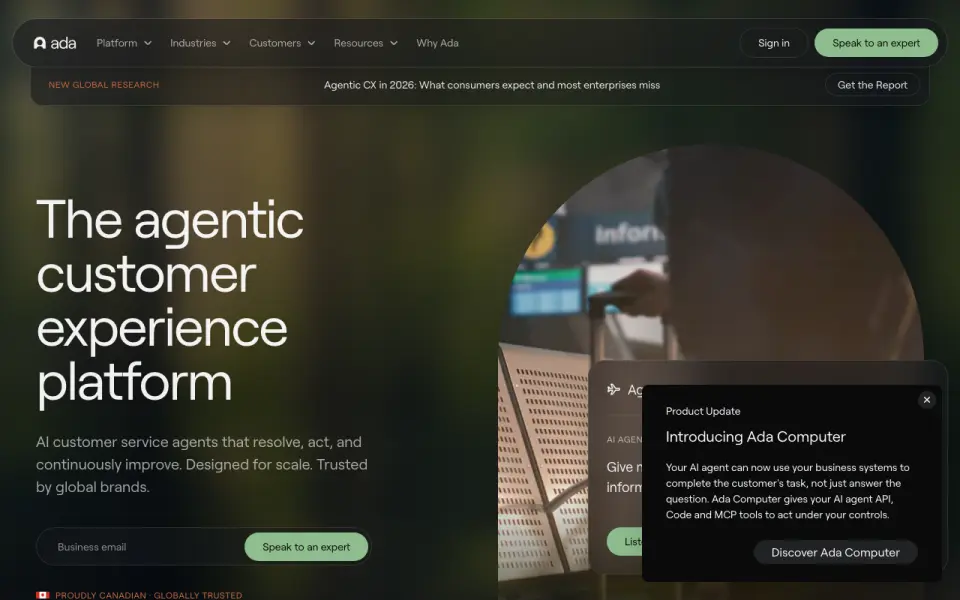
What Ada is
Ada is an agentic customer experience platform that provides AI customer service agents. Its agents are designed to resolve inquiries and carry out tasks through connected business systems. The listed customer contact channels are voice, messaging, and email, and Ada describes its offering as supporting omnichannel, multilingual customer experiences. The platform includes tools to test, analyze, and optimize agent performance, along with a visual flow builder, AI bot generation, knowledge-base answers, and human handoff. Integrations include Zendesk, Salesforce, Amazon Connect, Freshworks, Genesys, ServiceNow, and Twilio Flex. Open APIs and SDKs connect the platform with enterprise systems and workflows. Ada states that it has HIPAA, SOC 2, GDPR, PCI DSS, and AIUC-1 compliance, and says it uses zero data retention policies with LLM providers. It also describes built-in safeguards and continuous monitoring to reduce hallucinations and support safe, accurate responses. The service is paid, has no free plan, and does not publish a price; prospective customers are invited to speak with an expert.
Good
- Supports voice, messaging, and email channels
- Includes visual flow builder and human handoff
- Offers open APIs and SDKs
- States compliance with HIPAA, SOC 2, GDPR, PCI DSS, and AIUC-1
Watch out
- No free plan
- Pricing is available by request
Who it suits
Ada suits organizations seeking AI customer service agents across voice, messaging, and email, particularly those needing integrations with enterprise systems and multilingual experiences.
Verdict
Ada combines AI customer service agents with tools for managing and optimizing agent performance across multiple channels. It is a paid product without a published price or free plan.
The facts
Each one read from Ada's own pages, with the date it was checked.
What it does
- AI bot generation
- Yeschecked 20 Sep 2026
- APIs and tools
- Ada says its agents can use API, Code, and MCP tools to act through business systems under customer controls.checked 5 Oct 2026
- Channels
- Ada offers customer service products for voice, messaging, and email.checked 5 Oct 2026
- Compliance
- Ada lists HIPAA, SOC 2, GDPR, PCI DSS, and AIUC-1 compliance on its website.checked 5 Oct 2026
- Customer service
- Ada’s agents are designed to resolve customer inquiries and perform tasks using connected business systems.checked 4 Oct 2026
- Deployment channels
- multichannelchecked 20 Sep 2026
- Developer access
- Ada describes open APIs and SDKs for connecting the platform to enterprise systems and workflows.checked 4 Oct 2026
- Human handoff
- Yeschecked 20 Sep 2026
- Industries
- Ada presents solutions for financial services, gaming, retail and ecommerce, technology, and travel.checked 5 Oct 2026
- Integrations
- Ada’s integrations page lists connections for customer service systems, including Aircall and Amadeus.checked 5 Oct 2026
- Knowledge-base answers
- Yeschecked 20 Sep 2026
- Languages
- Ada says its platform supports omnichannel, multilingual customer experiences.checked 4 Oct 2026
- Languages and continuity
- Ada says its agents can work across channels and languages while preserving customer identity, context, and conversation continuity.checked 5 Oct 2026
- Pricing
- The pricing page directs visitors to schedule a custom demo and does not state a price.checked 5 Oct 2026
- Pricing availability
- The public pages reviewed direct prospective customers to speak with an expert and do not state a price.checked 4 Oct 2026
- Privacy
- Ada says it has zero data retention policies with LLM providers.checked 4 Oct 2026
- Product
- Ada describes its product as an agentic customer experience platform with AI customer service agents that resolve customer issues, take actions, and improve over time.checked 5 Oct 2026
- Safety controls
- Ada says built-in safeguards and continuous monitoring are used to reduce hallucinations and support accuracy and safe responses.checked 4 Oct 2026
The company
- Company
- Ada says it was established in 2016 and is a Canadian company.checked 5 Oct 2026
- Founded
- 2016checked 28 Sep 2026
- Headquarters
- Toronto, Ontario, Canadachecked 28 Sep 2026
Money
- Free plan
- Nochecked 20 Sep 2026
Where it runs
- Platform capabilities
- The platform includes tools to test, analyze, and optimize AI agent performance.checked 4 Oct 2026
- Platform features
- The platform includes tools to test, analyze, and optimize AI agent performance.checked 5 Oct 2026
The full review of Ada
Ada is an AI customer service platform for organizations that need agents to resolve inquiries and take action through connected business systems. It suits larger, multichannel operations that need to manage agent performance as well as customer conversations. Its breadth is compelling, but custom pricing and the absence of a free plan make it a considered enterprise purchase rather than an easy starting point.
Overview
Ada brings customer service agents together with tools to test, analyze, and optimize their performance. Agents are designed to handle inquiries and perform tasks through business systems, rather than only return answers. The platform spans voice, messaging, and email, with support for multilingual customer experiences and continuity of customer identity and conversation context across channels.
The combination of a visual flow builder, AI agent generation, knowledge-base answers, and human handoff gives teams several ways to shape how service is delivered. API and SDK access, plus API, Code, and MCP tools, extend that reach into enterprise systems and workflows. This flexibility is useful for complex service operations, but it also means Ada is better suited to organizations prepared to define and manage an integrated program than to teams seeking a small, standalone chatbot.
Key features
- Multichannel service: Voice, messaging, and email let teams support customers across different contact paths. Ada says agents can preserve identity, context, and conversation continuity across channels and languages.
- Agent design and answers: AI bot generation and a visual flow builder support agent creation, while knowledge-base answers and human handoff allow automated service to sit alongside escalation to people.
- Actions through business systems: Agents can use API, Code, and MCP tools under customer controls. Open APIs and SDKs are intended to connect Ada with enterprise systems and workflows.
- Performance management: Testing, analysis, and optimization tools help teams evaluate and improve agent performance, rather than treating deployment as the end of the work.
- Integrations: Ada names Zendesk, Salesforce, Amazon Connect, Freshworks, Genesys, ServiceNow, and Twilio Flex among its integrations.
- Security and safeguards: Ada states that it has HIPAA, SOC 2, GDPR, PCI DSS, and AIUC-1 compliance, and that LLM providers are subject to zero data retention policies. It also describes built-in safeguards, continuous monitoring, annual independent penetration testing, and disaster recovery and business continuity plans. Its Trust Center makes SOC 2 Type 2 and SOC 3 reports available to authorized users.
Pricing
Ada uses paid, custom pricing; there is no free plan. Prospective customers are directed to schedule a custom demo and speak with an expert, with the team saying it will reach out within one business day to arrange a 30-minute call. That sales-led process may suit organizations evaluating a broad deployment, but it gives smaller teams no published price or free tier to use as a low-commitment starting point. No plan-specific prices, seat limits, quotas, or trial terms are stated.
Platforms
Ada supports Android, iOS, web, and API access. Its product channels include voice, messaging, and email, so the platform covers both mobile and web access and multiple customer-service routes.
Who it's for
Ada is aimed at organizations seeking AI agents that can work across channels, answer from a knowledge base, and take actions through connected systems. Its listed industry solutions span financial services, gaming, retail and ecommerce, technology, and travel. The combination of integrations, developer tools, performance management, and stated compliance credentials makes it a stronger fit for organizations with complex service workflows and the resources to assess and operate a custom deployment. Teams that need a free plan, transparent upfront pricing, or a lightweight tool should look elsewhere.
Pros and cons
Pros
- Agents can do more than answer: API, Code, and MCP tools let them act through connected business systems under customer controls.
- Channel and language continuity: Ada supports voice, messaging, and email, and says agents preserve customer identity and conversation context across channels and languages.
- Built for ongoing improvement: Testing, analysis, and optimization tools give teams a way to manage agent performance after launch.
- Broad enterprise connectivity: Named integrations and open APIs and SDKs support connections to common service platforms and custom workflows.
Cons
- No free plan or published price: Buyers must enter a sales conversation to establish cost, making Ada harder to assess against a fixed budget.
- Not a small-team entry point: The paid, custom-demo sales process offers no free tier or published self-serve plan for teams that want to start small.
Alternatives
- Forethought Solve is worth considering for teams focused on chat and mobile agents, autoflows, custom actions, CSAT collection, insights, ticket triage models, and multilingual support. Its Team plan has no published price, and it has no free plan or free trial.
- Capacity may suit buyers comparing paid plans by storage allowance, with Core, Pro, and Enterprise tiers offering up to 100GB, 1TB, and 2TB respectively; prices are not published.
- Inbenta is another paid option, with a free trial and consumption-based pricing; usage rates are not published.
- Help Scout is a possible alternative for smaller teams that want a free plan: its Free tier includes five users, one Inbox, one Docs site, and 100 contacts per month.
- Kore.ai is another paid, web-based option to consider.
- Intercom may suit teams looking for a paid service platform with a free trial and Android, iOS, and web support; its Essential plan is $19 a month, billed annually per seat.
- Zoho Desk is an alternative for teams seeking a freemium service tool, with a free tier for three users.
- Freshdesk may appeal to teams that want a free program for one to two agents for six months, alongside paid plans and a free trial.
Verdict
Choose Ada if your organization needs customer-service agents that can work across channels, take actions through connected systems, and be actively tested and optimized. Its mix of agent capabilities, integrations, and enterprise controls is the main reason to consider it. Look elsewhere if you need a free starting point or a clear price before speaking with sales: Ada offers neither.