Google Ad Manager App Mediation
Google Ad Manager App Mediation routes mobile app ad requests through eligible third-party networks in sequence, ordering them by expected yield.
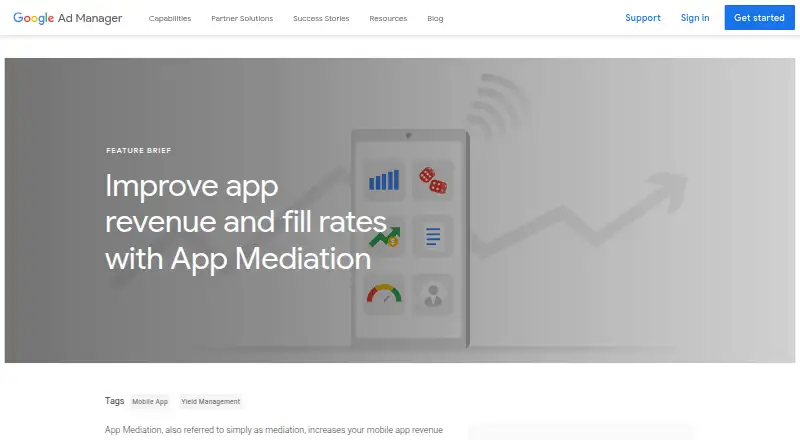
What Google Ad Manager App Mediation is
Google Ad Manager App Mediation routes mobile app ad requests through eligible third-party networks in sequence, ordering them by expected yield. Yield groups specify which networks may participate for particular requests. The system uses estimated CPM and real-time Ad Exchange CPM to order eligible networks, and the mediation chain competes with Ad Manager line items and real-time bids through Dynamic Allocation. Apps send requests using Google Mobile Ads SDK, which calls each network adapter in turn until an ad is returned. Setup requires the SDK, adapters for the selected networks, and an Ad Exchange for mobile apps account linked and set as the default for dynamic allocation. Publishers configure yield partners and groups to specify networks and inventory. If no network fills a request, it remains unfilled rather than automatically returning to the ad server. A serving chain can include up to 50 networks; longer sequential chains risk greater latency. The listed plan is free, subject to the Ad Exchange account requirement. Mediation setup guides cover Android and iOS.
Good
- Free listed plan.
- Routes requests through eligible networks by expected yield.
- Chain can compete through Dynamic Allocation.
- Supports Android and iOS apps.
- Ad inspector can reveal mediation details per request.
Watch out
- Requires a linked Ad Exchange for mobile apps account.
- Requires SDK and adapters for chosen networks.
- Unfilled requests do not return automatically to the ad server.
- Sequential chains longer than 50 networks risk greater latency.
Who it suits
App developers seeking to serve ads through third-party networks may find App Mediation relevant. It requires Google Mobile Ads SDK, network adapters, and a linked Ad Exchange for mobile apps account.
Verdict
App Mediation offers a free way to sequence eligible third-party networks in mobile app ad requests, with yield groups controlling participation. Developers should account for the required SDK, adapters, Ad Exchange account, and unfilled-request behavior.
Plans and prices
From Google Ad Manager App Mediation's own pricing page, checked 3 Oct 2001.
| Plan | Price | What it gives you |
|---|---|---|
| Google Ad Manager App Mediation | Free | Up to 50 mediation networks in a serving chain · Ad Exchange for mobile apps account must be linked and set as default for dynamic allocation |
The facts
Each one read from Google Ad Manager App Mediation's own pages, with the date it was checked.
What it does
- Account prerequisite
- The Ad Manager homepage says users need an AdSense account to work with Google Ad Manager.checked 2 Oct 2001
- Ad Exchange requirement
- To activate yield groups and mediation, publishers must link an Ad Exchange for mobile apps account and mark it as default for dynamic allocation.checked 2 Oct 2001
- Auction competition
- The expected yield of a mediation chain competes with Ad Manager line items and real-time bids from Authorized Buyers and Exchange Bidders through Dynamic Allocation.checked 2 Oct 2001
- Automatic data
- Ad Manager can use automatic data collection to estimate a mediation network's CPM from historical CPM data adjusted for impression discrepancies.checked 2 Oct 2001
- Configuration
- Publishers create yield partners for ad networks and yield groups to specify which inventory is available to those networks.checked 3 Oct 2001
- COPPA signal
- Ad Manager mediation can pass a child-directed age treatment signal from the Google Mobile Ads SDK to third-party networks, while developers remain responsible for those networks' ad treatment.checked 3 Oct 2001
- Demand competition
- The mediation chain's expected yield competes with Ad Manager line items and real-time bids from Authorized Buyers and Exchange Bidders through Dynamic Allocation.checked 3 Oct 2001
- Format support
- Participating mediation networks can serve rewarded and rewarded interstitial formats when those formats are selected in a yield group.checked 3 Oct 2001
- Integration requirement
- Apps must install Google Mobile Ads SDK and implement network adapters for each third-party ad network used in mediation.checked 2 Oct 2001
- Intended users
- The feature brief presents App Mediation for mobile app publishers seeking to improve revenue and fill rates.checked 3 Oct 2001
- Measurement limitation
- Third-party mediation network impressions are not eligible for Active View measurement.checked 3 Oct 2001
- Network ordering
- Ad Manager orders eligible networks by estimated CPM and real-time Ad Exchange CPM, excluding networks with lower expected yield than Ad Exchange.checked 2 Oct 2001
- Partner availability
- A yield partner not listed among the available ad networks can be added as Other company, which requires custom events in the app and yield groups for mediation.checked 2 Oct 2001
- Privacy guidance
- Google advises reviewing applicable regional privacy laws such as CPRA, GDPR, and LGPD when configuring yield partners.checked 2 Oct 2001
- Purpose
- App Mediation calls third-party ad networks in expected-yield order to help fill mobile app ad requests and increase revenue.checked 3 Oct 2001
- SDK integration
- Apps send ad requests through the Google Mobile Ads SDK, which calls network adapters sequentially until an ad is returned.checked 3 Oct 2001
- SDK workflow
- The mobile app sends requests through Google Mobile Ads SDK, which calls each network in the returned mediation chain until an ad is returned.checked 2 Oct 2001
- Serving limit
- At serving, up to 50 networks are included in a mediation chain, and longer chains risk greater latency because callouts are sequential.checked 3 Oct 2001
- Setup requirements
- Mediation setup requires the Google Mobile Ads SDK, adapters for the chosen third-party networks, and an Ad Exchange for mobile apps account linked and set as default for dynamic allocation.checked 3 Oct 2001
- Support
- Google links mediation setup and learning resources from the feature brief and provides a Google Ad Manager Help center.checked 3 Oct 2001
- Testing and diagnostics
- Ad inspector can check fill, show errors, reveal mediation details per request, and test an individual yield partner on a device.checked 3 Oct 2001
- Unfilled requests
- If no network in the mediation chain can fill a request, the request remains unfilled and the system does not automatically pass it back to the ad server.checked 2 Oct 2001
Where it runs
- Platform support
- Google's setup guide provides mediation developer guides for Android and iOS apps.checked 2 Oct 2001
- Supported mobile platforms
- Google's mediation setup guide lists Android and iOS and directs developers to platform-specific SDK and adapter guides.checked 3 Oct 2001
The full review of Google Ad Manager App Mediation
Overview
Google Ad Manager App Mediation is a mobile ad-serving feature that sequences eligible third-party networks according to expected yield. It suits app publishers who want mediation to compete with Ad Manager demand, and is less suitable for teams seeking a standalone setup without Google’s account and SDK requirements.
Its strongest case is yield-based ordering alongside Ad Manager line items and real-time bids. The trade-off is a sequential chain that can leave requests unfilled and add latency as networks are called.
Key features
Yield groups determine which networks can serve each request and which inventory they can access. Ad Manager orders eligible networks using estimated CPM and real-time Ad Exchange CPM, excluding networks with lower expected yield than Ad Exchange. Automatic data collection can estimate a network’s CPM from historical CPM data adjusted for impression discrepancies, reducing the need to supply that estimate manually.
The expected yield of the mediation chain competes through Dynamic Allocation with Ad Manager line items and real-time bids from Authorized Buyers and Exchange Bidders. In practice, mediation is part of a broader Ad Manager auction rather than an isolated sequence detached from its other demand.
The app sends each request through Google Mobile Ads SDK, which calls network adapters in sequence until one returns an ad. A serving chain can include up to 50 networks; because calls are sequential, longer chains risk greater latency. If none fills the request, it remains unfilled rather than automatically returning to the ad server.
Ad inspector can check fill, surface show errors, reveal mediation details for a request, and test an individual yield partner on a device. Yield groups can include rewarded and rewarded interstitial formats. Third-party mediation impressions are not eligible for Active View measurement, a material limitation for publishers relying on that measurement.
A partner absent from the available network list can be added as an Other company, but doing so requires custom events in the app as well as yield groups. Mediation can pass a child-directed age treatment signal from the Google Mobile Ads SDK to third-party networks; developers remain responsible for those networks’ ad treatment. Publishers should also review applicable privacy requirements, including CPRA, GDPR, and LGPD, when configuring partners.
Pricing
The Google Ad Manager App Mediation plan costs nothing. It includes up to 50 mediation networks in a serving chain; the plan requires an Ad Exchange for mobile apps account linked and set as the default for dynamic allocation. There is no paid tier described for this feature, so its listed price makes it an option for publishers who want mediation without a software charge, not a promise of cost-free implementation: SDK and adapter integration and the account prerequisite still apply.
Google Ad Manager requires an AdSense account to work with the platform. The free plan’s 50-network ceiling is also a practical reason not to build an unnecessarily long chain, given the latency risk of sequential callouts.
Platforms
The mediation setup guides cover Android and iOS apps, with platform-specific SDK and adapter guidance. Ad Manager is also available on the web, but mediation requests themselves pass through the mobile app’s Google Mobile Ads SDK.
Who it's for
This is a strong fit for app publishers already working in Google Ad Manager who want third-party network yield to compete with the platform’s other demand. Developers must be prepared to install Google Mobile Ads SDK, implement adapters for each chosen network, create yield partners and yield groups, and link an Ad Exchange for mobile apps account as the dynamic-allocation default.
It is a weaker fit for publishers who need requests to fall back automatically when every mediated network fails, or who depend on Active View measurement for third-party mediation impressions. Teams with many networks should weigh the serving limit and latency risk rather than assume a longer sequence is always better.
Pros and cons
- Pro: Eligible networks are ordered using estimated CPM and real-time Ad Exchange CPM, and their expected yield competes with Ad Manager line items and real-time bids through Dynamic Allocation.
- Pro: Ad inspector provides request-level mediation details and tools to check fill, diagnose show errors, and test a yield partner on a device.
- Con: Setup depends on Google Mobile Ads SDK, network adapters, an Ad Exchange for mobile apps account, and an AdSense account for Google Ad Manager.
- Con: A failed chain stays unfilled; it does not automatically pass the request back to the ad server.
- Con: Sequential callouts can increase latency, chains are capped at 50 networks, and third-party mediation impressions are ineligible for Active View.
Alternatives
For a broader category comparison, browse Game Monetization Software.
- DT FairBid is a free alternative for publishers who want mediation without a software charge; its publisher collects payments directly from mediated ad networks.
- Google AdMob is another free Google option for app advertising, with earnings dependent on advertiser demand and ad performance and a USD 100 payment threshold.
- CAS.AI Mediation is free to set up, but CAS takes a cut from earnings; its no-loss A/B test applies to apps with 5,000 or more daily active users.
- Apphud, PlayFab, RevenueCat, Superwall, and Qonversion are also alternatives.
Verdict
Choose Google Ad Manager App Mediation if your app already uses Ad Manager and you want eligible third-party networks to compete on expected yield alongside its other demand. Its free price and request-level diagnostics are compelling, but the SDK, adapter, Ad Exchange, and AdSense prerequisites are real integration costs, and an unfilled chain will not fall back automatically. Look elsewhere if that behavior or Active View measurement for mediated impressions is essential.
Getting started
- Open the Google Ad Manager feature brief and setup resources.
- Have an AdSense account to work with Google Ad Manager.
- Link an Ad Exchange for mobile apps account and set it as default for dynamic allocation.
- Install Google Mobile Ads SDK and implement adapters for selected networks.
- Create yield partners and yield groups for networks and inventory.
- Follow the Android or iOS mediation guide for your app.
Limits worth knowing
The free plan allows up to 50 networks in a serving chain, and requires an Ad Exchange for mobile apps account linked and set as the default for dynamic allocation. Unfilled requests remain unfilled, and third-party mediation network impressions are not eligible for Active View measurement.
Questions
Is Google Ad Manager App Mediation free?
The listed plan is free. It requires an Ad Exchange for mobile apps account linked and set as default for dynamic allocation.
Which platforms are supported?
The mediation setup guides cover Android and iOS apps.
What does the app need for integration?
The app must install Google Mobile Ads SDK and implement adapters for each third-party ad network used.
Can the mediation chain use rewarded ads?
Participating networks can serve rewarded and rewarded interstitial formats when those formats are selected in a yield group.
What happens if no network fills a request?
The request remains unfilled; the system does not automatically pass it back to the ad server.
Can an unlisted yield partner be added?
A partner can be added as Other company, which requires custom events in the app and yield groups for mediation.
Alternatives to Google Ad Manager App Mediation
- 1
PlayFab
Free planAndroidiOSWebAPI8.3From $99 a month - 2

RevenueCat
Free planOpen sourceAndroidiOSWebAPI8.0Free plan - 3

Adapty
Free planOpen sourceAndroidiOSWebAPI7.8Free plan - 4

Unity
Free planAndroidiOSWebLinux7.8Free plan - 5
Apphud
Free planAndroidiOSWebAPI7.3From $49 a month - 6
CAS.AI Mediation
Free planAndroidiOSWebAPI7.3Free plan