Basis DSP
Basis DSP gives media buyers a platform to plan, buy, and manage programmatic campaigns across inventory, audiences, and data.
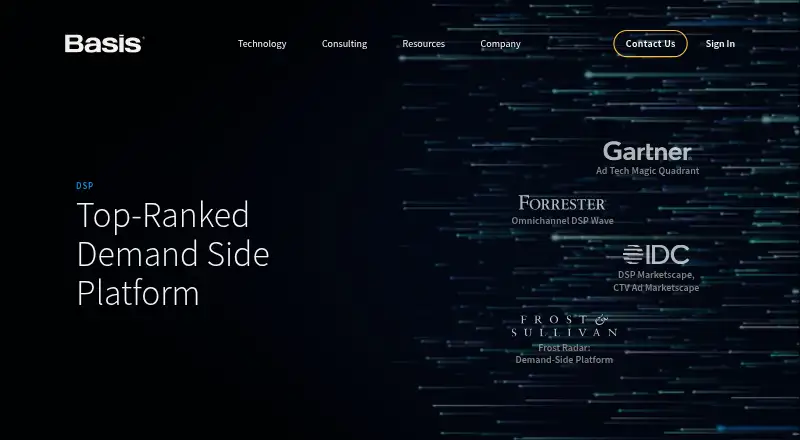
What Basis DSP is
Basis DSP gives media buyers a platform to plan, buy, and manage programmatic campaigns across inventory, audiences, and data. Its interface combines programmatic planning and activation with search, social, and site direct. Campaign channels include connected TV, video, native, audio, display, and mobile advertising. Targeting options include cross-device, contextual, TV, hyper-local, behavioral, demographic, and retargeting approaches. Basis lists more than 25,000 audience segments from over 30 data providers, along with a private marketplace library containing over 2,000 active deals across hundreds of sites. An AI engine analyzes campaign data for algorithmic and machine learning optimization. Brand protection uses partner vetting and automated monitoring, with integrations for privacy-compliant addressability and measurement. The platform interoperates with search, social, and ad server platforms. Its Enterprise API can support custom media-buying workflows and interfaces. Basis offers consulting and onboarding for media teams. The company says it has provided unified software and services since 2001 and is headquartered in Chicago. The DSP is available via web and API; pricing is on request.
Good
- Supports connected TV, video, native, audio, display, and mobile.
- Offers targeting across several audience and context types.
- Lists more than 25,000 audience segments.
- Enterprise API supports custom media-buying workflows.
- Consulting and onboarding are available for media teams.
Watch out
- Pricing is on request.
- The listed availability is web and API.
Who it suits
Basis DSP is aimed at media professionals planning and managing advertising campaigns across multiple digital channels. Its Enterprise API is described for brands, agencies, MarTech platforms, publishers, and franchise models.
Verdict
Basis DSP combines programmatic campaign management with search, social, and site-direct workflows, plus a range of channel and targeting options. Teams considering it will need to request pricing and assess how its API and services fit their media operations.
Plans and prices
From Basis DSP's own pricing page, checked 15 Oct 2026.
| Plan | Price | What it gives you |
|---|---|---|
| Basis DSP | Priced on request | Pricing negotiated with seller · Consumption-based percentage of media spend |
| DSP technology fee (Forrester composite) | Priced on request | Applies to DSP programmatic spend; publisher-direct, search and social placements excluded · 12% of programmatic spend |
The facts
Each one read from Basis DSP's own pages, with the date it was checked.
What it does
- Advertising channels
- Supported formats include connected TV, video, native, audio, display, mobile, retargeting and programmatic advertising.checked 15 Oct 2026
- AI optimization
- Its AI engine supports algorithmic and machine-learning optimization that analyzes campaign data automatically.checked 15 Oct 2026
- API
- The Enterprise API enables custom media-buying interfaces and workflows using Basis real-time bidding technology.checked 15 Oct 2026
- API capabilities
- The API can create campaigns, tactics and ads, manage audiences and conversion tracking, and perform optimization and analysis.checked 15 Oct 2026
- API documentation
- Basis says Enterprise API customers receive detailed documentation and dedicated support, but the page does not identify a public SDK.checked 15 Oct 2026
- API targeting
- API users can target by city, region or country, use hyper-local targeting, and track audiences across devices and platforms.checked 15 Oct 2026
- Audience data
- The DSP offers more than 25,000 audience segments from over 30 data providers.checked 15 Oct 2026
- Brand safety
- Brand-safety controls use partner vetting, automated monitoring and privacy-oriented addressability and measurement.checked 15 Oct 2026
- Brand safety and privacy
- Basis describes real-time brand protection using partner vetting, automated monitoring, and integrations for privacy-compliant addressability and measurement.checked 4 Oct 2026
- Campaign channels
- The DSP supports connected TV, video, native, audio, display, and mobile advertising.checked 4 Oct 2026
- First-party data
- Its DMP tools let customers build custom audience segments and lookalike targeting from first-party data.checked 15 Oct 2026
- Integrations
- Basis lists more than 170 industry API integrations spanning programmatic, search, social, direct and connected TV.checked 15 Oct 2026
- Licence and hosting
- Basis describes the DSP as proprietary and its terms grant limited access to a hosted service; no open-source licence or self-hosting option is stated.checked 15 Oct 2026
- Limit: operations
- Some reviewers report creative approvals taking up to 72 hours, weaker cookie-based retargeting, limited self-managed lookalikes and occasional unwanted ad placements.checked 15 Oct 2026
- Limit: pricing and scale
- Reviewers report opaque ad-network costs, expensive managed service or national campaigns, and suitability concerns for complex multinational performance work.checked 15 Oct 2026
- Limit: reporting and interface
- Reviewers describe the interface as dated or clunky and ask for more detailed, customizable reporting and better forecasting.checked 15 Oct 2026
- Named integrations
- Listed connectors include Google Campaign Manager, Google Ads, Microsoft Advertising, Instagram, LinkedIn, YouTube, Facebook, TikTok, Snapchat, Reddit and Pinterest.checked 15 Oct 2026
Money
- Billing integration
- The platform centralizes media data for transfer into accounting or ERP systems.checked 15 Oct 2026
The company
- Company founding
- Basis says Shawn Riegsecker founded the company in 2001.checked 15 Oct 2026
- Company headquarters and size
- LinkedIn lists Chicago, Illinois headquarters and 501–1,000 employees.checked 15 Oct 2026
- Company history
- Basis says it has provided unified software and services since 2001.checked 4 Oct 2026
- Company legal name
- The company identifies itself as Basis Global Technologies, LLC, formerly Centro.checked 15 Oct 2026
- Founded
- 2001checked 4 Oct 2026
- Headquarters
- Chicago, Illinois, United Stateschecked 4 Oct 2026
The full review of Basis DSP
Basis DSP is a media-buying platform for professionals running programmatic campaigns alongside search, social, and site-direct activity. It is best suited to teams that need that breadth and an API for custom workflows; buyers seeking a fixed, self-service price should look elsewhere.
Overview
Basis brings programmatic planning and activation together with search, social, and site-direct workflows in one interface. For teams coordinating several buying channels, that shared workflow is its central advantage; a buyer focused on a single channel may not need that scope. Basis has provided unified software and services since 2001, and the platform is available on the web and through an API.
Key features
Campaign channels and optimization
The DSP supports connected TV, video, native, audio, display, and mobile advertising. Its AI engine automatically analyzes campaign data using algorithmic and machine-learning optimization. This combination suits teams managing varied formats and looking to automate analysis, though the platform's breadth is most valuable when those formats and workflows are part of the same operation.
Inventory, audiences, and targeting
Basis offers over 2,000 active private-marketplace deals across hundreds of sites and more than 25,000 audience segments from over 30 data providers. Targeting spans cross-device, contextual, TV, hyper-local, behavioral, demographic, and retargeting approaches. That range gives media professionals multiple ways to shape campaigns, while the scale is more than a narrow campaign brief may require.
Protection, integrations, and services
Real-time brand protection combines partner vetting, automated monitoring, and integrations for privacy-compliant addressability and measurement. Basis also says the platform interoperates with search, social, and ad server platforms. The Enterprise API supports custom buying workflows and interfaces, and consulting and onboarding services are available for media teams. These options make the platform a stronger fit for organizations building coordinated operations than for buyers looking for a standalone, low-overhead tool.
Pricing
Basis DSP is paid software with custom pricing; teams need to request a quote. That model may suit media operations whose requirements call for a tailored arrangement, but it makes upfront budget comparisons difficult. No fixed-price or free plan is described, so buyers looking for a published entry price should consider alternatives.
Platforms
Basis DSP is available on web and through an API. The API is particularly relevant to MarTech platforms, publishers, franchise models, brands, and agencies that want to build or integrate custom media-buying workflows; web access supports teams working directly in the platform.
Who it's for
Basis is aimed at media professionals, with brands and agencies among its intended users. Its cross-channel interface, targeting breadth, and support services favor teams managing substantial or varied media operations. The Enterprise API also makes it relevant to MarTech platforms, publishers, and franchise models that need a custom interface or workflow. It is less compelling for buyers with narrow needs or a requirement for transparent, fixed pricing.
Pros and cons
- Pros: A single interface connects programmatic work with search, social, and site-direct activity, which can help teams coordinate multiple buying workflows.
- Pros: Broad campaign formats, marketplace deals, audience segments, and targeting options give media teams considerable choice in how they reach audiences.
- Pros: An Enterprise API, integrations, and consulting and onboarding services support custom operations and implementation.
- Cons: Custom pricing requires a sales conversation and makes direct budget comparison less straightforward.
- Cons: The breadth is likely unnecessary for teams with a single-channel or otherwise limited buying operation.
Alternatives
Demand Side Platform is the broader category for comparing DSP options. Choose Amazon Marketing Cloud instead if a free option matters most: its plan is free for eligible advertisers, with web and API access. Adobe Advertising Creative may suit buyers comparing usage-based or annual subscription arrangements, with self-service and managed account options; it is paid and has web and API access. Consider Adtelligent or Yahoo DSP as other paid, web-and-API alternatives. Adform DSP and illumin are paid alternatives with web access, while Moloco Ads and Nexxen DSP are other paid options.
Verdict
Basis DSP is a strong candidate for agencies, brands, and other media professionals that want programmatic buying, adjacent channel workflows, and custom API options under one platform. Its main reason to choose it is that joined-up scope, backed by a wide range of inventory and targeting; its main reason to look elsewhere is custom pricing, especially for teams that need a clear fixed cost or only a narrow set of buying capabilities.
Alternatives to Basis DSP
- 1
Amazon Marketing Cloud
Free planWebAPI7.0Free plan - 2
Nexxen DSP
WebAPI6.1 - 3
Adform DSP
WebAPIExtension6.0 - 4
The Trade Desk
WebAPI5.9 - 5
illumin
WebAPI5.8 - 6
 5.7