
RevenueCat
RevenueCat helps developers manage in-app purchases and subscriptions across platforms.
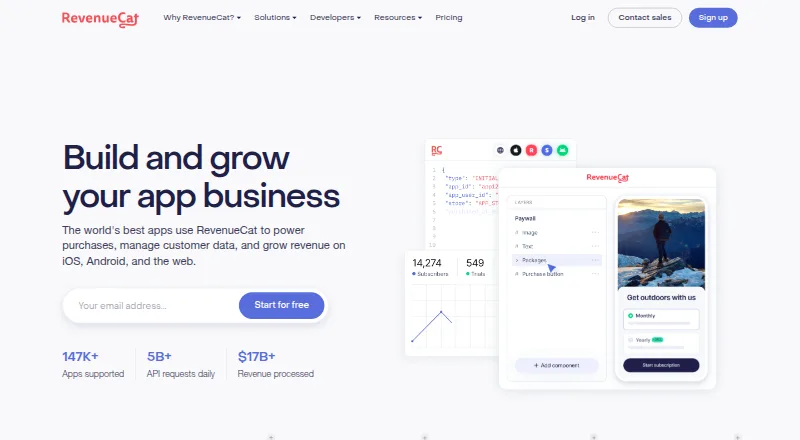
What RevenueCat is
RevenueCat helps developers manage in-app purchases and subscriptions across platforms. Its Purchases SDK implements purchases and subscriptions and syncs tokens with the RevenueCat server. Developers can configure paywalls remotely and run A/B tests for pricing models. The pricing page lists dashboard reporting for 40+ metrics, automated daily normalized data deliveries and real-time webhook notifications. RevenueCat Web supports RevenueCat Billing, Stripe Billing and Paddle Billing, alongside a web SDK, purchase links, paywalls, funnels and options to sync external purchases.
Listed integrations include Adjust, AppsFlyer, Meta Ads, Amplitude, Mixpanel, Braze, Intercom, Slack, Segment, Stripe and Paddle. RevenueCat events are detected server-side from app store subscription changes and can be forwarded to configured third-party tools. The platform is available for Android, iOS, macOS, web and API. Its Pro plan costs nothing up to $2,500 in monthly tracked revenue; after that threshold, the charge is 1% of tracked revenue. Growth Tools lists paywalls, web-to-app funnels and A/B/n testing, and says customers can use their own in-app purchase infrastructure. Enterprise offers volume discounts, flexible tracking configurations, dedicated support and custom SLAs. RevenueCat says it was founded in 2017 and identifies itself as GDPR compliant and SOC2 certified.
Good
- Purchases SDK supports subscriptions and purchases across platforms.
- Remotely configurable paywalls and A/B tests for pricing models.
- Dashboard reporting covers 40+ metrics.
- Real-time webhook notifications and automated daily normalized data deliveries.
- Integrates with analytics, attribution, messaging and payment services.
Watch out
- Pro charges 1% of tracked revenue after $2,500 monthly tracked revenue.
- Growth Tools and Enterprise have no listed prices.
- Growth Tools directs customers to talk to sales.
Who it suits
RevenueCat is for developers building apps with in-app purchases or subscriptions, from teams just getting started to those scaling to millions of customers. It may suit teams that want paywalls, pricing experiments, purchase analytics or web billing options.
Verdict
Choose RevenueCat if you need to manage app purchases and subscriptions across platforms, with tools for paywalls, experiments and reporting. Pro has a free allowance up to $2,500 in monthly tracked revenue, then charges 1% of tracked revenue. Teams needing Growth Tools or Enterprise features should weigh the unlisted pricing and, for Growth Tools, contact sales.
Plans and prices
From RevenueCat's own pricing page, checked 15 Oct 2026.
| Plan | Price | What it gives you |
|---|---|---|
| Enterprise | Priced on request | Volume discounts · flexible tracking configurations · dedicated support · custom SLAs · Custom pricing and usage |
| Growth Tools | — | Paywalls · web-to-app funnels · A/B/n testing · can run with customer-owned IAP infrastructure · 1% of MTR on tracked conversions |
| Pro | — | All RevenueCat features and data · no hidden tiers or limits · 1% of monthly tracked revenue after $2,500 MTR; $0 up to $2,500 MTR |
The facts
Each one read from RevenueCat's own pages, with the date it was checked.
What it does
- Analytics
- The pricing page lists dashboard reporting for 40+ metrics, automated daily normalized data deliveries, and real-time webhook notifications.checked 29 Sep 2026
- API limits
- The documented webhook-integration API has a default rate limit of 60 requests per minute and uses bearer authentication.checked 15 Oct 2026
- Attribution
- Supported attribution connections include Adjust, Airbridge and Apple Search Ads, with lifecycle revenue data sent from RevenueCat servers.checked 15 Oct 2026
- Charts
- The dashboard analyzes revenue, subscriptions, trials, churn and retention, with reporting for more than 40 metrics.checked 15 Oct 2026
- Customer Center
- Customer Center provides a self-service subscription management screen that developers can add to their apps.checked 15 Oct 2026
- Documentation depth
- Documentation includes quickstarts, platform installation, SDK and API references, webhook schemas, sample apps, migration guidance and known-issue pages.checked 15 Oct 2026
- Entitlements
- Entitlements let developers control which app content or features each customer can access.checked 15 Oct 2026
- Experiments
- RevenueCat supports cross-platform A/B testing of prices and paywall designs with results reporting.checked 15 Oct 2026
- Integration behavior
- RevenueCat events are detected server-side from app store subscription changes and can be forwarded to configured third-party tools.checked 29 Sep 2026
- Integrations
- Native integrations send normalized subscription events to tools including Amplitude, Braze, Mixpanel, Segment, Slack, Zendesk, S3 and Google Cloud.checked 15 Oct 2026
- Limit: outages and charts
- Capterra reviewers report downtime and say charting or churn analytics can be inaccurate or unpolished.checked 15 Oct 2026
- Limit: revenue-based pricing
- Capterra reviewers complain that percentage-of-revenue pricing can become expensive for moderate or low-margin apps as revenue grows.checked 15 Oct 2026
- Limit: support and documentation
- Capterra reviews include complaints about scattered documentation, inconsistent API behavior, slow support responses and unresolved Android issues.checked 15 Oct 2026
- Notable pricing threshold
- The Pro plan is free up to $2,500 in monthly tracked revenue, then charges 1% of tracked revenue after that threshold.checked 29 Sep 2026
- Paywalls
- Paywalls can be designed and updated remotely without shipping new app code.checked 15 Oct 2026
- Paywalls and experiments
- RevenueCat offers remotely configurable paywalls and A/B tests for pricing models.checked 29 Sep 2026
The company
- Company founded
- LinkedIn lists RevenueCat as founded in 2017.checked 15 Oct 2026
- Company founding
- RevenueCat says it was founded in 2017.checked 29 Sep 2026
- Company headquarters
- LinkedIn lists headquarters in Brandon, Florida.checked 15 Oct 2026
- Company legal name
- Crunchbase lists the legal name as RevenueCat, Inc.checked 15 Oct 2026
- Company size
- LinkedIn lists a 51–200 employee company size, while its page displays 185 employees.checked 15 Oct 2026
- Founded
- 2017checked 28 Sep 2026
Where it runs
- Cross-platform subscriber record
- Purchases made on web, iOS or Android are represented in one subscriber record with shared entitlements and purchase history.checked 15 Oct 2026
- Limit: mobile app requests
- Google Play reviewers request calendar views, revenue forecasts, better widget resizing and more consistent widget theming; another review reports authentication errors.checked 15 Oct 2026
The full review of RevenueCat
Overview
RevenueCat is a purchase and subscription management platform for developers building apps across mobile and web. It is best suited to teams that want shared purchase infrastructure alongside paywalls, experiments and subscription analytics. Its broad toolkit is compelling, but the Pro fee grows with tracked revenue above its free allowance.
Founded in 2017, RevenueCat uses its Purchases SDK to implement purchases and subscriptions across platforms, syncing tokens with its server. That gives app teams one system for managing subscription activity across supported environments rather than treating every platform as a separate workflow.
Remotely configurable paywalls and pricing-model A/B tests support ongoing monetization work. Reporting includes more than 40 metrics, automated daily normalized data deliveries and real-time webhook notifications. RevenueCat Web supports RevenueCat Billing, Stripe Billing and Paddle Billing, with a web SDK, purchase links, paywalls, funnels and external purchase sync options.
Its analytics include predictive customer lifetime value, profitability metrics, cohort analysis and customer segmentation. Data refresh is real-time, while the forecast horizon is fixed. RevenueCat also appears in Customer Lifetime Value Software and Game Monetization Software.
Key features
Purchase infrastructure and monetization
The Purchases SDK covers purchases and subscriptions across platforms and syncs tokens with RevenueCat’s server. For developers managing subscription products across app environments, this shared layer is the core value: it brings purchase implementation and ongoing subscription management into one platform. Teams seeking only a narrow analytics tool may find the wider purchase-and-monetization focus unnecessary.
Paywalls can be changed remotely, and A/B tests compare pricing models. These tools give teams a way to iterate on how they present and price subscriptions without limiting the product to purchase processing. Growth Tools adds paywalls, web-to-app funnels and A/B/n testing, and allows teams to use their own in-app purchase infrastructure.
Reporting, integrations and web billing
More than 40 reporting metrics, cohort analysis, customer segmentation, predictive CLV and profitability metrics make the analytics relevant to teams that need to examine subscription performance and customer value. Daily normalized data deliveries and real-time webhooks provide both a regular reporting flow and prompt event notifications. The fixed forecast horizon is a constraint for teams that need forecasts across varying time windows.
RevenueCat detects events server-side from app store subscription changes and can forward them to configured third-party tools. Listed integrations include Adjust, AppsFlyer, Meta Ads, Amplitude, Mixpanel, Braze, Intercom, Slack, Segment, Stripe and Paddle. Web billing support spans RevenueCat Billing, Stripe Billing and Paddle Billing, with purchase links, funnels and external purchase sync options; that breadth is useful for teams connecting web purchases with app subscriptions.
The pricing page identifies RevenueCat as GDPR compliant and SOC2 certified and provides a report request. Email and technical support forums are listed, while Enterprise adds dedicated support and custom SLAs.
Pricing
Pro
Pro is free up to $2,500 in monthly tracked revenue, then costs 1% of tracked revenue after that threshold. The free allowance makes it accessible to teams starting out, while the percentage-based charge means the bill rises with revenue once an app crosses the cap. Teams should account for that variable cost as they scale.
Growth Tools
Growth Tools has custom pricing and usage; the plan says to talk to sales and describes a 1% MTR charge on what you track. It includes paywalls, web-to-app funnels and A/B/n testing, plus the option to use your own IAP infrastructure. It is the relevant step for teams that specifically need those growth tools, but its custom-pricing approach makes cost less straightforward to plan than Pro.
Enterprise
Enterprise uses custom pricing and usage, with contact-sales terms. Volume discounts, flexible tracking configurations, dedicated support and custom SLAs target high-volume apps with specialized needs. Smaller teams are less likely to need those enterprise-specific terms and should compare them against Pro or Growth Tools.
Platforms
RevenueCat supports Android, iOS, macOS, web and API. That range suits developers coordinating subscription purchases across app platforms and web, with an API surface for integration into their systems.
Who it's for
RevenueCat is a strong fit for developers building subscription apps who want purchase implementation, remotely managed paywalls, pricing experiments and reporting in one platform. The free Pro allowance lowers the barrier for early teams, and Enterprise features address high-volume apps. It is a weaker fit for teams that need a fixed forecast horizon or cannot justify a fee tied to tracked revenue above the Pro threshold.
Pros and cons
- Pros: The Purchases SDK handles purchases and subscriptions across supported platforms while syncing tokens with RevenueCat’s server, giving multi-platform app teams shared infrastructure.
- Pros: Remote paywalls, pricing A/B tests and web-to-app tools support monetization iteration beyond purchase processing alone.
- Pros: Reporting combines more than 40 metrics, real-time data refresh, daily normalized deliveries, webhooks and customer-value analysis.
- Cons: Pro charges 1% of tracked revenue after $2,500 in monthly tracked revenue, so the ongoing cost rises with tracked volume.
- Cons: Growth Tools and Enterprise use custom pricing, making those plans harder to evaluate against a set budget.
- Cons: The forecast horizon is fixed, limiting flexibility for teams that need different forecast periods.
Alternatives
Pushwoosh is worth considering if a team wants a freemium option with a free plan and a Pay-as-you-go tier that includes 1,000 MAU, 5 AI requests per day, 20,000 email sends per month and unlimited push notifications.
WorthSignal is a free option for readers comparing standalone customer-lifetime-value software.
CLVTools is a free R package under GPL-3 for readers comfortable with R; compiling it from source requires GNU GSL.
VOZIQ AI Platform offers a free BYOL solution for predictive subscriber churn reduction, though AWS infrastructure costs may apply.
Klaviyo has a free tier capped at 250 active profiles, 500 email sends per month and $5 of mobile messages per month, making it an option for teams with modest messaging needs.
SaaSFlow offers a free plan with all features, unlimited users and unlimited data sources up to €120k ARR (€10k MRR), for teams whose needs fit that revenue limit.
Siftmo has a free Starter plan capped at 50 monthly orders, with paid Growth at $29 a month for up to 500 monthly orders.
PyMC-Marketing is a free, Apache 2.0 open-source Python library for readers seeking a self-hosted option.
Verdict
Choose RevenueCat if you are building a subscription app across platforms and want purchase infrastructure, paywall experiments and reporting under one roof. Its combination of cross-platform SDK, web billing and subscription analytics is the main reason to choose it. Look elsewhere if the 1% charge above $2,500 in monthly tracked revenue is a poor fit or you need a flexible forecast horizon.
Getting started
- Visit the RevenueCat website.
- Use the platform on Android, iOS, macOS, web or through its API.
- Start with the Pro plan, free up to $2,500 in monthly tracked revenue.
- Use the Purchases SDK to implement purchases and subscriptions across platforms.
- Consider Growth Tools for paywalls, web-to-app funnels or A/B/n testing, or contact sales.
- Configure listed integrations to forward RevenueCat events to third-party tools.
Limits worth knowing
Pro is free up to $2,500 in monthly tracked revenue; after that, it charges 1% of tracked revenue. Growth Tools and Enterprise list no prices, and Enterprise uses custom pricing and usage.
Questions
Is RevenueCat free?
Its Pro plan costs nothing up to $2,500 in monthly tracked revenue. After that threshold, it charges 1% of tracked revenue.
Which platforms does it support?
The listed platforms are Android, iOS, macOS, web and API.
What does the Purchases SDK do?
It implements purchases and subscriptions across platforms and syncs tokens with the RevenueCat server.
Can I use RevenueCat for web billing?
RevenueCat Web supports RevenueCat Billing, Stripe Billing and Paddle Billing, with web SDK, purchase links, paywalls, funnels and external purchase sync options.
What integrations are listed?
They include Adjust, AppsFlyer, Meta Ads, Amplitude, Mixpanel, Braze, Intercom, Slack, Segment, Stripe and Paddle.
What security and compliance details does RevenueCat state?
The pricing page identifies RevenueCat as GDPR compliant and SOC2 certified, and links to a report request.
Alternatives to RevenueCat
- 1

Pushwoosh
Free planAndroidiOSWebWindows7.8From $5 a month - 2
Oracle Responsys
AndroidiOSWebAPI7.3From $2 a year - 3

Klaviyo
Free planWeb7.0Free plan - 4

TrueProfit
AndroidiOSWebExtension7.0From $35 a month - 5

Reaktion
AndroidiOSWeb6.8From $169 a month - 6

Baremetrics
WebAPI6.6From $75 a month