WorthSignal
WorthSignal turns spreadsheet-style customer data into analyses of segmentation, lifetime value, retention, and marketing return on investment.
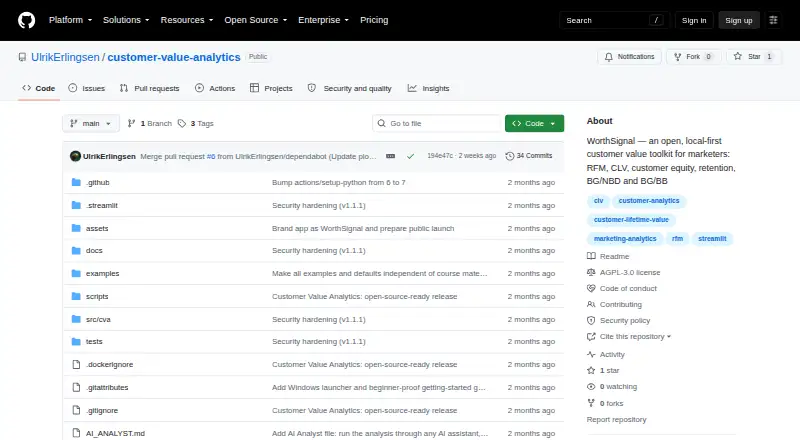
What WorthSignal is
WorthSignal turns spreadsheet-style customer data into analyses of segmentation, lifetime value, retention, and marketing return on investment. It accepts XLSX, XLS, XLSM, CSV, and JSON files, suggests column mappings, and lets users adjust them without changing the uploaded file. Its nine analysis areas include RFM targeting, customer lifetime value, customer equity, acquisition and retention budgets, and complaint recovery. Results can be downloaded as Excel or JSON. In local mode, analyses run in memory on the user’s computer, and the app says it does not intentionally send customer data to its maintainer or a third-party API. Hosted deployments process files on the chosen server, leaving access controls, logs, retention, and privacy obligations to that operator. The project documents its methods and describes them as classic, deliberately simple models. It is licensed under AGPL-3.0-or-later, with commercial use allowed subject to the license conditions. WorthSignal requires Python 3.10 or newer and offers launch instructions for Windows and Mac, terminal instructions for any operating system, and a Docker deployment option. The README describes it as designed for working marketers who use spreadsheets rather than notebooks or statistics software.
Good
- Reads XLSX, XLS, XLSM, CSV, and JSON files.
- Suggests column mappings without changing uploaded files.
- Exports results as Excel or JSON.
- Local analyses run in memory on the user’s computer.
- Commercial use is allowed subject to license conditions.
Watch out
- Requires Python 3.10 or newer.
- Hosted deployments place privacy responsibilities on the operator.
- Security reports have no formal response-time SLA.
- Older release branches are not maintained.
Who it suits
WorthSignal is aimed at marketers and spreadsheet users who want customer value, retention, segmentation, or marketing ROI analyses without relying on notebooks or statistics software. It may also suit users who want to run analyses locally or deploy the app themselves.
Verdict
WorthSignal combines spreadsheet input, customer-value analyses, and Excel or JSON exports in a free, open-source project. Its documented methods are deliberately simple, and hosted operators must manage their own deployment privacy responsibilities.
Plans and prices
From WorthSignal's own pricing page, checked 7 Oct 2026.
| Plan | Price | What it gives you |
|---|---|---|
| WorthSignal | Free | Open-source AGPL-3.0-or-later; local-first customer analytics toolkit |
The facts
Each one read from WorthSignal's own pages, with the date it was checked.
What it does
- Analysis areas
- It covers nine areas, including RFM targeting, CLV, customer equity, acquisition and retention budgets, Markov switching ROI, contractual retention, BG/NBD, BG/BB and complaint recovery.checked 7 Oct 2026
- Data handling
- The app reads XLSX, XLS, XLSM, CSV and JSON files, suggests column mappings and leaves the uploaded file unchanged.checked 7 Oct 2026
- Deployment limits
- The project maintains security fixes on the latest main branch and does not currently maintain older release branches.checked 7 Oct 2026
- Exports
- Analysis results can be downloaded as Excel or JSON.checked 7 Oct 2026
- File formats
- The app reads .xlsx, .xls, .xlsm, .csv, and .json files and exports results as Excel or JSON.checked 7 Oct 2026
- Hosted deployment
- For hosted deployments, uploaded files are processed by the chosen server and the deployment operator is responsible for access controls, logs, retention and privacy obligations.checked 7 Oct 2026
- Integrations
- The README documents file-based input and Excel or JSON downloads, and says the app can be deployed on Streamlit Community Cloud from a GitHub repository.checked 7 Oct 2026
- Intended users
- The README describes the app as made for working marketers and says it is designed for spreadsheet users who do not need a notebook or statistics software.checked 7 Oct 2026
- License
- The repository states that WorthSignal is licensed under AGPL-3.0-or-later and that commercial use is allowed subject to the license conditions.checked 7 Oct 2026
- Local privacy
- In local mode, analyses run in memory on the user’s computer, and the app says it does not intentionally send uploaded customer data to the maintainer or a third-party API.checked 7 Oct 2026
- Methods
- The project says its methods are documented and cited, and describes them as classic, deliberately simple models rather than advanced statistical approaches.checked 7 Oct 2026
- No telemetry
- The app does not include user accounts, advertising, product analytics, telemetry, or a customer-data database.checked 7 Oct 2026
- Purpose
- WorthSignal turns Excel, CSV or JSON customer data into customer segmentation, lifetime value, retention and marketing ROI analyses.checked 7 Oct 2026
- Requirements
- Running the app requires Python 3.10 or newer.checked 7 Oct 2026
- Security support
- Security fixes are made on the latest main branch, and vulnerability reports are reviewed on a best-effort basis without a formal response-time SLA.checked 7 Oct 2026
- Support
- Security reports are reviewed on a best-effort basis and the volunteer project does not promise a formal response-time SLA.checked 7 Oct 2026
- Supported systems
- The README gives launch instructions for Windows and Mac, terminal instructions for any operating system, and a Docker deployment option.checked 7 Oct 2026
Where it runs
- Data mapping
- WorthSignal suggests input columns and lets users correct every mapping without modifying the uploaded file.checked 7 Oct 2026
The company
- Headquarters
- Norwaychecked 28 Sep 2026
- Maker
- The maker’s site identifies Ulrik Erlingsen as the person who independently designs and builds the Signal products.checked 7 Oct 2026
The full review of WorthSignal
WorthSignal turns spreadsheet customer data into segmentation, lifetime-value, retention and marketing ROI analyses. It is best for marketers who want file-based analysis without a notebook or statistics software. Its free, local-first approach is appealing, though its deliberately simple methods and lack of predictive segments limit its reach.
Overview
WorthSignal is an independently built, open-source toolkit for examining customer value. Its documented, cited methods are classic models rather than advanced statistical approaches. That makes it a practical way to answer common marketing questions from spreadsheets, but not a replacement for specialist analytics software when sophisticated modeling is central to the work.
Local mode runs analyses in memory on the user's computer; the app says it does not intentionally send uploaded customer data to its maintainer or a third-party API. It also has no user accounts, advertising, product analytics, telemetry or customer-data database. A hosted deployment changes the privacy equation: files are processed by the chosen server, and its operator is responsible for access controls, logs, retention and privacy obligations.
Key features
The nine analysis areas include RFM targeting, customer lifetime value, customer equity, acquisition and retention budgets, Markov switching ROI, contractual retention, BG/NBD, BG/BB and complaint recovery. Cohort analysis, profitability metrics and a configurable forecast horizon extend the range of questions it can address. The breadth is useful for marketers who want several customer-value analyses in one file-based workflow, while the emphasis on classic models keeps it short of advanced statistical tooling.
WorthSignal reads XLSX, XLS, XLSM, CSV and JSON files, suggests column mappings and lets users correct them without altering the uploaded file. Results download as Excel or JSON. Segmentation can use needs, preferences, values, behavior, demographics, channels, product usage, purchase behavior, engagement, price sensitivity and transaction-derived RFM variables. Refresh is batch-based, with no predictive segments, so it is better suited to periodic analysis than live, automatically changing audiences.
It can be deployed from a GitHub repository on Streamlit Community Cloud, run through terminal instructions on any operating system, or deployed with Docker. Windows and Mac launch instructions are also provided. Running it requires Python 3.10 or newer, a meaningful setup requirement for users who are not comfortable installing software or managing a deployment.
Pricing
WorthSignal costs free. The WorthSignal plan is the open-source AGPL-3.0-or-later customer analytics toolkit; there is no paid tier or free-trial clock to weigh against a subscription. Commercial use is allowed subject to the license conditions. The trade-off is that users manage their own installation or hosting, and the project does not promise formal support response times.
Platforms
WorthSignal supports Linux, macOS, Windows, web and self-hosted use. The local option keeps analysis on the user's computer, while web hosting puts file processing on the selected server. Python 3.10 or newer is required to run the app; Docker and Streamlit Community Cloud provide deployment routes, not a continuously refreshed data integration.
Who it's for
Working marketers who already handle customer data in spreadsheets are the clearest fit, particularly those who want classic segmentation and customer-value analyses without adopting notebook or statistics software. It is less suitable for teams that need predictive segments, live refreshes, advanced statistical methods, or an operator-managed hosted service with defined support commitments.
Pros and cons
- Pro: Nine analysis areas plus cohort and profitability analysis cover a broad set of customer-value questions in one tool.
- Pro: Local in-memory analysis and no telemetry or customer-data database support a privacy-conscious workflow.
- Pro: File mapping can be corrected without changing source files, and results export to Excel or JSON.
- Con: Batch refresh and no predictive segments make it a poor fit for teams maintaining live audiences.
- Con: Python 3.10 or newer and self-managed deployment add operational work compared with a hosted service.
- Con: Security fixes target only the latest main branch, and vulnerability reports receive best-effort review without a response-time SLA.
Alternatives
For a broader shortlist, compare the Customer Segmentation Software and Customer Lifetime Value Software directories.
Intempt Marketing is worth considering if a free plan with up to three seats, one project and 100,000 analytics events per month fits better than WorthSignal's local, file-based approach. SegOps AI offers a free tier with 50,000 monthly tracked users, five active segments and eight seats, making it an option for teams that want those stated usage allowances. Hightouch is the better direction when syncs matter: its free plan includes two active syncs per month, hourly sync frequency and 100,000,000 operations per month.
Zyro Audience Builder suits readers seeking a forever-free web plan that includes revenue attribution. Omniconvert Nexus Customer Intelligence is another free web option, with its founding-brand plan free while onboarding those brands and no trial clock. Readers seeking a paid campaign tool can consider Apteco, whose Broadcaster bundle starts at £161 a month and includes single-step campaigns plus email and SMS upload and broadcast. Bluecore offers a custom enterprise plan; Peak is another paid option.
Verdict
Choose WorthSignal if you are a spreadsheet-oriented marketer who wants a free, open-source way to run a broad set of classic customer-value analyses, especially with local processing. Look elsewhere if predictive segments, live refresh, advanced modeling, or managed support are requirements; its file-based workflow and self-managed operating model are decisive limits.
Getting started
- Open the WorthSignal GitHub project.
- Choose a Windows or Mac launch route, terminal instructions for your operating system, or Docker deployment.
- Make sure the system running the app has Python 3.10 or newer.
- Load an XLSX, XLS, XLSM, CSV, or JSON file and review the suggested column mappings.
- Run analyses and download results as Excel or JSON.
Limits worth knowing
The project is free under AGPL-3.0-or-later, subject to its license conditions. Security fixes are maintained on the latest main branch, and vulnerability reports are reviewed on a best-effort basis without a formal response-time SLA.
Questions
How much does WorthSignal cost?
The listed plan is free at no cost. It is open source under AGPL-3.0-or-later.
What files does it accept?
It reads XLSX, XLS, XLSM, CSV, and JSON files. Results can be downloaded as Excel or JSON.
Where does customer data go?
In local mode, analyses run in memory on the user's computer, and the app says it does not intentionally send uploaded data to its maintainer or a third-party API. With a hosted deployment, the chosen server processes files and its operator is responsible for access controls, logs, retention, and privacy obligations.
What analyses does it cover?
It covers nine areas, including RFM targeting, CLV, customer equity, acquisition and retention budgets, Markov switching ROI, contractual retention, BG/NBD, BG/BB, and complaint recovery.
What does it require to run?
WorthSignal requires Python 3.10 or newer. The project gives launch instructions for Windows and Mac, terminal instructions for any operating system, and a Docker option.
Can a business use it commercially?
Yes. The repository allows commercial use subject to the AGPL-3.0-or-later license conditions.
Alternatives to WorthSignal
- 1

RevenueCat
Open sourceAndroidiOSWebAPI8.1 - 2

Pushwoosh
Free planAndroidiOSWebWindows7.8From $5 a month - 3
Oracle Responsys
AndroidiOSWebAPI7.3From $2 a year - 4

Klaviyo
Free planWeb7.0Free plan - 5

TrueProfit
AndroidiOSWebExtension7.0From $35 a month - 6

Reaktion
AndroidiOSWeb6.8From $169 a month