CLVTools
CLVTools is a free, open-source R package for modeling customer attrition when purchases are not tied to contracts.
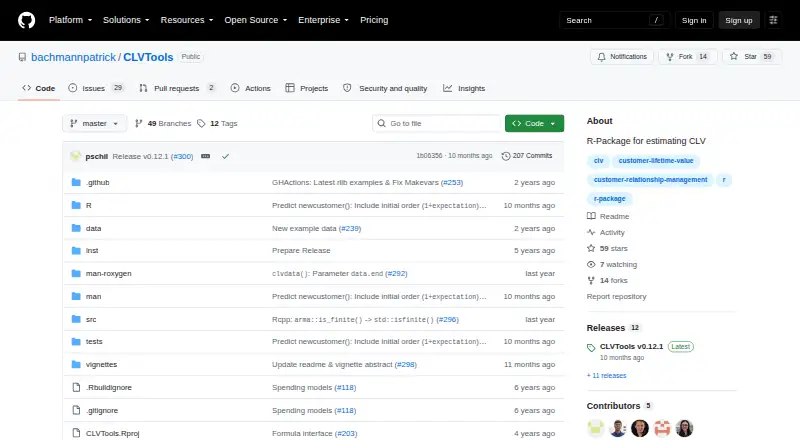
What CLVTools is
CLVTools is a free, open-source R package for modeling customer attrition when purchases are not tied to contracts. It implements Pareto/NBD, BG/NBD, Gamma/Gompertz/NBD, and Gamma/Gamma models, and can estimate individual customers’ future transactions and probability of being alive. Models support time-invariant covariates, with time-varying covariates available for some models. Additional options include correlation between purchase and attrition processes, L2 regularization, and equality constraints for contextual-factor parameters. The required input is transaction history with customer IDs and purchase dates; its example also uses prices. The package is intended for non-contractual settings, often for cohorts that joined at the same time. It supports predictive customer lifetime value analysis, cohort analysis, and customer segmentation, with a configurable forecast horizon. Stable releases are installed from CRAN; a development version is available from GitHub using devtools. It runs on Linux, macOS, and Windows. Compiling from source requires the GSL C++ library. Documentation includes a walkthrough, reference manual, and vignettes.
Good
- Implements four probabilistic customer models.
- Predicts individual transactions and probability of being alive.
- Supports covariates and model extensions.
- Offers configurable forecast horizons and cohort analysis.
- Available for Linux, macOS, and Windows.
Watch out
- Requires R.
- Source compilation requires the GSL C++ library.
Who it suits
CLVTools suits analysts working with customer transaction histories in non-contractual businesses, especially those analyzing cohorts. It requires R, and source builds require GSL.
Verdict
CLVTools brings several non-contractual attrition models and individual-level predictions into an R package. It is relevant for customer lifetime value, cohort, and segmentation work, with source compilation requiring GSL.
Plans and prices
From CLVTools's own pricing page, checked 9 Oct 2026.
| Plan | Price | What it gives you |
|---|---|---|
| CLVTools R package | Free | Requires R; compiling from source requires GNU GSL · GPL-3 licensed; no price stated |
The facts
Each one read from CLVTools's own pages, with the date it was checked.
What it does
- Build dependency
- Compiling CLVTools from source requires the external C++ library GSL.checked 9 Oct 2026
- Covariates
- The package supports time-invariant covariates across its models and time-varying covariates for some models.checked 9 Oct 2026
- Distribution
- The stable release is installed from CRAN, and a development version is installed from GitHub using devtools.checked 9 Oct 2026
- Documentation
- The project links to a walkthrough, a reference manual, and vignettes covering modeling, advanced techniques, and package classes.checked 9 Oct 2026
- Input data
- CLVTools requires customer transaction history with a purchase date and customer ID for each transaction record.checked 9 Oct 2026
- Installation
- The site documents installation from CRAN and installation of a development version from GitHub.checked 9 Oct 2026
- Intended use
- The package describes its models as suited to non-contractual settings and says they are usually applied to customer cohorts that joined at the same time.checked 9 Oct 2026
- License
- The package is licensed under GPL-3.checked 9 Oct 2026
- Maintainer
- The package authors page identifies Patrick Bachmann as maintainer and author.checked 9 Oct 2026
- Model extensions
- Available extensions include purchase and attrition process correlation, L2 regularization for contextual-factor parameters, and equality constraints between contextual-factor parameters.checked 9 Oct 2026
- Model options
- Supported extensions include purchase and attrition process correlation, L2 regularization, and equality constraints for contextual factor parameters.checked 9 Oct 2026
- Models
- It implements Pareto/NBD, BG/NBD, Gamma/Gompertz/NBD, and Gamma/Gamma models.checked 9 Oct 2026
- Operating systems
- The source installation instructions cover Linux, Intel and Apple Silicon Mac, and Windows.checked 9 Oct 2026
- Predictions
- The package can predict future customer behavior at the individual level, including expected transactions and probability of being alive.checked 9 Oct 2026
- Purpose
- CLVTools is an R package for probabilistic customer attrition models in non-contractual business settings.checked 9 Oct 2026
- Support
- The project invites bug reports through GitHub Issues and contributions through pull requests.checked 9 Oct 2026
- Support and contributions
- The GitHub project welcomes feedback and contributions, and directs bug reports to GitHub Issues and contributions to pull requests.checked 9 Oct 2026
- Supported models
- The package implements Pareto/NBD, BG/NBD, Gamma/Gompertz/NBD, and Gamma/Gamma models.checked 9 Oct 2026
Where it runs
- Platforms
- The installation instructions cover Linux, Mac with Intel or Apple Silicon, and Windows.checked 9 Oct 2026
The full review of CLVTools
CLVTools is an R package for analysts modeling customer purchasing and attrition in non-contractual businesses. Its appeal is a focused set of probabilistic models and customer-level predictions; it is less suited to anyone seeking a ready-made customer platform.
Overview
In a non-contractual setting, customers can stop buying without formally cancelling. CLVTools estimates expected future transactions and the probability that each customer remains active, making it useful for predictive customer lifetime value work as well as cohort analysis and segmentation. The forecast horizon is configurable.
The models are generally used on cohorts whose members joined at the same time, so the package is a natural fit for aligned customer groups. It takes transaction histories with customer IDs and purchase dates; the example also uses prices. Analysts should expect to shape and analyze data in R rather than work through a turnkey interface.
Key features
Choice of probabilistic models
CLVTools implements Pareto/NBD, BG/NBD, Gamma/Gompertz/NBD, and Gamma/Gamma. That range gives analysts several approaches to purchase and attrition behavior in one package, with Gamma/Gamma also supporting monetary-value modeling. Individual-level estimates can distinguish customers that a single cohort average would treat alike.
Covariates and model controls
Time-invariant covariates are supported across the models, while time-varying covariates are available for some. Analysts can also use extensions for correlation between purchase and attrition processes, L2 regularization for contextual-factor parameters, and equality constraints between those parameters. These options provide room to tailor model specification, but they are most valuable to users comfortable making statistical choices in R.
Installation and documentation
The stable release is installed from CRAN; a development version is available from GitHub using devtools. Walkthroughs, a reference manual, and vignettes on modeling, advanced techniques, and package classes provide routes into the package. The project welcomes contributions, with bug reports directed to GitHub Issues and contributions handled through pull requests.
Pricing
CLVTools R package: free. The package is open source under GPL-3, with no paid tier described. R is required. Installing the stable release from CRAN avoids the source-compilation step; compiling from source requires the external GNU Scientific Library (GSL). That dependency matters most to users setting up a development environment or building the package themselves.
Platforms
CLVTools supports Linux, macOS, and Windows. Its source installation guidance covers Linux, Intel and Apple Silicon Mac, and Windows. The package requires R, so operating-system support does not make it a standalone desktop application.
Who it's for
CLVTools suits analysts and researchers with customer transaction histories who need probabilistic forecasts for non-contractual purchasing, especially when working with same-start cohorts or individual-level estimates. It is a poor match for teams that want a visual campaign tool, an all-purpose customer platform, or analysis without R.
Pros and cons
- Pros: Four model families cover purchase, attrition, and monetary-value analysis within one R package.
- Pros: Customer-level transaction and alive-probability predictions support more differentiated CLV work than cohort averages alone.
- Pros: Covariates and model extensions offer additional control for users who need to tailor their specification.
- Cons: R is required, which rules it out for users seeking a no-code workflow.
- Cons: Source compilation depends on GSL, adding a setup requirement for users building from source.
- Cons: The emphasis on non-contractual settings and same-start cohorts narrows its fit for other customer-analysis needs.
Alternatives
For a broader selection, browse Customer Lifetime Value Software.
- PyMC-Marketing is another free, open-source modeling library; choose it if an Apache 2.0 Python library is a better fit than an R package.
- Pushwoosh offers a free plan with push notifications, email, and AI requests; choose it for messaging capabilities rather than CLV modeling.
- RevenueCat has a free Pro plan up to $2,500 in monthly tracked revenue, then charges 1% of tracked revenue; it is the alternative to consider for that revenue-based plan structure.
- SaaSFlow has a free plan with all features, unlimited users, and unlimited data sources up to €120k ARR (€10k MRR); its Pro plan is €100 a month with annual billing. Consider it if those SaaS metrics and terms fit your needs.
- Siftmo offers a free Starter plan capped at 50 monthly orders, with Growth at $29 a month for up to 500; choose it if those order-based tiers match your requirements.
- Klaviyo has a free plan capped at 250 active profiles, 500 email sends per month, and $5 of mobile messages per month; it may fit a small messaging workload within those limits.
- WorthSignal is another free option.
- VOZIQ AI Platform is available free of charge on a BYOL basis, with AWS infrastructure costs potentially applying.
Verdict
Choose CLVTools if you work in R and need established probabilistic models with individual-level predictions for non-contractual customer histories. Its modeling range and specification controls are the case for choosing it; the R workflow, source-build dependency, and cohort-oriented scope are reasons to look elsewhere.
Getting started
- Install R on Linux, macOS, or Windows
- Install the stable CLVTools release from CRAN
- Alternatively install the development version from GitHub using devtools
- Prepare transaction data with customer IDs and purchase dates
- Compile from source only after installing the GNU GSL C++ library
Limits worth knowing
The package requires R, and compiling it from source requires GNU GSL. Time-varying covariates are supported for some models rather than all models.
Questions
What does CLVTools cost?
It is free and licensed under GPL-3; the listed plan is free.
Which operating systems are supported?
Installation instructions cover Linux, Intel and Apple Silicon Mac, and Windows.
Where can it be installed from?
The stable release is installed from CRAN. A development version is available from GitHub using devtools.
What data does it use?
CLVTools takes customer transaction histories with customer IDs and purchase dates; its example also uses prices.
Which models are included?
It implements Pareto/NBD, BG/NBD, Gamma/Gompertz/NBD, and Gamma/Gamma models.
Is it open source?
Yes. CLVTools is distributed under the GPL-3 license, and the project welcomes feedback, GitHub Issues bug reports, and pull-request contributions.
Alternatives to CLVTools
- 1

RevenueCat
Open sourceAndroidiOSWebAPI8.1 - 2

Pushwoosh
Free planAndroidiOSWebWindows7.8From $5 a month - 3
Oracle Responsys
AndroidiOSWebAPI7.3From $2 a year - 4

Klaviyo
Free planWeb7.0Free plan - 5

TrueProfit
AndroidiOSWebExtension7.0From $35 a month - 6

Reaktion
AndroidiOSWeb6.8From $169 a month