
Smaply
Smaply is a web platform for bringing customer research, journey maps, and metrics together so teams can prioritize customer-experience improvements.
What Smaply is
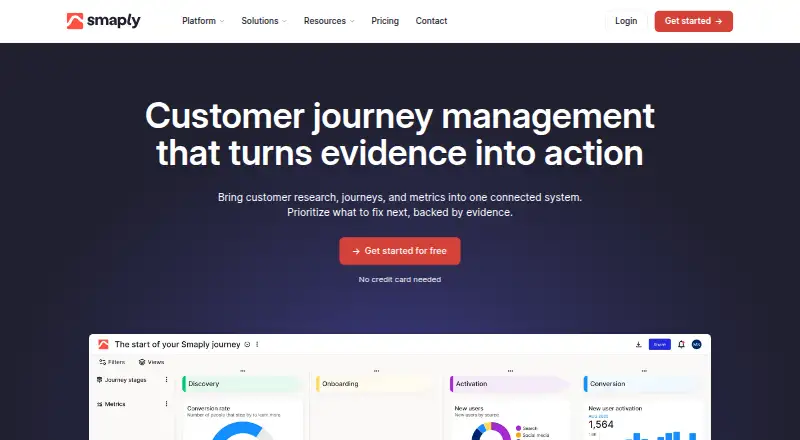
Smaply is a web platform for bringing customer research, journey maps, and metrics together so teams can prioritize customer-experience improvements. Journey maps support eleven lane types, drag-and-drop stages, steps and cards, emotion charts, live data, images, embeds, and planning cards. Maps have autosave, version history, bulk updates, and live links that show the latest version. Smaply AI can draft maps from descriptions and extract quotes, sentiment, and themes from research transcripts; Research Hub is part of the Governance plan. Teams can comment on map cards and use admin, editor, and viewer roles, with viewer availability depending on plan. Listed integrations and embeds include Qualtrics, Tableau, Google Docs, SharePoint, Google Sheets, Linear, Trello, Asana, and Jira. Smaply says it is ISO 27001:2022 certified, SOC 2 Type II audited, and GDPR and DSGVO compliant. The Free plan is limited to one personal workspace, 10 maps, 10 personas, three advanced cards per map, and no viewer seats.
Good
- Maps support eleven lane types.
- Includes version history and autosave.
- AI can draft maps and analyze transcripts.
- Integrates with named collaboration and analytics tools.
- States EU hosting by default and encryption in transit and at rest.
Watch out
- Free is limited to 10 maps.
- Free has no viewer seats.
- Viewer availability depends on plan.
Who it suits
Smaply is aimed at organizations and teams doing service design, customer-experience work, research, or journey management. It may suit teams that need collaborative mapping alongside research and metrics.
Verdict
Smaply combines journey mapping with research analysis, collaboration, and plan-dependent viewer access. Its Free plan has clear map and workspace limits, while paid plans begin at $38 per editor per month when billed yearly.
Plans and prices
From Smaply's own pricing page, checked 2 Oct 2026.
| Plan | Price | What it gives you |
|---|---|---|
| Free | Free | 1 personal workspace · 10 maps · 10 personas · 3 advanced cards per map · no viewer seats · Free forever; begins with 14-day full-featured trial |
| Repository | $38 a month | 1 team workspace · unlimited maps, personas, and portfolio cards · no viewer seats · Per editor / month; billed yearly ($449 USD) |
| Framework | $67 a month | 3 team workspaces · unlimited maps, personas, and advanced cards · 5 viewer seats included · Per editor / month; billed yearly ($799 USD) |
| Governance | $96 a month | Unlimited team workspaces, maps, personas, advanced cards, and viewer seats · some enterprise features from 10 users · Per editor / month; billed yearly ($1,149 USD) |
The facts
Each one read from Smaply's own pages, with the date it was checked.
What it does
- AI data policy
- Smaply states that customer data does not train anyone's model.checked 2 Oct 2026
- Collaboration
- The platform supports comments on journey map cards and role-based access for admins, editors, and viewers; viewer availability depends on the plan.checked 2 Oct 2026
- Data protection
- The security page says data is encrypted at rest with AES-256 and in transit with TLS 1.3, hosted on Google Cloud in the EU by default, with US hosting on request.checked 2 Oct 2026
- Integrations
- Smaply lists integrations and embeds including Qualtrics, Tableau, Monday.com, OneDrive, Google Docs, SharePoint, Google Sheets, Linear, Trello, Azure DevOps, Asana, and Jira.checked 2 Oct 2026
- Intended users
- Smaply describes its audience as organizations and teams doing service design, customer experience work, research, and journey management.checked 2 Oct 2026
- Journey maps
- Journey maps support eleven lane types, drag-and-drop stages, steps and cards, emotion charts, live data, images, embeds, and planning cards.checked 2 Oct 2026
- Purpose
- Smaply brings customer research, journeys, and metrics into one system to help teams prioritize and act on customer experience improvements.checked 2 Oct 2026
- Research and AI
- Smaply AI can draft journey maps from descriptions and extract quotes, sentiment, and themes from research transcripts; the Governance plan includes Research Hub.checked 2 Oct 2026
- Security
- Smaply states that it is ISO 27001:2022 certified, SOC 2 Type II audited, and GDPR and DSGVO compliant.checked 2 Oct 2026
- Support
- Free and Repository plans include self-service helpdesk support; Framework includes helpdesk and email support with a stated 24-hour response time.checked 2 Oct 2026
The company
- Headquarters
- Innsbruck, Austriachecked 23 Sep 2026
Where it runs
- Mapping updates
- Maps include version history, bulk updates, autosave, and live links that show the latest version.checked 2 Oct 2026
Money
- Notable plan limits
- The Free plan is limited to one personal workspace, 10 maps, 10 personas, three advanced cards per map, and no viewer seats.checked 2 Oct 2026
The full review of Smaply
Smaply is a web-based customer experience platform for bringing research, journey maps, and metrics into one system. It suits service design and CX teams that need to turn customer insight into coordinated improvement work. Its mapping and collaboration tools are broad, but meaningful team use quickly depends on a paid plan.
Overview
Smaply connects customer research with journey mapping and planning, so teams can organize experience work around customer needs rather than treating maps as standalone diagrams. Its maps combine stages, steps, cards, emotions, live data, images, embeds, and planning cards, with service blueprints and persona profiles also supported.
That breadth is useful when journey work is ongoing and shared across a team. Version history, bulk updates, autosave, and live links help keep maps current as work changes. PDF is the stated export format, so teams that need other export types should weigh that limitation.
Key features
Mapping and upkeep
Eleven lane types and drag-and-drop stages give teams options for structuring journeys; emotion charts add a way to represent customer reactions. Live data, images, embeds, and planning cards connect a map to supporting material and next steps. Version history and bulk updates are practical for teams maintaining multiple maps, while live links show the latest version instead of a stale copy.
Research, collaboration, and security
Smaply AI can draft maps from descriptions and extract quotes, sentiment, and themes from research transcripts. Customer data does not train anyone’s model, according to Smaply. Research Hub is included with Governance, making that plan the relevant tier for teams seeking the integrated research workspace.
Comments on map cards and role-based admin, editor, and viewer access support shared review, although viewer access varies by plan. Integrations and embeds include Qualtrics, Tableau, Monday.com, OneDrive, Google Docs, SharePoint, Google Sheets, Linear, Trello, Azure DevOps, Asana, and Jira. Smaply states it is ISO 27001:2022 certified, SOC 2 Type II audited, and GDPR and DSGVO compliant; it describes AES-256 encryption at rest, TLS 1.3 in transit, and EU Google Cloud hosting by default, with US hosting on request.
Pricing
Smaply is freemium, with a 14-day full-featured trial at the start of its Free plan. The Free plan remains free forever, but is restricted to one personal workspace, 10 maps, 10 personas, three advanced cards per map, and no viewer seats. It is a reasonable way for an individual to begin mapping, but the caps constrain broader collaboration and portfolio work.
Repository costs $38 per editor per month, billed yearly ($449 USD). It adds one team workspace and unlimited maps, personas, and portfolio cards, but has no viewer seats. That makes it the entry paid tier for editors who need shared team work and do not need stakeholders to view maps through viewer accounts.
Framework costs $67 per editor per month, billed yearly ($799 USD). It provides three team workspaces, unlimited maps, personas, and advanced cards, plus five viewer seats. This is the more suitable tier for teams sharing work with a small stakeholder group or using advanced cards across several workspaces. Framework includes helpdesk and email support with a stated 24-hour response time; Free and Repository include self-service helpdesk support.
Governance costs $96 per editor per month, billed yearly ($1,149 USD). It adds unlimited team workspaces, maps, personas, advanced cards, and viewer seats; some enterprise features begin at 10 users. Research Hub is also included at this level, making Governance the fit for larger organizations with extensive research and access needs. The higher per-editor price is difficult to justify for teams that do not need those expanded limits.
Platforms
Smaply runs on the web. Its listed export format is PDF.
Who it's for
Smaply is aimed at organizations and teams doing service design, customer experience work, research, and journey management. It is strongest for teams that want research analysis, mapping, planning, and stakeholder access in one workflow. A solo user or small team can start free, but should expect to move up a tier when map limits, advanced cards, team workspaces, or viewer seats become important.
Pros and cons
- Pros: Maps bring together eleven lane types, emotion charts, supporting content, and planning cards, which serves detailed journey work.
- Pros: Version history, bulk updates, autosave, and current-version live links help teams maintain maps over time.
- Pros: AI transcript analysis, broad listed integrations, and published security controls support research-centered and organization-wide use.
- Cons: Free is capped at 10 maps and personas, three advanced cards per map, and no viewer seats, limiting its usefulness for collaborative programs.
- Cons: Repository has no viewer seats, while Framework includes only five; wider stakeholder access requires Governance.
- Cons: PDF is the stated export format, which may not suit teams needing other export types.
Alternatives
For a broader comparison, see Customer Journey Mapping Software.
- UXPressia is worth considering if its free allowance of three journey maps, three personas, three impact maps, and PNG export better fits a small starting project.
- Customer Journey App may suit teams that value a free tier with JSON, HTML, PDF, and PPTX export, plus 10 version snapshots.
- Milkymap is an option for readers who want an iOS as well as web platform.
- TheyDo is a paid alternative with a 30-day trial for two users, five journeys, one journey framework, and unlimited viewers.
- Custellence may fit teams that prioritize unlimited viewers in a free plan, though that plan is limited to one workspace, two users, and two journey maps.
- SuiteCX is another option.
- René Studio may appeal to teams seeking a free tier with three journeys, one collaborator per workspace, and 1,000 AI credits per month.
- Cemantica is another option.
Verdict
Choose Smaply if your team needs customer research, journey mapping, and planning to work together, and you can match its per-editor tiers to your workspace and viewer needs. Its strongest case is the combination of rich maps, research analysis, and ongoing map maintenance. Look elsewhere if you need broader export formats, viewer access on the entry paid plan, or a less costly way to support a large editor group.