Lansweeper
Lansweeper is Cyber Asset Intelligence software for organizations that need visibility into their technology environments.
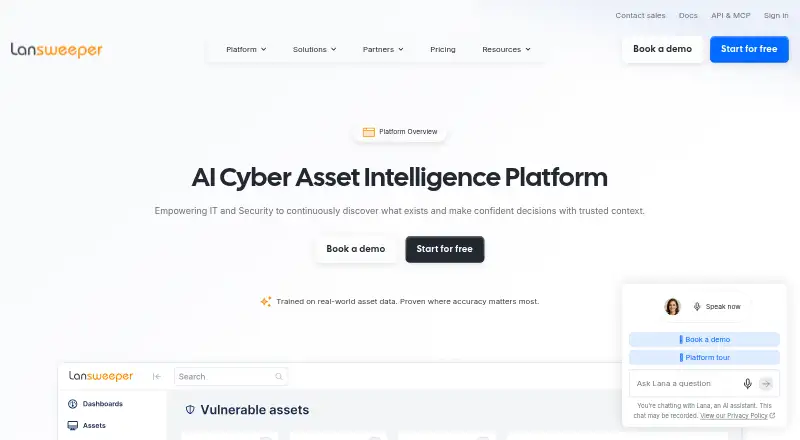
What Lansweeper is
Lansweeper is Cyber Asset Intelligence software for organizations that need visibility into their technology environments. It discovers IT, operational technology, cloud, and virtual assets, including unmanaged and rogue devices. Discovery can run without an agent, with an IT Agent available for situations such as work-from-home environments. Inventory tools include data federation, normalization, asset classification, cleanup rules, dashboards, and dynamically generated diagrams. The platform also provides vulnerability insights and identifies software or assets that are, or will be, at end of life. Lansweeper supports hybrid deployment, with cloud-first Lansweeper Sites and the on-premise Lansweeper Classic option. It offers integrations, a GraphQL API, webhooks, and a Flow Builder for custom workflows. Starter has limited Service Desk ticket enrichment integrations and API features; Pro and Enterprise include all marketplace apps, while full API access is in Enterprise. Plans include a free option for up to 100 assets and a 14-day trial. Paid plans start at $199 a month billed annually.
Good
- Discovers IT, operational technology, cloud, and virtual assets
- Agentless discovery is available
- Includes vulnerability and end-of-life insights
- Supports hybrid deployment, including an on-premise option
- Free plan covers up to 100 assets
Watch out
- Free plan is limited to 100 assets
- Starter integrations are limited to ticket enrichment
- Full API access is Enterprise-only
- Asset licenses are not stackable
Who it suits
Lansweeper suits organizations that need to inventory and understand assets across IT, operational technology, cloud, and virtual environments. Its plan limits and feature tiers may matter to teams choosing between a small asset count and broader API or integration access.
Verdict
Lansweeper combines asset discovery, inventory, lifecycle and vulnerability insights, and workflow tools. Check the asset limits and plan-specific integration and API access against your organization's requirements.
Plans and prices
From Lansweeper's own pricing page, checked 23 Sep 2026.
| Plan | Price | What it gives you |
|---|---|---|
| Free Trial | Priced on request | 14-day full trial · Continues free for up to 100 assets · Unlimited user seats · Community support |
| Free Trial | — | 14-day full trial · Continues free for up to 100 assets · Unlimited user seats · Community support |
| Enterprise | Priced on request | Starts at 10,000 assets · more than 3 installations · full API access · Enterprise support · Billed annually |
| Free | Free | Up to 100 assets · unlimited user seats · community support |
| Pro | — | 2,000–9,000 assets · up to 3 installations · vulnerability and lifecycle insights · all integrations · Pro support · Billed annually; price displayed as “449 528 474” per month |
| Starter | — | 2,000 assets · 1 installation · Service Desk ticket enrichment integrations · SSO · Starter support · Billed annually; price displayed as “245 299 270” per month |
The facts
Each one read from Lansweeper's own pages, with the date it was checked.
What it does
- Agentless scanning
- Lansweeper says its asset discovery can be done without an agent, while an IT Agent is available for situations such as work-from-home environments.checked 7 Oct 2026
- API
- The platform offers a GraphQL API and webhooks, with full API access included in Enterprise and limited API features in Starter and Pro.checked 7 Oct 2026
- Asset limit
- 100checked 23 Sep 2026
- Asset limits
- The pricing page says Enterprise starts at 10,000 assets, while Starter includes 2,000 and Pro scales from 2,000 to 9,000 assets.checked 7 Oct 2026
- Automation
- Lansweeper offers a Flow Builder for custom workflows and automations.checked 7 Oct 2026
- Compliance
- Lansweeper lists SOC 2 Type 2, ISO/IEC 27001:2022, TX-RAMP, CSA STAR Level 1, GDPR, and other security or compliance frameworks on its Trust Center.checked 7 Oct 2026
- Contract tracking
- Yeschecked 23 Sep 2026
- Deployment
- Lansweeper documents cloud-first, local on-premise, and hybrid installation types.checked 7 Oct 2026
- Discovery
- The platform discovers IT, operational technology, cloud, and virtual assets, including unmanaged and rogue assets.checked 7 Oct 2026
- Insights
- The platform provides vulnerability insights and identifies software and assets that are or will reach end of life.checked 7 Oct 2026
- Integration limits
- The Starter plan is limited to Service Desk ticket enrichment integrations, while Pro and Enterprise include all marketplace apps.checked 7 Oct 2026
- Integrations
- The integrations directory lists products including Jira Service Management, HaloITSM, Datadog, and Acronis; Starter is limited to Service Desk ticket enrichment integrations.checked 7 Oct 2026
- Inventory
- Inventory capabilities include data federation, normalization, asset classification, cleanup rules, dashboards, and dynamically generated diagrams.checked 7 Oct 2026
- Limits
- The pricing page says Starter includes 2,000 assets, Pro scales from 2,000 to 9,000, and Enterprise starts at 10,000 assets; asset licenses are not stackable.checked 7 Oct 2026
- Operating systems
- The trial setup documentation lists Windows, Linux, and macOS as supported operating systems.checked 7 Oct 2026
- Paid from
- 199checked 23 Sep 2026
- Purpose
- Lansweeper describes its platform as Cyber Asset Intelligence software that gives organizations visibility and control over their technology environments.checked 7 Oct 2026
- Security
- The Trust Center displays SOC 2 Type II, ISO 27001, GDPR, and other security or compliance designations.checked 7 Oct 2026
- Security controls
- Lansweeper says its cloud platform uses TLS encryption in transit, AES-256 encryption at rest, encrypted credential storage, and logical separation of customer data.checked 7 Oct 2026
- Self-hosted option
- Lansweeper documents Lansweeper Classic as an on-premise solution alongside its cloud-first Lansweeper Sites option.checked 7 Oct 2026
The company
- Company
- Lansweeper says it was founded in 2004.checked 7 Oct 2026
- Founded
- 2004checked 23 Sep 2026
- Headquarters
- Merelbeke, Belgiumchecked 23 Sep 2026
Money
- Free plan
- Yeschecked 23 Sep 2026
The full review of Lansweeper
Lansweeper is an asset intelligence platform for organizations that need a current view of technology across IT, operational technology, cloud, and virtual environments. It is best suited to teams managing substantial, mixed estates; its free tier is useful for a small inventory, but paid plans make more sense once discovery, integrations, or scale become central.
Overview
Lansweeper combines discovery with inventory management and operational context. It can identify unmanaged and rogue assets, and agentless scanning is useful where installing software on every device is impractical. An IT Agent is also available for cases such as work-from-home environments. The hybrid deployment model accommodates both cloud use and Lansweeper Classic on-premise, alongside the cloud-first Lansweeper Sites option.
Inventory tools go beyond collecting device records: data federation and normalization, asset classification, cleanup rules, dashboards, and generated diagrams help teams turn discovery into a more coherent view. Vulnerability insights and end-of-life identification add useful lifecycle context. This breadth is valuable to organizations with varied estates, though the 100-asset free cap makes the no-cost option a limited fit for larger environments.
Key features
Discovery and inventory
Discovery spans IT, operational technology, cloud, and virtual assets, including unmanaged devices. Agentless scanning lowers the deployment burden; the optional agent addresses environments where direct network discovery is less suitable. Classification and cleanup rules can help keep an inventory usable as it grows, while dashboards and diagrams make relationships easier to inspect.
Lifecycle, integrations, and automation
Vulnerability insights and alerts about software or assets approaching end of life give IT teams information for prioritizing remediation and replacement. Flow Builder supports custom workflows and automations. Integration access depends on tier: Starter is restricted to Service Desk ticket enrichment, while Pro and Enterprise include marketplace apps. The directory includes tools such as Jira Service Management, HaloITSM, Datadog, and Acronis.
A GraphQL API and webhooks support connected workflows, but full API access is reserved for Enterprise; Starter and Pro have limited API features. That distinction matters to teams planning deeper integrations or custom automation. The cloud service uses TLS in transit, AES-256 encryption at rest, encrypted credential storage, and logical separation of customer data. Its Trust Center lists frameworks including SOC 2 Type 2, ISO/IEC 27001:2022, TX-RAMP, CSA STAR Level 1, and GDPR.
Pricing
Lansweeper offers a free plan, paid subscriptions, and a 14-day trial with access to all features without a credit card. Asset licenses are not stackable, so organizations should match a plan's capacity to their estate rather than assume they can combine smaller licenses.
| Plan | Price and capacity | What it includes |
|---|---|---|
| Free | free; up to 100 assets | Unlimited user seats and community support |
| Starter | $199 a month, billed annually; 2,000 assets | One installation, Service Desk ticket enrichment, single sign-on, and Starter support |
| Pro | $379 a month, billed annually; 2,000 to 9,000 assets | Up to three installations, vulnerability and lifecycle insights, all integrations, and tier-specific support |
| Enterprise | Custom pricing, billed annually; starts at 10,000 assets | More than three installations, full API access, and Enterprise support, including a customer success manager |
The free plan's unlimited seats are generous for collaboration, but its 100-asset ceiling and community support make it a small-estate or initial-evaluation option, not a substitute for a production plan at scale. Starter is the lower-cost paid entry for inventories of up to 2,000 assets, but its single installation and restricted integrations make it less suitable for distributed or heavily connected operations. Pro is the clearer choice for teams needing lifecycle and vulnerability insights or broader integrations; its capacity tops out at 9,000 assets. Enterprise is aimed at larger estates needing at least 10,000 assets, more installations, and full API access. The 14-day trial offers a practical way to assess the complete feature set before committing.
Platforms
Lansweeper supports web, API, Windows, Linux, and macOS, with self-hosted deployment also available. Windows, Linux, and macOS are supported operating systems for trial setup. The mix of cloud-first and on-premise options helps organizations choose a deployment approach aligned with their environment.
Who it's for
Lansweeper is a strong fit for IT teams responsible for large or mixed technology estates that need discovery, normalized inventory, lifecycle visibility, and workflow connections in one platform. Pro is particularly relevant when vulnerability and end-of-life context or marketplace integrations are priorities. Small teams with no more than 100 assets can start free, while large organizations needing extensive installations and full API access should consider Enterprise. It is less compelling for a small inventory that only needs a basic list of assets, or for a team whose integration requirements exceed Starter's ticket-enrichment scope but whose estate does not justify Pro.
Pros and cons
- Pros: Agentless discovery covers IT, OT, cloud, and virtual assets, including unmanaged devices, reducing reliance on manual inventory.
- Pros: Normalization, classification, cleanup rules, dashboards, and diagrams help teams maintain and interpret collected asset data.
- Pros: Vulnerability and lifecycle insights, plus Flow Builder, connect inventory with remediation and workflow needs.
- Pros: A 14-day all-feature trial requires no credit card, and the free plan permits unlimited seats.
- Cons: The free plan stops at 100 assets, far below the capacity of paid tiers.
- Cons: Starter limits integrations to Service Desk ticket enrichment and includes only one installation, constraining teams with broader operational needs.
- Cons: Full API access requires Enterprise, while Pro and Starter offer only limited API features.
- Cons: Asset licenses cannot be stacked, so choosing the right capacity tier matters as the estate grows.
Alternatives
For a different emphasis or a narrower use case, consider Application Dependency Mapping Software for application dependency mapping, IT Asset Management Software for the broader asset-management category, IT SLA Management Software for SLA management, IT Help Desk Software for help desk needs, Network Discovery Software for network discovery, or Asset Tracking Software for asset tracking options.
Netdata is a freemium option for readers seeking monitoring across mobile and desktop platforms; its free Community plan caps usage at five active connected nodes and one active custom dashboard per room. Dynatrace Kubernetes Monitoring is a paid Kubernetes-focused alternative with a free trial and hourly pod-based billing. uControl Asset Management is worth considering for on-premise use: its free Community plan allows up to 10k servers and unlimited users. New Relic Kubernetes Monitoring offers a free option with 100 GB of data ingest, making it a consideration for readers prioritizing Kubernetes monitoring and usage-based data capacity. Backstage is a free open-source framework for readers seeking that kind of framework instead. ManageEngine Applications Manager offers a free tier for up to five apps or servers, useful for a small monitoring scope. Azure Application Insights uses usage-based data ingestion, with the first 5 GB per month per billing account free. Cartography is a free open-source infrastructure mapping tool for readers who specifically want infrastructure mapping.
Verdict
Choose Lansweeper when your organization needs broad asset discovery and an inventory that can support lifecycle decisions and connected workflows. Its strongest case is the combination of agentless discovery across varied environments with inventory and operational insights. Look elsewhere if your estate fits the 100-asset free cap and needs no more, or if the paid-tier capacity, integration, or API boundaries do not match your requirements.
Getting started
- Visit lansweeper.com/product/ and choose a plan or the 14-day trial.
- For the trial, select a supported operating system: Windows, Linux, or macOS.
- Choose cloud-first Lansweeper Sites or the on-premise Lansweeper Classic option.
- Begin discovery with agentless scanning or use the IT Agent for situations such as work-from-home environments.
- Review the asset limit and installation count for the selected plan.
Limits worth knowing
The free plan covers up to 100 assets and includes community support. Starter includes 2,000 assets and one installation, with integrations limited to Service Desk ticket enrichment; asset licenses are not stackable.
Questions
Is Lansweeper free?
Yes. The free plan supports up to 100 assets, unlimited user seats, and community support.
Is there a free trial?
Yes. The 14-day trial provides access to all features without requiring a credit card.
How much do the paid plans cost?
Starter costs $199 a month billed annually. Pro costs $379 a month billed annually; no Enterprise price is provided in the listed plan details.
How many assets do the plans support?
Free supports up to 100 assets. Starter includes 2,000, Pro scales from 2,000 to 9,000, and Enterprise starts at 10,000 assets.
Can Lansweeper be self-hosted?
Yes. Lansweeper documents the on-premise Lansweeper Classic option alongside its cloud-first Lansweeper Sites option.
Which operating systems are supported for trial setup?
The trial setup documentation lists Windows, Linux, and macOS.
Alternatives to Lansweeper
- 1

GLPI
Open sourceAndroidiOSWebAPI9.1From €19 a month - 2

Freshservice
AndroidiOSWebAPI8.6From $19 a month - 3

Reftab
Free planAndroidiOSWeb8.6From $9 a year - 4

LICENSEWARE
Free planWebAPILinuxmacOS8.6From $3.36 a year - 5
i-doit
Open sourceAndroidiOSWebAPI8.5From €48.65 a month - 6

Alloy Navigator
AndroidiOSWebAPI8.3From $19 a month