
LICENSEWARE
LICENSEWARE is a modular software asset management platform for examining enterprise software licensing data, costs, and audit risks.
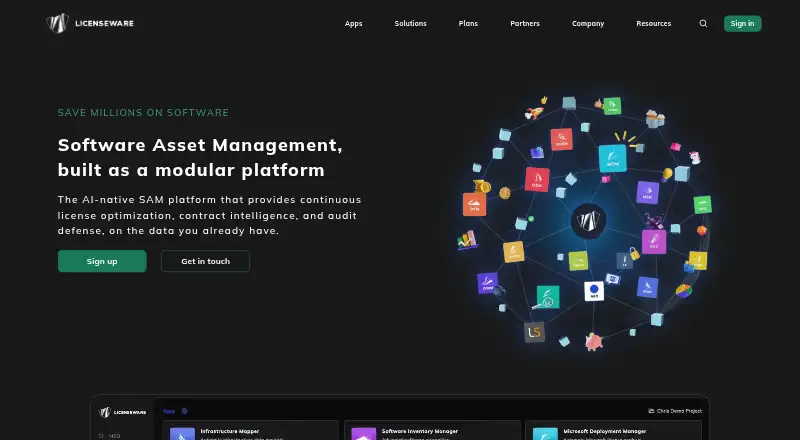
What LICENSEWARE is
LICENSEWARE is a modular software asset management platform for examining enterprise software licensing data, costs, and audit risks. Its apps cover software inventory, contracts and licenses, renewals, infrastructure mapping, maturity assessment, and vendor-specific licensing analysis. The NEO assistant answers vendor-specific licensing questions, analyzes contracts, and generates contextual reports. Listed data sources number 58+, including Lansweeper, Microsoft Graph, SCCM, Oracle LMS scripts, ServiceNow, Proactivanet, and NinjaOne; new APIs, uploaders, and agents can be requested. Its Collector scans Linux, Windows, macOS, and Docker hosts for software, hardware, processes, and container data. The maker says it uses TLS 1.2 or higher, service-to-service encryption, encryption at rest, and regular vulnerability testing, and identifies the company as SOC 2 Type 1 and Type 2 certified. Customer data is hosted in a selected Netherlands, Iowa, or Sydney region and, according to the maker, does not move between regions. The maker says identifiable customer data is not used for AI training, and documents are analyzed only on demand when explicitly requested. Plans include a Free option, Pay as you go at $1, Chill at $150 a month, and Core at $3.36 a year.
Good
- Covers software inventory, contracts, renewals, and licensing analysis.
- NEO can analyze contracts and generate contextual reports.
- Lists more than 58 data sources.
- Collector scans Linux, Windows, macOS, and Docker hosts.
- Free plan has no time limit and allows unlimited uploads.
Watch out
- Free-plan reports are limited to 10 rows per table.
- Advanced plan pricing is not listed.
- Free-plan support is self-support.
Who it suits
LICENSEWARE is intended for SAM and IT asset managers, procurement leads, compliance teams, consulting partners, and resellers. It suits organizations seeking software inventory and licensing analysis across multiple data sources.
Verdict
LICENSEWARE brings software inventory, licensing analysis, contracts, and infrastructure data into a modular platform. The free plan allows unlimited uploads, but its reports are capped at 10 rows per table.
Plans and prices
From LICENSEWARE's own pricing page, checked 20 Sep 2026.
| Plan | Price | What it gives you |
|---|---|---|
| PAYG | $1 a month | Consumption-based pricing · Any apps or all apps on demand · Volume discount applicable · One-off |
| Chill | $150 a month | up to 1,000 devices · contract and license management · software inventory analysis · NEO answers · per month |
| Core | $3.36 a year | more than 1,000 devices · Chill features · API connectors · premium support with onboarding · per device per year |
| Free | Free | unlimited data uploads · full app functionality · reports capped at 10 rows per table · NEO unrestricted · forever |
| Pay as you go | $1, paid once | from $1 per device · any apps or all apps · volume discounts · one-off |
| Advanced | Priced on request | more than 1,000 devices · Core features · advanced vendor analysis · extended SAM-expert support · custom via partner or direct |
The facts
Each one read from LICENSEWARE's own pages, with the date it was checked.
What it does
- AI assistant
- NEO answers vendor-specific licensing questions and can analyze contracts and generate contextual reports.checked 29 Sep 2026
- AI data handling
- The AI documentation says models run behind a secure API layer with logging and monitoring, using Azure and Google Cloud infrastructure.checked 14 Oct 2026
- Audience
- The maker identifies SAM managers, IT asset managers, procurement leads, compliance teams, consulting partners, and resellers as intended users.checked 29 Sep 2026
- Cloud limitation
- AWS, Azure, GCP and OCI reports are not supported directly out of the box but can be converted to Licenseware templates.checked 14 Oct 2026
- Collector
- LICENSEWARE Collector gathers software and hardware usage from Linux, Windows, macOS and Docker hosts.checked 14 Oct 2026
- Compliance
- Licenseware states that it has SOC 2 Type 1 and Type 2 certification and follows GDPR obligations.checked 14 Oct 2026
- Connector requests
- The maker says new APIs, uploaders, and agents are built on request, and most new integrations ship within two weeks.checked 29 Sep 2026
- Contracts
- License and Contracts Manager centralizes contracts, licenses and renewals and reconciles entitlements with deployment data.checked 14 Oct 2026
- Core functions
- Its apps cover software inventory, contracts and licenses, renewals, infrastructure mapping, maturity assessment, and vendor-specific licensing analysis.checked 29 Sep 2026
- Data residency
- Customer data is hosted in the selected Netherlands, Iowa, or Sydney region, and the maker says data does not move between regions.checked 29 Sep 2026
- Deployment
- hybridchecked 20 Sep 2026
- Documentation
- The Knowledge Center contains platform, upload, account, security, integration, reporting, project and support articles.checked 14 Oct 2026
- Extensibility
- The documentation says new uploaders and APIs can be built on request and publishes a minimum standardized data schema for integrations.checked 14 Oct 2026
- Funding
- The LinkedIn company page displays Crunchbase information showing four funding rounds, including a US$1.2 million seed round dated December 29, 2022.checked 14 Oct 2026
- Integrations
- Supported sources include Lansweeper, Microsoft SCCM, Flexera, Snow, ServiceNow, vCenter, BigFix, MAP Toolkit, IBM HMC and many CSV, export and script formats.checked 14 Oct 2026
- Inventory management
- Software Inventory Manager recognizes, normalizes and categorizes software and highlights overlap, end-of-life software and unauthorized installs.checked 14 Oct 2026
Where it runs
- Collector platforms
- LICENSEWARE Collector scans Linux, Windows, macOS, and Docker hosts for software, hardware, processes, and container data.checked 29 Sep 2026
- Infrastructure mapping
- Infrastructure Mapper records CPU, virtualization and host relationships needed for topology-sensitive licensing calculations.checked 14 Oct 2026
The company
- Company
- LICENSEWARE describes itself as a globally distributed deep-tech company founded in 2020.checked 29 Sep 2026
- Company size
- LinkedIn lists LICENSEWARE as a privately held software-development company with 11–50 employees.checked 14 Oct 2026
- Founded
- LinkedIn lists the company as founded in 2020.checked 14 Oct 2026
- Headquarters
- LinkedIn lists Bucharest as headquarters and also shows locations in Oxford, Valencia and Slobozia.checked 14 Oct 2026
Money
- Free plan
- Yeschecked 20 Sep 2026
- Free-plan limit
- The free plan has no time limit and allows unlimited uploads, but reports are limited to 10 rows per table.checked 29 Sep 2026
The full review of LICENSEWARE
Overview
LICENSEWARE is best suited to organizations that need to connect software inventory with licensing, contract, and infrastructure work. Its mix of modular analysis and a no-time-limit free plan is appealing for evaluation, but the free reports’ 10-row cap makes them a poor fit for sustained review of large estates.
Founded in 2020 and headquartered in Bucharest, Romania, the globally distributed maker offers hybrid deployment and a collector for Linux, Windows, macOS, and Docker hosts. Its scope reaches beyond inventory into renewals, maturity assessment, and vendor-specific licensing analysis, so it makes most sense when several of those jobs need to sit together.
Key features
Licensing and asset analysis
LICENSEWARE’s apps address software inventory, contracts and licenses, renewals, infrastructure mapping, maturity assessment, and vendor-specific analysis. The product also supports license compliance, software recognition, usage optimization, and purchase workflows. That breadth can help SAM, procurement, and compliance teams connect asset data to decisions; organizations seeking only a basic inventory may not need such a wide platform.
Collection and integrations
The Collector scans Linux, Windows, and macOS hosts, as well as Docker hosts, for software, hardware, processes, and container data. The data sources page covers more than 58 sources, including Lansweeper, Microsoft Graph, SCCM, Oracle LMS scripts, ServiceNow, Proactivanet, and NinjaOne. The maker says it builds new APIs, uploaders, and agents on request, with most new integrations shipping within two weeks. That request-based route is useful when an existing source is missing, though it still requires a request rather than an out-of-the-box connector.
NEO and security
NEO answers vendor-specific licensing questions, analyzes contracts, and generates contextual reports. The maker says identifiable customer data is not used to train AI models, and documents are analyzed only on demand when explicitly requested. LICENSEWARE says it is SOC 2 Type 1 and Type 2 certified, uses TLS 1.2 or higher, service-to-service encryption and encryption at rest, and performs regular vulnerability testing. Customers choose hosting in the Netherlands, Iowa, or Sydney; the maker says data does not move between regions.
Pricing
The Free plan costs nothing, has no time limit, and allows unlimited uploads, but reports are limited to 10 rows per table. It is a useful way to explore the product or handle small data sets; the row cap is a material constraint for larger estates.
PAYG is $1 a month, billed One-off, with consumption-based pricing for any apps or all apps on demand and volume discounts applicable. A separate Pay as you go plan is $1, paid once, billed $1 / device for one-off analysis, with any apps on demand and volume discounts available. These options suit occasional or variable analysis better than assuming a fixed ongoing subscription; buyers should distinguish the monthly one-off consumption model from the per-device one-off analysis charge.
Chill costs $150 a month, billed monthly, for 1,000 devices. It offers standard support and is the clearest fixed monthly choice for an organization within that device count. Core costs $3.36 a year, billed annually, for more than 1,000 devices; it includes premium support with onboarding. Advanced has custom pricing for more than 1,000 devices and extended expert support. Free offers self-support, while PAYG and Chill have standard support. The stated price terms do not explain how Core’s annual price scales with device volume, so buyers should confirm the applicable charge before comparing it with Chill.
Platforms
LICENSEWARE supports API, Linux, macOS, web, and Windows, with hybrid deployment. The Collector’s host coverage includes Linux, Windows, macOS, and Docker; it scans for software, hardware, processes, and container data.
Who it's for
The intended users include SAM managers, IT asset managers, procurement leads, compliance teams, consulting partners, and resellers. It is a stronger match for teams that need licensing analysis alongside inventory and contract work than for buyers looking for a narrowly focused catalog. The unlimited-upload free tier can help assess fit, but its report cap limits how far it can support ongoing operational use.
Pros and cons
- Pros: Inventory, contracts, renewals, infrastructure mapping, and vendor-specific analysis are covered across modular apps, giving licensing teams a broader workflow than inventory alone.
- Pros: More than 58 data sources and on-request connector development give teams multiple paths to bring data in, including when a needed source is not already covered.
- Pros: Free has no time limit and unlimited uploads, making it possible to explore the platform without a timed trial window.
- Cons: Free reports stop at 10 rows per table, limiting their usefulness for large inventories and full-scale reporting.
- Cons: The menu includes consumption-based and one-off options as well as device-count plans, so buyers need to match pricing terms carefully to their intended usage.
Alternatives
Flexera One IT Asset Management is a paid option with a free plan and self-hosted and web platforms; its pricing is custom, so consider it if those platforms better fit your deployment requirements.
Eracent Software License Management is a paid enterprise license-management alternative with a free trial and broad platform coverage, including mobile and self-hosted options. Choose it if those platform options are a priority.
Matrix42 FastViewer is a paid product with a free trial and a price of €540 a year per concurrent session, plus 19% VAT. Consider it if that session-based pricing and its Android, iOS, macOS, self-hosted, web, and Windows coverage suit your needs.
SAP Cloud ALM has a free plan for eligible support customers, limited to one tenant per customer number, 24 GB SAP HANA Memory, and 24 GB of monthly outbound API data transfer. It is worth considering if those terms and its API and web platforms fit your requirements.
License Dashboard is a paid alternative with API, Linux, web, and Windows platforms.
Block 64 is a paid alternative with a free trial and API, Linux, macOS, web, and Windows platforms.
Xensam is a paid alternative with monthly invoicing based on installed, active agents and charges for actual usage, without levels or bands; it supports API, Linux, macOS, web, and Windows.
LAMUM (License Asset Manager with Usage Monitoring) is a freemium web alternative.
For broader category comparisons, see Software Asset Management Software, IT Vendor Management Software, and IT Asset Management Software.
Verdict
Choose LICENSEWARE if your team needs licensing work that spans inventory, contracts, renewals, and vendor-specific analysis, and you value hybrid deployment plus a no-time-limit way to start. Its strongest case is the breadth of connected workflows and collection sources; its clearest drawbacks are the free report cap and pricing models that need careful matching to actual consumption. Look elsewhere if you need uncapped reporting on a free plan or a simpler, more clearly bounded cost structure.
Getting started
- Visit the LICENSEWARE website.
- Choose the Free plan or a listed paid plan.
- Select the apps or consumption-based analysis suited to your needs.
- Connect data sources such as Microsoft Graph, SCCM, or ServiceNow.
- Use the Collector on Linux, Windows, macOS, or Docker hosts where host data is needed.
- Use API, Linux, macOS, web, or Windows access with hybrid deployment.
Limits worth knowing
The Free plan has no time limit and allows unlimited uploads, but reports are limited to 10 rows per table. Chill is listed for 1,000 devices, while Core and Advanced are for more than 1,000 devices.
Questions
Is LICENSEWARE free?
Yes. The Free plan is listed as free, with unlimited uploads and reports limited to 10 rows per table.
What paid plans and prices are listed?
Pay as you go is listed at $1, paid once, billed $1 per device for one-off analysis; Chill at $150 a month, and Core at $3.36 a year. Advanced has no listed price.
Which platforms does LICENSEWARE support?
The listed platforms are API, Linux, macOS, web, and Windows. Deployment is hybrid.
What does LICENSEWARE do?
Its apps cover inventory, contracts and licenses, renewals, infrastructure mapping, maturity assessment, and vendor-specific licensing analysis. NEO can answer licensing questions and analyze contracts.
What integrations are available?
The data sources page lists more than 58 sources, including Lansweeper, Microsoft Graph, SCCM, Oracle LMS scripts, ServiceNow, Proactivanet, and NinjaOne. The maker says new APIs, uploaders, and agents can be built on request.
Who makes LICENSEWARE?
LICENSEWARE is the maker. The company describes itself as globally distributed, founded in 2020, and headquartered in Bucharest, Romania.
Alternatives to LICENSEWARE
- 1

ManageEngine ServiceDesk Plus
AndroidiOSWebAPI8.0From $10 a month - 2

Ramp AP
Free planAndroidiOSWebAPI8.0From $15 a month - 3

Alloy Navigator
AndroidiOSWebAPI7.9From $19 a month - 4

Freshservice
AndroidiOSWebAPI7.9From $19 a month - 5

SolarWinds Service Desk
AndroidiOSWebAPI7.2From $39 a month - 6

Gatekeeper
WebAPI6.7