
Wiki.js
Wiki.js is a knowledge base platform for writing and sharing documentation.
What Wiki.js is
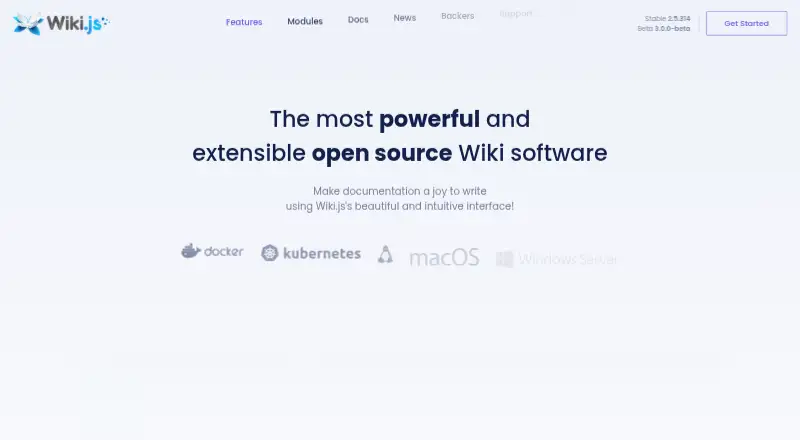
Wiki.js is a knowledge base platform for writing and sharing documentation. It is self-hosted and released under the AGPL license, with deployment options for Docker, Kubernetes, or bare metal on Linux, macOS, and Windows. The editor supports Markdown with live preview, tables, tabsets, diagrams, math, and syntax highlighting for more than 180 languages. Authentication options include OIDC, LDAP, SAML 2.0, and local authentication, while access rules can be granted, denied, and inherited across groups and pages. Edits are attributed, compared, and restorable, and content can sync with Git or be pushed to local disk and cloud storage such as S3, Azure, and GCP. The 3.0 beta uses Node.js with PostgreSQL and adds real-time collaboration and REST endpoints documented with OpenAPI. The stable release instead requires Node.js 18.x or later and a supported database, including PostgreSQL, MySQL, MariaDB, MSSQL, or SQLite3. Wiki.js is free forever as a self-hosted option. Support is available through GitHub Discussions, bug reports, feature suggestions, vulnerability disclosure, and developer documentation.
Good
- Runs on Linux, macOS, and Windows.
- Editor supports syntax highlighting for over 180 languages.
- Supports OIDC, LDAP, SAML 2.0, and local authentication.
- Edits can be attributed, compared, and restored.
- Free forever under the AGPL license.
Watch out
- Wiki.js is self-hosted.
- Stable release requires Node.js 18.x or later and a supported database.
- Version 3.0 is listed as beta.
Who it suits
Wiki.js suits people and teams who want to host and manage a documentation knowledge base. Its authentication and page-rule options support controlled access across groups and pages.
Verdict
Wiki.js offers flexible documentation authoring, access controls, and content storage for self-hosted use. Note the different requirements for the 3.0 beta and stable release.
Plans and prices
From Wiki.js's own pricing page, checked 30 Sep 2026.
| Plan | Price | What it gives you |
|---|---|---|
| Free forever | Free | AGPL licensed · self-hosted |
The facts
Each one read from Wiki.js's own pages, with the date it was checked.
What it does
- API
- Every action in the Wiki.js 3.0 beta user interface is exposed as a REST endpoint documented with OpenAPI.checked 30 Sep 2026
- Architecture
- Wiki.js runs on Node.js with PostgreSQL in version 3.0 beta.checked 30 Sep 2026
- Audit trail
- Every edit is diffed, attributed, and restorable in one click.checked 30 Sep 2026
- Authentication
- Supported authentication includes OIDC, LDAP, SAML 2.0, and local authentication.checked 30 Sep 2026
- Authoring
- The editor supports Markdown with live preview, tables, tabsets, diagrams, math, and syntax highlighting for more than 180 languages.checked 30 Sep 2026
- Collaboration
- Wiki.js 3.0 beta provides real-time collaboration with live cursors, presence, and conflict-free merges.checked 30 Sep 2026
- Custom domain
- Yeschecked 20 Sep 2026
- Deployment
- Wiki.js can run in Docker, Kubernetes, or bare metal environments on Linux, macOS, and Windows.checked 30 Sep 2026
- Integrations
- Wiki.js lists more than 50 integrations for authentication, logging, rendering, search, and storage.checked 30 Sep 2026
- License
- Wiki.js is released under the AGPL license.checked 30 Sep 2026
- Permissions
- Access can be granted, denied, and inherited across groups and page rules.checked 30 Sep 2026
- Publishing audience
- bothchecked 20 Sep 2026
- Purpose
- Wiki.js is a knowledge base platform for writing and sharing documentation.checked 30 Sep 2026
- Security reporting
- The security policy supports the 2.x series and asks users to submit vulnerability reports privately through GitHub security advisories.checked 30 Sep 2026
- SSO support
- Yeschecked 20 Sep 2026
- Stable requirements
- The stable release requires Node.js 18.x or later and PostgreSQL, MySQL, MariaDB, MSSQL, or SQLite3.checked 30 Sep 2026
- Storage
- Content can synchronize with Git or be pushed to local disk and cloud storage such as S3, Azure, and GCP.checked 30 Sep 2026
- Support
- Support is provided through GitHub Discussions, bug reports, feature suggestions, vulnerability disclosure, and developer documentation.checked 30 Sep 2026
- Version history
- Yeschecked 20 Sep 2026
Money
- Free plan
- Yeschecked 20 Sep 2026
The full review of Wiki.js
Overview
Wiki.js is an AGPL-licensed knowledge base for teams that want to write and share documentation on infrastructure they control. It is a strong fit for technical and internal documentation that needs flexible publishing and granular access rules, provided the team is prepared to operate a self-hosted service.
Its free price and broad authoring tools make it an appealing option for organizations comfortable with open-source software. The important caveat is that some capabilities belong to the 3.0 beta, whose requirements differ from those of the stable release.
Key features
Rich documentation authoring
The Markdown editor combines live preview with tables, tabsets, diagrams, math, and syntax highlighting for more than 180 languages. That range suits technical teams who need code examples and structured explanations alongside prose, rather than a basic text-only wiki.
Access and authentication
Authentication supports OIDC, LDAP, SAML 2.0, and local accounts. Administrators can grant, deny, or inherit permissions across groups and page rules, while custom-domain support and single sign-on help accommodate both public-facing and internal knowledge bases. These controls are useful for mixed audiences, though they require someone to design and maintain the permission structure.
Revision control and collaboration
Edits are diffed and attributed, and previous versions can be restored in one click. That makes review and recovery more practical than relying on manual backups. Real-time collaboration with live cursors, presence, and conflict-free merges is described for the 3.0 beta, not as a general stable-release capability.
Integrations, API, and content storage
Wiki.js lists more than 50 integrations spanning authentication, logging, rendering, search, and storage. Content can synchronize with Git or be pushed to local disk and cloud storage such as S3, Azure, and GCP. In 3.0 beta, every user-interface action is exposed through a REST endpoint documented with OpenAPI, a useful foundation for teams building connected workflows.
The stable release requires Node.js 18.x or later and supports PostgreSQL, MySQL, MariaDB, MSSQL, or SQLite3. The 3.0 beta runs on Node.js with PostgreSQL, so operators should confirm which release they intend to deploy before planning infrastructure.
Pricing
Wiki.js is free forever at no cost under the AGPL license, with self-hosting. There are no paid tiers described; the tradeoff is that the organization supplies and operates the hosting environment rather than paying for a hosted plan. The AGPL license should also be considered when evaluating how the software will be used or distributed.
Platforms
Wiki.js is available for web use and can be self-hosted on Linux, macOS, or Windows. Deployment can use Docker, Kubernetes, or bare metal. This gives infrastructure teams several ways to fit it into their environment, but it is not a turnkey hosted service.
Who it's for
Wiki.js is best for technical teams, organizations, and communities that want a free, self-hosted documentation platform with public or internal publishing, SSO, revision history, and control over content storage. It is less suitable for readers who want a managed service or do not want to take responsibility for application and database operations.
Pros and cons
- Pro: The Markdown editor covers diagrams, math, tables, tabsets, and more than 180 syntax-highlighted languages, which supports detailed technical documentation.
- Pro: OIDC, LDAP, SAML 2.0, local authentication, and inherited page and group rules offer a broad access-control toolkit.
- Pro: Git synchronization and local or cloud storage destinations give teams options for keeping content portable and integrated with existing workflows.
- Con: Self-hosting is required, so teams must provision and maintain the service and its database.
- Con: Real-time collaboration and the OpenAPI-described REST interface are identified as 3.0 beta capabilities; stable-release operators should not assume they are available there.
- Con: The stable release needs Node.js 18.x or later plus a supported database, adding operational dependencies for smaller teams.
Alternatives
CompassDocs is worth considering for teams seeking a similar self-hosted, AGPL community option with unlimited users and documents, or a cloud plan starting at 8.00 USD.
BookStack is another free, MIT-licensed self-hosted choice if its simpler no-cost-to-download-and-install model is a better fit.
KBPublisher may suit organizations that want a free on-premise community edition with unlimited staff users, end users, articles, and files.
XWiki offers a free on-premises community edition with community support that comes without guarantees.
Slite is a paid alternative for teams preferring a hosted product; its Basic plan costs $10 a month when billed yearly and includes unlimited docs and 5GB storage per user.
Happy HR, HRDocket Employee Self-Service, and Vivantio are also alternatives to compare.
Browse Knowledge base software, Knowledge Management Software, Wiki Software, and HR Knowledge Base Software for more options.
Verdict
Choose Wiki.js if you want a free, self-hosted knowledge base with capable Markdown authoring, flexible authentication, and control over revisions and storage. Look elsewhere if you need managed hosting or rely on real-time collaboration and API features without adopting the 3.0 beta.
Alternatives to Wiki.js
- 1

Confluence
Free planAndroidiOSWebSelf-hosted9.0From $5.42 a month - 2

ProProfs Knowledge Base
Free planAndroidiOSWebAPI9.0From $0.99 a month - 3

Zendesk Guide
AndroidiOSWebAPI8.6From $19 a month - 4

Scalar
Free planOpen sourceWebAPILinuxmacOS8.6From $150 a month - 5

Mintlify
Free planWebAPILinuxmacOS8.5From $450 a month - 6

Lark
Free planAndroidiOSWebAPI8.5From $6 a month