
Voiceflow
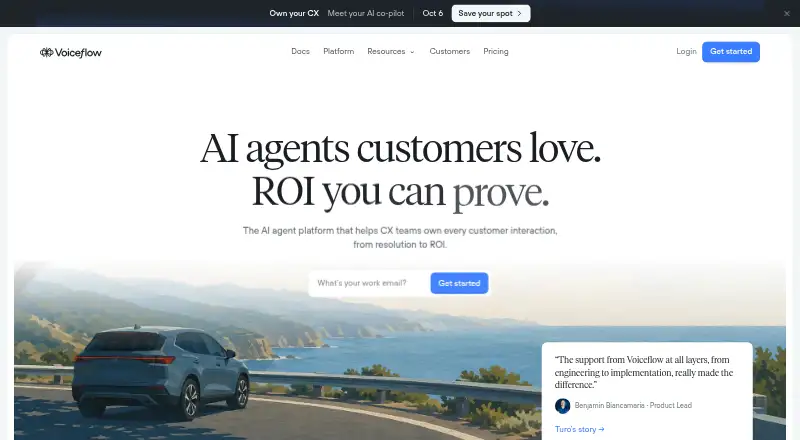
Voiceflow is a platform for building, testing, deploying, and monitoring chat and voice agents across channels and languages.
What Voiceflow is
Voiceflow is a platform for building, testing, deploying, and monitoring chat and voice agents across channels and languages. Its builder combines agentic playbooks, deterministic workflows, shared instructions, and guardrails. Teams can review transcripts and call recordings, run evaluations and tests, and track analytics. Agents can be deployed through a chat widget, mobile apps, phone calls, SMS, or custom interfaces using the Conversations API.
Native integrations include Zendesk, Salesforce, HubSpot, Shopify, Airtable, Google Sheets, Gmail, and Twilio. Agents can also connect to external REST APIs, custom Functions, and MCP servers. Teams can select from major LLM providers or bring their own model. Voiceflow says it does not use customer data to train AI or machine-learning models, and that connected model providers are configured for zero data retention. Its security information describes encryption at rest with customer-managed keys and encryption in transit using TLS and mTLS.
The company was founded in 2019. Agencies and partners have a free-trial plan with usage-based billing; business pricing is available on request. Support includes business implementation that can be self-serve or fully managed.
Good
- Supports voice and chat deployments across channels.
- Includes transcript and call-recording review.
- Connects to APIs, Functions, and MCP servers.
- Teams can choose or bring a model.
- Agencies and partners have a free-trial plan.
Watch out
- Business pricing is available on request.
- The agency plan uses usage-based billing.
- Some integrations require connecting external services.
Who it suits
Voiceflow is presented for CX and support leaders, engineers, enterprise teams, and agencies or partners building agents for clients. It may suit teams that need agents across voice and chat channels, integrations, and evaluation tools.
Verdict
Voiceflow combines agent-building tools with deployment channels, integrations, and monitoring features. Teams should account for usage-based billing on the agency plan and request pricing for the business offering.
Plans and prices
From Voiceflow's own pricing page, checked 14 Oct 2026.
| Plan | Price | What it gives you |
|---|---|---|
| Starter | Free | 100 credits/month |
| Agencies & Partners | Free | Free trial, no credit card required · Usage-based billing · Multi-client workspace management · White-labeling and client handoff tools · Access to major model providers |
| Pro | $120 a month | 20,000 credits/month · $120/mo |
| Business | $500 a month | 100,000 credits/month · $500/mo |
| Pro | $972 a year | 180,000 credits/year · $972/yr |
| Enterprise | Priced on request | Custom enterprise deployment and support · Contact sales |
| Businesses | Priced on request | Request pricing · Self-serve or managed implementation support · Voice and chat deployment · Real-time observability and analytics · Team roles and permissions |
The facts
Each one read from Voiceflow's own pages, with the date it was checked.
What it does
- Agent builder
- The builder combines global instructions, visual playbooks, deterministic workflows and knowledge bases.checked 14 Oct 2026
- Agent building
- The platform combines agentic playbooks, deterministic workflows, global instructions, and guardrails.checked 9 Oct 2026
- AI bot generation
- Yeschecked 20 Sep 2026
- AI data privacy
- Voiceflow says customer data is not used to train models and connected model providers are configured for zero data retention.checked 14 Oct 2026
- API scope
- The REST API supports agent construction, conversations, publishing through environments, transcripts, evaluations, tests, analytics and webhooks.checked 14 Oct 2026
- Channels
- Agents can be deployed through web chat, mobile interfaces, telephony, SMS and custom interfaces using the Conversations API.checked 14 Oct 2026
- CLI and authentication
- A personal access token authenticates the REST API, vf command-line interface and MCP server.checked 14 Oct 2026
- Data privacy
- Voiceflow says it does not use customer data to train machine learning or AI models and that integrated model providers are configured for zero data retention.checked 9 Oct 2026
- Data protection
- The security page describes encryption at rest with customer-managed keys and encryption in transit using TLS and mTLS.checked 9 Oct 2026
- Deployment channels
- multichannelchecked 20 Sep 2026
- Documentation
- Documentation includes quickstarts, API reference, deployment guides, widgets, telephony, SMS, testing, analytics and billing material.checked 14 Oct 2026
- Extensibility
- Agents can call REST APIs, custom Functions and Model Context Protocol servers in addition to native integrations.checked 14 Oct 2026
- Funding
- A 2024 company release announced a $15 million OpenView-led round at a $105 million valuation and $35 million total raised.checked 14 Oct 2026
- Human handoff
- Yeschecked 20 Sep 2026
- Integrations
- Native connectors include Zendesk, Salesforce, HubSpot, Shopify, Airtable, Google Sheets, Gmail and Twilio.checked 14 Oct 2026
- Intended users
- The product is presented for CX and support leaders, engineers, enterprise teams, and agencies or partners building agents for clients.checked 9 Oct 2026
- Knowledge base
- Knowledge bases can connect agent answers to imported information and services such as Zendesk and Shopify.checked 14 Oct 2026
- Knowledge-base answers
- Yeschecked 20 Sep 2026
- License
- Voiceflow, Inc.'s terms grant a revocable, nonexclusive service license and restrict copying and reverse engineering, indicating the hosted product is proprietary.checked 14 Oct 2026
- Limit: CloudTalk review
- CloudTalk reports confusing usage credits, agents stopping when credits run out, demo-gated public pricing, third-party requirements for phone agents and a steeper learning curve for advanced work.checked 14 Oct 2026
The company
- Company customers
- Voiceflow's About page reports more than 3,000 customers and over 1 billion agent messages processed.checked 14 Oct 2026
- Company facts
- LinkedIn lists Voiceflow as founded in 2019, headquartered in San Francisco and employing 201–500 people.checked 14 Oct 2026
- Company history
- The company says it began with Alexa and Google interactive-story experiments in a dorm room and later expanded to voice, chat and connected-device experiences.checked 14 Oct 2026
- Founded
- 2019checked 23 Sep 2026
The full review of Voiceflow
Voiceflow is a platform for building and operating chat and voice agents, best suited to customer experience teams, engineers, and agencies managing agents across channels. Its combination of flexible agent design and operational tools is compelling, but usage-based agency billing and custom business pricing call for a clear cost assessment.
Overview
Voiceflow brings agent creation, testing, deployment, and monitoring into one platform. Teams can combine agentic playbooks for flexible exchanges with deterministic workflows, shared instructions, and guardrails for more controlled behavior. That balance is useful when support needs both conversational range and reliable process steps.
Agents can serve customers through a native chat widget, mobile apps, phone calls, SMS, or custom interfaces connected through the Conversations API. Support for multiple languages and model choice—including major LLM providers or a team’s own model—makes the platform adaptable to different deployments. Its breadth is a strength, though teams should ensure they need more than a basic chatbot before taking on its operational scope.
Key features
The visual builder, AI agent generation, knowledge grounding, and human handoff cover the core stages of customer automation: creating an agent, giving it reference material, and passing an interaction onward when automation is not enough. These features make Voiceflow a stronger fit for service workflows than a tool focused only on scripted exchanges.
Teams can inspect transcripts and call recordings, run evaluations and tests, and track analytics. That gives operators ways to review behavior after deployment as well as refine it before release. Native connections to Zendesk, Salesforce, HubSpot, Shopify, Airtable, Google Sheets, Gmail, and Twilio help link agents with common business tools; REST APIs, custom Functions, and MCP servers extend that reach for bespoke systems.
Voiceflow also describes security measures including SOC 2 Type II and ISO/IEC 27001:2022 certifications, GDPR and HIPAA compliance, encryption at rest with customer-managed keys, and TLS and mTLS in transit. It says customer data is not used to train AI models and that integrated model providers are configured for zero data retention. Those protections are relevant for organizations handling sensitive conversations, though security claims do not remove the need to assess deployment requirements internally.
Pricing
Agencies & Partners: free. This option includes a free trial with no credit card required, multi-client workspace management, white-labeling and client handoff tools, and access to major model providers. Usage-based billing means the free starting point is not a promise of zero ongoing cost; agencies should model expected usage across client work before scaling.
Businesses: custom pricing. The plan offers voice and chat deployment, real-time observability and analytics, team roles and permissions, plus self-serve or managed implementation support. It is aimed at business teams that need deployment and oversight capabilities, but requesting a quote makes price comparisons less straightforward.
The agency offer is the clearer entry point for partners, while businesses get an explicitly supported implementation path and team controls. Neither plan’s published details establish seat counts or usage quotas, so organizations should confirm those terms as part of a cost discussion.
Platforms
Voiceflow is available on Android, iOS, and the web, with an API for custom integrations and interfaces. Its deployment options span chat, mobile applications, phone, and SMS, giving teams a route to serve customers across digital and voice channels rather than a single surface.
Who it's for
Voiceflow is suited to CX and support leaders who need to automate customer interactions while retaining review and escalation options. Engineers can use its APIs, Functions, and MCP connectivity to link agents to custom systems. Agencies and partners have client workspaces and white-labeling tools; enterprise teams may value the deployment, measurement, and security capabilities. It is less compelling for a buyer seeking a simple, transparently priced chatbot with a defined usage allowance.
Pros and cons
- Pros: Flexible agent design combines playbooks with controlled workflows, instructions, and guardrails, supporting both open-ended and predictable interactions.
- Pros: Broad deployment channels and integrations let teams connect customer-facing agents to existing services and custom systems.
- Pros: Transcript and recording review, testing, evaluations, and analytics support ongoing quality oversight.
- Cons: Agency usage-based billing can make total cost depend on activity, so the free trial does not settle longer-term budget planning.
- Cons: Business pricing requires a request, limiting upfront price comparison.
Alternatives
For category comparisons, see AI Voice Agents, AI Customer Service Agents, Chatbot Builders, Conversational AI Platforms, and AI Agent Platforms.
LiveKit Agents is worth considering for a freemium option with a $0 per month Build plan that includes 1,000 agent session minutes, five concurrent sessions, and one deployment. Rapida AI offers a free Launch plan for one agent with bring-your-own speech and language components and 10-day observability retention; its Scale plan is 500.00 USD. Vapi provides a $0 start with $5 in free credits and $0.05/min Vapi hosting, with models passed through at cost.
Retell AI is an alternative for teams considering per-minute voice agent pricing: its Pay as you go plan is $0.07 a month, with agents priced at $0.07-$0.31 per minute and $10 in free credits. Ring AI has a free tier with 100 minutes/month for testing. Tone offers a free self-hosted plan with unlimited agents, calls, and workflows, using a bring-your-own model, voice, and telephony approach. Yellow.ai has a free plan with one AI agent and a stated 500/month inclusion, as well as a limit of two agents. Intervo offers a self-hosted open-source option with source code under an MIT License.
Verdict
Choose Voiceflow if your team needs to build and operate chat and voice agents across channels, with tools to evaluate behavior and connect agents to business systems. Its strongest case is the breadth of the full workflow, from flexible building to monitoring and handoff. Look elsewhere if a fixed, easily comparable price or a basic chatbot is the priority; agency usage charges and custom business pricing make budgeting a necessary part of the decision.
Alternatives to Voiceflow
- 1
Chatbase
Free planAndroidiOSWebAPI8.9From $40 a month - 2
AiSensy
Free planAndroidiOSWebAPI8.8Free plan - 3

Microsoft Copilot
Free planAndroidiOSWebWindows8.7From $99.99 a year - 4

Rasa
Free planOpen sourceWebAPILinuxmacOS8.6Free plan - 5

Yellow.ai
Free planAndroidiOSWebAPI8.6Free plan - 6

Guzli
Free planOpen sourceWebAPIExtension8.6From $29.99 a month