
LiveKit Agents
LiveKit Agents is an open-source framework and cloud platform for building voice, video, and physical AI agents.
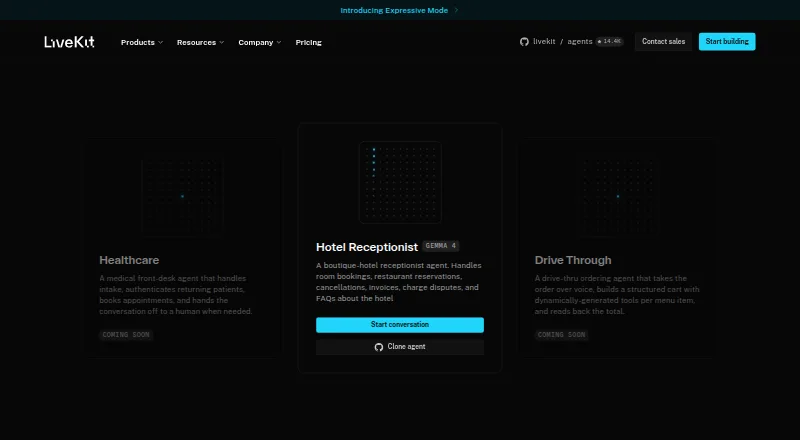
What LiveKit Agents is
LiveKit Agents is an open-source framework and cloud platform for building voice, video, and physical AI agents. Python or Node.js programs can join LiveKit rooms as realtime participants, with deployment to LiveKit Cloud or a developer-selected environment. Agents can take in voice, video, and text and return output in any modality. They support LLM tools, frontend RPC calls, multi-agent handoffs, and phone connections through native SIP. LiveKit Inference offers models from providers including OpenAI, Google, AssemblyAI, Deepgram, Cartesia, and ElevenLabs; open-source plugins add connections to other providers. LiveKit Cloud offers session replay, transcripts, trace spans, logs, and reports. The free Build plan includes 1,000 agent session minutes and five concurrent sessions. LiveKit lists SOC 2 Type II, GDPR, HIPAA, CCPA / CPRA, and the EU–US Data Privacy Framework; PCI DSS and ISO 27001 are in progress.
Good
- Build plan includes 1,000 agent session minutes.
- Deploy to LiveKit Cloud or a custom environment.
- Supports voice, video, and text input.
- Native SIP connects agents to phone systems.
- Cloud offers session replays, transcripts, logs, and reports.
Watch out
- Build allows five concurrent agent sessions.
- Agent Builder is intended for simple voice prototypes.
- HIPAA BAAs are available only to Scale and Enterprise customers.
Who it suits
It suits developers building realtime voice, video, or multimodal agents who want deployment options and integrations. Teams connecting agents to phone systems can use native SIP support.
Verdict
LiveKit Agents combines a developer framework with cloud deployment and realtime agent tooling. The free Build plan is limited, while Ship starts at $50/mo.
Plans and prices
From LiveKit Agents's own pricing page, checked 15 Oct 2026.
| Plan | Price | What it gives you |
|---|---|---|
| Build | Free | 1,000 agent minutes · 5 concurrent sessions · 1 deployment · 100,000 observability entries · 1 free US number · $0/mo |
| Ship | $50 a month | 5,000 agent minutes · 20 concurrent sessions · 2 deployments · 500,000 observability entries · custom voices · $50/mo |
| Scale | $500 a month | 50,000 agent minutes · up to 600 concurrent sessions · 4 deployments · 5,000,000 observability entries · HIPAA/security reports · $500/mo |
| Enterprise | Priced on request | Volume pricing · shared Slack channel · SSO · support SLA · Custom |
The facts
Each one read from LiveKit Agents's own pages, with the date it was checked.
What it does
- Agent Builder
- Agent Builder is a browser-based, no-code tool included with LiveKit Cloud and is unavailable in self-hosted deployments.checked 15 Oct 2026
- Agent orchestration
- The documentation covers agent sessions, workflows, handoffs, tasks, task groups, tools, and external-data retrieval.checked 15 Oct 2026
- Client SDKs
- LiveKit offers frontend and client SDKs for web, mobile, and other platforms, while its Unity SDK supports macOS, Windows, Linux, iOS, and Android.checked 15 Oct 2026
- Compliance
- LiveKit lists SOC 2 Type II, GDPR, HIPAA, CCPA / CPRA, and the EU–US Data Privacy Framework; it says PCI DSS and ISO 27001 are in progress.checked 29 Sep 2026
- Deployment
- Agents can be deployed to LiveKit Cloud or to a custom environment of the developer’s choice.checked 29 Sep 2026
- Documentation
- Official documentation includes quickstarts, recipes, SDK references, API references, deployment guidance, telephony, models, testing, and troubleshooting material.checked 15 Oct 2026
- Encryption
- WebRTC media uses SRTP with DTLS-SRTP exchange, SIP supports TLS and SRTP, and stored data uses AES-256 encryption.checked 15 Oct 2026
- HIPAA
- LiveKit says BAAs are available for Scale and Enterprise customers handling protected health information.checked 29 Sep 2026
- Inference retention
- LiveKit says prompts, audio, and model outputs sent through LiveKit Inference are not logged or retained by LiveKit or its model providers.checked 15 Oct 2026
- Integrations
- LiveKit Inference provides models from providers including OpenAI, Google, AssemblyAI, Deepgram, Cartesia, and ElevenLabs, while open source plugins connect to additional providers.checked 29 Sep 2026
- Licence
- The Agents framework is Apache-2.0 licensed, while LiveKit turn-detection models use a separate LiveKit Model License.checked 15 Oct 2026
- Limit: cloud-only capabilities
- CloudTalk’s comparison says Agent Builder, LiveKit Inference, adaptive interruption handling, Krisp noise cancellation, and built-in observability are unavailable when self-hosting.checked 15 Oct 2026
- Limit: operational complexity
- Airframe’s review notes that self-hosting can require command-line and server-management skills and that production deployments carry operational complexity.checked 15 Oct 2026
- Limit: pricing concerns
- A G2 review praised capability but specifically identified pricing as a concern.checked 15 Oct 2026
- Media and modalities
- Agents can process realtime voice, video, and text input and produce output in any modality.checked 29 Sep 2026
- Model integrations
- LiveKit Inference and plugins connect agents to OpenAI, Google, AssemblyAI, Deepgram, Cartesia, ElevenLabs, and other providers.checked 15 Oct 2026
- Multimodal agents
- The framework supports realtime spoken interaction, video input and output, and physical-agent applications.checked 15 Oct 2026
- Node requirement
- The Node.js quickstart requires Node.js 20 or newer and pnpm 10.15.0 or newer.checked 15 Oct 2026
- Notable limit
- Agent Builder is intended for simple voice agent prototypes and produces Python code for deployment to LiveKit Cloud.checked 29 Sep 2026
The company
- Company founded and size
- LinkedIn lists LiveKit as founded in 2021 with 51–200 employees.checked 15 Oct 2026
- Company headquarters
- LiveKit’s official site lists 369 Sutter Street in San Francisco, California.checked 15 Oct 2026
- Company legal name
- Crunchbase identifies the legal entity as LiveKit Incorporated.checked 15 Oct 2026
- Company location
- LiveKit lists its address as 369 Sutter St, San Francisco, California.checked 29 Sep 2026
- Headquarters
- San Francisco, California, United Stateschecked 23 Sep 2026
The full review of LiveKit Agents
Overview
LiveKit Agents is a developer framework and cloud platform for building realtime voice, video, and physical AI agents. It suits teams that want to build agents in Python or Node.js and choose between managed cloud deployment and their own environment. Its breadth across media, integrations, and telephony is compelling, but operating it means working with a framework rather than simply configuring a finished assistant.
Key features
Python and Node.js programs can join LiveKit rooms as realtime participants, processing voice, video, and text input and producing output in any modality. That makes the framework a fit for agents built around live interactions, not just text exchanges. LLM tool use, frontend RPC calls, and multi-agent handoffs support more involved workflows, though they also make this a developer-oriented choice.
Teams can deploy to LiveKit Cloud or a custom environment. LiveKit Inference connects to models from OpenAI, Google, AssemblyAI, Deepgram, Cartesia, and ElevenLabs; open-source plugins extend provider options. Native SIP connects agents to phone systems, with inbound and outbound calls, custom phone numbers, and human handoff among the listed capabilities.
LiveKit Cloud’s agent insights include session replay, transcripts, trace spans, logs, and session reports, giving teams several ways to inspect agent sessions. LiveKit says prompts, audio, and completions processed through LiveKit Inference and its model providers are not logged or retained. It lists SOC 2 Type II, GDPR, HIPAA, CCPA / CPRA, and the EU–US Data Privacy Framework; PCI DSS and ISO 27001 are in progress. BAAs are available to Scale and Enterprise customers handling protected health information.
Agent Builder is a narrower route: it is intended for simple voice-agent prototypes and produces Python code for deployment to LiveKit Cloud. It is not a substitute for the broader framework when a project needs a custom environment.
Pricing
The free Build plan costs $0/mo and includes 1,000 agent session minutes, five concurrent agent sessions, one agent deployment, $2.50 in inference credits, and community support. It is a practical starting point for a small prototype, but its session and deployment caps limit how far a live service can grow before an upgrade.
Ship starts at $50/mo, billed starting at $50/mo. It raises the allowance to 5,000 session minutes, then $0.01 per minute, 20 concurrent sessions, and two deployments, and adds email support. This is the first paid tier and a more workable fit for a small production workload, although overage charges matter for services with sustained use.
Scale starts at $500/mo, billed starting at $500/mo. It includes 50,000 session minutes, then $0.01 per minute, up to 600 concurrent sessions, four deployments, region pinning, security reports, and HIPAA. The higher allowance and controls suit larger or regulated deployments, but make it difficult to justify for a small project. Enterprise has custom pricing and adds volume pricing, a shared Slack channel, SSO, and a support SLA.
Platforms
LiveKit Agents supports Android, iOS, Linux, macOS, Windows, and web, as well as API access and self-hosted deployment. That range gives developers options across client platforms and hosting environments.
Who it's for
LiveKit Agents is best suited to developers and teams building realtime agents that need multiple media modalities, phone connectivity, or a choice of deployment environment. Its free tier lowers the cost of a small start, while the cloud insights and higher concurrency tiers address more demanding operations. It is a poor fit for someone seeking a simple no-code voice agent beyond a prototype, or a small project that cannot absorb the paid tiers or usage overages.
Pros and cons
- Pro: Realtime voice, video, and text support, plus flexible output modalities, suit agents that need to work with live media.
- Pro: Native SIP, inbound and outbound calling, custom numbers, and human handoff make phone workflows part of the platform.
- Pro: Cloud deployment and custom environments let teams choose how to run agents; cloud insights include replay, transcripts, traces, logs, and reports.
- Con: Build is capped at 1,000 session minutes, five concurrent sessions, and one deployment, so it is a limited base for a growing service.
- Con: Ship’s 5,000-minute allowance is followed by $0.01-per-minute charges, so costs rise with usage.
- Con: Agent Builder only targets simple voice prototypes and deploys generated Python code to LiveKit Cloud.
Alternatives
Rapida AI is another freemium option; its free Launch plan includes one agent, requires bring-your-own STT, TTS, LLM, and SIP, and includes 10-day observability retention. It may suit teams prepared to supply those components themselves.
Yellow.ai has a free plan with one AI agent, 500/month included, a two-agent limit, 1,000 records, and one active campaign. Consider it when those included limits and its web, iOS, and Android platforms fit the project.
Bland AI is a paid alternative with a free plan; its Start plan is billed at $0.14/min, with a $0 platform fee, 10 concurrent calls, and 100 calls per day.
Tone offers a free self-host plan with unlimited agents, calls, and workflows, using a bring-your-own LLM, voice, and telephony setup. It may suit teams that prefer that self-hosted arrangement.
Intervo is another freemium option for web.
Ring AI has a free tier with 100 minutes per month for testing, while its Enterprise plan is billed per minute at $0.10 per contact.
Dialzara is a paid web option with no free plan and a free trial.
Genesys Cloud Agentic Virtual Agent is a paid alternative with no free plan.
For category browsing, see AI Voice Agents and Conversational AI Platforms.
Verdict
Choose LiveKit Agents if you are building a developer-led realtime agent and value media flexibility, telephony, and the option to self-deploy. The free Build plan is useful for a bounded start, but session caps and paid overages matter as usage grows. Look elsewhere if you need a ready-made assistant or a generous production allowance at no cost.
Getting started
- Visit the LiveKit Agents website.
- Choose Python or Node.js for a program that joins LiveKit rooms.
- Select the free Build plan or a paid plan.
- Deploy the agent to LiveKit Cloud or a custom environment.
- Connect models through LiveKit Inference or open source plugins.
- Use native SIP to connect an agent to a phone system, if needed.
Limits worth knowing
Build includes 1,000 agent session minutes, five concurrent sessions, one deployment, and $2.50 in inference credits. Ship includes 5,000 minutes, then charges $0.01 per additional minute.
Questions
Is LiveKit Agents open source?
Yes. LiveKit describes Agents as an open source framework alongside its cloud platform.
Is there a free plan?
Yes. Build costs nothing and includes 1,000 agent session minutes, five concurrent sessions, one deployment, and $2.50 in inference credits.
How much does Ship cost?
It includes 5,000 agent session minutes, then additional minutes cost $0.01 each.
Where can agents run?
Agents can be deployed to LiveKit Cloud or a custom environment. Listed platforms include Android, API, iOS, Linux, macOS, self-hosted, web, and Windows.
Which model providers are available?
LiveKit Inference includes models from OpenAI, Google, AssemblyAI, Deepgram, Cartesia, and ElevenLabs. Open source plugins connect to additional providers.
What support comes with each plan?
Build includes community support, Ship includes email support, and Enterprise includes a support SLA.
Alternatives to LiveKit Agents
- 1

Pipecat
Free planOpen sourceAndroidiOSWebAPI8.5From $0.01 a month - 2

Voiceflow
Free planAndroidiOSWebAPI8.2From $972 a year - 3
Vapi
Free planAndroidiOSWebAPI8.1From $29 a month - 4
SOVA
Free planOpen sourceAndroidiOSWebAPI8.0Free plan - 5

Radioso
Free planOpen sourceWebAPILinuxmacOS7.8Free plan - 6

Yellow.ai
Free planAndroidiOSWebAPI7.8Free plan