
Rapida AI
Rapida AI is an open-source platform for building, deploying, and operating production voice AI agents across phone, web, WhatsApp, and SIP.
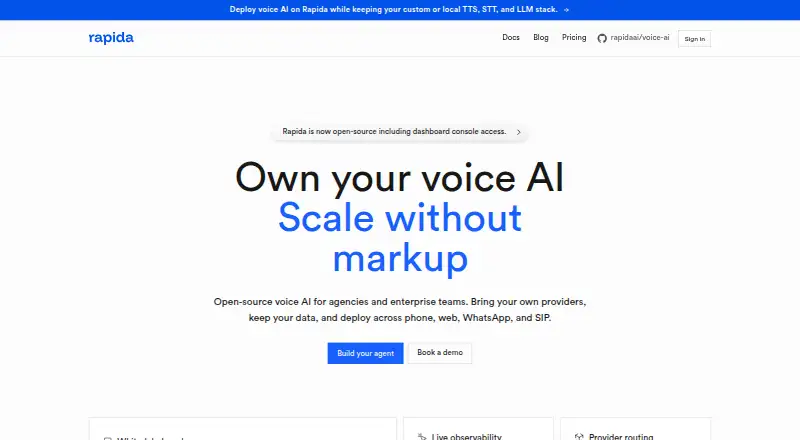
What Rapida AI is
Rapida AI is an open-source platform for building, deploying, and operating production voice AI agents across phone, web, WhatsApp, and SIP. Its tools include speech processing with voice activity detection and noise cancellation, knowledge retrieval, language-model routing, and live call transfer. Teams can use or route among their own speech-to-text, text-to-speech, and language-model providers without rewriting application logic. Integrations include telephony, AI, and speech providers such as Twilio, Vonage, Asterisk, OpenAI, Anthropic, Google Gemini, Deepgram, and ElevenLabs. Agents can call HTTP endpoints during conversations and sync data from Notion, GitHub, HubSpot, and Jira. Rapida provides traces, transcripts, call monitoring, handoff visibility, and request and webhook logs. It offers managed cloud and self-hosted deployment; self-hosting requires Docker and at least 4 GB RAM for Voice Only, or 8–16 GB with the knowledge base. The free Launch plan includes one agent.
Good
- Supports phone, web, WhatsApp, and SIP.
- Can route among teams’ own AI providers.
- Includes call monitoring, traces, and transcripts.
- Offers managed cloud and self-hosted deployment.
- Free Launch plan includes one agent.
Watch out
- Self-hosting requires Docker.
- Knowledge-base setup requires 8–16 GB RAM.
- Scale costs $500 a month.
- Launch observability retention is 10 days.
Who it suits
Rapida may suit agencies, enterprise teams, contact center operators, CPaaS and CCaaS companies, and developers building voice agents. Self-hosting is an option for teams that want audio, transcripts, and customer data kept on their own infrastructure.
Verdict
Rapida combines voice-agent building blocks with provider choice, integrations, and observability. Its free plan is limited to one agent; paid plans start at $500 a month.
Plans and prices
From Rapida AI's own pricing page, checked 30 Sep 2026.
| Plan | Price | What it gives you |
|---|---|---|
| Launch | Free | 1 agent · Bring your own STT, TTS, LLM, and SIP · 10-day observability retention · Community support |
| Scale | $500 a month | 4 agents · 3 collaboration workspaces · 100,000 audio session minutes included · Up to 200 concurrent sessions · 30-day observability retention · Email support · per month |
| Grow | $2,000 a month | Unlimited agents · Up to 20 collaboration workspaces · 500,000 audio session minutes included · Up to 1,000 concurrent sessions · 90-day observability retention · Email and private Slack support · per month |
| Enterprise | Priced on request | Private or dedicated deployment · Custom agent, workspace, and concurrency limits · Custom observability retention · Custom local STT, TTS, and LLM support · Security review and deployment guidance · SLA and enterprise support · Custom |
The facts
Each one read from Rapida AI's own pages, with the date it was checked.
What it does
- Audience
- The maker describes Rapida as serving agencies, enterprise teams, contact center operators, CPaaS and CCaaS companies, and developers.checked 30 Sep 2026
- Compliance options
- The maker describes self-hosted deployment on HIPAA-compliant or GDPR-scoped infrastructure with the customer's own BAAs and DPAs, plus audit logs, configurable retention, and transcript-level PII redaction.checked 30 Sep 2026
- Deployment
- Rapida offers managed cloud service and self-hosted deployment on infrastructure controlled by the team or its clients.checked 30 Sep 2026
- Integrations
- Documented providers include Twilio, Vonage, Exotel, Asterisk, OpenAI, Anthropic, Google Gemini, Deepgram, ElevenLabs, Azure, and AWS.checked 30 Sep 2026
- Observability
- Rapida provides session traces, live observability, transcripts, call monitoring, handoff visibility, request logs, webhook logs, and debugging context.checked 30 Sep 2026
- Product
- Rapida AI is an open-source platform for building, deploying, and operating production voice AI agents across phone, web, WhatsApp, and SIP.checked 30 Sep 2026
- Provider choice
- Teams can bring or route between their own STT, TTS, and LLM providers without rewriting application logic.checked 30 Sep 2026
- Security and data control
- The maker says self-hosted deployments keep audio, transcripts, and customer data on the user's infrastructure, and its credential vault encrypts API keys and OAuth tokens at rest.checked 30 Sep 2026
- Self-host requirements
- The documented self-hosted setup requires Docker and at least 4 GB RAM for Voice Only or 8–16 GB RAM with the knowledge base.checked 30 Sep 2026
- Support
- Launch includes community support, Scale includes email support, Grow includes email and private Slack support, and Enterprise includes SLA and enterprise support.checked 30 Sep 2026
- Voice features
- The platform supports speech processing with VAD and noise cancellation, knowledge retrieval, LLM routing, and live call transfer.checked 30 Sep 2026
- White-label
- Agencies can launch client-branded assistants, isolate workspaces, and reuse rollout patterns.checked 30 Sep 2026
- Workflow connections
- Rapida can call HTTP endpoints during conversations and sync data from Notion, GitHub, HubSpot, and Jira.checked 30 Sep 2026
The full review of Rapida AI
Rapida AI is an open-source platform for building and operating voice agents across phone, web, WhatsApp, and SIP. It suits agencies and technical teams that need to control providers, deployment, and call operations. Its range is strong, but the free plan is limited to one agent and scaling beyond it starts at $500 a month.
Overview
Rapida brings the components for production voice agents together: provider routing, integrations, workflow connections, and tools for monitoring calls. The choice between managed cloud and self-hosting is meaningful: cloud reduces infrastructure work, while self-hosting lets teams run the service on infrastructure they or their clients control. That flexibility comes with operational demands, particularly for teams that choose to host it themselves.
Key features
Teams can bring their own speech-to-text, text-to-speech, and language-model providers, or route between providers without rewriting application logic. Voice activity detection, noise cancellation, knowledge retrieval, LLM routing, and live call transfer cover both conversation handling and escalation to a person. Documented integrations include Twilio, Vonage, Exotel, Asterisk, OpenAI, Anthropic, Google Gemini, Deepgram, ElevenLabs, Azure, and AWS.
Agents can call HTTP endpoints during conversations and sync data from Notion, GitHub, HubSpot, and Jira. Session traces, transcripts, call monitoring, handoff visibility, request and webhook logs, and debugging context give teams ways to inspect call behavior and troubleshoot issues. This operational visibility is useful when managing live deployments, though it does not remove the work of tuning and maintaining an agent.
Agencies can launch client-branded assistants, isolate workspaces, and reuse rollout patterns. Rapida also supports inbound and outbound calls, human handoff, and custom phone numbers. For self-hosted deployments, Rapida says audio, transcripts, and customer data stay on the team's infrastructure; API keys and OAuth tokens are encrypted at rest in its credential vault. It describes options for HIPAA-compliant or GDPR-scoped infrastructure using the customer's own BAAs and DPAs, along with audit logs, configurable retention, and transcript-level PII redaction.
Self-hosting requires Docker and at least 4 GB of RAM for Voice Only, or 8–16 GB with the knowledge base. That gives technically capable teams control, but makes self-hosting a less suitable route for organizations without capacity to manage deployment infrastructure.
Pricing
- Launch — free: One agent, bring-your-own STT, TTS, LLM, and SIP, 10-day observability retention, and community support. This is a useful starting point for a single-agent build, but it does not offer the multi-agent capacity or included audio minutes of paid plans.
- Scale — $500 a month, billed per month: Four agents, three collaboration workspaces, 100,000 audio session minutes, up to 200 concurrent sessions, 30-day observability retention, and email support. It fits teams moving beyond a single agent that can work within those limits.
- Grow — $2,000 a month, billed per month: Unlimited agents, up to 20 collaboration workspaces, 500,000 audio session minutes, up to 1,000 concurrent sessions, 90-day observability retention, and email plus private Slack support. The higher ceiling and longer retention suit larger operations; the price is a substantial step up from Scale.
- Enterprise — custom pricing: Private or dedicated deployment, custom agent, workspace, and concurrency limits, custom observability retention, support for custom local STT, TTS, and LLM providers, security review, deployment guidance, and SLA and enterprise support. This is the option for teams that need tailored limits or deployment and support terms.
Paid plans are billed monthly. Scale’s 200-session concurrency limit matches the stated 200 concurrent calls; Grow raises its plan limit to 1,000 concurrent sessions.
Platforms
Rapida supports API, Linux, macOS, web, and Windows, as well as self-hosted deployment. The mix accommodates teams integrating through an API, using a browser-based service, or running deployments on their own infrastructure.
Who it's for
Rapida is a strong fit for agencies that need client-branded assistants and workspace isolation, and for developers or contact center, CPaaS, and CCaaS teams building voice operations around their own providers and workflows. Teams with strict data-control requirements may value self-hosting and the described compliance options, provided they can manage the infrastructure. It is less compelling for a small team seeking a low-cost, multi-agent service: Launch allows only one agent, and Scale starts at $500 a month.
Pros and cons
- Pro: Provider choice across speech and language models avoids tying application logic to a single vendor.
- Pro: Call traces, transcripts, monitoring, and handoff visibility give operations teams useful ways to inspect agent sessions.
- Pro: Managed cloud and self-hosting let teams choose between less infrastructure work and more direct data control.
- Con: The free plan is capped at one agent, so even modest multi-agent use requires a paid plan.
- Con: Scale starts at $500 a month, a significant entry price for teams that need more than Launch but do not need enterprise capacity.
- Con: Self-hosting requires Docker and at least 4 GB of RAM, rising to 8–16 GB with the knowledge base.
Alternatives
LiveKit Agents is worth considering when mobile platform coverage or a small starting allowance matters: its Build plan is free and includes 1,000 agent session minutes, five concurrent agent sessions, and one agent deployment.
Yellow.ai offers a free plan with one AI agent, 500/month included, a two-agent limit, 1,000 records, and one active campaign; it may suit readers comparing a broader set of platform features and limits.
Intervo is an alternative for readers who specifically want a self-hosted option with full source code under an MIT License and community support.
Ring AI has a free tier with 100 minutes per month for testing, making it an option for readers who want to start with a small voice allowance.
Tone offers a free self-hosted plan with unlimited agents, calls, and workflows, plus bring-your-own LLM, voice, and telephony; it is worth comparing for teams prioritizing those stated limits.
Vapi offers usage-based billing and $5 free credits to get started, an alternative for readers who prefer that billing approach to Rapida's monthly plans.
Bland AI starts with a $0.14/minute plan that includes 10 concurrent calls and 100 calls per day, a choice to consider when those call limits and per-minute pricing fit better.
Dialzara offers a Business Lite plan at $29 a month with 60 minutes and $0.48 per minute overage, for readers looking for a lower-cost monthly starting point.
Browse more options in AI Voice Agents and Conversational AI Platforms.
Verdict
Choose Rapida if your team needs voice-agent infrastructure with provider flexibility, production monitoring, and a choice of managed or self-hosted deployment. Its operational features and agency-oriented workspace controls make it a capable fit for teams running multiple client or contact-center deployments. Look elsewhere if one agent is not enough but $500 a month is too steep: the free plan's single-agent cap leaves little middle ground.
Getting started
- Visit https://www.rapida.ai/.
- Choose the managed cloud service or self-hosted deployment.
- For self-hosting, prepare Docker and at least 4 GB RAM for Voice Only, or 8–16 GB RAM with the knowledge base.
- Select Launch, Scale, Grow, or Enterprise based on agent, workspace, session, and support needs.
- Connect the required STT, TTS, LLM, and SIP providers.
Limits worth knowing
Launch is free and includes one agent with 10-day observability retention. Scale costs $500 a month and includes four agents, three collaboration workspaces, 100,000 audio session minutes, up to 200 concurrent sessions, and 30-day observability retention.
Questions
Is Rapida AI open source?
Yes. Rapida AI is an open-source platform.
Is there a free plan?
Yes. Launch is free and includes one agent, bring-your-own STT, TTS, LLM, and SIP, 10-day observability retention, and community support.
What do paid plans cost?
Scale costs $500 a month, and Grow costs $2,000 a month. Enterprise pricing is custom.
Which platforms does Rapida AI support?
The listed platforms are API, Linux, macOS, self-hosted, web, and Windows.
Can Rapida AI be self-hosted?
Yes. Self-hosted deployment runs on infrastructure controlled by the team or its clients. The documented setup requires Docker and at least 4 GB RAM for Voice Only, or 8–16 GB with the knowledge base.
Which integrations are documented?
Providers include Twilio, Vonage, Exotel, Asterisk, OpenAI, Anthropic, Google Gemini, Deepgram, ElevenLabs, Azure, and AWS. Rapida can also call HTTP endpoints and sync data from Notion, GitHub, HubSpot, and Jira.
Alternatives to Rapida AI
- 1

LiveKit Agents
Free planOpen sourceAndroidiOSWebAPI8.6From $50 a month - 2

Pipecat
Free planOpen sourceAndroidiOSWebAPI8.5From $0.01 a month - 3

Voiceflow
Free planAndroidiOSWebAPI8.2From $972 a year - 4
Vapi
Free planAndroidiOSWebAPI8.1From $29 a month - 5

Yellow.ai
Free planAndroidiOSWebAPI7.8Free plan - 6

ElevenLabs
Free planWebAPI7.6From $6 a month