Ring AI
Ring AI is an enterprise platform for creating and running conversational voice agents.
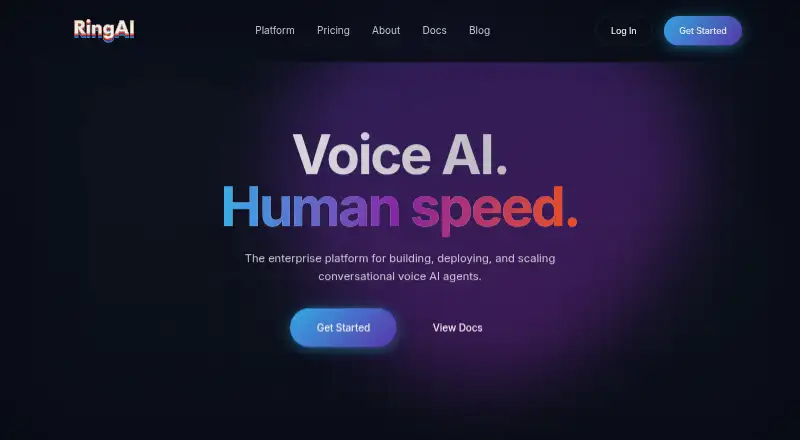
What Ring AI is
Ring AI is an enterprise platform for creating and running conversational voice agents. A visual drag-and-drop builder lets teams set up agents and workflows without code. The service handles inbound and outbound calls, interruption handling, and voices in more than 30 languages, with over 50 natural voices. Listed uses include customer support, sales outreach, scheduling, lead qualification, collections, and surveys. Ring AI connects to existing phone systems through SIP and lists more than 500 integrations, including Salesforce, HubSpot, Zendesk, Stripe, and Calendly, as well as custom webhooks. Campaign automation can place personalized calls and retry when calls go unanswered or encounter busy signals. The product page says calls include recordings and full transcriptions. Web and API access are available; developer documentation covers a REST API, webhooks, SDKs, and operations for workflows, telephony, campaigns, and phone numbers. Pricing includes a free tier with 100 testing minutes per month, Pay As You Go at $0.12 per minute, and Growth at $399 per month with 5,000 minutes included. Enterprise pricing is $0.10 per contact, billed per minute, with multi-year contract pricing.
Good
- No-code visual agent and workflow builder
- Inbound and outbound calling
- More than 50 voices and 30 languages
- More than 500 integrations and custom webhooks
- Free tier includes 100 testing minutes monthly
Watch out
- Enterprise pricing requires a multi-year contract
- Growth costs $399 per month
- Phone support is limited to Business and Enterprise customers
Who it suits
Ring AI may suit organizations building voice workflows for support, sales, scheduling, or other listed call use cases. Its no-code builder and API options address teams with different development needs.
Verdict
Ring AI combines a visual builder, calling tools, campaign automation, and API access for voice-agent workflows. The free tier offers 100 monthly testing minutes; paid options include per-minute and monthly pricing.
Plans and prices
From Ring AI's own pricing page, checked 4 Oct 2026.
| Plan | Price | What it gives you |
|---|---|---|
| Free Tier | Free | 100 minutes/month for testing · $0 /month |
| Enterprise | Priced on request | Unlimited voice agents · Sub-250ms response latency · Full API access and integrations · Dedicated customer success manager · 99.99% uptime SLA · Custom model training on your data · per minute; multi-year contract pricing |
| Pay As You Go | $0.12, paid once | Pay-as-you-go usage · $0.12 /minute; no commitments, no minimums |
| Growth | $399 a month | 5,000 minutes included · $399 /month |
The facts
Each one read from Ring AI's own pages, with the date it was checked.
What it does
- Agent builder
- Its visual drag-and-drop builder lets users create voice agents and workflows without code.checked 4 Oct 2026
- API
- The developer documentation describes a REST API, webhooks, SDKs, and API operations for workflows, telephony, campaigns, and phone numbers.checked 4 Oct 2026
- Campaigns
- Campaign automation can launch thousands of personalized calls and includes retry logic for no-answers and busy signals.checked 4 Oct 2026
- Integrations
- Ring AI says it offers 500+ integrations, including Salesforce, HubSpot, Zendesk, Stripe, and Calendly, plus custom webhooks.checked 4 Oct 2026
- Product
- Ring AI is an enterprise platform for building, deploying, and scaling conversational voice AI agents.checked 4 Oct 2026
- Recording
- The product page says every call is recorded with a full transcription.checked 4 Oct 2026
- Reliability
- The maker states that enterprise customers receive a 99.99% uptime SLA.checked 4 Oct 2026
- Response times
- The maker aims to respond to inquiries within 24 hours on business days and says enterprise customers with priority support receive responses within four hours.checked 4 Oct 2026
- Security
- API requests require bearer-token or API-key authentication, and the docs advise keeping credentials out of client-side code and public repositories.checked 4 Oct 2026
- Support
- The contact page says all customers can access email support and community Discord, while phone support is available to Business and Enterprise customers.checked 4 Oct 2026
- Telephony
- The platform supports SIP integration with existing phone systems and offers inbound and outbound calling.checked 4 Oct 2026
- Use cases
- The maker lists customer support, sales outreach, scheduling, lead qualification, collections, and surveys as use cases.checked 4 Oct 2026
- Voice features
- The product supports inbound and outbound calling, interruption handling, 50+ natural voices, and 30+ languages.checked 4 Oct 2026
The company
- Company
- The site identifies Arkade AI Inc. as the company behind Ring AI and says it is made in Utah.checked 4 Oct 2026
The full review of Ring AI
Overview
Ring AI is an enterprise platform for building and operating conversational voice agents, with a visual builder for teams that want to create workflows without code. It suits businesses automating phone-based support, sales, or operations; its mix of campaign tools and API access is compelling, but its most capable plan requires a multi-year contract.
Key features
The drag-and-drop builder lets teams assemble voice agents and workflows without coding. Agents can handle inbound and outbound calls, interruptions, human handoff, and custom phone numbers, with more than 50 natural voices and support for over 30 languages. That breadth is useful for organizations serving callers across channels and languages, though the platform’s enterprise orientation may be more than a small team needs.
Campaign automation can launch thousands of personalized calls and retry when a call is unanswered or busy, making it relevant to outreach and follow-up at scale. Ring AI also records every call and provides a full transcription, which can help teams review interactions. The stated use cases include customer support, sales outreach, scheduling, lead qualification, collections, and surveys.
Ring AI supports SIP connections to existing phone systems and says it offers more than 500 integrations, including Salesforce, HubSpot, Zendesk, Stripe, and Calendly, as well as custom webhooks. Its REST API, webhooks, and SDKs cover workflows, telephony, campaigns, and phone numbers. API access makes the product adaptable for developers, but credentials require care: requests use bearer tokens or API keys, and Ring AI advises keeping them out of client-side code and public repositories.
Ring AI states a 99.99% uptime SLA for enterprise customers. All customers can access email support and a community Discord; phone support is reserved for Business and Enterprise customers. The company aims to answer inquiries within 24 hours on business days, with a four-hour response target for enterprise customers receiving priority support.
Pricing
The Free Tier costs nothing (billed $0 /month) and includes 100 minutes/month for testing. It is a useful way to evaluate the workflow, but the small monthly allowance makes it unsuitable for sustained calling.
Pay As You Go costs $0.12, paid once (billed $0.12 /minute), with no commitments or minimums. It fits variable or modest usage better than a monthly commitment, though per-minute costs can add up as call volume grows.
Growth costs $399 a month (billed $399 /month) and includes 5,000 minutes. That allowance gives teams a predictable monthly pool, but buyers should weigh the fixed cost against expected usage.
Enterprise costs $0.10 per contact (billed per minute) under multi-year contract pricing. It includes unlimited voice agents, sub-250ms response latency, full API access and integrations, a dedicated customer success manager, a 99.99% uptime SLA, and custom model training on your data. This is the strongest fit for organizations needing scale and dedicated support; the multi-year term makes it a substantial commitment.
Platforms
Ring AI is available on the web and through an API. The API supports programmatic access to workflows, telephony, campaigns, and phone numbers, so it can serve both browser-based teams and developers integrating voice operations into software.
Who it's for
Ring AI is best suited to businesses with meaningful phone-agent workloads, especially those combining inbound service with outbound campaigns or connecting voice workflows to existing systems. Its no-code builder can help non-developers shape workflows, while API access and SIP support give technical teams room to integrate. Smaller teams with occasional calls may prefer the free testing tier or pay-as-you-go plan rather than Growth or a multi-year Enterprise commitment.
Pros and cons
- Pros: The visual builder lowers the barrier to creating agent workflows without code.
- Pros: Inbound and outbound calling, human handoff, campaign retries, and call transcripts cover a broad range of phone operations.
- Pros: SIP, custom webhooks, and more than 500 integrations provide paths into existing systems.
- Pros: The Free Tier provides 100 monthly testing minutes, and Pay As You Go avoids minimums and commitments.
- Cons: The Free Tier is limited to testing, not ongoing calling at scale.
- Cons: Growth has a fixed $399 monthly cost, while Enterprise pricing entails a multi-year contract.
- Cons: API credentials must be protected from client-side code and public repositories.
Alternatives
Consider AI Voice Agents or Conversational AI Platforms to compare options across those categories. LiveKit Agents is worth considering if broad platform support, including mobile, desktop, Linux, and self-hosted deployments, matters; its free Build plan includes 1,000 agent session minutes, five concurrent sessions, and one deployment.
Rapida AI may suit teams that want to bring their own speech, language, and SIP components: its free Launch plan includes one agent and community support. Tone is another option for teams preferring self-hosting; its free plan allows unlimited agents, calls, and workflows when users bring their own LLM, voice, and telephony.
Yellow.ai may be a better fit for teams seeking a broader web and mobile footprint; its free plan includes one AI agent, 500/month included, a two-agent limit, 1,000 records, and one active campaign. Intervo is an alternative for teams prioritizing self-hosting and source access: its self-hosted plan includes full source code under an MIT License.
Vapi is an option for buyers who want usage-based billing without a free plan; it provides $5 in free credits to start. Bland AI may appeal to teams comparing per-minute calling, with its Start plan priced at $0.14/min and a $0 platform fee. Kore.ai offers a customized quote for projects needing tailored pricing.
Verdict
Choose Ring AI if your organization needs a configurable voice-agent platform that combines no-code workflow building, large-scale calling campaigns, telephony integration, and developer access. Its strongest case is the range from testing to enterprise operations; its main drawback is that higher-volume or dedicated enterprise use brings a fixed monthly expense or a multi-year contract. Teams with light or unpredictable usage should start with the free tier or pay-as-you-go, and compare alternatives if self-hosting or a broader device footprint is the priority.
Alternatives to Ring AI
- 1

LiveKit Agents
Free planOpen sourceAndroidiOSWebAPI8.6From $50 a month - 2

Pipecat
Free planOpen sourceAndroidiOSWebAPI8.5From $0.01 a month - 3

Voiceflow
Free planAndroidiOSWebAPI8.2From $972 a year - 4
Vapi
Free planAndroidiOSWebAPI8.1From $29 a month - 5

Yellow.ai
Free planAndroidiOSWebAPI7.8Free plan - 6

ElevenLabs
Free planWebAPI7.6From $6 a month