
GovXRM
GovXRM is a constituent relationship platform for government that brings resident, business, and property records together with cases and services.
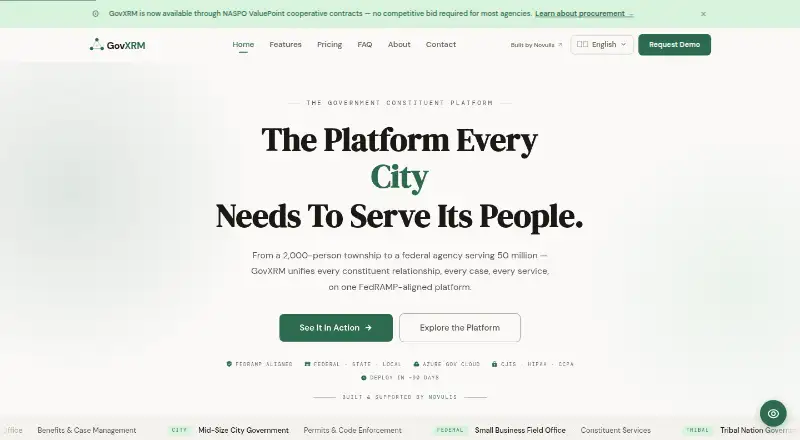
What GovXRM is
GovXRM is a constituent relationship platform for government that brings resident, business, and property records together with cases and services. Its six capabilities cover profiles, cases, a resident portal, insight, integrations, and automation. XRM Profile links records across departments and includes identity verification and deduplication. XRM Case supports configurable workflows, department routing, SLA alerts, document management, e-signatures, and an audit trail. The branded, mobile-first XRM Portal offers status tracking, online payments, e-signatures, WCAG 2.1 AA accessibility, and support for the top 30 US languages. Integration options include a REST API, legacy adapters for Accela and Tyler Munis, Esri ArcGIS integration, finance synchronization, and state data exchange connectors. Automation can route work, trigger SLA actions, notify residents, prefill forms, and remind users about license or permit renewals. GovXRM is cloud-hosted on Microsoft Azure Government, with US-only government data centers and FedRAMP High-aligned controls. It is designed for federal, state, county, city, township, tribal, and special-district governments. Pricing is on request; listed annual subscription licenses range from $600,000 a year to $1,800,000 a year.
Good
- Links resident, business, and property records across departments.
- Portal supports the top 30 US languages.
- Includes REST API and legacy system adapters.
- Hosted in US-only government data centers.
Watch out
- Pricing is on request.
- Listed annual subscription licenses start at $600,000 a year.
- Third-party payment processing and related fees are separate from GovXRM Payments licensing.
Who it suits
GovXRM is designed for federal, state, county, city, township, tribal, and special-district governments. Its modules cover agencies needing linked constituent records, case workflows, resident self-service, integrations, or automation.
Verdict
GovXRM combines constituent records, cases, a resident portal, integrations, and automation for government agencies. Its listed annual license amounts are substantial, and payment-processing fees are separate from the platform licensing.
Plans and prices
From GovXRM's own pricing page, checked 30 Sep 2026.
| Plan | Price | What it gives you |
|---|---|---|
| Automate | — | 1 unit per install or deployment · annual subscription license |
| Case Pro | — | 1 unit per install or deployment · annual subscription license |
| Connect | — | 1 unit per install or deployment · annual subscription license |
| Custom agency plan | Priced on request | agency size · modules · procurement path · timeline |
| GovXRM Core | — | 1 unit per install or deployment · annual subscription license |
| GovXRM Portal | — | 1 unit per install or deployment · annual subscription license |
| Insight | — | 1 unit per install or deployment · annual subscription license |
| Profile | — | 1 unit per install or deployment · annual subscription license |
The facts
Each one read from GovXRM's own pages, with the date it was checked.
What it does
- Automation
- XRM Automate provides rules-based routing, SLA triggers, resident notifications, form pre-population, and license or permit renewal reminders.checked 30 Sep 2026
- Case management
- XRM Case supports configurable workflows, multi-department routing, SLA alerts, document management, e-signatures, and a full audit trail.checked 30 Sep 2026
- Compliance alignment
- The site says the platform is designed to meet IRS, CJIS, HIPAA, ITAR, Section 508, WCAG 2.1 AA, and CPRA requirements.checked 30 Sep 2026
- Core modules
- The platform has six capabilities: XRM Profile, XRM Case, XRM Portal, XRM Insight, XRM Connect, and XRM Automate.checked 30 Sep 2026
- Deployment
- GovXRM says most agencies can go live within 90 days, with a typical implementation timeline of 60–90 days.checked 30 Sep 2026
- Identity and audit
- Microsoft Entra ID single sign-on and a tamper-proof audit trail are included platform capabilities.checked 30 Sep 2026
- Integrations
- XRM Connect provides REST API access, legacy adapters for Accela and Tyler Munis, Esri ArcGIS integration, finance synchronization, and state data exchange connectors.checked 30 Sep 2026
- Payment fee limit
- Third-party payment processing, merchant acquiring, interchange, card-network, banking, chargeback, dispute, refund, payout, and processor fees are separate from GovXRM Payments licensing.checked 30 Sep 2026
- Purpose
- GovXRM is a constituent relationship platform for government that unifies resident relationships, cases, and services.checked 30 Sep 2026
- Resident portal
- XRM Portal is a branded, mobile-first self-service portal with support for the top 30 US languages, WCAG 2.1 AA accessibility, status tracking, e-signatures, and online payments.checked 30 Sep 2026
- Security hosting
- GovXRM is built on Microsoft Azure Government with US-only government data centers and FedRAMP High-aligned controls.checked 30 Sep 2026
- Support response
- The procurement team says requested documentation is sent to a work email within one business day.checked 30 Sep 2026
- Target customers
- The platform is designed for federal, state, county, city, township, tribal, and special-district governments.checked 30 Sep 2026
- Unified profiles
- XRM Profile provides a unified record for residents, businesses, and properties with cross-department linkage, identity verification, and deduplication.checked 30 Sep 2026
The full review of GovXRM
GovXRM is a constituent relationship platform for government agencies coordinating residents, cases, and services across departments. It is best suited to public bodies that need broad, connected workflows and government-oriented hosting. Its substantial annual deployment licenses make it a major procurement decision rather than a lightweight starting point.
Overview
Six capabilities—Profile, Case, Portal, Insight, Connect, and Automate—span constituent records, casework, resident self-service, integrations, and workflow automation. That breadth can replace disconnected departmental processes with a shared platform; agencies seeking only one focused tool may find the scope and cost difficult to justify.
GovXRM targets federal, state, county, city, township, tribal, and special-district governments. It is cloud-based, with API access, and runs on Microsoft Azure Government data centers located in the US. Its controls are FedRAMP High-aligned, and its stated design aligns with IRS, CJIS, HIPAA, ITAR, Section 508, WCAG 2.1 AA, and CPRA requirements. Microsoft Entra ID single sign-on and a tamper-proof audit trail support identity and accountability needs. These alignments are relevant to agencies with demanding public-sector requirements, though they do not by themselves establish that every agency’s compliance obligations are met.
Key features
Connected records and casework
XRM Profile links residents, businesses, and properties across departments, with identity verification and deduplication. This shared record is valuable when several teams serve the same constituent or property. XRM Case adds configurable workflows, interdepartmental routing, SLA alerts, document handling, e-signatures, and a full audit trail, making it a strong fit for cases that move between teams. Agencies with simple, single-team queues may not need that breadth.
Resident services, integrations, and automation
XRM Portal offers a branded, mobile-first self-service portal with support for the top 30 US languages, WCAG 2.1 AA accessibility, status tracking, e-signatures, and online payments. That combination can help agencies serve residents without requiring every interaction to begin with staff, while language and accessibility support address important public-service needs.
XRM Connect provides REST API access, legacy adapters for Accela and Tyler Munis, Esri ArcGIS integration, finance synchronization, and state data exchange connectors. XRM Automate handles rules-based routing, SLA triggers, resident notifications, form pre-population, and license or permit renewal reminders. Together, these capabilities make GovXRM more compelling for agencies connecting existing systems and repeatable processes than for those seeking an isolated case tracker.
Pricing
GovXRM’s annual subscription licenses are priced per install or deployment, not per seat. Insight, Case Pro, Connect, Automate, and Profile each cost $600,000 a year for one unit per install or deployment. Each is a substantial commitment for an individual capability, so agencies should match the selected module to a clear operational need.
GovXRM Portal costs $840,000 a year for one unit per install or deployment. It is the relevant option for agencies prioritizing resident self-service, but its price sits above the other individual modules. GovXRM Core costs $1,800,000 a year for one unit per install or deployment; its higher license may suit agencies seeking broader platform coverage, while organizations needing only one capability have lower-priced module options.
The custom agency plan has custom pricing based on agency size, modules, procurement path, and timeline. Third-party payment processing and related merchant, card-network, banking, chargeback, dispute, refund, payout, and processor fees are separate from GovXRM Payments licensing, so the portal’s online payment capability should not be treated as covering transaction costs. No free plan or trial is offered in the stated pricing model.
Platforms
GovXRM supports web and API access. Its cloud deployment suits agencies seeking a hosted platform; no other deployment option is offered.
Who it's for
GovXRM is aimed at governments from federal through local and tribal levels, including special districts. It is most appropriate where constituent records, multi-department casework, resident-facing services, and integrations need to work together. Agencies should also plan for a typical 60–90 day implementation; GovXRM says most can go live within 90 days. Procurement teams can request documentation, which the team says it sends to a work email within one business day.
Pros and cons
- Pro: Shared resident, business, and property records with deduplication and identity verification can reduce fragmentation across departments.
- Pro: Case workflows, SLA alerts, e-signatures, and audit trails support accountable coordination across teams.
- Pro: A multilingual, accessible portal and integrations for public-sector systems broaden its usefulness beyond internal case management.
- Con: Individual module licenses start at $600,000 a year, making even a narrow deployment expensive.
- Con: Payment-processing and related transaction fees are additional to GovXRM Payments licensing.
- Con: A typical 60–90 day implementation requires more planning than an agency seeking an immediate, small-scale tool.
Alternatives
Public Sector CRM Software is a useful next step for comparing options by category.
Pega Government Platform is worth considering when an agency wants to configure or extend components to its needs and prefers to contact Pega for pricing; it is explicitly not a turn-key solution.
Casework may suit a councillor seeking a free starting point: its free plan is free per councillor, with one councillor seat and 50 entries. Its API and web platforms are narrower in stated scope than GovXRM’s full public-sector suite.
ContactWise CRM Constituent Edition is an alternative for buyers who want a paid constituent CRM with a free trial.
efficy Public Sector CRM may suit organizations preferring per-user pricing: its Sales and Customer Service plans each cost €69 a month per user, with packages tailored to organizational needs.
OpenGov Accounts Payable is an alternative to consider for accounts-payable needs.
Parthenon may be a better fit for smaller contact outreach needs: Reach 1k costs $19 a month and covers up to 1,000 contacts with one user license; an SMS add-on is available and a .gov email is required.
Ready311 is worth considering when the priority is 311 service, with unlimited staff accounts, mobile apps, API access, and integrations under a custom annual contract billed up front and aligned with the fiscal year.
SeeClickFix 311 CRM is another 311 CRM option with custom pricing after discussing organizational needs.
Verdict
GovXRM is best for government agencies that need constituent records, cross-department casework, resident self-service, and integrations in one government-oriented platform. Its connected capabilities are the main reason to choose it; the high annual deployment licenses and additional payment-processing fees are the main reasons to look elsewhere, especially for agencies with narrower needs or tighter budgets.
Alternatives to GovXRM
- 1
Salesboom
AndroidiOSWebAPI7.7From $14 a month - 2
Parthenon
AndroidiOSWebmacOS7.6From $19 a month - 3
eCasework
AndroidiOSWebAPI7.4From £100 a year - 4
Casework
Free planWebAPI7.3From £19 a month - 5
efficy Public Sector CRM
AndroidiOSWebAPI7.2From €69 a month - 6
Nagrik Political Suite
AndroidiOSWebSelf-hosted6.8From ₹10,000 a month