
Breeze
Breeze is an open-source remote monitoring and management platform with an AI operator for investigating, fixing and documenting fleet issues.
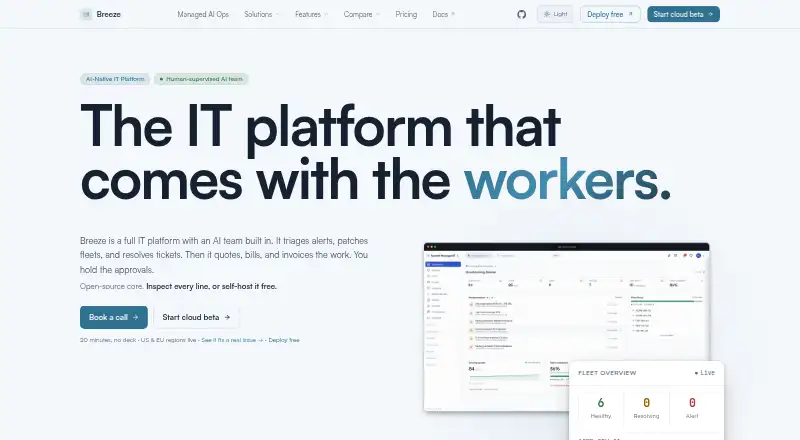
What Breeze is
Breeze is an open-source remote monitoring and management platform with an AI operator for investigating, fixing and documenting fleet issues. A configurable four-tier risk engine can allow routine actions automatically, hold sensitive actions for approval or block actions. The platform includes device management, remote access, patching, scripts, monitoring, automation, tickets, quotes, billing and invoicing. Its agent is a single Go binary for Linux, macOS and Windows. Breeze's MCP server connects fleet tools to clients including Claude Desktop, Claude Code, Cursor, Windsurf and ChatGPT. Integration categories cover communications, PSA or ticketing, and monitoring; its documentation names Slack and Teams. Listed security controls include MFA, role-based and scoped access, hashed API keys and tokens, and AES-256-GCM encryption for secrets at rest. Breeze says its SOC 2 examination is in progress and does not describe the product as SOC 2 compliant before a report is issued. The self-hosted Community plan is free with unlimited devices. Cloud Starter is $20 a year for up to 3 devices, while Cloud is $99 a month for up to 250 devices. Breeze is built by LanternOps, LLC.
Good
- Free self-hosted Community plan has unlimited devices.
- Four-tier engine governs AI actions.
- Agent supports Linux, macOS and Windows.
- Includes remote access, patching and automation.
- Security controls include MFA and scoped access.
Watch out
- Cloud Starter is limited to 3 devices.
- Cloud supports up to 250 devices.
- SOC 2 examination is still in progress.
Who it suits
Breeze is aimed at solo MSPs, lean IT teams, AI-client users and teams that want to self-host and control their infrastructure. Its range of fleet and business functions may suit teams seeking RMM alongside ticketing and billing.
Verdict
Breeze brings fleet management and business functions together with an AI operator governed by configurable risk controls. Choose between free self-hosting and paid cloud plans with stated device limits.
Plans and prices
From Breeze's own pricing page, checked 15 Oct 2026.
| Plan | Price | What it gives you |
|---|---|---|
| Community | Free | self-hosted · unlimited devices · all 64 modules · BYOK Anthropic AI · Docker Compose · Discord support · forever |
| Cloud Starter | $20 a year | hosted beta · up to 3 devices · backups and updates managed · BYOK Anthropic AI · Discord support · annual |
| Cloud | $99 a month | hosted beta · up to 250 devices · credit-based Breeze AI · priority email support · SSO/SAML · uptime SLA · monthly; $1,000/year or $1,800/2 years |
| Support Standard | $2,000 a year | next-business-day engineer response · upgrade and migration help · security advisories · bug prioritization · annual founding price locked 2 years |
| Support Priority | $6,000 a year | everything in Standard · 4-hour response target · named contact · shepherded upgrades · quarterly health review · compliance packet · annual founding price locked 2 years |
| Enterprise | Priced on request | dedicated infrastructure · custom SLA · compliance and audit support · white-glove onboarding · dedicated account manager · custom |
| Managed AI Ops | Priced on request | supervised AI agents · triage, patching and tickets · persistent memory · playbooks · compliance evidence · available self-hosted or cloud · tailored to fleet |
The facts
Each one read from Breeze's own pages, with the date it was checked.
Where it runs
- Agent platforms
- The repository lists working agents for macOS, Windows and Linux; Windows uses a signed MSI and watchdog service, while Linux uses systemd.checked 15 Oct 2026
- App availability
- The iPhone app supports fleet chat, approval cards, push notifications, biometric locking, two-factor sign-in and connections to US, EU or self-hosted servers.checked 15 Oct 2026
- Device management
- The platform provides inventory, grouping, tags, custom fields, maintenance windows and fleet status management.checked 15 Oct 2026
What it does
- AI client integrations
- The MCP server connects fleet tools to clients including Claude Desktop, Claude Code, Cursor, Windsurf, and ChatGPT.checked 29 Sep 2026
- AI governance
- Its four-tier risk engine lets routine actions run automatically, holds sensitive actions for approval, and blocks other actions.checked 29 Sep 2026
- AI operations
- Its operator investigates alerts, diagnoses causes, applies fixes and documents the work while waiting for approval on higher-risk actions.checked 15 Oct 2026
- API key limitation
- Regular organization API keys are restricted to MCP, development push and custom-field surfaces; broader machine access uses partner keys.checked 15 Oct 2026
- Business operations
- Quotes, time entries, service catalog, billing and invoicing are integrated with ticket records.checked 15 Oct 2026
- Compliance status
- Breeze says its SOC 2 examination is in progress and that it does not describe the product as SOC 2 compliant until the report is issued.checked 29 Sep 2026
- Core features
- The platform includes device management, remote access, patching, scripts, monitoring, automation, tickets, quotes, billing, and invoicing.checked 29 Sep 2026
- Documentation depth
- The docs cover Docker deployment, one-line agent enrollment, production setup, security architecture, integrations and a detailed API reference.checked 15 Oct 2026
- Integration persistence limit
- The documentation says communication, monitoring and ticketing integration data is currently in memory and can be lost across API restarts, while PSA data is database-backed.checked 15 Oct 2026
- Integrations
- Documented integrations include PSA, communication, monitoring, QuickBooks Online, Pax8, TD SYNNEX and UniFi.checked 15 Oct 2026
- Licence
- The repository identifies Breeze as free software under the AGPL-3.0 licence.checked 15 Oct 2026
- Limit: binary distribution outage
- A GitHub issue reported that releases 0.105.0 and 0.105.1 broke GitHub binary synchronization, leaving fresh self-hosted installs without agent binaries or auto-update payloads.checked 15 Oct 2026
- Limit: configuration policies
- A GitHub issue reported that, on version 0.82.1, automations, peripheral controls, Breeze Assist settings and PAM actions produced no expected endpoint effects; the issue was marked as having a shipped fix awaiting confirmation.checked 15 Oct 2026
- MCP server
- Breeze exposes 17 governed MCP tools that work with Claude, Cursor, Windsurf and ChatGPT clients.checked 15 Oct 2026
- Network discovery
- Agents can scan subnets with ARP, ICMP, TCP and SNMP methods, then build discovered-asset and topology records.checked 15 Oct 2026
- Notable limits
- Cloud Starter covers up to 3 devices, while Cloud covers up to 250 devices; the self-hosted Community plan has unlimited devices.checked 29 Sep 2026
- Notable news: version 0.70.0
- A June 15, 2026 LanternOps log entry said version 0.70.0 added email-to-ticket, product catalog pricing and bundles, end-to-end privileged access management and Breeze AI for Office.checked 15 Oct 2026
- Other integrations
- Breeze describes integration categories for communications, PSA or ticketing, and monitoring; its documentation names Slack and Teams among supported connections.checked 29 Sep 2026
The company
- Company
- Breeze is built by LanternOps, LLC.checked 29 Sep 2026
- Company size
- LinkedIn lists LanternOps as a privately held software-development company with 2–10 employees.checked 15 Oct 2026
- Founded
- LinkedIn lists LanternOps as founded in 2025.checked 15 Oct 2026
The full review of Breeze
Overview
Breeze is an open-source remote monitoring and management platform for operating IT fleets. Built by LanternOps, LLC, it combines endpoint oversight with service-provider workflows: device management, remote access, patching, scripts, monitoring, automation, ticketing, quotes, billing, and invoicing. Multi-tenant management and a customer portal are also included in its listed capabilities.
Its built-in AI operator is designed to investigate fleet issues, make fixes, and document the work. A configurable four-tier risk engine sets boundaries for those actions: routine work can proceed automatically, sensitive steps can wait for approval, and other actions can be blocked. That control model is central to how Breeze presents AI-assisted operations.
Breeze supports cloud and self-hosted deployment. A single Go binary serves as its agent for Linux, macOS, and Windows endpoints. An MCP server connects fleet tools to AI clients such as Claude Desktop, Claude Code, Cursor, Windsurf, and ChatGPT.
Key features
Fleet and service operations
The platform spans common endpoint-management work as well as administration for service providers. Teams can manage devices, connect remotely, patch systems, run scripts, monitor endpoints, and automate workflows. Ticketing, quotes, billing, and invoicing extend that scope beyond technical maintenance. Breeze also lists PSA ticketing, remote monitoring, and multi-tenant management.
Governed AI operations
The AI operator can investigate, fix, and document fleet issues, while the four-tier risk engine determines which actions may run, require approval, or be blocked. The MCP server offers a way to connect fleet tools with supported AI clients, including Claude Desktop, Claude Code, Cursor, Windsurf, and ChatGPT. Breeze’s listed integrations also cover communications, PSA or ticketing, and monitoring; its documentation names Slack and Teams among supported connections.
Security and compliance
Breeze’s trust center lists multifactor authentication, role-based access control, scoped access, hashed API keys and tokens, and AES-256-GCM encryption for secrets at rest. Its SOC 2 examination is in progress. Breeze does not describe the product as SOC 2 compliant before the report is issued, an important distinction for organizations evaluating compliance requirements.
Pricing
Breeze uses a freemium model. The self-hosted Community plan is free forever, with unlimited devices, all 64 modules, and a requirement to bring your own Anthropic key. Hosted options are marked beta and have different device limits.
| Plan | Price | What is listed |
|---|---|---|
| Community | Free | Self-hosted; unlimited devices; all 64 modules; bring your own Anthropic key |
| Cloud Starter | $20 /year | Hosted server; up to 3 devices; beta; bring your own Anthropic key |
| Cloud | $99 /month, or $1,000/year, or $1,800 for two years | Hosted server; up to 250 devices; beta; Breeze AI included on a credit basis |
| Support Standard | $2,000 /year | Self-host support; next-business-day response; founding price locked for 2 years |
| Support Priority | $6,000 /year | Self-host support; 4-hour response target; founding price locked for 2 years |
| Enterprise | Price not listed | Dedicated infrastructure; custom SLA terms; compliance and audit support; white-glove onboarding |
| Managed AI Ops | Price not listed | Billing tailored to your fleet; supervised AI team works your queue; curated intake |
The entry-level hosted plan is limited to three devices, while Cloud covers up to 250. Community has no listed device cap, but it is self-hosted and requires customers to provide an Anthropic key. Community support is available through Discord; paid cloud and self-host support plans list email or engineer support options.
Platforms
Breeze lists API, iOS, Linux, macOS, self-hosted, web, and Windows among its platforms. Its agent specifically supports Linux, macOS, and Windows endpoints. Hybrid deployment allows the service to be used in hosted or self-managed environments, while the Community plan provides a free self-hosted route.
Who it's for
Breeze identifies solo MSPs, lean IT teams, users of AI clients, and teams seeking to self-host and control their infrastructure as its intended audience. Its combination of fleet management and ticketing, quotes, billing, and invoicing may suit providers that want technical operations and service administration in one platform. The free Community tier offers room for unlimited devices, while hosted plans put explicit device ceilings on their included capacity.
Teams considering Breeze should account for its deployment and AI requirements: Community is self-hosted and uses a customer-provided Anthropic key, whereas Cloud is hosted and includes credit-based Breeze AI. Organizations with formal compliance gates should also note that the SOC 2 examination remains in progress.
Pros and cons
Pros
- Combines monitoring, remote access, patching, scripts, automation, ticketing, and billing-related tools.
- Offers a free, self-hosted plan with unlimited devices and all 64 modules.
- Uses configurable approval and blocking controls for AI-driven actions.
- Supports multiple AI clients through an MCP server and lists Slack and Teams connections.
- Provides published security controls including MFA, role-based access, scoped access, and encrypted secrets at rest.
Cons
- Cloud Starter is capped at three devices, and Cloud at 250 devices.
- The hosted plans are marked beta.
- The free plan requires customers to self-host and bring their own Anthropic key.
- SOC 2 compliance is not claimed while the examination is still in progress.
- Enterprise and Managed AI Ops pricing is not listed.
Alternatives
For a broader look at tools in this category, see Managed Service Provider Software. Other options include Tactical RMM and Checkmk for monitoring and management, ManageEngine ServiceDesk Plus for service desk workflows, and ManageEngine MSP Central for MSP operations. Readers comparing endpoint, remote-access, or backup products can also consider ITarian Remote Desktop, ManageEngine Endpoint Central, Site24x7 MSP, and Datto Endpoint Backup for Windows.
Verdict
Breeze brings endpoint management, remote operations, service workflows, and a governed AI operator into one open-source RMM platform. Its free self-hosted plan is notable for unlimited devices, while the hosted plans trade that flexibility for managed infrastructure and defined device limits. The configurable risk engine, broad workflow scope, and AI-client integrations give teams several ways to shape how they operate the platform. The key considerations are the beta status of hosted plans, the self-hosting and Anthropic-key requirements of Community, and the fact that SOC 2 review is not yet complete. Breeze is most relevant to MSPs and lean IT teams that want integrated fleet operations and are comfortable choosing between self-managed and hosted deployment.
Getting started
- Visit the Breeze website.
- Choose self-hosted Community or a hosted Cloud plan.
- For Community, arrange self-hosting and bring your own Anthropic key.
- For Cloud Starter, use the hosted server and bring your own Anthropic key.
- Deploy the Breeze agent on Linux, macOS, or Windows endpoints.
- Connect an AI client through the MCP server if desired.
Limits worth knowing
The free Community plan is self-hosted and requires your own Anthropic key. Cloud Starter costs $20 a year, supports up to 3 devices, is in beta, and requires your own Anthropic key; Cloud costs $99 a month, supports up to 250 devices, is in beta, and includes credit-based Breeze AI.
Questions
Is Breeze open source?
Yes. Breeze describes itself as an open-source RMM platform.
Is there a free plan?
Yes. Community is free forever, self-hosted, and supports unlimited devices.
What platforms does the Breeze agent support?
The single Go binary agent supports Linux, macOS, and Windows endpoints.
How much does hosted Breeze cost?
Cloud Starter is $20 a year. Cloud is $99 a month, with listed alternatives of $1,000 per year or $1,800 for two years.
Which AI clients can connect to Breeze?
Its MCP server connects with Claude Desktop, Claude Code, Cursor, Windsurf, and ChatGPT.
Who makes Breeze?
Breeze is built by LanternOps, LLC.
Alternatives to Breeze
- 1

Checkmk
Free planOpen sourceAndroidiOSWebAPI8.8From $275 a month - 2

ManageEngine ServiceDesk Plus
AndroidiOSWebAPI8.0From $10 a month - 3
NinjaOne
AndroidiOSWebAPI7.9From $1.50 a month - 4
Atera
AndroidiOSWebAPI7.8From $169 a month - 5

Hudu
AndroidiOSWebAPI7.2 - 6
RepairShopr
AndroidiOSWebAPI7.1From $59.99 a year