
Znuny
Znuny is an open-source IT service management and helpdesk platform for service management, IT, and customer support.
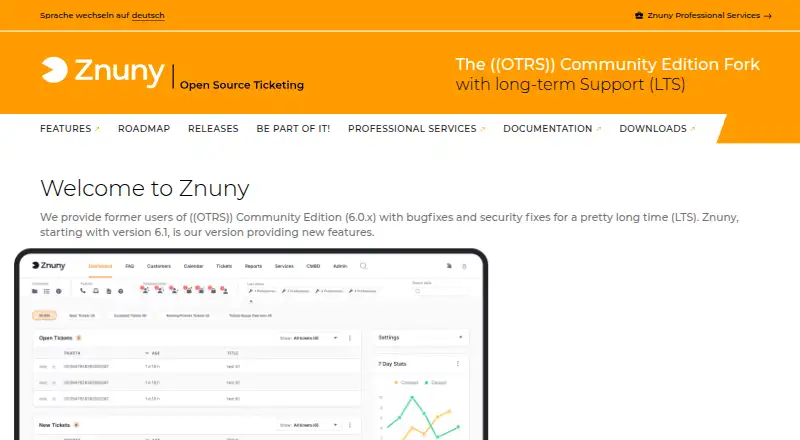
What Znuny is
Znuny is an open-source IT service management and helpdesk platform for service management, IT, and customer support. It brings portal, email, phone with CTI, web services, and monitoring tools into ticket workflows. Automation can route and classify tickets, handle escalation and notifications, manage states, and coordinate multi-step business processes. Customers can use knowledge management and a self-service portal to find answers. Teams can tailor the system through dynamic fields, a modular design, more than 2,000 configuration options, and access to its open-source code. Integrations with CRM systems, catalogues, databases, and other external systems are available through add-ons and web services. Znuny can be deployed on premise, on a customer's server or cloud provider, or through its managed hosting. The open-source software is free to use; paid hosting and support plans are also listed. The project identifies Znuny GmbH as responsible for its site and gives Berlin, Germany, as its headquarters.
Good
- Free open-source software.
- Ticket workflows include portal, email, phone, and monitoring.
- Automation covers routing, escalation, and multi-step processes.
- Supports on-premise, customer-hosted, and managed hosting deployment.
Watch out
- Managed hosting and support plans are paid.
- Configuration options may require teams to tailor the system.
Who it suits
Znuny suits service and IT teams that need configurable ticket workflows, self-service, and multiple deployment options. Organizations wanting hosting or defined support arrangements can also consider its paid services.
Verdict
Znuny combines helpdesk and IT service management workflows with extensive configuration and deployment choices. Its free software may suit teams prepared to manage their own setup; managed hosting and support are paid options.
Plans and prices
From Znuny's own pricing page, checked 8 Oct 2026.
| Plan | Price | What it gives you |
|---|---|---|
| Znuny (open-source software) | Free | Open-source and free to use |
| Silver Hosting | $799 a month | 250GB storage · 35 service requests · one time setup fee · Paid annually |
| Gold Hosting | $1,419 a month | 500GB storage · 65 service requests · no setup fee · Paid annually |
| Platinum Hosting | $3,169 a month | 750GB storage · unlimited service requests · no setup fee · Paid annually |
| Silver Support | $4,499 a year | 35 service requests · 4h max reaction time · 2 authorized support contacts · $4,499/year |
| Gold Support | $9,999 a year | 65 service requests · 2h max reaction time · 3 authorized support contacts · $9,999/year |
| Platinum Support | $28,999 a year | Unlimited service requests · 0.5h max reaction time · 5 authorized support contacts · $28,999/year |
The facts
Each one read from Znuny's own pages, with the date it was checked.
What it does
- API access
- Yeschecked 20 Sep 2026
- Automation
- Its automation toolkit supports routing, classification, escalation, notifications, state management, and multi-step business processes.checked 8 Oct 2026
- Compliance
- Znuny says it has SOC 2 certification since 2024, ISO/IEC 27001:2022 certification since January 2025, and complies with GDPR.checked 8 Oct 2026
- Customer portal
- Yeschecked 20 Sep 2026
- Customization
- Znuny offers over 2,000 configuration options, flexible dynamic fields, modular architecture, and access to its open-source code.checked 8 Oct 2026
- Deployment
- Znuny can be run on premise, on the customer's server or cloud provider, or through Znuny's managed hosting.checked 8 Oct 2026
- Help center
- Yeschecked 20 Sep 2026
- Hosting
- Znuny offers dedicated managed hosting with a test system, daily backups, monitoring, certified data centers, and no user-based pricing.checked 8 Oct 2026
- Integrations
- The product supports integrations with CRM systems, catalogues, databases, and external systems through add-ons and web services.checked 8 Oct 2026
- Knowledge and self-service
- The product includes knowledge management and a self-service portal to help customers resolve common questions.checked 8 Oct 2026
- Organization
- The project site identifies Znuny GmbH as responsible for the site's content and lists its headquarters in Berlin, Germany.checked 8 Oct 2026
- Purpose
- Znuny is an open-source ITSM and helpdesk platform for service management, IT, and customer support.checked 8 Oct 2026
- Release support
- The current LTS release receives extended security and bug-fix maintenance, while stable releases receive newer features on a regular cadence.checked 8 Oct 2026
- Security
- Znuny provides granular permission controls, and its release downloads include SHA-256 checksums and PGP signatures for verification.checked 8 Oct 2026
- Shared inbox
- Yeschecked 20 Sep 2026
- SLA management
- Yeschecked 20 Sep 2026
- Support
- Support contracts cover configuration, installation, updates, troubleshooting, performance tuning, backup, and recovery, with defined service levels and response times.checked 8 Oct 2026
- Ticket automation
- Yeschecked 20 Sep 2026
- Ticket channels
- It brings customer portal, email, phone with CTI, REST and SOAP web services, and monitoring tools into ticket workflows.checked 8 Oct 2026
The company
- Founded
- 2013checked 28 Sep 2026
- Headquarters
- Berlin, Germanychecked 28 Sep 2026
Money
- Free plan
- Yeschecked 20 Sep 2026
The full review of Znuny
Znuny is an open-source service platform for organizations handling IT and customer-support requests. It is strongest for teams that need to shape detailed workflows and can take responsibility for deployment and configuration. The free software keeps the entry cost low; hosted operations and contracted support are paid, substantial commitments.
Overview
Znuny brings requests from a customer portal, email, phone with CTI, REST and SOAP web services, and monitoring tools into ticket workflows. Shared inboxes, SLA management, a help center, ticket automation, and a customer portal cover the central helpdesk tasks. This breadth is useful when several service channels need to follow coordinated processes, but may be more machinery than a team needs for straightforward ticket assignment.
More than 2,000 configuration options, flexible dynamic fields, a modular design, and access to the source code let organizations adapt the system to their own practices. That is a meaningful advantage for teams with specific workflows and technical capacity; it also means Znuny is less compelling for buyers who want a narrowly scoped, ready-to-run help desk. It can run on premise, on a customer server or cloud provider, or through Znuny's managed hosting.
Key features
Workflow automation and self-service
Automation handles routing, classification, escalation, notifications, state management, and multi-step business processes. Teams can use those controls to make service work more consistent; organizations with only basic assignment needs may not benefit enough to justify configuring them. Knowledge management and the self-service portal give customers a way to resolve common questions without opening a ticket.
Integration, security, and maintenance
Add-ons and web services connect Znuny with CRM systems, catalogues, databases, and external systems, making it more adaptable to an existing service environment. Granular permissions support controlled access, while release downloads include SHA-256 checksums and PGP signatures for verification. Znuny says it complies with GDPR and holds SOC 2 certification since 2024 and ISO/IEC 27001:2022 certification since January 2025.
The current LTS release receives extended security and bug-fix maintenance; stable releases add newer features on a regular cadence. That gives operators a choice between longer maintenance and a newer feature cadence, but still leaves release management as part of running a self-hosted system.
Pricing
The open-source software costs free. It is the natural starting point for teams willing to host, configure, and maintain Znuny themselves; no per-seat price is given. For organizations wanting operational help, hosting and support are separate paid options, with annual billing and request limits on lower tiers.
| Plan | Price and terms | What it includes |
|---|---|---|
| Silver Hosting | $799 a month, billed Paid annually | 250GB storage, 35 service requests, one time setup fee |
| Gold Hosting | $1,419 a month, billed Paid annually | 500GB storage, 65 service requests, no setup fee |
| Platinum Hosting | $3,169 a month, billed Paid annually | 750GB storage, unlimited service requests, no setup fee |
Managed hosting includes a test system, daily backups, monitoring, certified data centers, and no user-based pricing. Silver is the lower-commitment option but caps service requests at 35 and adds a setup fee; Gold removes that fee and raises the cap to 65. Platinum is the only hosting tier with unlimited requests, at a much higher monthly price. These terms make hosting more attractive when avoiding in-house operations matters more than minimizing spend.
| Plan | Price | Support terms |
|---|---|---|
| Silver Support | $4,499 a year (billed $4,499/year) | 35 service requests, 4h max reaction time, 2 authorized support contacts |
| Gold Support | $9,999 a year (billed $9,999/year) | 65 service requests, 2h max reaction time, 3 authorized support contacts |
| Platinum Support | $28,999 a year (billed $28,999/year) | Unlimited service requests, 0.5h max reaction time, 5 authorized support contacts |
Support contracts cover configuration, installation, updates, troubleshooting, performance tuning, backup, and recovery, with defined service levels and response times. Silver suits teams that can work within 35 requests and a four-hour maximum reaction time; Gold and Platinum raise the limits and shorten response times for organizations needing more coverage. The annual prices and caps make these contracts a poor fit for teams seeking occasional, low-cost assistance.
Platforms
Znuny supports API access, Linux, self-hosted deployment, and web use. Its deployment range is useful for organizations that want to choose their own infrastructure or use managed hosting, but the platform list does not offer a broad set of native desktop or mobile options.
Who it's for
Znuny is best for service and IT teams with multi-channel requests, detailed workflow requirements, and the technical capacity to configure or operate a flexible platform. Organizations can choose self-hosting for control or pay for hosting and support when they need operational coverage. Teams looking for a simple turnkey help desk, or unwilling to take on configuration and infrastructure decisions, should look elsewhere.
Pros and cons
- Pros: Extensive configuration and source access let technically capable teams adapt workflows rather than fit their processes to a fixed product.
- Pros: Portal, email, phone with CTI, web services, and monitoring inputs converge on ticket workflows, alongside automation and self-service tools.
- Pros: Self-hosting and managed hosting offer different levels of operational responsibility, while support contracts cover installation through recovery.
- Cons: The breadth of configuration means teams should expect to make and maintain more operational decisions than with a narrowly scoped help desk.
- Cons: Hosting and support tiers involve significant monthly or annual costs; lower tiers cap service requests, and Silver Hosting also charges a one time setup fee.
Alternatives
iTop is another free option, with a free Community plan described as not limited and support for macOS and Windows as well as Linux and web. Choose it when those platform options or an explicitly unlimited free plan are priorities.
iTop is another community-oriented alternative, with an on-premise Community offer and an Atelier operational service-management option. Consider it when that packaging aligns better with your service-management needs.
Pandora RC offers a free tier for five devices and paid plans for larger device counts. It may fit better when a small device allowance is the main requirement.
FreeITSM is a free option for teams seeking an alternative ITSM platform available on Linux, Windows, web, and self-hosted environments.
GLPI offers a free plan and a Public Cloud plan at €19 a month per IT agent, with a free trial. Consider it when a per-agent cloud plan and trial are preferable to Znuny's managed-hosting tiers.
Nova-Suite has a free forever, self-hosted Standard plan with unlimited agents and a full feature set. It is worth considering when those plan terms are a closer fit.
Vivantio is a paid alternative priced at $49 a month per agent, with a published range of $49–$99 per agent per month billed annually and free end users. Choose it when a per-agent paid model suits the organization better.
Hornbill IT Asset Management is another alternative with personalized pricing tailored to requirements and scalable packages.
The IT Change Management Software, IT SLA Management Software, and Help desk software directories can help compare options by category.
Verdict
Choose Znuny if your service operation needs configurable, multi-channel workflows and you have the capacity to run them, whether on your own infrastructure or through managed hosting. Its open-source software makes a zero-price start possible, while its paid plans add defined operational support. Look elsewhere if you need a turnkey system or cannot justify the configuration work and the cost of hosted or contracted assistance.
Alternatives to Znuny
- 1

Chatwoot
Free planOpen sourceAndroidiOSWebAPI9.4From $19 a month - 2

Desk365
Free planAndroidiOSWebAPI8.7From $12 a month - 3

Front
AndroidiOSWebAPI8.6From $25 a month - 4
Intercom
AndroidiOSWeb8.5From $19 a month - 5

Deskero
Free planAndroidiOSWebAPI8.5From $12 a month - 6
Odoo Helpdesk
Free planAndroidiOSWebAPI8.4From $31.10 a month