Rapla
Rapla is an open-source system for scheduling resources and planning events involving rooms, people, and equipment.
What Rapla is
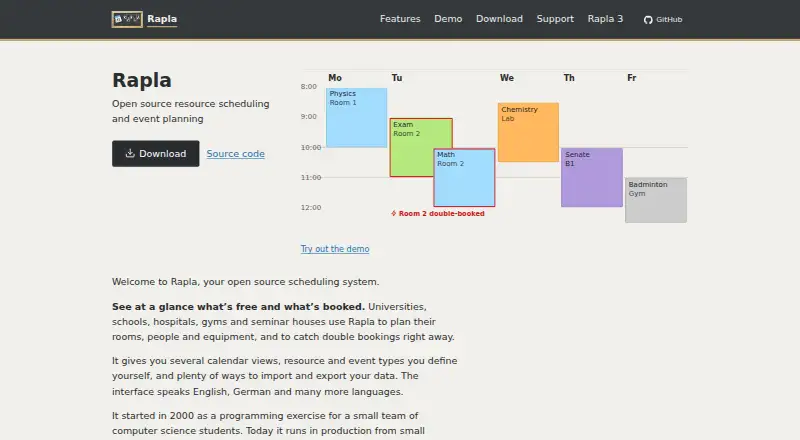
Rapla is an open-source system for scheduling resources and planning events involving rooms, people, and equipment. Its calendar provides month, week, day, and specialized views, supports recurring appointments, and checks for conflicts before saving. Administrators can define resource, person, and event types, organize them with categories and attributes, and set fine-grained permissions. Rapla can export schedules to PDF and iCal, and email users when a resource is allocated. Data can be stored in a file or in MySQL, PostgreSQL, or HSQLDB. Rapla 2 is labeled stable and can run as a standalone application or in client-server mode; its desktop client supports Linux, Windows, and macOS using Java and OpenWebStart. Rapla 3 describes Exchange sync to booked persons’ Outlook calendars, a GraphQL API, OAuth 2.0 with PKCE, and sign-in with Microsoft, Google, or Keycloak. Rapla 3 nightly builds are labeled self-signed, untested, and unsuitable for production. The software is free under AGPL-3.0-or-later or Apache-2.0.
Good
- Calendar views include month, week, day, and specialized formats.
- Checks for scheduling conflicts before saving.
- Exports to PDF and iCal.
- Supports file, MySQL, PostgreSQL, or HSQLDB storage.
- Free under AGPL-3.0-or-later or Apache-2.0.
Watch out
- Rapla 3 nightly builds are untested and not for production.
- Several interface translations have varying completeness.
- Desktop client uses Java and OpenWebStart.
Who it suits
Rapla suits organizations that schedule shared rooms, people, or equipment, including the listed settings of schools, universities, hospitals, gyms, and seminar houses. It offers both standalone and client-server deployment options.
Verdict
Rapla covers resource scheduling with conflict checks, configurable permissions, and multiple storage choices. Rapla 2 is the stable release; the listed Rapla 3 nightly builds are not intended for production use.
Plans and prices
From Rapla's own pricing page, checked 8 Oct 2026.
| Plan | Price | What it gives you |
|---|---|---|
| Rapla (open-source software) | Free | Open source under AGPL-3.0-or-later or Apache-2.0 · no paid plans listed |
The facts
Each one read from Rapla's own pages, with the date it was checked.
What it does
- Administration
- Users can define resource, person and event types, categories, attributes, and fine-grained permissions.checked 8 Oct 2026
- API and identity
- Rapla 3 describes a GraphQL API, OAuth 2.0 with PKCE, sign-in with Microsoft, Google or Keycloak, and scoped API keys.checked 8 Oct 2026
- Audience
- The maker says universities, schools, hospitals, gyms and seminar houses use Rapla to schedule rooms, people and equipment.checked 8 Oct 2026
- Deployment
- Rapla 2 can run as a standalone application or in client-server mode, with a desktop client for Linux, Windows and macOS using Java and OpenWebStart.checked 8 Oct 2026
- Exports and notifications
- Rapla supports PDF and iCal export and can email users when a resource is allocated.checked 8 Oct 2026
- Integrations
- Rapla 3 is described as supporting Exchange sync to booked persons’ Outlook calendars and iCal export; iCal subscription and import are listed as planned.checked 8 Oct 2026
- Language support
- The interface is available in English and German, with translations of varying completeness in French, Dutch, Polish, Spanish, Finnish, Brazilian Portuguese and Czech.checked 8 Oct 2026
- Purpose
- Rapla is an open-source system for scheduling resources and planning events, including rooms, people and equipment.checked 8 Oct 2026
- Release status
- Rapla 2 is labeled stable, while Rapla 3 nightly builds are described as self-signed, untested and not for production.checked 8 Oct 2026
- Scheduling
- It offers month, week, day and specialized calendar views, repeating appointments, and conflict detection before saving.checked 8 Oct 2026
- Security and privacy
- The maker states that rapla.org and its demo are hosted on EU-located infrastructure under a data processing agreement, and that demo entries are visible to other visitors and erased in a nightly reset.checked 8 Oct 2026
- Storage
- Rapla can store data in a file or in MySQL, PostgreSQL or HSQLDB.checked 8 Oct 2026
- Support
- The maker points users to a wiki, documentation overview, FAQ and GitHub issues, and lists third-party professional support providers.checked 8 Oct 2026
The company
- Founded
- 2000checked 28 Sep 2026
Money
- Free plan
- Yeschecked 20 Sep 2026
The full review of Rapla
Rapla is a free, open-source resource scheduler for coordinating rooms, people, equipment and events. It is best suited to institutions that need configurable booking rules and can manage a desktop or client-server deployment. Its stable release covers core scheduling; Rapla 3 nightly builds are not ready for production use.
Overview
Rapla combines event planning with resource calendars, using daily planning granularity and conflict checks before appointments are saved. That makes it a practical choice when room and equipment availability must be coordinated alongside people’s schedules. The trade-off is its deployment model: Rapla 2 runs standalone or in client-server mode, and its desktop client relies on Java and OpenWebStart rather than a broadly accessible web service.
Key features
- Calendar scheduling: Month, week, day and specialized views, along with repeating appointments, support recurring bookings and one-off events. Conflict detection can catch clashes before they are saved, a useful safeguard for shared resources.
- Configurable administration: Administrators can define resource, person and event types, categories and attributes, then apply fine-grained permissions. This suits organizations with varied booking rules, but the flexibility depends on having someone able to configure those rules.
- Exports and email: PDF and iCal exports make schedules easier to share, while email notifications can alert users when a resource is allocated. These tools help communicate bookings without changing Rapla’s central role as the scheduler.
- Storage choices: Data can be stored in a file or in MySQL, PostgreSQL or HSQLDB. The options accommodate different deployment needs, though they also leave storage selection and upkeep to the organization.
- Rapla 3 integrations and access: Rapla 3 describes Exchange synchronization to booked persons’ Outlook calendars, a GraphQL API, OAuth 2.0 with PKCE, sign-in through Microsoft, Google or Keycloak, and scoped API keys. iCal subscription and import are planned. These capabilities may appeal to teams planning integrations, but the nightly builds are self-signed, untested and explicitly not for production.
The interface is available in English and German, with translations of varying completeness in French, Dutch, Polish, Spanish, Finnish, Brazilian Portuguese and Czech. Rapla points users to a wiki, documentation, an FAQ and GitHub issues, and lists third-party professional support providers.
Pricing
Rapla (open-source software): free. The software is open source under AGPL-3.0-or-later or Apache-2.0, and no paid plans are listed. This is a strong fit for organizations that can operate the deployment themselves and want to avoid a software license fee; it is less suited to buyers who need a commercial hosted plan or a single vendor responsible for implementation and ongoing support.
Platforms
Rapla is available for Linux, macOS, Windows and self-hosted deployment. Rapla 2 can run as a standalone application or in client-server mode, with desktop clients for Linux, Windows and macOS using Java and OpenWebStart. Organizations should account for that client setup when choosing it for users or IT environments.
Who it's for
The maker names universities, schools, hospitals, gyms and seminar houses among Rapla’s users. Its resource types, permissions and conflict checks make it relevant to institutions scheduling rooms, people and equipment under distinct booking rules. It is a weaker fit for teams that require a production-ready Rapla 3 integration set or prefer a hosted, web-first product.
Pros and cons
- Pro: No software license fee. The open-source plan is free, with no paid plans listed.
- Pro: Detailed booking controls. Custom resource and event structures, fine-grained permissions and pre-save conflict detection address real coordination needs.
- Pro: Multiple storage options. File storage and three database choices give organizations flexibility in how they deploy.
- Con: Deployment needs technical ownership. The stable release uses standalone or client-server deployment, while its desktop client requires Java and OpenWebStart.
- Con: Rapla 3 is not production-ready. Its nightly builds are self-signed and untested, so organizations cannot safely treat their newer integrations as stable production capabilities.
- Con: Translation completeness varies. Only English and German are identified as interface languages without that qualification.
Alternatives
For a different resource-management approach, browse Resource Management Software or Calendar apps.
- Teamdeck is worth considering if mobile and web access matter: it has Android, iOS, macOS, Windows and web platforms, plus a free Startup plan for up to six team members.
- Ganttic may suit teams that want Gantt charts and project tools in a free plan, which covers up to 10 resources with unlimited users and projects.
- LibrePlan is another free, self-hosted open-source option, with Linux and web platforms.
- SAVIOM is a paid option with a free trial for organizations seeking resource management software.
- Smartsheet is a paid alternative with a free trial and broad platform support, including web, desktop and mobile.
- Tempo Portfolio Manager may fit teams focused on portfolio work: its free plan covers 10 members, three projects and 300 tasks.
- Mosaic is another paid option with a free plan and Android, iOS and web platforms.
- Napta is an alternative with Android, web and iOS platforms.
Verdict
Rapla is a strong choice for schools, universities and other institutions that need structured resource booking, conflict checks and configurable permissions without a software license fee. Its main advantage is control over scheduling and deployment; its main reason to look elsewhere is the technical responsibility involved, especially if you need a production-ready web-first service or stable Rapla 3 integrations.
Alternatives to Rapla
- 1
Teamdeck
Free planAndroidiOSWebAPI8.2From $2 a month - 2

Scoro
AndroidiOSWebAPI7.6From $17 a month - 3

Smartsheet
AndroidiOSWebAPI7.6From $9 a month - 4

EG Silverbucket
AndroidiOSWebAPI7.5From €11 a month - 5

Ganttic
Free planAndroidiOSWebAPI7.4From $25 a month - 6
Epicflow
AndroidiOSWebAPI7.0From €22.50 a month