
PostHog
PostHog is a platform for product development, customer communication, and understanding customer data.
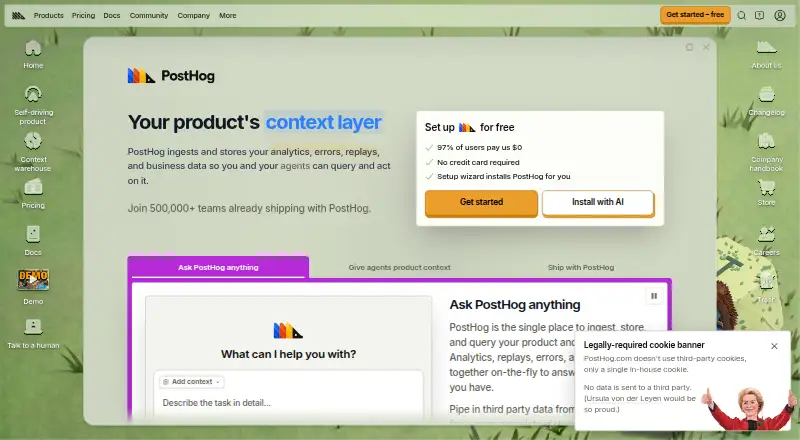
What PostHog is
PostHog is a platform for product development, customer communication, and understanding customer data. Its analytics tools cover product and web activity, funnels, heatmaps, trends, lifecycle analysis, and user paths. Session Replay records sessions from web, React Native, iOS, Android, Flutter, and other SDKs. Feature Flags can target users, groups, or traffic shares, with phased rollouts, kill switches, variants, JSON payloads, and beta opt-ins. An integrated data warehouse can connect to external sources such as Snowflake or BigQuery, while its event pipeline transforms data in real time and routes it to more than 50 destinations. PostHog Desktop is a coding agent that can use product signals to investigate issues and create pull requests. A free plan includes one year of event and metadata retention and one month of recording retention; paid plans guarantee seven years of event and metadata retention. PostHog also describes an MIT-licensed open-source product.
Good
- Analytics include funnels, heatmaps, and user paths
- Session Replay supports multiple platforms and SDKs
- Feature Flags support phased rollouts and kill switches
- Event pipeline connects to more than 50 destinations
- Free plan includes 1M analytics events
Watch out
- Free-plan recordings are retained for one month
- Free-plan events and metadata are retained for one year
- Free plan includes community support
Who it suits
PostHog suits product teams that need analytics, session replay, feature controls, or event routing. Its tools also support developers investigating issues with product signals.
Verdict
PostHog combines product analytics with replay, feature flags, event routing, and a data warehouse. Retention and support differ between the free and paid plans.
Plans and prices
From PostHog's own pricing page, checked 30 Sep 2026.
| Plan | Price | What it gives you |
|---|---|---|
| Free | Free | 1M analytics events · 5K session recordings · 1M feature-flag requests · 100K exceptions · 1,500 survey responses · 1M warehouse rows · monthly; no credit card required |
| Pay-as-you-go Analytics | Priced on request | 1M free analytics events per month · 6 projects · 7-year data retention |
| Pay-as-you-go Analytics | — | 1M free analytics events per month · 6 projects · 7-year data retention |
| Pay-as-you-go | — | Unlimited usage · 6 projects · 7-year data retention · email support · usage-based; billed once a month |
The facts
Each one read from PostHog's own pages, with the date it was checked.
What it does
- AI development
- PostHog Desktop is a desktop coding agent that can use product signals such as errors, support tickets, session replays, GitHub issues, Linear, and Zendesk to research causes and create pull requests.checked 30 Sep 2026
- Analytics
- The product suite includes product analytics, web analytics, funnels, heatmaps, graphs and trends, lifecycle analysis, and user paths.checked 30 Sep 2026
- API access
- Yeschecked 21 Sep 2026
- Conversion funnels
- Yeschecked 21 Sep 2026
- Data retention
- limitedchecked 21 Sep 2026
- Data warehouse
- PostHog includes an integrated data warehouse and can also connect external warehouses such as Snowflake or BigQuery as data sources.checked 30 Sep 2026
- Event tracking
- Yeschecked 21 Sep 2026
- Feature flags
- Feature Flags can target specific users, groups, or traffic percentages and support phased rollouts, kill switches, multivariate variants, JSON payloads, and beta opt-ins.checked 30 Sep 2026
- Integrations
- PostHog CDP transforms events in real time and moves them across more than 50 destinations, including webhooks, Slack, Braze, and Customer.io.checked 30 Sep 2026
- Open source
- PostHog says it has an open-source product licensed under MIT.checked 30 Sep 2026
- Product scope
- PostHog describes itself as a single platform for people who build things, including tools for building products, talking to customers, and understanding customer data.checked 30 Sep 2026
- Retention
- Events and metadata are guaranteed to be retained for seven years on paid plans and one year on free plans; free-plan recordings are retained for one month.checked 30 Sep 2026
- Security compliance
- PostHog's Trust Center lists SOC 2, GDPR, CCPA, and HIPAA compliance, and says its products are covered by an independently audited SOC 2 Type II report.checked 30 Sep 2026
- Security controls
- The Trust Center lists audit logging, multi-factor authentication, encryption at rest, encryption in transit, backups, and application penetration testing.checked 30 Sep 2026
- Session recordings
- Yeschecked 21 Sep 2026
- Session replay
- Session Replay records sessions from web, React Native, iOS, Android, Flutter, and other SDKs.checked 30 Sep 2026
- Support
- The free plan includes community support, while pay-as-you-go includes email support and Slack support for customers spending over $2,000 per month.checked 30 Sep 2026
The company
- Company history
- PostHog says it was founded in January 2020 by James Hawkins and Tim Glaser and was part of Y Combinator's Winter 2020 batch.checked 30 Sep 2026
- Founded
- 2020checked 28 Sep 2026
Where it runs
- Desktop platforms
- PostHog Desktop is shipped for macOS (Apple Silicon and Intel), Windows, and Linux, including AppImage, .deb, and .rpm packages.checked 30 Sep 2026
Money
- Free plan
- Yeschecked 21 Sep 2026
The full review of PostHog
PostHog suits product teams that want analytics, replay, and release controls in one platform, with extra tools for routing and storing customer data. Its breadth is a strong fit for teams building across web and mobile; the trade-off is that the free tier has short replay retention and paid support comes with usage-based plans.
Overview
PostHog brings together product and web analytics, session replay, feature flags, event routing, and a data warehouse. That range can reduce the need to stitch together separate tools, particularly for teams that want to connect product signals to release decisions and customer data workflows.
The company was founded in San Francisco in 2020. It offers an open-source product under the MIT license, and its Trust Center lists SOC 2, GDPR, CCPA, and HIPAA compliance. PostHog says its products are covered by an independently audited SOC 2 Type II report.
Key features
Analytics and session replay
Event tracking, conversion funnels, heatmaps, lifecycle analysis, trends, and user paths give teams several ways to examine product use and movement through key journeys. Session Replay adds recordings from web, React Native, iOS, Android, Flutter, and other SDKs. That breadth is useful when a team needs both aggregate patterns and individual session context, though free-plan recordings last only one month.
Feature flags and event routing
Feature Flags can target users, groups, or traffic percentages, with phased rollouts, kill switches, multivariate variants, JSON payloads, and beta opt-ins. These controls suit teams that want to limit exposure while releasing changes. The CDP transforms events in real time and sends them to more than 50 destinations, including webhooks, Slack, Braze, and Customer.io, making it relevant when event routing is part of the product stack.
Warehouse and desktop agent
The integrated data warehouse can connect external sources such as Snowflake and BigQuery. PostHog Desktop, available for macOS, Windows, and Linux, is a coding agent that can use signals such as errors, support tickets, session replays, GitHub issues, Linear, and Zendesk to investigate causes and create pull requests. These additions widen the platform beyond analytics, but teams choosing PostHog primarily for a narrow measurement need may not need that breadth.
Security and support
Listed controls include audit logging, multi-factor authentication, encryption at rest and in transit, backups, and application penetration testing. Free users receive community support. Pay-as-you-go includes email support; Slack support is for customers spending over $2,000 per month, a meaningful threshold for teams that require a direct support channel.
Pricing
Free
Free: free, billed monthly with no credit card required. The monthly allowances are 1M analytics events, 5K session recordings, 1M feature-flag requests, 100K exceptions, 1,500 survey responses, and 1M warehouse rows. It is a substantial starting tier for teams evaluating several parts of the platform, but its one-year event and metadata retention and one-month recording retention make it less suitable for long-term analysis or replay archives.
Pay-as-you-go plans
Pay-as-you-go Analytics has custom pricing and includes 1M free analytics events per month, 6 projects, and seven-year data retention. It is the clearer fit for teams focused on analytics that need longer retention and multiple projects.
Pay-as-you-go also has custom pricing and is billed monthly based on usage. It offers unlimited usage, 6 projects, seven-year data retention, and email support. The usage-based billing and expanded scope suit teams ready to pay for broader use, but costs depend on usage rather than a fixed published rate. Paid plans guarantee seven-year retention for events and metadata; the free plan guarantees one year.
Platforms
PostHog supports Android, iOS, Linux, macOS, Windows, web, API, and self-hosted use. Its coverage suits teams spanning mobile and web products as well as organizations that want a self-hosted option.
Who it's for
PostHog is best suited to product teams that want behavioral analytics and session replay alongside controlled rollouts, event routing, and warehouse connections. Its free tier gives smaller teams room to start without a credit card; teams with longer retention needs, multiple projects, or support requirements should weigh the custom-priced paid plans. It is less compelling for buyers who need only a narrowly focused analytics tool or who require predictable published pricing.
Pros and cons
- Broad product toolkit: Analytics, replay, feature flags, CDP, and warehouse functions can serve connected product workflows in one platform.
- Useful rollout controls: Targeting, phased releases, and kill switches give teams options for managing feature exposure.
- Free entry with meaningful quotas: The free plan includes monthly allowances across analytics, recordings, flags, exceptions, surveys, and warehouse rows without requiring a credit card.
- Free retention is short: Events and metadata are retained for one year and recordings for one month, limiting historical analysis on the no-cost plan.
- Paid prices are custom: Usage-based billing avoids a single fixed package but makes cost planning less straightforward.
- Higher bar for Slack support: Slack support is reserved for customers spending over $2,000 per month.
Alternatives
For game-focused analytics with a free plan that has no MAU limits and includes dashboards, events, funnels, cohorts, retention, and real-time reporting, consider GameAnalytics. If an independent, bootstrapped maker or self-hosting is a priority, Helion is another option. Zoho Apptics may suit teams whose needs fit its free tier of one project, five applications per project, 5K errors per month, and 25K engagements per month.
devtodev is worth considering for a small team that can work within its free tier of 25k MAU, 30 custom events, five team members, and three-month raw-data storage. OpenPanel offers a listed $2.50 a month option for 5K events per month, which may fit a project seeking a low-volume paid plan. Pendo Analytics has a free plan capped at 500 monthly active users and includes product analytics and in-app guides, making it a candidate for teams centered on those needs.
Sankofa Analytics offers 50k events and 250 session replays per month on its free plan, with 14-day event retention, two-day replay retention, one project, and three seats. HUAWEI Analytics Kit is a free alternative with 30+ automatically collected events and 500 custom events. For more options by use case, browse Product Analytics Tools, Web analytics tools, Customer Analytics Software, and Mobile App Analytics Software.
Verdict
Choose PostHog if your product team wants analytics, replay, release controls, and data workflows in one platform, and can work with usage-based paid pricing as needs grow. Its strongest case is breadth backed by a useful free starting tier; look elsewhere if short free-plan retention, custom paid pricing, or the Slack-support spending threshold does not fit your team.
Getting started
- Visit https://posthog.com.
- Choose the Free plan, which does not require a credit card, or a listed pay-as-you-go option.
- Use PostHog through its web platform or available API and SDKs.
- For PostHog Desktop, use the macOS, Windows, or Linux release.
- Connect an external warehouse or route events to destinations if those tools fit your setup.
Limits worth knowing
The Free plan includes 1 million analytics events, 5,000 session recordings, 1 million feature-flag requests, 100,000 exceptions, 1,500 survey responses, and 1 million warehouse rows. Free event and metadata retention is one year, and free recordings are retained for one month; paid plans guarantee seven years of event and metadata retention.
Questions
Is PostHog free?
Yes. The Free plan is free, is billed monthly, and does not require a credit card.
What limits apply to the Free plan?
It includes 1 million analytics events, 5,000 session recordings, 1 million feature-flag requests, 100,000 exceptions, 1,500 survey responses, and 1 million warehouse rows.
Which platforms does PostHog support?
Listed platforms include Android, iOS, Linux, macOS, Windows, web, API, and self-hosted. PostHog Desktop is available for macOS, Windows, and Linux.
Is PostHog open source?
PostHog says it has an open-source product licensed under MIT.
How long is data retained?
Events and metadata are retained for one year on the Free plan and guaranteed for seven years on paid plans. Free-plan recordings are retained for one month.
What are the paid plan prices?
The Pay-as-you-go Analytics and Pay-as-you-go plans have no price listed here. Pay-as-you-go is billed based on usage once a month.
Alternatives to PostHog
- 1

Countly
Free planOpen sourceAndroidiOSWebAPI9.4From $175 a month - 2

Amplitude
Free planAndroidiOSWebAPI9.1From $995 a month - 3

Contentsquare
Free planAndroidiOSWebAPI9.1Free plan - 4
Triple Whale
Free planAndroidiOSWebAPI8.7From $219 a month - 5

Heap
Free planAndroidiOSWebAPI8.6Free plan - 6

Clicky
Free planAndroidiOSWebAPI8.6From $79.99 a year