
Personyze
Personyze personalizes websites and marketing by combining visitor behavior and data to change pages, product recommendations, and emails in real time.
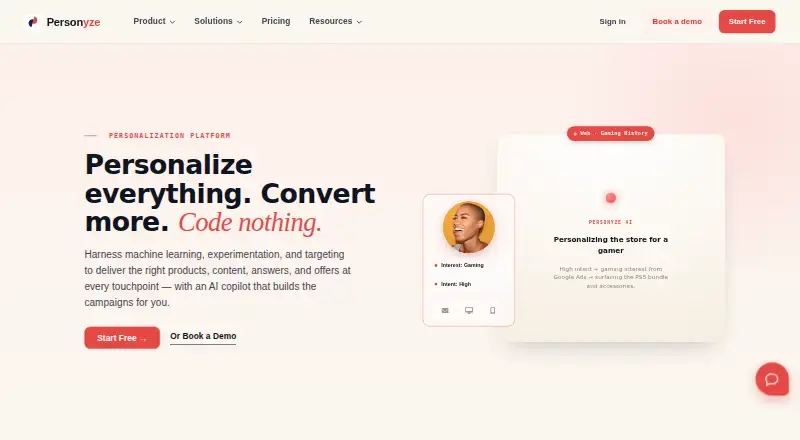
What Personyze is
Personyze personalizes websites and marketing by combining visitor behavior and data to change pages, product recommendations, and emails in real time. Its behavioral targeting uses more than 70 attributes, while 50-plus recommendation algorithms cover products and content. Teams can run A/B and multivariate tests with significance calculations, audience splits, and holdout groups on every plan. The platform is available on web, Android, iOS, and through an API. Its listed integrations include HubSpot, Salesforce, Twilio Segment, Tealium, Google Tag Manager, and the REST API. Higher plans add email personalization at open time, broadcast email and SMS, browser push notifications, and mobile SDK personalization. Consent controls can hold tracking until consent; the maker says gated mode does not read or write device data beforehand. Page views are the primary usage meter, with plan-specific charges for overages.
Good
- More than 70 behavioral targeting attributes.
- 50+ algorithms for product and content recommendations.
- A/B and multivariate testing on every plan.
- Consent controls can delay tracking.
- Free plan available.
Watch out
- Page views are the primary usage meter.
- Overages are billed in plan-specific blocks.
- Several channels are added only on higher plans.
Who it suits
Personyze suits ecommerce, SaaS, B2B, publishing, travel and hospitality, or education teams seeking real-time personalization and testing. It may also fit teams that need consent controls and integrations with the listed platforms.
Verdict
Personyze brings behavioral targeting, recommendations, and experimentation into one personalization platform. Check page-view allowances and which channels are included before choosing a plan.
Plans and prices
From Personyze's own pricing page, checked 14 Oct 2026.
| Plan | Price | What it gives you |
|---|---|---|
| Free | Free | 5k pageviews · 1 domain · 3 active campaigns · 8 AI tasks/month · email support · forever |
| Personyze STARTER (Shopify) | $99 a month | 25,000 pageviews/month · 100 AI chats/month · product recommendations · popups, banners and A/B testing · behavior targeting · 7-day trial · recurring every 30 days |
| Starter | $149 a month | 50k pageviews · +$40 per extra 100k · 1 domain · 12 AI tasks/month · basic support · monthly |
| Personyze LITE (Shopify) | $249 a month | Product recommendations · social proof · A/B testing · targeted promotions · dynamic email content · 7-day trial · recurring every 30 days |
| Growth | $250 a month | 100k pageviews · +$40 per extra 100k · 2 domains · 16 AI tasks/month · email and SMS personalization · monthly |
| Power | $450 a month | 1M pageviews · +$100 per extra 1M · 5 domains · 26 AI tasks/month · dedicated account manager · monthly |
| Enterprise | $1,450 a month | 10M pageviews · +$80 per extra 1M · 10 domains · 44 AI tasks/month · iOS/Android SDKs · headless API · custom SLAs · monthly |
| Personyze LITE annual (Shopify) | $2,249 a year | Same Lite features · 25% annual saving · annual |
The facts
Each one read from Personyze's own pages, with the date it was checked.
What it does
- A/B and multivariate testing
- Users can test headlines, layouts, calls to action and whole pages with audience splits, significance calculations and holdout groups.checked 14 Oct 2026
- Access controls
- The platform supports SSO, two-factor sign-in, Google or Microsoft work account sign-in, and role-based permissions.checked 4 Oct 2026
- AI chat and search
- The AI search and chat tools answer visitors from the customer’s pages, documents and catalog, including product prices, stock and sizes.checked 14 Oct 2026
- API limitation
- The API reference says actions and audience conditions are currently read-only over REST, while user, list and catalog objects support CRUD operations.checked 14 Oct 2026
- Audience and ABM targeting
- Behavioral segments, AI audience discovery and account-based marketing can identify target companies and personalize experiences using CRM or enrichment data.checked 14 Oct 2026
- Cancellation
- Personyze says customer data is deleted within 90 days after cancellation.checked 4 Oct 2026
- Channels
- Higher plans add open-time email personalization, broadcast email and SMS, browser push notifications, and mobile SDK personalization.checked 4 Oct 2026
- Consent
- Consent controls can delay tracking until consent, and the maker says no device data is read or written before consent in either gated mode.checked 4 Oct 2026
- Deployment model
- The normal deployment is an asynchronous JavaScript tag or tag-manager template that works on browser-based sites and supports single-page applications; Personyze states its data is hosted on AWS.checked 14 Oct 2026
- Documentation depth
- The public wiki includes installation paths, integration guides, campaign and recommendation tutorials, analytics, privacy, troubleshooting, API authentication, path parameters and per-object endpoint references.checked 14 Oct 2026
- Dynamic landing pages
- Landing pages can render different variants according to segment, referrer, campaign source or behavior without changing site code.checked 14 Oct 2026
- Historical criticism
- A Forbes criticism cited by Wikipedia argued that personalization can contribute to filter bubbles by repeatedly showing only content inferred from prior activity.checked 14 Oct 2026
- Integrations
- Listed connectors cover Shopify, Magento, WooCommerce, BigCommerce, Salesforce Commerce Cloud, WordPress, Drupal, Joomla, Wix, Squarespace, Webflow, Segment, Tealium, GA4, Salesforce, HubSpot, Dynamics 365, Zoho, Marketo, Mailchimp, Klaviyo, Brevo, Omnisend, ActiveCampaign, Zapier, Make, n8n, Slack and webhooks.checked 14 Oct 2026
- Limit: campaign controls
- A reviewer reports missing basic template controls such as a popup close button and campaigns sometimes becoming live while still intended as drafts.checked 14 Oct 2026
- Limit: learning curve
- Multiple reviewers say the large number of settings and options makes initial setup and campaign creation difficult.checked 14 Oct 2026
- Limit: reporting
- Reviewers request better dashboards, report filtering and ways to share reporting with sales teams.checked 14 Oct 2026
- Limits
- Page views are the primary usage meter, and overages are billed by plan-specific blocks; monthly plan users are not moved to a higher tier without consent.checked 4 Oct 2026
- Notable news
- Wikipedia records a June 2011 partnership announcement with Rapleaf to add demographic data to Personyze personalization.checked 14 Oct 2026
- Personalization
- The platform supports behavioral targeting with 70+ attributes and real-time content changes across site elements.checked 4 Oct 2026
- Praise: flexibility and value
- Reviewers describe the product as feature-rich, flexible, affordable and useful as an all-in-one ecommerce personalization suite.checked 14 Oct 2026
The company
- Company facts
- LinkedIn lists Personyze as privately held, founded in 2008, headquartered in Tel Aviv, with 11–50 employees.checked 14 Oct 2026
- Company history
- Personyze’s own history says its first behavioral-targeting product shipped in 2008, unified personalization followed in 2012, A/B testing in 2016, email and push in 2019, and AI copilots in 2024.checked 14 Oct 2026
- Founded
- 2008checked 23 Sep 2026
- Independent company record
- Startup Nation Central lists Israeli registrar number 514127026, 11–50 employees and undisclosed funding, but its profile incorrectly labels the company non-active and says operations ceased in August 2021.checked 14 Oct 2026
The full review of Personyze
Overview
Personyze is a personalization platform for teams that want to coordinate behavioral targeting, recommendations, and experimentation across digital experiences. It suits organizations with enough traffic and campaign activity to make those capabilities useful, but its page-view quotas make plan fit important.
Its breadth is a strength: testing is included across plans, while higher tiers extend personalization into additional channels. The trade-off is a usage-based ladder that can become costly as traffic grows.
Key features
Personyze uses more than 70 behavioral attributes to target visitors and change site content in real time. That gives teams a broad basis for tailoring site elements, though the practical ceiling will depend on how effectively they define audiences and campaigns.
More than 50 recommendation algorithms cover products and content, making the platform relevant beyond retail catalogs. A/B and multivariate testing include significance calculations, audience splits, and holdout groups on every plan. That is a meaningful baseline for teams that want to evaluate personalization rather than simply deploy it.
Higher plans add open-time email personalization, broadcast email and SMS, browser push notifications, and mobile SDK personalization. Integrations include HubSpot, Salesforce, Twilio Segment, Tealium, Google Tag Manager, and the REST API. The visual editor and experiment workflows support campaign creation and comparison.
Consent controls can defer tracking until consent; Personyze says its gated modes do not read or write device data before consent. The company says the service runs on AWS, isolates customer data in separate database tables, uses HTTPS for its dashboard, API, and tracking code, and conducts monthly penetration testing. Access controls include SSO, two-factor sign-in, Google or Microsoft work-account sign-in, and role-based permissions.
Pricing
The free plan costs nothing, billed Forever. It allows 5k pageviews, one domain, three active campaigns, and eight AI tasks a month, with email support. This is a useful low-commitment starting point, but its traffic and campaign caps make it a narrow fit for ongoing, higher-volume programs.
Starter costs $149 a month, billed Monthly, for 50k pageviews, one domain, 12 AI tasks a month, and Basic support. It adds room for regular campaigns, but the same single-domain limit as Free may constrain teams managing multiple sites. Growth costs $250 a month, billed Monthly, and raises the allowance to 100k pageviews, two domains, and 16 AI tasks a month, also with Basic support. It fits teams that need a second domain and more capacity without moving to a large traffic tier.
Power costs $450 a month, billed Monthly, and includes 1M pageviews, five domains, 26 AI tasks a month, and an account manager. It is the stronger fit for multi-site operations with substantial traffic. Enterprise costs $1,450 a month, billed Monthly, and includes 10M pageviews, ten domains, 44 AI tasks a month, and Enterprise support; it targets larger programs that need the highest stated allowances.
Page views are the primary usage meter. Starter and Growth overages cost +$40 per extra 100k; Power overages cost +$100 per extra 1M; Enterprise overages cost +$80 per extra 1M. Monthly-plan customers are not moved to a higher tier without consent. Paid plans include email, chat, and 24/7 phone support; Starter includes up to one hour and Growth up to two hours of campaign build help monthly. AI Chat Agent, Hosted Landing Pages, and Audience Discovery add-ons each have a free trial, with no stated duration. Personyze says customer data is deleted within 90 days after cancellation.
Platforms
Personyze supports Android, iOS, web, and API. Its channel-specific mobile SDK personalization is reserved for higher plans, so mobile teams should distinguish platform availability from the features included at their tier.
Who it's for
Personyze describes use by ecommerce, SaaS, B2B, publishing and media, travel and hospitality, and education teams. It is most compelling for organizations that need targeting, recommendations, and testing together, especially when they can match page-view and domain allowances to their operation. A team seeking only a small, low-cost recommendation service may find the wider platform and tier structure unnecessary.
Pros and cons
- Pros: Behavioral targeting, recommendations, and A/B and multivariate testing are combined, and testing is included on every plan.
- Pros: The free plan provides a way to begin without a subscription, while paid tiers scale page views and domains with published overage rates.
- Pros: Consent controls and multiple account-security options address privacy and access-management needs.
- Cons: Free is capped at 5k pageviews, one domain, and three active campaigns, limiting its use for larger programs.
- Cons: Page-view overages add cost, and higher-tier monthly prices rise substantially as traffic capacity expands.
- Cons: Several additional channels are limited to higher plans, so a lower-tier buyer may not get the multichannel setup they want.
Alternatives
Recombee is worth considering when recommendation delivery is the priority: its Forever free plan allows fewer than 100,000 interactions and recommendation requests a month, fewer than 20,000 active users, and fewer than 20,000 catalog items. Personyze is the more directly described choice for combining recommendations with on-site targeting and experimentation.
Amazon Personalize may suit teams comparing a usage-limited starting point: its AWS Free Tier is free for the first two months and includes up to 20 GB of data processing and storage per month, plus up to 5 million interactions per month for User-.
Netcore Unbxd Personalization is another paid personalization option.
Treasure AI Composable CDP may fit buyers considering a paid composable CDP; its plan is custom pricing, with warehouse credits applying to query execution.
Pega CRM is another paid web option, with a free trial.
Kameleoon is worth comparing if a short experiment-focused trial matters: its PBX Starter trial is free for 30 days, requires no credit card, and supports up to three experiments. Its paid PBX Starter price is $495 a month.
Barilliance is another paid web option; its Live! plan starts at $250 a month.
Verdict
Choose Personyze if your team wants one platform for behavioral targeting, recommendations, and experimentation, and its page-view, domain, and AI-task allowances fit your workload. Its broad feature set and testing on every plan are the main reasons to choose it; the traffic-based cost ladder and higher-plan channel restrictions are the reasons to look elsewhere.
Getting started
- Visit https://www.personyze.com/.
- Start with the free plan or choose a paid plan from $149 a month.
- Use the free trial for the AI Chat Agent, Hosted Landing Pages, or Audience Discovery add-on if relevant.
- Connect through a named integration such as HubSpot, Salesforce, Twilio Segment, Tealium, Google Tag Manager, or the REST API.
Limits worth knowing
The Free plan allows 5k pageviews, one domain, three active campaigns, and eight AI tasks a month. Paid plans have plan-specific page-view allowances and overage blocks; monthly users are not moved to a higher tier without consent.
Questions
Is Personyze free?
Yes. The Free plan costs nothing, billed Forever, and includes 5k pageviews, one domain, three active campaigns, and eight AI tasks a month.
How much do paid plans cost?
Starter is $149 a month, Growth $250 a month, Power $450 a month, and Enterprise $1,450 a month.
Which platforms does Personyze support?
The listed platforms are Android, API, iOS, and web.
What integrations are named?
Personyze names HubSpot, Salesforce, Twilio Segment, Tealium, Google Tag Manager, and the REST API.
What happens to customer data after cancellation?
Personyze says customer data is deleted within 90 days after cancellation.
Alternatives to Personyze
- 1

Zoho PageSense
Free planAndroidiOSWebAPI8.1From $20 a month - 2

Omniconvert Explore
Free planAndroidiOSWebAPI8.0From $167 a month - 3

AB Tasty
AndroidiOSWebAPI7.9From €15,000 a year - 4

ConvertFlow
Free planWebAPI7.6From $29 a month - 5

Poptin
Free planWebAPI7.5From $25 a year - 6

Freshmarketer
Free planWebAPI7.4From $15 a month