
Treasure AI Composable CDP
Treasure AI Composable CDP provides customer identity resolution, segmentation, AI decisioning, and activation using a company's existing cloud data warehouse.
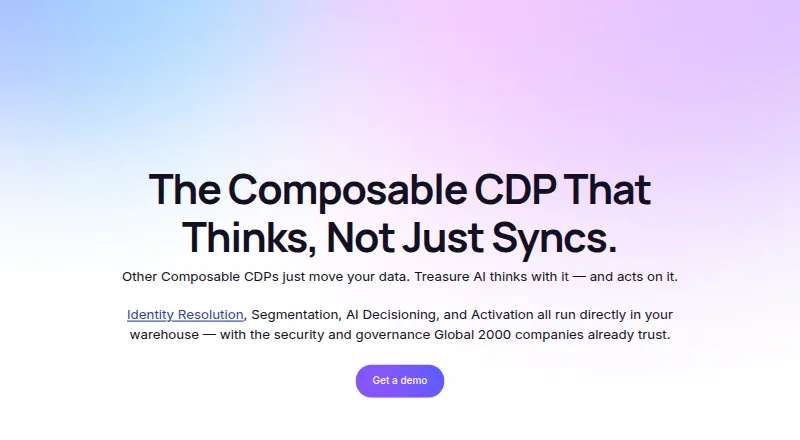
What Treasure AI Composable CDP is
Treasure AI Composable CDP provides customer identity resolution, segmentation, AI decisioning, and activation using a company's existing cloud data warehouse. It supports Snowflake, Databricks, and Google BigQuery, with broader zero-copy capability for Amazon Redshift. Identity resolution, machine learning, and AI decisioning queries run on the customer's warehouse compute. Customer data is described as remaining in that warehouse rather than being persistently stored in Treasure AI's infrastructure, although temporary caches may be used. Native messaging covers email, SMS, and mobile push; activation data passes through Treasure AI for delivery and is then discarded. Marketers can build audiences visually from warehouse data without SQL, and journey orchestration supports batch and real-time operation. The product page states SOC 2 Type II certification and HIPAA and GDPR compliance, and cites support for 8B+ profiles and 99.99% uptime. It also lists 300+ prebuilt connectors and more than 200 activation destinations. Pricing is on request, and warehouse credits apply to query execution; a 14-day trial is listed.
Good
- Uses existing warehouse compute for key queries.
- Supports Snowflake, Databricks, BigQuery, and Redshift.
- Visual audience building does not require SQL.
- Journey orchestration supports batch and real-time operation.
- Native email, SMS, and mobile push messaging.
Watch out
- Pricing is available on request.
- Warehouse credits apply for query execution.
- There is no free plan.
Who it suits
This platform suits enterprise teams that want to build audiences and orchestrate activation from data in their existing warehouse. It may also suit marketers who want visual audience building without writing SQL.
Verdict
Treasure AI Composable CDP keeps its core data work tied to a customer's warehouse while offering audience creation and activation tools. Consider the request-based pricing and warehouse-credit requirement when assessing fit.
Plans and prices
From Treasure AI Composable CDP's own pricing page, checked 21 Sep 2026.
| Plan | Price | What it gives you |
|---|---|---|
| Intelligent Customer Data Platform | Priced on request | Unified data ingestion and profile unification · Segmentation and audience management · Batch audience activation · Journey orchestration · Security, privacy and governance controls · QA and development sandboxes |
| Treasure AI Composable CDP | Priced on request | Custom pricing not stated on the product page · warehouse credits apply for query execution |
The facts
Each one read from Treasure AI Composable CDP's own pages, with the date it was checked.
What it does
- API access
- Composable Audience Studio documentation describes an API endpoint for creating composable audiences, authenticated with a Treasure AI API key.checked 29 Sep 2026
- Audience building
- Composable Audience Studio lets marketers visually build audiences on warehouse data without writing SQL.checked 29 Sep 2026
- Batch and real time
- The page says journey orchestration supports both batch and real-time operation.checked 29 Sep 2026
- Data handling
- The page says customer data is persisted in the customer's warehouse and not persistently stored in Treasure AI's infrastructure, though ephemeral caches may be used for low-latency access.checked 29 Sep 2026
- Integrations
- The product page describes 300+ pre-built connectors and more than 200 activation destinations.checked 29 Sep 2026
- Intended customers
- Treasure AI describes the Composable CDP as built for enterprise environments and cites use by global brands.checked 29 Sep 2026
- Messaging
- Native messaging includes email, SMS, and mobile push, with activation data passing through Treasure AI transiently for delivery and then being discarded.checked 29 Sep 2026
- Purpose
- It provides warehouse-native customer identity resolution, segmentation, AI decisioning, and activation using a customer's existing cloud data warehouse.checked 29 Sep 2026
- Scale and availability
- The product page cites support for 8B+ profiles and 99.99% uptime.checked 29 Sep 2026
- Security and compliance
- The product page states that Treasure AI is SOC 2 Type II certified and HIPAA and GDPR compliant.checked 29 Sep 2026
- Support
- Treasure AI lists Standard, Advanced, Corporate, and Enterprise support tiers; Standard Support is included with SaaS subscriptions.checked 29 Sep 2026
- Warehouse support
- The product supports Snowflake, Databricks, and Google BigQuery, and its broader zero-copy capability also covers Amazon Redshift.checked 29 Sep 2026
- Zero-copy processing
- Identity resolution, machine learning, and AI decisioning queries run on the customer's warehouse compute.checked 29 Sep 2026
The company
- Company history
- Treasure AI says it was formerly Treasure Data and that it has built enterprise customer data platforms since 2011.checked 29 Sep 2026
- Founded
- 2011checked 28 Sep 2026
- Headquarters
- Mountain View, California, United Stateschecked 28 Sep 2026
The full review of Treasure AI Composable CDP
Treasure AI Composable CDP is a warehouse-native customer data platform for organizations that want identity, audiences, AI decisions, and activation to operate on their own cloud data. It is best suited to enterprise teams with a supported warehouse and sophisticated cross-channel programs. The architecture is powerful for that audience, while custom pricing and warehouse-credit usage make total cost an important part of the decision.
Overview
Treasure AI connects customer data work to Snowflake, Databricks, and Google BigQuery, with zero-copy support extending to Amazon Redshift. Identity resolution, machine-learning workloads, and AI decisioning query the customer’s warehouse compute instead of requiring a separate persistent copy in Treasure AI’s infrastructure. Customer data remains in the warehouse; ephemeral caches can be used for low-latency access.
This approach gives data and governance teams a clear home for customer records, but it also means query execution consumes warehouse credits in addition to the software subscription. Treasure AI positions the platform for enterprise environments, citing more than 8 billion profiles and 99.99% uptime. The company says it has built enterprise CDPs since 2011 and was formerly Treasure Data.
Key features
Composable Audience Studio provides a visual way for marketers to create audiences from warehouse data without writing SQL. That lowers the technical barrier to segmentation while preserving the warehouse as the source of truth. An API endpoint can also create composable audiences, authenticated with a Treasure AI API key, which suits teams embedding audience creation in their own workflows.
Journey orchestration supports batch and real-time operation. Native delivery covers email, SMS, and mobile push; activation data passes through Treasure AI transiently for delivery and is then discarded. That design supports channel execution without turning Treasure AI into a second long-term data store.
The platform offers real-time profiles, hybrid matching, identity resolution, household matching, real-time APIs, and batch file import. Personalization options span web, apps, content, and offers, with experimentation and server-side delivery included. More than 300 pre-built connectors and over 200 activation destinations give integration teams broad starting coverage, although the practical value depends on whether the destinations match a company’s stack.
Treasure AI states that it is SOC 2 Type II certified and HIPAA and GDPR compliant. Standard, Advanced, Corporate, and Enterprise support tiers are available, with Standard Support included in SaaS subscriptions.
Pricing
The Treasure AI Composable CDP plan uses custom pricing, with a 14-day trial. There is no free plan. Warehouse credits apply to query execution, so buyers should budget for both the negotiated subscription and the compute generated by identity, audience, and decisioning workloads.
Custom pricing and the warehouse dependency fit organizations able to forecast usage and negotiate an enterprise agreement. They are less suitable for small teams seeking a self-serve entry point, a permanent free tier, or a predictable all-in monthly bill. The 14-day trial is useful for an initial evaluation, but it is short for validating complex warehouse integrations and multi-channel journeys.
Platforms
Treasure AI Composable CDP is available on Android, iOS, web, and through an API. The API and server-side delivery options are particularly relevant to teams that need to connect activation to existing applications and services.
Who it's for
This is a strong fit for global brands and enterprise data or marketing teams already operating Snowflake, Databricks, BigQuery, or Redshift. It suits organizations that want marketers to build audiences visually while data remains governed in the warehouse, and that need batch and real-time activation across many destinations.
Look elsewhere if you lack an established cloud warehouse, need transparent subscription pricing, or want a no-cost plan for a smaller deployment. The warehouse-credit requirement and enterprise support model can be disproportionate for lightweight personalization projects.
Pros and cons
Pros
- Warehouse-native processing: Identity, machine learning, and decisioning run on existing warehouse compute, while customer data is not persistently stored in Treasure AI.
- Broad activation: Native email, SMS, and mobile push plus 300+ connectors and 200+ destinations support large channel programs.
- Flexible audience operations: Visual, no-SQL audience building is complemented by an authenticated API.
- Enterprise coverage: Real-time profiles, household matching, personalization, experimentation, and stated support for 8B+ profiles address complex deployments.
Cons
- Custom pricing: Buyers cannot compare a published subscription price before engaging sales.
- Additional compute cost: Query execution uses warehouse credits, making usage forecasting part of procurement.
- No free plan: Smaller teams have only the 14-day trial as an initial evaluation window.
- Enterprise orientation: The platform is harder to justify without a mature warehouse and substantial activation needs.
Alternatives
Personyze is the better starting point for smaller personalization programs that want a freemium option, including a free plan capped at 5,000 pageviews, one domain, three active campaigns, and eight AI tasks per month.
Recombee suits recommendation-focused projects seeking a permanent free tier with limits of fewer than 100,000 interactions and requests per month, fewer than 20,000 active users, and fewer than 20,000 catalog items.
Amazon Personalize is worth considering when an AWS-based service and a first-two-month free tier are preferable; its stated tier includes up to 20 GB of monthly data processing or storage and 5 million interactions.
Netcore Unbxd Personalization is another paid personalization option for Android, iOS, web, and API deployments.
ZS Personalize.AI is a paid alternative for teams willing to request a demo.
AB Tasty is the alternative to consider when experimentation is the priority; its Pro plan includes unlimited experiments, variations, and metrics, three workspaces, three domains, and advanced support.
Pega CRM is a paid, web-based CRM option with a free trial.
Taggstar is a paid choice for social-proof messaging with API-request-based pricing.
For broader category comparisons, see Personalization Software, Retail CRM Software, Identity Resolution Software, and Customer Data Platforms.
Verdict
Choose Treasure AI Composable CDP if your enterprise already runs a supported warehouse and needs governed identity resolution, audience creation, AI decisioning, and activation without copying customer data into another persistent platform. Its main reason to look elsewhere is the combination of custom pricing and warehouse-credit consumption, which makes it a poor fit for teams seeking a low-cost, self-serve CDP.
Alternatives to Treasure AI Composable CDP
- 1

RudderStack Customer Data Platform
Free planOpen sourceAndroidiOSWebAPI8.5From $265 a month - 2

Hightouch
Free planAndroidiOSWebAPI8.2From $350 a month - 3

Twilio Segment
Free planAndroidiOSWebAPI8.2From $120 a month - 4
Manago AI (formerly SALESmanago)
Free planAndroidiOSWebAPI8.1From €30 a month - 5

Leadspace
Free planWebAPIExtension7.7From $49 a month - 6
SAP Analytics Cloud
AndroidiOSWebAPI7.6From $36 a month