
Amazon Personalize
Amazon Personalize is a managed machine learning service that uses customer data to generate item recommendations and user segments.
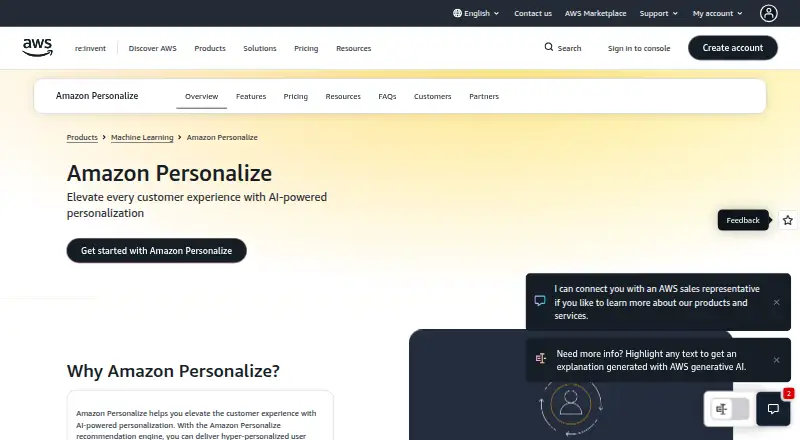
What Amazon Personalize is
Amazon Personalize is a managed machine learning service that uses customer data to generate item recommendations and user segments. Its options include user personalization, personalized ranking, similar items, personalized search, user segmentation, Trending Now, and Next Best Action. It supports both real-time recommendations and batch workflows. The user-personalization recipe can be trained on up to 3 billion interactions and 5 million unique items. Inference is available through the getRecommendations and getPersonalizedRanking APIs. A search-ranking plugin integrates with OpenSearch v2.9 and above to personalize search results in real time. Listed AWS integrations include SageMaker AI Data Wrangler, Amplify, S3, CloudWatch, and CloudTrail; partner services include Amplitude, Braze, Optimizely, and Segment. AWS says data is encrypted and models are unique to each customer account rather than shared with other AWS accounts or Amazon business units. A free tier is available for the first two months of usage, with monthly allowances for data processing, interactions, training, and real-time requests. Pay-as-you-go pricing has no minimum fees or upfront commitments.
Good
- Offers real-time and batch recommendations
- Supports seven recommendation and segmentation types
- Integrates with OpenSearch v2.9 and above
- Models are unique to each customer account
Watch out
- Free tier lasts for the first two months of usage
- Pay-as-you-go rates are not fully listed
- No web experimentation is listed
Who it suits
It may suit app and web teams that want personalized recommendations or user segments from customer data. It also supports teams needing real-time recommendations, bulk batch workflows, or personalized search results through OpenSearch.
Verdict
Amazon Personalize covers several recommendation and segmentation workflows, with both real-time and batch delivery. Review the free-tier allowances and pay-as-you-go rates for the workload you expect.
Plans and prices
From Amazon Personalize's own pricing page, checked 15 Oct 2026.
| Plan | Price | What it gives you |
|---|---|---|
| AWS Free Tier | Free | 20 GB data processing/storage per month · 5 million interactions/month for User-Personalization-v2 and Personalized-Ranking-v2 · 100 training hours/month for other custom solutions · 50,000 v2 or 180,000 other real-time requests/month · first two months of Amazon Personalize use |
| v2 recipe usage | $0.05 a month | $0.05/GB data ingestion · $0.002/1,000 training interactions · $0.15/1,000 recommendation requests · usage-based |
| Custom recommendation solutions | $0.24 a month | $0.05/GB ingestion · $0.24/training hour · inference rates vary by request volume and recipe · usage-based |
| Amazon Personalize pay-as-you-go | — | v2 data ingestion $0.05/GB · v2 training $0.002 per 1,000 interactions · v2 inference $0.15 per 1,000 recommendation requests · custom-solution training $0.24 per training hour · custom-solution real-time inference $0.0556 per 1,000 requests for first 72 million monthly requests · pay only for what you use; no minimum fees or upfront commitments |
The facts
Each one read from Amazon Personalize's own pages, with the date it was checked.
What it does
- API documentation
- The API reference documents operations, data types, common errors, common parameters, regional endpoints, and quotas.checked 15 Oct 2026
- Automatic training update
- An August 30, 2024 launch lets users change automatic retraining status and cadence on existing solutions through the API or console.checked 15 Oct 2026
- AWS integrations
- Amazon Personalize integrates with Amazon SageMaker AI Data Wrangler, AWS Amplify, Amazon S3, Amazon CloudWatch, and AWS CloudTrail.checked 1 Oct 2026
- Batch and streaming
- Personalize supports low-latency real-time recommendations, batch generation for large campaigns, and incremental bulk imports.checked 15 Oct 2026
- Business rules
- Filters and promotion rules can exclude items, enforce business constraints, and control the proportion of promoted content.checked 15 Oct 2026
- Compliance
- Third-party auditors assess Amazon Personalize under AWS compliance programs including SOC, PCI, and HIPAA.checked 1 Oct 2026
- Content Generator
- Content Generator uses generative AI to write thematic snippets describing why recommended items belong together.checked 15 Oct 2026
- Contextual recommendations
- Recommendation requests can include context such as device type and time of day to improve relevance.checked 15 Oct 2026
- Data privacy
- Amazon Personalize models are unique to each customer account and are not shared with other AWS accounts or Amazon business units.checked 1 Oct 2026
- Documentation depth
- The developer guide covers preparation, schemas, recipes, training, deployment, batch jobs, filtering, troubleshooting, IAM, VPC endpoints, quotas, and API operations.checked 15 Oct 2026
- Inference APIs
- The service provides getRecommendations and getPersonalizedRanking inference APIs.checked 1 Oct 2026
- Integrations
- Documented integrations include S3, SageMaker AI Data Wrangler, AWS Amplify, OpenSearch, Amplitude, Braze, Optimizely, Segment, CloudWatch Evidently, and LangChain.checked 15 Oct 2026
- LangChain
- AWS provides preconfigured LangChain integration code that invokes Personalize and passes recommendations into generative-AI applications.checked 15 Oct 2026
- Latest documented change
- The November 30, 2025 documentation history entry added the Semantic-Similarity recipe with metadata-based similarity, optional popularity or timestamp ranking, incremental training, and selectable training columns.checked 15 Oct 2026
- Limit: black-box operations
- G2 reviewers mention limited explanation of recommendation decisions, fragmented logs, difficult debugging, and a lack of built-in performance visualizations.checked 15 Oct 2026
- Limit: data preparation
- G2 reviewers repeatedly say clean interaction data, schema design, and initial pipeline setup require substantial effort.checked 15 Oct 2026
- Limit: Gartner reviewer concern
- Gartner's displayed criticism says the product requires e-commerce understanding, is oriented toward online sellers, and may fit smaller businesses better than larger ones.checked 15 Oct 2026
- Next Best Action
- Next Best Action recommends likely actions such as joining a loyalty program, subscribing to email, or downloading an app.checked 15 Oct 2026
- Partner support
- AWS Personalize Partners assist with data preparation, model optimization, and end-to-end solutions, and are qualified to deliver a proof of concept in four days or less.checked 1 Oct 2026
The company
- Founded
- 2019checked 28 Sep 2026
- Maker company facts
- LinkedIn lists AWS as founded in 2006, headquartered in Seattle, publicly held, and employing 10,001 or more people.checked 15 Oct 2026
- Maker legal name
- Amazon Web Services (AWS) is identified on LinkedIn as the AWS organization and on AWS legal materials as Amazon Web Services, Inc.checked 15 Oct 2026
Money
- Limit: cost and transparency
- G2 reviewers report that campaign, endpoint, and inference costs can rise quickly and that billing drivers are not always obvious.checked 15 Oct 2026
- Limit: support and billing complaints
- Trustpilot's AWS reviewers frequently report difficulty reaching human support, unexpected or continuing charges, account suspensions, and slow case responses.checked 15 Oct 2026
Getting started
- Visit https://aws.amazon.com/personalize/.
- Start with the AWS Free Tier, which is listed for the first two months of usage, or use the pay-as-you-go plan.
- Use customer data to generate recommendations or user segments.
- Choose real-time recommendations or batch recommendations for bulk workflows.
- Connect through the inference APIs or the listed integrations.
Limits worth knowing
The AWS Free Tier is billed for the first two months of usage and lists up to 20 GB of data processing and storage per month, up to 5 million monthly interactions for User-Personalization-v2 and Personalized-Ranking-v2, and up to 100 monthly training hours for other Custom Recommendation Solutions. The listed free-tier allowance for real-time requests is cut off at 50,000. Pay-as-you-go lists v2 ingestion at $0.05/GB, v2 training at $0.002 per 1,000 interactions, v2 inference at $0.15 per 1,000 recommendation requests, and custom-solution training at $0.24 per training hour; other rate details are cut off.
Questions
What does Amazon Personalize do?
It uses customer data to generate item recommendations and user segments. Recommendation options include personalized ranking, similar items, personalized search, Trending Now, and Next Best Action.
Does Amazon Personalize have a free plan?
Yes. The AWS Free Tier is listed as free and is billed for the first two months of usage, with monthly allowances.
What does pay-as-you-go cost?
No overall plan price is listed. Rates include v2 data ingestion at $0.05/GB, v2 training at $0.002 per 1,000 interactions, and v2 inference at $0.15 per 1,000 recommendation requests.
What platforms does it support?
The listed platforms are Android, API, iOS, and web.
What services does it integrate with?
Listed AWS integrations include SageMaker AI Data Wrangler, AWS Amplify, Amazon S3, CloudWatch, and CloudTrail. Listed partner services include Amplitude, Braze, Optimizely, and Segment.
How does Amazon Personalize handle customer models?
Models are unique to each customer account and are not shared with other AWS accounts or Amazon business units. The service encrypts data and supports AWS Identity and Access Management.
Alternatives to Amazon Personalize
- 1

Personyze
Free planAndroidiOSWebAPI8.2From $99 a month - 2

AB Tasty
AndroidiOSWebAPI7.9From €15,000 a year - 3
Salesforce Personalization
AndroidiOSWebAPI7.4From $8,000 a month - 4
Nosto
AndroidiOSWebAPI7.3From $0.01 a month - 5
Frankie AI
Free planAndroidiOSWebAPI7.2From $10 a month - 6

Mida
Free planAndroidiOSWebAPI7.2From $299 a month