
Netcore Unbxd Personalization
Netcore Unbxd Personalization adjusts ecommerce search results, product listings, and recommendations to each shopper.
What Netcore Unbxd Personalization is
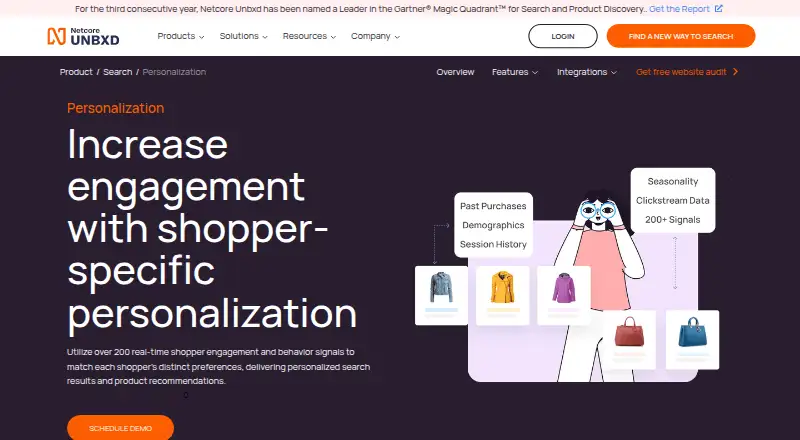
Netcore Unbxd Personalization adjusts ecommerce search results, product listings, and recommendations to each shopper. The engine uses more than 200 real-time signals, including shopper behavior, catalog, query, and contextual information. During a session, it uses intent and activity to surface relevant products as shoppers move through a site. For first-time shoppers, it infers intent from patterns among similar shoppers and segments. Teams can use a visual workbench to create, test, deploy, and optimize strategies without coding. Business and merchandising teams can configure rules and segments, including logic for diversity, newness, or raising products that receive little attention. Testing includes A/B experiments and multi-arm bandit models that favor strategies based on conversion or engagement metrics. Personalization can reach search, listings, product pages, cart, checkout, post-purchase experiences, homepage widgets, and email campaigns. Listed integrations include Shopify, BigCommerce, Hybris, and Magento, with iOS and Android SDKs and APIs also available. Pricing is on request.
Good
- Uses more than 200 real-time signals.
- Visual workbench requires no coding.
- Supports A/B and multi-arm bandit testing.
- Covers search, listings, checkout, and email.
- iOS and Android SDKs are listed.
Watch out
- Pricing is available only on request.
- Business use requires configuring strategies and rules.
- Browser TLS support should be enforced by customers.
Who it suits
It suits ecommerce retailers seeking to tailor product discovery across shopping touchpoints. Its no-code workbench is intended for business and merchandising teams configuring personalization rules and experiments.
Verdict
Netcore Unbxd Personalization combines real-time shopper signals with configurable merchandising rules and experimentation. Retailers should request pricing and assess its integrations and security requirements.
The facts
Each one read from Netcore Unbxd Personalization's own pages, with the date it was checked.
What it does
- Audience
- The product page describes the offering for ecommerce shoppers and identifies business and merchandising teams as users of its controls.checked 30 Sep 2026
- Behavioral signals
- The page says the engine uses more than 200 real-time shopper engagement and behavior signals.checked 30 Sep 2026
- Business controls
- Business and merchandising teams can configure rules, define segments, and apply business logic such as diversity, newness, or starving-product uplift.checked 30 Sep 2026
- Cold start
- For first-time shoppers, it uses patterns from similar shopping patterns and segments to infer intent.checked 30 Sep 2026
- Data privacy
- The maker's FAQ says its products do not collect consumer personal data such as email ID, username, or phone number, subject to stated conditions.checked 30 Sep 2026
- Infrastructure
- The infrastructure page describes DDoS protection, Cloudflare delivery measures, redundancy across availability zones, and managed failover.checked 30 Sep 2026
- In-session personalization
- It uses shopper intent and behavior during a session to present relevant products as the shopper navigates.checked 30 Sep 2026
- Integrations
- The maker lists Shopify, BigCommerce, Hybris, and Magento integrations.checked 30 Sep 2026
- Intended users
- The maker presents the product for ecommerce retailers and highlights solutions for apparel and lifestyle, jewelry, home and living, retail and marketplaces, and electronics.checked 30 Sep 2026
- Mobile SDKs
- The documentation lists iOS and Android SDKs for integrating Unbxd search into mobile apps.checked 30 Sep 2026
- No-code workbench
- A visual UI workbench lets teams create, test, deploy, and optimize personalization strategies without coding or development effort.checked 30 Sep 2026
- Product
- Netcore Unbxd Personalization is an AI-powered engine that tailors search results, product listings, and recommendations to each shopper.checked 30 Sep 2026
- Purpose
- Netcore Unbxd Personalization tailors search results, product listings, and recommendations to each shopper using more than 200 behavioral, catalog, query, and contextual signals in real time.checked 30 Sep 2026
- Recovery objectives
- The infrastructure page states a two-hour Recovery Point Objective and an automated Recovery Time Objective.checked 30 Sep 2026
- SDKs and APIs
- The integration directory lists iOS and Android SDKs and Netcore Unbxd APIs.checked 30 Sep 2026
- Security
- The maker’s Trust Center describes SOC 2 Type 2, HIPAA, and OWASP certification information and offers access to detailed security documentation by request.checked 30 Sep 2026
- Shopping journey
- Personalization can be applied to search, category and listing pages, product pages, cart, checkout, post-purchase experiences, home page widgets, and email campaigns.checked 30 Sep 2026
- Support
- The contact page provides a contact support option alongside sales, demo, and general inquiry options.checked 30 Sep 2026
- Testing
- Its testing framework supports A/B experiments and multi-arm bandit models to favor strategies based on conversion or engagement metrics.checked 30 Sep 2026
- Touchpoints
- Personalization can be applied to search results, category and listing pages, product detail pages, cart and checkout, post-purchase experiences, home-page widgets, and email campaigns.checked 30 Sep 2026
- Visual workbench
- The visual UI workbench lets teams create, test, deploy, and optimize personalization strategies without coding.checked 30 Sep 2026
The company
- Company history
- Netcore says it was established in 1997; its press release says Unbxd was founded in 2012 and is based in California, USA.checked 30 Sep 2026
- Founded
- 2011checked 28 Sep 2026
- Headquarters
- Mountain View, California, United Stateschecked 28 Sep 2026
The full review of Netcore Unbxd Personalization
Overview
Netcore Unbxd Personalization is an AI-powered ecommerce engine that tailors search, product listings, and recommendations to individual shoppers. It suits retailers that want merchandising teams to shape personalization across a broad shopping journey; businesses seeking a self-serve, published-price tool should look elsewhere.
Its combination of real-time signals, business controls, and experimentation makes it a substantial option for retailers with varied merchandising needs. Custom pricing and the need to assess integrations and security make it a considered purchase rather than a straightforward plug-in.
Key features
The engine uses more than 200 real-time shopper engagement and behavior signals, along with catalog, query, and contextual signals, to tailor results and recommendations. During a session it can respond to a shopper’s intent as they navigate. For first-time shoppers, it infers likely intent from patterns among similar shoppers and segments, helping address the cold-start problem without relying on an established individual history.
A visual workbench lets teams create, test, deploy, and optimize strategies without coding. Business and merchandising teams can define segments and apply rules for priorities such as diversity, newness, or giving underperforming products a lift. That flexibility is useful when commercial priorities should guide automated recommendations, though it also means teams need to decide which rules and segments fit their merchandising strategy.
Personalization can span search, category and listing pages, product pages, cart, checkout, post-purchase experiences, home-page widgets, and email campaigns. A/B experiments and multi-arm bandit models let teams favor strategies based on conversion or engagement measures. The breadth supports consistent merchandising across touchpoints; retailers interested only in a narrow recommendation use case may not need that scope.
Integrations include Shopify, BigCommerce, Hybris, and Magento. iOS and Android SDKs support mobile-app integration, and Netcore Unbxd APIs are available. The infrastructure description includes DDoS protection, Cloudflare delivery measures, redundancy across availability zones, managed failover, a two-hour Recovery Point Objective, and an automated Recovery Time Objective. The maker’s FAQ says the service supports TLS 1.3 with 256-bit keys and that customers should enforce TLS support in their browsers. It also says products do not collect consumer personal data such as email address, username, or phone number, subject to stated conditions.
Pricing
Netcore Unbxd Personalization is paid, with custom pricing. There are no published plan tiers, quotas, seat limits, trial terms, or renewal conditions to compare, so retailers should request a quote and establish how the commercial terms fit their expected use before committing. This approach may suit businesses evaluating a larger ecommerce personalization deployment, but makes budgeting and price comparison harder than with a tool offering a clear free tier or published entry plan.
Platforms
The listed platforms are Android, iOS, web, and API. Mobile SDKs are documented for iOS and Android, while server-side delivery is supported. The combination can suit retailers coordinating app and web experiences, provided the available integrations match their commerce stack.
Who it's for
Netcore Unbxd Personalization is aimed at ecommerce retailers, with solutions presented for apparel and lifestyle, jewelry, home and living, retail and marketplaces, and electronics. It is best suited to organizations where business and merchandising teams want control over segments and rules, while still using algorithmic recommendations and structured experiments. Retailers that do not need personalization across multiple touchpoints or lack the capacity to define and maintain merchandising logic may find its breadth unnecessary.
Pros and cons
- Pros: More than 200 real-time shopper signals and in-session personalization can make results more responsive to shopper intent.
- Pros: A no-code workbench, configurable business rules, and segment controls give merchandising teams a direct role in strategy.
- Pros: A/B testing and multi-arm bandits support comparing approaches against conversion or engagement goals.
- Pros: Personalization covers shopping and post-purchase touchpoints, with web, app, API, and server-side support.
- Cons: Custom pricing without published tiers makes it difficult to budget or compare costs before engaging sales.
- Cons: The range of channels and business controls is more than a retailer with a single, limited personalization need may require.
- Cons: Integration fit and customer-side browser TLS requirements warrant review before deployment.
Alternatives
For a freemium personalization tool with a permanent free plan capped at 5,000 pageviews, one domain, three active campaigns, and eight AI tasks per month, consider Personyze. If recommendation usage limits matter more than a broad merchandising workbench, Recombee has a free plan with monthly caps on interactions, recommendation requests, active users, and catalog items. Retailers evaluating a service with an AWS Free Tier for its first two months can compare Amazon Personalize.
Treasure AI Composable CDP is another paid option with warehouse credits applying to query execution. ZS Personalize.AI is a paid alternative from a management consulting and technology firm. Retailers comparing paid experimentation tools can consider AB Tasty, whose Pro plan includes unlimited experiments, variations, and metrics, three workspaces, three domains, and advanced support. Pega CRM is a paid, web-based alternative with a free trial. Monetate offers a customized pricing plan.
Browse the Personalization Software category for more options.
Verdict
Choose Netcore Unbxd Personalization if you are an ecommerce retailer that needs shopper-responsive personalization across multiple touchpoints and wants merchandising teams to steer it with rules and experiments. Its main strength is the blend of real-time signals and business control; its main drawback is that custom pricing and integration requirements make fit and cost harder to establish upfront. Retailers seeking a simpler, transparently priced starting point should compare alternatives first.
Alternatives to Netcore Unbxd Personalization
- 1

Personyze
Free planAndroidiOSWebAPI8.2From $99 a month - 2

Amazon Personalize
Free planAndroidiOSWebAPI8.1$0.05 usage-based - 3

Recombee
Free planAndroidiOSWebAPI8.1From $99 a month - 4

AB Tasty
AndroidiOSWebAPI7.9From €15,000 a year - 5
Salesforce Personalization
AndroidiOSWebAPI7.4From $8,000 a month - 6
Nosto
AndroidiOSWebAPI7.3From $0.01 a month