
ConvertFlow
ConvertFlow is a funnel platform for building quizzes, forms, popups, landing pages, surveys, product recommendations, upsells, cross-sells, and embedded cal…
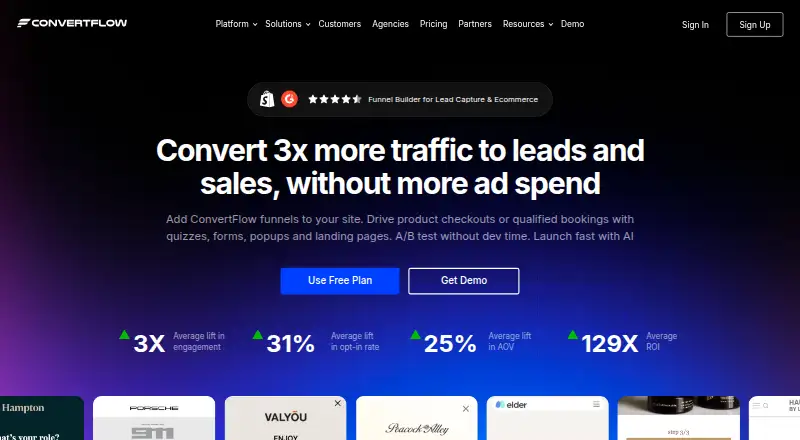
What ConvertFlow is
ConvertFlow is a funnel platform for building quizzes, forms, popups, landing pages, surveys, product recommendations, upsells, cross-sells, and embedded calls to action. Campaigns can target visitors based on quiz responses, cart activity, visit history, custom fields, and CRM segments. Its Remix AI builder can generate and optimize funnels using knowledge from more than 200,000 experiments. Teams can publish landing pages to Shopify or host them on a custom domain with HTTPS. Testing options include A/B, multivariate, and round-robin split tests, with AI-generated tests and scheduled experiments also supported. Integrations span marketing, ecommerce, CRM, analytics, and automation tools, alongside Zapier, Segment, custom webhooks, and a JavaScript API. ConvertFlow lists a free plan with five funnel campaigns, but integrations require a paid plan. Personal costs $25 a year with annual billing and includes up to 10k monthly funnel views and 10 campaigns. Higher plans add features such as CRM and SMS integrations, split testing, and account support. ConvertFlow describes its audience as entrepreneurs, marketing professionals, agencies, ecommerce brands, and lead-generation teams.
Good
- Builds landing pages, forms, quizzes, and popups.
- Targets visitors using cart activity and CRM segments.
- Supports A/B, multivariate, and round-robin tests.
- Landing pages can publish to Shopify or custom domains.
Watch out
- Free plan is limited to five funnel campaigns.
- Integrations require a paid plan.
- Personal is $25 a year, billed annually.
Who it suits
It suits entrepreneurs, agencies, ecommerce brands, marketing professionals, and lead-generation teams building targeted funnel campaigns. Teams that need integrations should note that these require a paid plan.
Verdict
ConvertFlow combines funnel creation, audience targeting, publishing, and testing in one platform. The free plan has campaign limits and excludes integrations, so check paid-plan terms for the features you need.
Plans and prices
From ConvertFlow's own pricing page, checked 1 Oct 2026.
| Plan | Price | What it gives you |
|---|---|---|
| Free | Free | 5 funnel campaigns · previews and testing · integrations require paid plan |
| Personal | $29 a month | 10k monthly funnel views · 10 funnel campaigns per site · 1 Personal site · Annual discount to $25/m |
| Prime | $99 a month | 30k monthly funnel views · 25 funnel campaigns per site · 1 Prime website · Annual discount to $83/m |
| Pro | $299 a month | 100k monthly funnel views · Unlimited funnel campaigns · 1 Pro website · Annual discount to $250/m |
| Custom | $999 a month | 1+ million monthly funnel views · Unlimited campaigns · Custom traffic limit and multi-site management · Annual discount to $833/m+ |
| Plus | $9,996 a year | Up to 1M monthly funnel views · dedicated account manager · funnel accelerator · monthly optimization meetings · $9,996.00 per year (= $833.00/month, billed annually) |
The facts
Each one read from ConvertFlow's own pages, with the date it was checked.
What it does
- AI builder
- Remix AI can generate and optimize funnels using knowledge from more than 200,000 experiments across thousands of brands.checked 1 Oct 2026
- Analytics
- Funnel reports show views, conversions and purchases, with conversion, revenue-attribution and breakdown reporting available by plan.checked 14 Oct 2026
- Audience
- ConvertFlow describes itself as suitable for entrepreneurs, marketing professionals, agencies, ecommerce brands and lead-generation teams.checked 1 Oct 2026
- Compliance
- Enterprise plans can enable SOC 2 reports, SSO/SAML and data compliance controls.checked 1 Oct 2026
- Documentation
- The knowledge base includes setup, campaigns, popups, landing pages, quizzes, targeting, reporting, troubleshooting, GDPR and integration tutorials, with 44 campaign articles and 19 landing-page articles listed.checked 14 Oct 2026
- Enterprise compliance
- The Enterprise offering can enable SOC 2 reports, SSO/SAML, data-compliance controls and custom integration development.checked 14 Oct 2026
- Integrations
- Listed direct integrations include Mailchimp, HubSpot, Klaviyo, Shopify, WordPress, Segment, Google Analytics, Salesforce, Meta, Attentive, Customer.io and many others.checked 14 Oct 2026
- JavaScript API
- The JavaScript API exposes visitor identity, cart, product, session and campaign controls plus events such as cfView, cfSubmit, cfConversion and cfPurchase tracking.checked 14 Oct 2026
- Landing-page builder
- The landing-page builder uses AI, responsive layouts, multi-step funnels, custom HTML and more than 100 landing-page templates.checked 14 Oct 2026
- Legal entity and founders
- Crunchbase lists the legal name as ConvertFlow Inc. and identifies Ethan Denney and Jonathan Denney as co-founders.checked 14 Oct 2026
- Licence and self-hosting
- A software directory states that ConvertFlow is not open source, has no published source code and is controlled as a vendor-hosted service rather than a self-hostable codebase.checked 14 Oct 2026
- Limit: attribution and URLs
- The TrustRadius review cites difficulty distinguishing paid from organic Google leads, repeated setup for custom fields and reliance on subdomains for some landing pages.checked 14 Oct 2026
- Limit: builder and documentation
- G2 reviewers report finicky element editing, weak media-library reuse, missing reusable sections and documentation that can be too shallow for advanced cases.checked 14 Oct 2026
- Limit: Shopify builder gaps
- Shopify reviewers mention a learning curve, bugs in complex conditional campaigns, front-end drag-and-drop inconsistencies and a missing calendar date-field control.checked 14 Oct 2026
- Limit: UX and publishing complaint
- A Trustpilot reviewer reports a very slow, frustrating page builder, unavailable support and inability to publish a landing page on the company's domain.checked 14 Oct 2026
- MCP support
- ConvertFlow publishes an MCP server path with machine-readable tools for connecting AI agents to funnel data.checked 14 Oct 2026
- Notable news: Slack integration
- A June 29, 2026 product update announced Slack reporting, weekly AI insights, split-test ideas and submission or lead alerts.checked 14 Oct 2026
- Performance
- The tracking script is 10–20 KB, loads asynchronously and is cached and served through a global CDN.checked 1 Oct 2026
- Personalization
- Two-way CRM integrations let campaigns target contact segments and use CRM fields as merge tags.checked 14 Oct 2026
- Popups and sticky bars
- The platform creates targeted popup modals, overlays, slide-ups and sticky bars for email, SMS, discounts, surveys and other campaigns.checked 14 Oct 2026
The company
- Company profile
- LinkedIn lists ConvertFlow as a privately held marketing-services company headquartered in Miami, founded in 2016, with 2–10 employees.checked 14 Oct 2026
- Headquarters
- Miami, Florida, United Stateschecked 23 Sep 2026
Money
- Limit: billing complaint
- A Trustpilot reviewer alleges continued Shopify-related charges totaling about $1,000 after quickly cancelling and advises monitoring billing closely.checked 14 Oct 2026
- Limit: price and free tier
- Capterra reviewers complain that the free plan is heavily limited and that paid pricing can be unaffordable for startups.checked 14 Oct 2026
The full review of ConvertFlow
Overview
ConvertFlow is a funnel-building platform for teams that want to combine lead capture, ecommerce campaigns and experimentation. It suits marketers and ecommerce businesses managing several campaign types; its main appeal is the breadth of tools, while its campaign and view caps make plan choice important as activity grows.
Key features
Build and target campaigns
A visual editor supports quizzes, forms, popups, landing pages, surveys, product recommendations, upsells, cross-sells and embedded calls to action. Remix AI can generate and optimize funnels based on knowledge from more than 200,000 experiments across thousands of brands. That gives teams a way to produce and refine varied campaigns in one platform, though the AI capability does not remove the need to choose a plan that fits campaign volume.
Targeting can use quiz answers, cart activity, visit history, custom fields and CRM contact segments. This range is useful when campaigns need to respond to both visitor behavior and customer records. Integrations span marketing, ecommerce, CRM, analytics and automation tools, with Zapier, Segment, custom webhooks and a JavaScript API also supported. The free plan excludes integrations, so teams that depend on connected systems need a paid plan.
Publishing and testing
Landing pages can be published to Shopify pages with one click or hosted on a custom domain with HTTPS. Testing covers A/B, multivariate and round-robin split tests, as well as AI-generated tests and scheduled experiments. Funnel diagnostics and experiment workflows add support for iterative optimization; funnel A/B testing is included from Pro, so it is not a reason to assume every paid tier offers that specific feature.
The tracking script is 10–20 KB, loads asynchronously and is cached and served through a global CDN. ConvertFlow says account passwords are hashed and that it takes measures to protect customer and consumer data. Enterprise plans can enable SOC 2 reports, SSO/SAML and data-compliance controls.
Pricing
ConvertFlow has a free plan and a free trial. The free tier costs nothing and includes five funnel campaigns, previews and testing, but no integrations. It can suit a small operation exploring campaigns, but the cap and integration exclusion limit its use for connected marketing workflows.
Personal is $25 a year (billed annual discount). It allows up to 10k monthly funnel views, 10 campaigns, 400+ templates and one domain per site. It fits a small site with modest traffic; the single-domain allowance and view ceiling are meaningful constraints. Prime is $83 a year (billed annual discount), raising the limits to 30k monthly views and 25 campaigns, and adding CRM and SMS integrations, Zapier and custom webhooks. It is a better fit for teams needing those connections and more campaign capacity.
Pro is $250 a year (billed annual discount), with up to 100k monthly views, funnel A/B split-testing, conditional logic and products, plus identity resolution and targeting. Choose it when those testing and targeting capabilities justify the higher tier. Plus is $833 a year (billed annual discount), with up to 1M monthly views, a dedicated account manager, funnel accelerator and monthly optimization meetings. Its higher support and capacity are aimed at larger operations. Paid plans include campaign-launch and split-testing assistance; higher tiers add onboarding, private Slack, account management and optimization meetings. Enterprise pricing is custom.
Platforms
ConvertFlow supports web and mobile, and its platform information also identifies API support. Shopify page publishing and custom-domain hosting give ecommerce teams two stated ways to put landing pages online.
Who it's for
ConvertFlow is best suited to entrepreneurs, marketing professionals, agencies, ecommerce brands and lead-generation teams that want multiple funnel formats, audience targeting and testing in one platform. Teams with light needs may find the free campaign cap workable; those needing integrations, larger view allowances or advanced support should assess paid tiers. It is less suitable when a popup-only tool or a self-hosted option is the priority.
Pros and cons
- Pros: Multiple campaign formats, behavior-based targeting and a broad set of integration options support varied conversion workflows.
- Pros: Testing includes several split-test approaches and scheduled experiments, while the lightweight asynchronous script is cached and CDN-served.
- Cons: The free plan is capped at five campaigns and excludes integrations, restricting connected or higher-volume use.
- Cons: Funnel A/B testing is a Pro feature, and higher capacity and account support require more expensive tiers.
Alternatives
For a popup-focused choice, Popupsmart has a free tier with 5K pageviews per month, one website, one live popup and a 100-email monthly quota; its Basic plan is $32.50 a year. Adoric may suit teams comparing higher pageview allowances: its Basic plan is $100 a month for 300,000 pageviews across three domains, and Essentials is $250 a month for 1,000,000 pageviews across four domains. FireBox is an option for those seeking a self-hosted or web popup tool, with a free plan that includes unlimited websites and campaigns, MailChimp integration, and page and URL targeting.
POWR Popup, BDOW!, Icegram Engage, Popup Builder and Popup Maker are other options to compare.
Browse Popup Software, Lead Generation Software, Sales Funnel Builders, Pop-Up Builder Software, Conversion Rate Optimization Software and Lead Capture Software for more category options.
Verdict
Choose ConvertFlow if your marketing or ecommerce team needs varied funnel campaigns, audience targeting and experimentation under one roof. Its breadth and targeting are the strongest reasons to pick it; the free tier's campaign cap and lack of integrations, plus the paid-tier step-up for A/B testing and larger limits, are reasons to look elsewhere if your needs are narrow or budget-led.
Getting started
- Open the ConvertFlow website.
- Use the web platform or API.
- Start with the free plan, or use the free trial.
- Select a paid plan if you need integrations.
- Publish landing pages to Shopify or host them on a custom domain with HTTPS.
Limits worth knowing
The free plan provides five funnel campaigns, and integrations require a paid plan. Personal includes up to 10,000 monthly funnel views and 10 campaigns; Prime includes up to 30,000 views and 25 campaigns, while Pro and Plus set higher view limits.
Questions
Is ConvertFlow free?
Yes. Its Free plan costs $0 and includes five funnel campaigns. Integrations require a paid plan.
What does ConvertFlow cost?
The listed Personal plan costs $29 per month billed monthly.
What platforms does ConvertFlow support?
ConvertFlow lists API and web platforms.
What integrations are available?
It offers integrations with marketing, ecommerce, CRM, analytics and automation tools, plus Zapier, Segment, custom webhooks and a JavaScript API. Integrations require a paid plan.
Can ConvertFlow pages be published to Shopify?
Yes. Landing pages can be published with one click to Shopify pages, or hosted on a custom domain with HTTPS.
What does ConvertFlow's free plan include?
It includes five funnel campaigns. Previews and testing are listed, while integrations require a paid plan.