OpenAL Soft
OpenAL Soft is a free software implementation of the OpenAL 3D audio API, used to play audio in a virtual 3D environment.
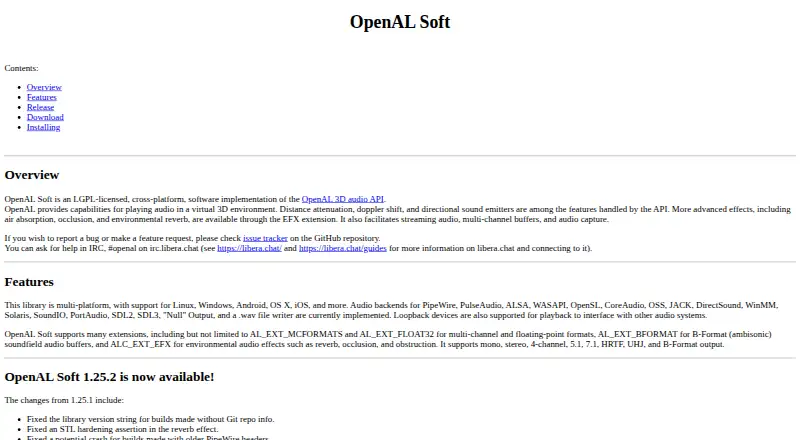
What OpenAL Soft is
OpenAL Soft is a free software implementation of the OpenAL 3D audio API, used to play audio in a virtual 3D environment. It handles spatial effects such as distance attenuation, Doppler shift, and directional sound emitters. Its EFX extension adds effects including air absorption, occlusion, and environmental reverb. The library supports streaming audio, multichannel buffers, and audio capture, with output options ranging from mono and stereo to 5.1, 7.1, HRTF, UHJ, and B-Format. Implemented audio backends include PipeWire, PulseAudio, ALSA, WASAPI, CoreAudio, JACK, SDL2, and SDL3. Developers can incorporate it into projects; building requires CMake 3.13 or newer and a compiler supporting C++20, while Autotools is not supported. The project is LGPL-licensed and offers a free plan at no cost. Version 1.25.2 is identified as the latest release, available in source form and as Win32 and Win64 binaries.
Good
- Handles distance, Doppler, and directional audio
- EFX includes occlusion and environmental reverb
- Supports streaming, multichannel buffers, and audio capture
- Free, LGPL-licensed software
Watch out
- Building requires CMake 3.13 or newer
- Autotools is not supported
Who it suits
OpenAL Soft suits developers incorporating a reusable 3D audio library into projects. Its listed runtime platforms include Windows, macOS, Linux, and Android, with additional API and self-hosted platform listings.
Verdict
OpenAL Soft provides spatial audio features, effects, and multiple backend and output options for projects using the OpenAL API. Building has specific CMake and compiler requirements.
Plans and prices
From OpenAL Soft's own pricing page, checked 3 Oct 2001.
| Plan | Price | What it gives you |
|---|---|---|
| OpenAL Soft | Free | LGPL-licensed software implementation of the OpenAL 3D audio API |
The facts
Each one read from OpenAL Soft's own pages, with the date it was checked.
What it does
- Audio backends
- Implemented backends include PipeWire, PulseAudio, ALSA, WASAPI, CoreAudio, JACK, SDL2, SDL3, and others.checked 3 Oct 2001
- Audio capabilities
- It supports streaming audio, multichannel buffers, and audio capture.checked 3 Oct 2001
- Build requirements
- Building requires CMake 3.13 or newer and should work with most compilers supporting C++20; Autotools is not supported.checked 3 Oct 2001
- Effects
- Its EFX extension provides effects including air absorption, occlusion, and environmental reverb.checked 3 Oct 2001
- Integrations
- The site says loopback devices can be used for playback to interface with other audio systems.checked 3 Oct 2001
- Intended users
- The site describes a reusable audio library and provides CMake build instructions for incorporating it into projects.checked 3 Oct 2001
- Latest release
- The site identifies version 1.25.2 as the latest release and provides it in source form and as Win32 and Win64 binaries.checked 3 Oct 2001
- License
- OpenAL Soft is LGPL-licensed.checked 3 Oct 2001
- Output formats
- Supported output includes mono, stereo, 4-channel, 5.1, 7.1, HRTF, UHJ, and B-Format.checked 3 Oct 2001
- Purpose
- OpenAL Soft is a software implementation of the OpenAL 3D audio API for playing audio in a virtual 3D environment.checked 3 Oct 2001
- Security
- The opened official page does not state security certifications or compliance claims.checked 3 Oct 2001
- Spatial audio
- The API handles distance attenuation, Doppler shift, and directional sound emitters.checked 3 Oct 2001
- Support
- The project directs users to its GitHub issue tracker for bugs and feature requests and to the #openal IRC channel for help.checked 3 Oct 2001
Where it runs
- Platforms
- The library supports Linux, Windows, Android, OS X, iOS, and other platforms.checked 3 Oct 2001
The full review of OpenAL Soft
OpenAL Soft is a free software library implementing the OpenAL 3D audio API. It is best suited to developers adding spatial audio to their own applications; choose it for its range of audio backends and output formats, not for a ready-made authoring workflow.
Overview
OpenAL Soft provides an audio layer for projects that use the OpenAL API, rather than a complete game-audio production environment. Its focus is useful when a project needs to control sound in a virtual 3D space and incorporate playback directly into its software. The trade-off is that developers need to integrate and build around the library themselves.
The project is LGPL-licensed and free. That removes a software charge, but teams should check whether the license fits their distribution plans before adopting it. Building requires CMake 3.13 or newer and a compiler supporting C++20; Autotools is not supported, which may rule it out for projects tied to that build system.
Key features
Spatial audio and effects
The API handles distance attenuation, Doppler shift and directional sound emitters, giving developers core controls for sound that changes with position and movement. The EFX extension adds air absorption, occlusion and environmental reverb. These features provide useful spatial-audio building blocks, but the application still has to determine how its world should drive them.
Playback and output choices
Streaming audio, multichannel buffers and audio capture make the library useful beyond simple sound playback. Output options include mono, stereo, 4-channel, 5.1 and 7.1, alongside HRTF, UHJ and B-Format. This breadth suits projects with varied output needs; it also means teams should identify the formats their application actually requires rather than treating the list as a complete production workflow.
Backend integration
Implemented backends include PipeWire, PulseAudio, ALSA, WASAPI, CoreAudio, JACK, SDL2 and SDL3. Loopback devices can connect playback to other audio systems, giving developers another integration route. The available backends span several desktop audio environments, but choosing and configuring the right route remains part of implementation.
Pricing
OpenAL Soft: free. The plan provides the LGPL-licensed OpenAL 3D audio API implementation; there is no free-trial decision or paid tier to weigh. Its main cost is engineering effort: the library is meant to be incorporated into a project, and building has specific CMake and compiler requirements.
Platforms
OpenAL Soft targets Windows, macOS, Linux and Android at runtime, and is also categorized for iOS, API use and self-hosted deployment. The latest release identified by the project is version 1.25.2, available as source and as Win32 and Win64 binaries.
Who it's for
Choose OpenAL Soft if you are developing software that needs spatial audio controls, effects, streaming or capture through the OpenAL API, and you can accommodate its license and build requirements. It is a stronger fit for developers who want a reusable audio library than for teams looking for a packaged authoring or middleware workflow. For project support, the developers direct users to the GitHub issue tracker for bugs and feature requests and the #openal IRC channel for help.
Pros and cons
- Pros: Spatial controls and EFX effects provide concrete tools for virtual environments without a software fee.
- Pros: Multiple backends and output formats give projects a broad set of integration and playback options.
- Pros: Source and Windows binaries are provided for the latest release identified by the project.
- Cons: It is a library to incorporate, not a complete audio-authoring workflow.
- Cons: CMake 3.13 or newer and C++20 compiler support are build prerequisites; Autotools is unsupported.
- Cons: LGPL licensing needs to fit the project's distribution approach.
Alternatives
Game Audio Middleware is a category to browse when you want to compare tools across that field.
- Amplitude Audio SDK is another free, open-source option, with Android, iOS, Linux, macOS and Windows platform support.
- Audiokinetic Wwise is worth considering if its free Indie plan fits your project: it covers game production budgets below $250K and includes unlimited sound files and media assets under a per-title license.
- Reactional Engine has a free plan with forum and Discord support, but requires a Reactional splash screen.
- psai offers a free Unity engine usable across Unity projects without further costs or royalties.
- SoLoud may suit projects that value permission for commercial use, modification and redistribution under its ZLib/LibPNG license.
- Steam Audio SDK is available free to all developers, subject to its license agreement.
- Unity Version Control is a different kind of tool: consider it if you need version control rather than an audio library.
- FMOD Studio offers a free Indie plan for games below its stated budget and company-revenue thresholds, with lifetime distribution rights.
Verdict
OpenAL Soft is a strong choice for developers who want a free, reusable OpenAL implementation with spatial controls, effects and varied backend and output support. Its central advantage is flexibility at the audio-library level; look elsewhere if you need an integrated production workflow or cannot meet its license and build requirements.
Alternatives to OpenAL Soft
- 1

Unity Version Control
Free planWebAPILinuxmacOS8.1Free plan - 2
Audiokinetic Wwise
Free planAndroidiOSLinuxmacOS7.4$8,000, paid once - 3

Amplitude Audio SDK
Free planAndroidiOSLinuxmacOS6.8Free plan - 4

Elias
AndroidiOSmacOSWindows6.8€5,850, paid once - 5
irrKlang
Free planLinuxmacOSWindows6.8€65, paid once - 6
psai
Free planAndroidiOSAPILinux6.8Free plan