Audiokinetic Wwise
Audiokinetic Wwise is a toolset for interactive game audio and motion, combining an authoring application, sound engine, game simulator, plug-in architecture…
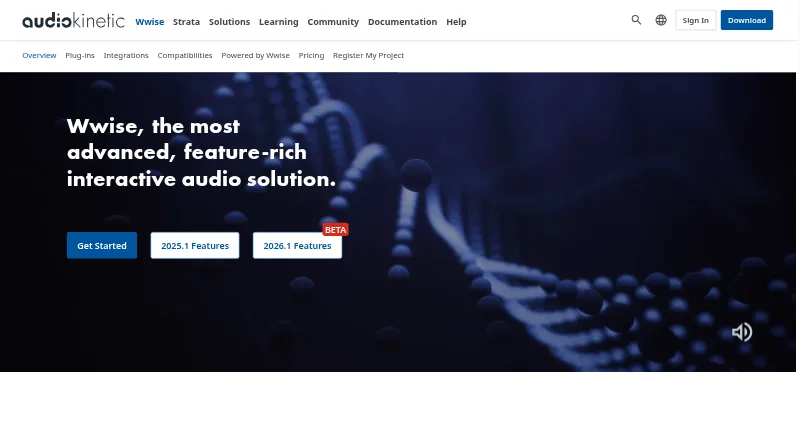
What Audiokinetic Wwise is
Audiokinetic Wwise is a toolset for interactive game audio and motion, combining an authoring application, sound engine, game simulator, plug-in architecture, and Authoring API. Its production pipeline spans authoring, simulation, integration, in-game mixing, and real-time profiling. A Wwise project can manage sound, voice, music, and motion assets, playback behaviors, Events, simulations, profiling, and platform-specific SoundBanks. The tool supports spatial audio, interactive music, dialogue management, localization, and audio streaming, with integrations for Unity and Unreal Engine. The Unity integration includes a plug-in library, C# SDK API bindings, components, and Editor windows. The free trial is for non-commercial use and limits Wwise SoundBanks to 200 media assets. The free Indie plan applies to game production budgets below $250K. Commercial licenses are per title, and each platform used by a title requires a license. Listed commercial plans start at $8,000, paid once, with pricing dependent on platforms. Runtime platforms include desktop, console, and mobile systems.
Good
- Workflow covers authoring through real-time profiling
- Projects manage audio, motion assets, and SoundBanks
- Integrations are available for Unity and Unreal Engine
- Supports spatial audio and interactive music
Watch out
- Free trial is limited to non-commercial use
- Trial SoundBanks are limited to 200 media assets
- Commercial licenses are per title and platform
- Commercial plans start at $8,000, paid once
Who it suits
Wwise suits game audio teams building interactive sound and motion for titles using Unity or Unreal Engine. Its per-title and per-platform licensing terms are important for commercial projects.
Verdict
Wwise brings authoring, simulation, integration, mixing, and profiling into a game-audio toolset. Check the trial restriction and per-title, per-platform licensing structure before planning commercial use.
Plans and prices
From Audiokinetic Wwise's own pricing page, checked 28 Sep 2001.
| Plan | Price | What it gives you |
|---|---|---|
| Indie | Free | Game production budget less than $250K · Unlimited sound files/media assets · Per-title license · Non-commercial projects can register for a free license · Free |
| Pro | $8,000, paid once | Game production budget between $250K and $2M · Per-title license · Price depends on platforms used · Starting at $8,000 US |
| Premium | $25,000, paid once | Game production budget greater than $2M · Per-title license · Price depends on platforms used · Starting at $25,000 US |
| Platinum | $45,000, paid once | Game production budget greater than $2M · Per-title license · Price depends on platforms used · Starting at $45,000 US |
The facts
Each one read from Audiokinetic Wwise's own pages, with the date it was checked.
What it does
- Engine integrations
- Audiokinetic provides Unity and Unreal integrations, and its Launcher can install integrations and plug-ins.checked 28 Sep 2001
- GaaS option
- The GaaS license is aimed at free-to-play or paid initial-access games and uses monthly fees tied to monthly revenue tiers; Tier 0 is free below $100K monthly revenue.checked 28 Sep 2001
- License restrictions
- The Wwise Project License is tied to a specific project title and cannot be used to create new titles.checked 28 Sep 2001
- License scope
- Commercial Wwise licenses are per title, and a license is required for each platform used by the title.checked 28 Sep 2001
- Project management
- A Wwise project can manage a game's sound, voice, music, and motion assets, playback behaviors, Events, simulations, profiling, and platform-specific SoundBanks.checked 28 Sep 2001
- Purpose
- Wwise combines an audio authoring application, sound engine, game simulator, plug-in architecture, and Authoring API for interactive game audio and motion.checked 28 Sep 2001
- Royalty option
- Audiokinetic offers a royalty-based license with a stated post-launch rate of 1% based on gross game sales.checked 28 Sep 2001
- Security
- Audiokinetic's SDK agreement says users may not reverse engineer, decompile, disassemble, or circumvent security measures in Wwise technology, subject to applicable law.checked 28 Sep 2001
- Support
- Without a Direct Support Plan, users can ask questions through the public Audiokinetic Community Q&A; paid support plans include ticket allowances or unlimited tickets.checked 28 Sep 2001
- Unity integration
- The Unity integration includes a plug-in library, C# SDK API bindings, components, and Editor windows.checked 28 Sep 2001
- Workflow
- Its production pipeline supports authoring, simulation, integration, in-game mixing, and real-time profiling.checked 28 Sep 2001
The company
- Headquarters
- Montreal, Quebec, Canadachecked 23 Sep 2001
Money
- Trial limit
- The Free Trial is for non-commercial use and limits Wwise SoundBanks to 200 media assets.checked 28 Sep 2001
Where it runs
- Unity target platforms
- The documented Unity integration has been tested on Windows, Mac, Linux, Xbox One and Series X, PlayStation 4 and 5, Nintendo Switch, Android, iOS, and tvOS.checked 28 Sep 2001
The full review of Audiokinetic Wwise
Audiokinetic Wwise is a production toolset for interactive game audio and motion, bringing authoring, simulation, integration and profiling into a single workflow. It suits game-audio teams working across engines and platforms; its per-title licensing and commercial budget thresholds make it less straightforward for small commercial projects.
Overview
Wwise is built for audio that responds to what happens in a game, rather than simply playing a fixed set of tracks. A project can manage sound, voice, music and motion assets alongside playback behavior, Events, simulations, profiling and platform-specific SoundBanks. That breadth can help teams keep audio work connected from authoring through integration and in-game adjustment.
Spatial audio, interactive music, dialogue management, localization tools and audio streaming cover several demanding game-audio needs. The trade-off is a production-oriented workflow that may be more than a small project needs.
Key features
- Authoring, simulation and profiling: The workflow supports building and simulating interactive audio, integrating it into a game, mixing in-game and profiling in real time. This lets a team address audio in context rather than treating implementation as a separate final step.
- Project and SoundBank management: Wwise projects group audio and motion assets with playback behaviors, Events and simulations, and can manage SoundBanks for individual platforms. That is useful when a title must prepare audio for multiple targets.
- Engine integrations: Audiokinetic provides Unity and Unreal Engine integrations, with its Launcher able to install integrations and plug-ins. Unity’s integration includes a plug-in library, C# SDK API bindings, components and Editor windows, giving Unity teams several points of connection to the toolset.
Pricing
Wwise uses a freemium model, but commercial licensing is structured per title and each platform used by a title requires a license. The project license is tied to one specific game and cannot be reused to create another title, so teams planning a slate of releases should account for separate licensing.
- Indie: Free for games with a production budget below $250K, with unlimited sound files and media assets and a per-title license. Non-commercial projects can register for a free license. This is the clearest fit for small-budget and non-commercial work.
- Pro: Starting at $8,000 US, once, for a game production budget between $250K and $2M. It is licensed per title, and price depends on platforms used.
- Premium: Starting at $25,000 US, once, for a game production budget greater than $2M. It is per-title, with price depending on platforms used.
- Platinum: Starting at $45,000 US, once, also for a game production budget greater than $2M. It is per-title, with price depending on platforms used.
The Free Trial is restricted to non-commercial use and caps Wwise SoundBanks at 200 media assets, so it is not a route to shipping a commercial game. Audiokinetic also offers a royalty-based license with a stated post-launch rate of 1% based on gross game sales. Its GaaS license targets free-to-play or paid initial-access games and charges monthly fees according to monthly revenue tiers; Tier 0 is free below $100K monthly revenue.
Platforms
Wwise is available for Android, iOS, Linux, macOS and Windows. Runtime targets include Windows, Mac, Linux, Xbox One and Series X, PlayStation 4 and 5, Nintendo Switch, Android, iOS and tvOS. The documented Unity integration has been tested on those listed desktop, console and mobile targets, including tvOS, giving Unity projects a broad stated reach.
Who it's for
Wwise is a strong fit for game-audio teams that need to author, simulate, integrate and profile sound and motion across a title’s development, especially when platform-specific SoundBanks and Unity or Unreal integration matter. Its commercial budget tiers and per-platform, per-title licensing need careful planning. Smaller commercial projects should compare the license cost and structure against their production needs before committing.
Pros and cons
Pros
- Broad production workflow: Authoring, simulation, integration, in-game mixing and real-time profiling cover more than asset playback alone.
- Game-specific audio management: Projects can coordinate sound, voice, music and motion assets, behaviors and platform-specific SoundBanks.
- Free Indie tier: Budgets below $250K get unlimited sound files and media assets under a per-title license.
Cons
- Trial is not for commercial work: Non-commercial use only, with a 200-media-asset SoundBank cap.
- Commercial licenses can be substantial: Pro starts at $8,000 US once, and platform count affects price; higher tiers start at $25,000 US and $45,000 US.
- Licenses do not transfer between titles: Each commercial title requires its own license, and each platform used by that title requires a license.
Alternatives
For a broader Game Audio Middleware shortlist, compare tools by the engines, platforms and licensing model your project needs.
- Amplitude Audio SDK is free and open source under Apache-2.0, making it a fit to consider when an open-source option matters.
- OpenAL Soft is a free, LGPL-licensed implementation of the OpenAL 3D audio API for readers seeking that API.
- SoLoud is free for commercial use under a ZLib/LibPNG license that permits modification and redistribution.
- Steam Audio SDK is available free to all developers, with a license agreement applying.
- Unity Version Control is a version-control alternative for project management rather than a game-audio authoring tool.
- FMOD Studio is another freemium game-audio option; its Indie plan is free or $2,000 per title for budgets under $600k, with the free option tied to company revenue under $200k/year.
- irrKlang offers a non-commercial free plan and a €65 one-time hobbyist Pro plan for individuals.
- Live Link Face is a free iOS and Android app for a narrower mobile use case.
Verdict
Choose Wwise if your game-audio team needs a connected workflow for authoring, simulation, in-game mixing and profiling, with project-level management and support for multiple engines and targets. Its main drawback is commercial licensing: budgets, titles and platforms all shape the commitment, while the trial cannot be used commercially. For a smaller commercial game or a project seeking a simpler free tool, compare alternatives before deciding.
Getting started
- Visit Audiokinetic's Wwise product page.
- Use the Free Trial for non-commercial evaluation, subject to its SoundBank limit.
- Use Audiokinetic Launcher to install integrations or plug-ins.
- Choose a license path that fits the title, platforms, production budget, or monthly revenue.
- For Unity or Unreal projects, select the relevant integration.
Limits worth knowing
The non-commercial Free Trial limits Wwise SoundBanks to 200 media assets. The free Indie plan is for production budgets below $250K; commercial plans are per-title, and price depends on platforms used.
Questions
Is Wwise free?
Yes. The Indie plan is listed as free for production budgets below $250K. A non-commercial Free Trial is also available, with SoundBanks limited to 200 media assets.
How much do the commercial plans cost?
Pro starts at $8,000, paid once, Premium at $25,000, paid once, and Platinum at $45,000, paid once. Price depends on platforms used.
Which game engines does Wwise support?
Audiokinetic provides integrations for Unity and Unreal Engine. Its Launcher can install integrations and plug-ins.
What platforms are supported at runtime?
Listed runtime platforms are Windows, Mac, Linux, Xbox One, Xbox Series X, PlayStation 4, PlayStation 5, Nintendo Switch, Android, iOS, and tvOS.
How are commercial licenses scoped?
Commercial Wwise licenses are per title, and each platform used by a title requires a license. A Wwise Project License is tied to a specific project title and cannot be used to create new titles.
Is there a royalty-based license?
Yes. Audiokinetic lists a royalty-based license with a post-launch rate of 1% based on gross game sales. Its GaaS license uses monthly fees tied to monthly revenue tiers, with Tier 0 free below $100K monthly revenue.
Alternatives to Audiokinetic Wwise
- 1

Unity Version Control
Free planWebAPILinuxmacOS8.1Free plan - 2

Amplitude Audio SDK
Free planAndroidiOSLinuxmacOS6.8Free plan - 3

Elias
AndroidiOSmacOSWindows6.8€5,850, paid once - 4
irrKlang
Free planLinuxmacOSWindows6.8€65, paid once - 5
psai
Free planAndroidiOSAPILinux6.8Free plan - 6
Reactional Engine
Free planAndroidiOSWebAPI6.8Free plan