
Amplitude Audio SDK
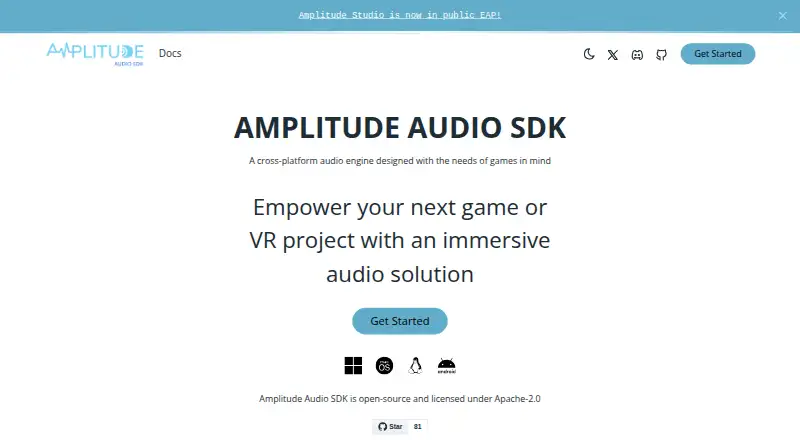
Amplitude Audio SDK is a cross-platform audio engine for games, with support for 2D, 3D, and VR/AR audio.
What Amplitude Audio SDK is
Amplitude Audio SDK is a cross-platform audio engine for games, with support for 2D, 3D, and VR/AR audio. It supports Android, iOS, Linux, macOS, and Windows, with Windows, Linux, and macOS listed as runtime platforms. Project assets are defined in JSON files and compiled into binary sound banks for runtime loading. Audio options include stereo panning, binaural rendering with user HRTF assets, and Ambisonic rendering. Developers can configure processing per runtime platform, including filters, room effects, and spatialization, and extend the pipeline with plugins for codecs, filters, resampling, drivers, fading, and other nodes. A MiniAudio-based default driver and MP3 and WAV decoding are included. Official integrations are listed for O3DE, ezEngine, Godot 4+, and Flax Engine. The SDK is free and open source under Apache-2.0, but documentation describes it as beta with no official release yet; nightly builds are intended for development, not production. Amplitude Studio is in its Early Access Program with complimentary access during that phase. Its tools include asset browsing and editing, visual editors for pipeline graphs and curves, and project validation, compilation, and release workflows.
Good
- Free and open source under Apache-2.0.
- Supports stereo, binaural, and Ambisonic rendering.
- Customizable processing pipeline and plugin extensions.
- Official integrations for four game engines.
Watch out
- SDK is in beta with no official release.
- Nightly builds are not recommended for production.
- Free Studio version excludes several tools.
Who it suits
Amplitude Audio SDK suits game developers who need configurable audio processing and spatial audio across supported platforms. Its beta status and development-only nightly builds make it less suited to production use at present.
Verdict
Amplitude Audio SDK offers a configurable foundation for game audio, with spatial rendering and engine integrations. Its beta status is an important constraint for teams considering production deployment.
Plans and prices
From Amplitude Audio SDK's own pricing page, checked 2 Oct 2001.
| Plan | Price | What it gives you |
|---|---|---|
| Amplitude Audio SDK | Free | Free and open source · Apache-2.0 license |
| Amplitude Studio Free | Free | Non-commercial use · Teams and individuals with less than $100k revenue in the last 12 months · No pipeline editor, Playground, or release tool |
| Amplitude Studio Paid | Priced on request | Subscription · Individual, Indies, and Studio options · Commercial use · All features · Perpetual licenses available · Lifetime access to updates |
The facts
Each one read from Amplitude Audio SDK's own pages, with the date it was checked.
What it does
- Audio processing
- Users can customize the processing pipeline, including filters, room effects, and spatialization, and configure it per runtime platform.checked 2 Oct 2001
- Availability
- The SDK documentation says the software is in beta with no official release yet; nightly builds are for development and are not recommended for production.checked 2 Oct 2001
- Data-driven authoring
- JSON files define project assets, which Amplitude compiles into binary files for sound banks and runtime loading.checked 2 Oct 2001
- Default audio support
- The SDK provides a MiniAudio-based default driver and decodes MP3 and WAV samples by default.checked 2 Oct 2001
- Extensibility
- Plugins can add custom codecs, filters, resampling algorithms, drivers, fading algorithms, and pipeline nodes.checked 2 Oct 2001
- Integrations
- Official integrations are available for O3DE, ezEngine, Godot 4+, and Flax Engine.checked 2 Oct 2001
- Purpose
- Amplitude is a cross-platform audio engine designed for games and supports audio for 2D, 3D, and VR/AR environments.checked 2 Oct 2001
- Security and compliance
- The opened maker pages identify the SDK as open source under Apache-2.0 and do not state a security certification or compliance standard.checked 2 Oct 2001
- Spatial audio
- The engine supports stereo panning and binaural rendering with user HRTF assets, as well as Ambisonic rendering.checked 2 Oct 2001
- Studio features
- Amplitude Studio provides asset browsing and editing, visual editors for pipeline graphs and curves, and a workflow to validate, save, compile, and release projects.checked 2 Oct 2001
- Studio status
- Amplitude Studio is described as being in its Early Access Program, with complimentary access during that phase.checked 2 Oct 2001
- Support
- The documentation directs users with installation issues to Discord and recommends Discord community support or GitHub issues for troubleshooting.checked 2 Oct 2001
Money
- Free Studio limits
- The planned free Studio version is limited to non-commercial users under the stated revenue threshold and excludes the pipeline editor, Playground, and release tool.checked 2 Oct 2001
Where it runs
- Platforms
- The SDK lists Android, iOS, Linux, OS X, and Windows as supported platforms.checked 2 Oct 2001
The full review of Amplitude Audio SDK
Overview
Amplitude Audio SDK is a cross-platform audio engine for games, supporting sound in 2D, 3D, and VR/AR environments. It suits developers who want to configure spatial audio and processing around their project. The core SDK costs nothing and is open source, though its beta status makes it a development option rather than a dependable production choice today.
Key features
Project assets are defined in JSON and compiled into binary sound banks for runtime loading. This gives teams a data-driven authoring workflow, but they will need to build around Amplitude’s asset and compilation process.
Spatial audio includes stereo panning, binaural rendering with user-provided HRTF assets, and Ambisonic rendering. That range supports different spatial approaches, while binaural use depends on supplying suitable HRTF assets.
The processing pipeline can be customized for each runtime platform, including filters, room effects, and spatialization. Plugins can add codecs, filters, resampling algorithms, drivers, fading algorithms, and pipeline nodes. A MiniAudio-based driver and MP3 and WAV decoding are provided by default; projects with other requirements may need custom extensions.
Audio streaming is supported, and official integrations cover O3DE, ezEngine, Godot 4+, and Flax Engine. Teams using those engines have a direct integration path, while projects on other engines may need to handle integration themselves.
Amplitude Studio adds asset browsing and editing, visual editors for pipeline graphs and curves, and a workflow to validate, save, compile, and release projects. It is in Early Access, with complimentary access during that phase. The planned free version is restricted to non-commercial users below the stated revenue threshold and omits the pipeline editor, Playground, and release tool, so teams needing those capabilities should consider the paid offering.
Pricing
The Amplitude Audio SDK is free and open source under the Apache-2.0 license. There are no stated seat or usage charges for this plan.
Amplitude Studio Free costs nothing. It is for non-commercial use by teams and individuals with less than $100k revenue in the last 12 months. The plan excludes the pipeline editor, Playground, and release tool, limiting its fit for users who need the full Studio workflow.
Amplitude Studio Paid has custom pricing. It supports commercial use and offers Individual, Indies, and Studio options, all features, perpetual licenses, and lifetime access to updates. Its price and the terms for each option are not established here, so commercial teams should confirm the fit before choosing it.
The SDK documentation says the software remains in beta, with no official release yet. Nightly builds are intended for development and are not recommended for production, a significant constraint for teams preparing a shipped game.
Platforms
The SDK lists Android, iOS, Linux, macOS, and Windows as supported platforms. Runtime platform support is specified for Windows, Linux, and macOS. The distinction matters to teams evaluating mobile support: Android and iOS are listed as platforms, but the stated runtime list covers desktop systems.
Official game-engine integrations are available for O3DE, ezEngine, Godot 4+, and Flax Engine. Installation help and troubleshooting are directed to Discord community support or GitHub issues, which will suit developers comfortable relying on community channels.
Who it's for
Amplitude is a strong fit for game developers who want a free, open-source foundation and are prepared to configure audio processing, use JSON-based authoring, or extend the engine with plugins. Its spatial rendering options and platform-specific pipeline configuration are useful for projects with tailored audio needs.
It is a weaker fit for teams that need a stable, officially released production SDK now, or that want a complete authoring workflow without building extensions. The beta caveat is especially important for production planning; Studio’s free tier also excludes tools needed to compile and release projects.
Pros and cons
- Pros: The SDK is free and Apache-2.0 licensed, making it accessible to commercial and non-commercial projects.
- Pros: Binaural and Ambisonic rendering, plus a configurable processing pipeline, give developers meaningful control over spatial sound.
- Pros: Plugins can extend core audio components, and official integrations cover four named game engines.
- Cons: The SDK is in beta with no official release, and nightly builds are not recommended for production.
- Cons: Binaural rendering relies on user-provided HRTF assets, while requirements beyond the default driver and MP3/WAV decoding may call for custom plugins.
- Cons: The planned free Studio version excludes the pipeline editor, Playground, and release tool, and is limited to non-commercial users below the revenue threshold.
Alternatives
Game Audio Middleware is the category directory for comparing game-audio tools.
Choose Audiokinetic Wwise if its free Indie plan fits your project: it is available to games with a production budget below $250K and includes unlimited sound files and media assets under a per-title license. Like Amplitude, Wwise has a free plan, and it also offers a free trial.
Reactional Engine has a free plan with forum and Discord support and requires a Reactional splash screen; its Studio option has custom pricing.
OpenAL Soft is an alternative for developers seeking a free implementation of the OpenAL 3D audio API under the LGPL license.
psai offers a free Unity Asset Store engine that can be used across Unity projects without further costs or royalties.
SoLoud is a free alternative under the ZLib/LibPNG license, which permits commercial use, modification, and redistribution.
Steam Audio SDK is available free to all developers, subject to its license agreement.
Unity Version Control is a free tier for teams that need version control, with unlimited cloud seats and 25 GB of storage before pay-as-you-go charges apply.
FMOD Studio is worth considering for an eligible indie: its Indie plan is free for companies under $200k in annual revenue and games with a development budget under $600k, with a $2,000 per-title option also stated.
Verdict
Choose Amplitude Audio SDK if you want a free, open-source game audio engine with configurable processing, spatial rendering, and integrations for its supported engines—and can work with beta software. Its flexibility is the main reason to choose it; its unreleased beta status is the main reason production teams should look elsewhere until an official release.
Getting started
- Visit the Amplitude Audio SDK website.
- Choose the SDK for a supported platform: Android, iOS, Linux, macOS, or Windows.
- Use JSON files to define project assets and compile them into binary sound banks.
- For development, use nightly builds; the documentation does not recommend them for production.
- If using Studio, note that it is in its Early Access Program with complimentary access during that phase.
Limits worth knowing
The planned free Studio version is for non-commercial users under the stated revenue threshold and excludes the pipeline editor, Playground, and release tool. Nightly SDK builds are for development and are not recommended for production.
Questions
Is Amplitude Audio SDK free?
Yes. The SDK plan is free and is open source under Apache-2.0.
What platforms does it support?
The listed platforms are Android, iOS, Linux, macOS, and Windows. Runtime platforms are Windows, Linux, and macOS.
Which game engines have official integrations?
Official integrations are available for O3DE, ezEngine, Godot 4+, and Flax Engine.
Is the SDK ready for production?
The documentation describes it as beta with no official release yet. Nightly builds are intended for development and are not recommended for production.
What does Amplitude Studio include?
Studio provides asset browsing and editing, visual editors for pipeline graphs and curves, and a workflow for validating, saving, compiling, and releasing projects.
What are the limits of free Studio?
The planned free version is limited to non-commercial users under the stated revenue threshold. It excludes the pipeline editor, Playground, and release tool.
Alternatives to Amplitude Audio SDK
- 1

Unity Version Control
Free planWebAPILinuxmacOS8.1Free plan - 2
Audiokinetic Wwise
Free planAndroidiOSLinuxmacOS7.4$8,000, paid once - 3

Elias
AndroidiOSmacOSWindows6.8€5,850, paid once - 4
irrKlang
Free planLinuxmacOSWindows6.8€65, paid once - 5
psai
Free planAndroidiOSAPILinux6.8Free plan - 6
Reactional Engine
Free planAndroidiOSWebAPI6.8Free plan