Reactional Engine
Reactional Engine is a framework for generating interactive music in games and changing it in response to gameplay in real time.
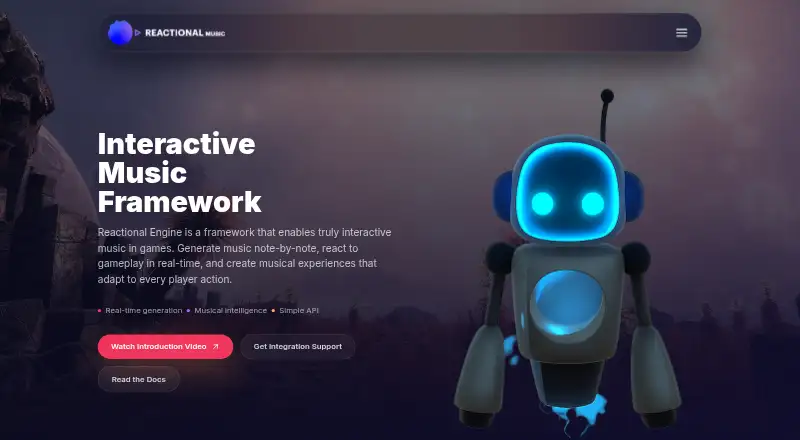
What Reactional Engine is
Reactional Engine is a framework for generating interactive music in games and changing it in response to gameplay in real time. It creates music note by note with virtual instruments rather than relying on loops. Developers can change key, scale, tempo, and instrumentation as play unfolds, and the engine can interpolate, modulate, improvise, or randomize musical elements. It can analyze commercial tracks for tempo and harmony to synchronize generated music and support transitions between commercial and generated material. Unity and Unreal integrations are available, and the engine page also describes Wwise and FMOD integrations; Godot is marked as coming soon. Runtime targets include Windows, macOS, Linux, iOS, Android, WebGL, PlayStation 4/5, Xbox, and Nintendo Switch. API examples cover transport controls, musical parameters, stingers, and callbacks for bars, beats, and notes. Developers can test any track for free and pay on release. Commercial music licensing is described with worldwide perpetual rights, and interactive themes start at $75 per track. Pricing is on request for Studio.
Good
- Generates music note by note with virtual instruments.
- Musical parameters can change in real time.
- Unity and Unreal integrations are available.
- Developers can prototype with any track for free.
Watch out
- Studio pricing is available on request.
- Free access requires a Reactional splash screen.
- Godot integration is listed as coming soon.
- Interactive themes start at $75 per track.
Who it suits
Reactional Engine is for game developers, composers, and music rights holders working on adaptive game music. Its real-time controls and listed runtime targets may suit projects that need scores to respond to gameplay across platforms.
Verdict
Reactional Engine provides note-level music generation and real-time musical controls for game projects. Developers can prototype for free, while Studio pricing and music licensing terms are worth reviewing for a release.
Plans and prices
From Reactional Engine's own pricing page, checked 7 Oct 2001.
| Plan | Price | What it gives you |
|---|---|---|
| Free | Free | Forum + Discord support · Reactional splash-screen required |
| Studio | Priced on request | Dedicated contact · Curated music assistance included · Reactional splash-screen optional |
The facts
Each one read from Reactional Engine's own pages, with the date it was checked.
What it does
- API
- The page gives examples for transport controls, setting musical parameters, triggering stingers, and receiving bar, beat, and note callbacks.checked 7 Oct 2001
- Commercial tracks
- The system analyzes commercial tracks’ tempo and harmony to synchronize generated music and support transitions between commercial and generated music.checked 7 Oct 2001
- Downloads
- Binaries for Windows and macOS are available through the Reactional Platform.checked 7 Oct 2001
- Generation
- It generates music note by note using virtual instruments rather than relying on loop-based systems.checked 7 Oct 2001
- Integrations
- Unity and Unreal are available now, Godot is listed as coming soon, and Wwise and FMOD integrations are described on the engine page.checked 7 Oct 2001
- Intended users
- The platform documentation describes its tools for game developers, composers, and music rights holders.checked 7 Oct 2001
- Musical controls
- The engine can change key, scale, tempo, and instrumentation in real time and can interpolate, modulate, improvise, and randomize musical elements.checked 7 Oct 2001
- Music licensing
- The maker describes commercial music licensing with worldwide perpetual rights and says interactive themes start at $75 per track.checked 7 Oct 2001
- Purpose
- Reactional Engine is a framework for generating interactive music note by note in games and reacting to gameplay in real time.checked 7 Oct 2001
- Security and compliance
- The pages opened describe globally licensed or rights-cleared music and link to a privacy policy, but state no security certification or compliance standard.checked 7 Oct 2001
- Support
- The engine page links to integration support and documentation; the pricing table lists Forum + Discord for Free and dedicated contact for Studio.checked 7 Oct 2001
- Targets
- The engine page lists Windows, Mac, Linux, iOS, Android, WebGL, PS4/PS5, Xbox, and Switch as platform targets.checked 7 Oct 2001
Money
- Free prototyping
- The maker says developers can test any track for free and pay on release.checked 7 Oct 2001
The company
- Headquarters
- Stockholm, Swedenchecked 28 Sep 2001
The full review of Reactional Engine
Reactional Engine is a framework for composing and controlling interactive music inside games. It suits developers and composers who want music to shift with gameplay, rather than rely on repeating loops. Its defining advantage is note-level musical control alongside transitions involving commercial tracks; teams should weigh Studio’s custom pricing and the free plan’s splash-screen requirement.
Overview
Reactional generates music note by note with virtual instruments, then lets a game change key, scale, tempo and instrumentation in real time. It can also interpolate, modulate, improvise and randomize musical elements. That makes it a specialized tool for responsive scores, not a general-purpose audio solution.
For projects that mix generated music with licensed tracks, the engine analyzes commercial tracks’ tempo and harmony to help synchronize the music and support transitions between them. Developers can test any track for free and pay on release. Reactional describes commercial licensing as offering worldwide perpetual rights, with interactive themes starting at $75 per track.
Key features
Musical control in a game
API examples cover transport controls, setting musical parameters, triggering stingers, and receiving bar, beat and note callbacks. Those controls give developers a way to connect gameplay events to musical changes at fine granularity. Unity and Unreal integrations are available; Wwise and FMOD integrations are also described, while Godot is coming soon. The range is useful for teams with an existing game-audio workflow, though Godot users will need to wait for that integration.
Build and runtime reach
Windows and macOS binaries are available through the Reactional Platform. Runtime targets include Windows, macOS, Linux, iOS, Android, WebGL, PlayStation 4/5, Xbox and Nintendo Switch. That breadth may suit projects shipping across desktop, mobile, browser and console, but the engine’s core appeal remains its interactive-music approach rather than broad audio tooling.
Pricing
The Free plan costs nothing. It includes Forum + Discord support, but requires a Reactional splash screen. That is a practical option for prototyping, especially since developers can test any track for free and pay on release; the branding requirement may rule it out for teams that need an unbranded release.
Studio has custom pricing. It includes dedicated contact and curated music assistance, with the Reactional splash screen optional. Teams preparing a commercial release may prefer those terms and support, but should confirm the full price and music licensing costs before committing. Interactive themes start at $75 per track, and the maker describes commercial music licensing as worldwide and perpetual.
A free trial is also available. No seat counts or usage quotas are given for either plan, so teams should confirm any project-specific limits alongside Studio pricing.
Platforms
Reactional lists Android, API, iOS, Linux, macOS, web and Windows among its platforms. Its game runtime targets additionally include WebGL, PlayStation 4/5, Xbox and Nintendo Switch. Unity and Unreal are supported game engines, while Godot is described as coming soon.
Who it's for
Game developers and composers are the clearest fit, particularly those building scores that need to react to play or move between generated music and commercial tracks. Music rights holders may also find the platform relevant. Teams seeking a conventional audio middleware tool without note-level music generation, or those unwilling to accept splash-screen branding or custom commercial terms, should compare other options.
Pros and cons
Pros
- Fine-grained musical behavior: Controls for key, scale, tempo and instrumentation, plus bar, beat and note callbacks, support music that follows game events.
- Commercial-track transitions: Tempo and harmony analysis can help synchronize generated music with commercial tracks.
- Prototype before release: Developers can test any track for free and pay on release.
- Broad runtime targets: The listed targets span mobile, desktop, web and major consoles.
Cons
- Free-plan branding: The required Reactional splash screen may not suit finished games.
- Studio price requires a quote: Teams cannot assess its budget impact from a fixed published price.
- Godot is not ready yet: Teams using that engine must wait for the integration described as coming soon.
Alternatives
For a free, open-source audio SDK, consider Amplitude Audio SDK: its Apache-2.0 license may suit teams prioritizing open licensing over Reactional’s adaptive music and commercial-track transitions. Audiokinetic Wwise is worth considering for eligible indie productions: its Indie plan is free for games with production budgets below $250K and includes unlimited sound files and media assets per title, while Reactional focuses on generating music note by note.
OpenAL Soft is a free implementation of the OpenAL 3D audio API, a more fitting choice when that API is the requirement. psai offers a free Unity engine usable across Unity projects without further costs or royalties; choose it if those terms matter more than Reactional’s commercial-track analysis. SoLoud allows free commercial use, modification and redistribution under the ZLib/LibPNG license, which may better suit teams looking for a permissively licensed audio engine.
Steam Audio SDK is available free to all developers, subject to its license agreement. Unity Version Control is a separate option for version control, with a free tier and pay-as-you-go usage beyond included limits. FMOD Studio may fit indie teams seeking audio middleware: its Indie plan is free or $2,000/title, with eligibility tied to development budget and company revenue.
For a broader category comparison, browse Game Audio Middleware.
Verdict
Reactional Engine is a strong fit for developers and composers who want a score to respond at the note level and need generated music to work alongside commercial tracks. Free prototyping lowers the barrier to evaluation, but the free splash-screen requirement and custom Studio pricing are real release considerations. Choose it for adaptive music and its licensing approach; look elsewhere if fixed pricing, unbranded free use or a general-purpose audio tool matters more.
Getting started
- Open the Reactional Engine website
- Use the Reactional Platform to access Windows or macOS binaries
- Choose Unity or Unreal integration
- Prototype with a track for free
- Configure transport, musical parameters, stingers, and callbacks through the API
- Contact the maker for Studio pricing and curated music assistance
Limits worth knowing
The Free plan requires a Reactional splash screen and provides Forum plus Discord support. Studio pricing is custom, and Godot support is listed as coming soon.
Questions
Is Reactional Engine free?
A Free plan costs nothing and supports prototyping, while Studio pricing is available by request.
What platforms can run its runtime?
Targets listed are Windows, macOS, Linux, iOS, Android, WebGL, PlayStation 4/5, Xbox, and Nintendo Switch.
Which game engines are supported?
Unity and Unreal Engine are available. Wwise and FMOD integrations are described, and Godot is listed as coming soon.
Can developers prototype without paying for tracks?
Yes. Developers can test any track for free and pay on release.
How is commercial music licensed?
The maker describes worldwide perpetual rights for commercial music licensing. Interactive themes start at $75 per track.
What does the Free plan include?
It includes Forum and Discord support and requires a Reactional splash screen.
Alternatives to Reactional Engine
- 1

Unity Version Control
Free planWebAPILinuxmacOS8.1Free plan - 2
Audiokinetic Wwise
Free planAndroidiOSLinuxmacOS7.4$8,000, paid once - 3

Amplitude Audio SDK
Free planAndroidiOSLinuxmacOS6.8Free plan - 4

Elias
AndroidiOSmacOSWindows6.8€5,850, paid once - 5
irrKlang
Free planLinuxmacOSWindows6.8€65, paid once - 6
psai
Free planAndroidiOSAPILinux6.8Free plan