
FMOD Studio
FMOD Studio is a tool for creating adaptive game audio and playing it in-game through the FMOD Engine.
What FMOD Studio is
FMOD Studio is a tool for creating adaptive game audio and playing it in-game through the FMOD Engine. Its event editor supports instruments, effects, randomization, modulation, multitrack music, and automated effects. The mixer routes signals, applies DSP effects to event groups, and uses prioritized snapshots for dynamic mixing. A built-in profiler can capture and simulate gameplay, then inspect events, 3D positions, parameters, API calls, voice, levels, and CPU usage. With Live Update, users can monitor levels and snapshots while hearing changes on a connected game device. FMOD Studio is ready to use with Unity and Unreal, and other engines can connect through its API using C++ or C#. Team features include shared presets, integrated source control, and profiler sessions for communication with outsourced sound teams. Indie licensing is free under stated budget and company-revenue conditions; Basic costs $6,000.00 USD once per game, and Premium costs $18,000.00 USD once per game. Non-game projects require custom pricing, and downloads require sign-in.
Good
- Supports adaptive audio and multitrack music
- Profiles gameplay events, positions, and CPU usage
- Live Update lets users hear changes on a connected device
- Integrates with Unity, Unreal, and other engines
- Offers shared presets and integrated source control
Watch out
- Downloads require signing in
- Non-game projects require custom license pricing
- Paid Basic and Premium licenses are priced per game
Who it suits
FMOD Studio suits game audio designers and teams building adaptive audio for Unity, Unreal, or custom engines. Its profiler, source control, and shared presets may help teams working with outsourced sound professionals.
Verdict
FMOD Studio combines audio authoring, mixing, profiling, and live iteration for game projects. Its Indie license is free under stated conditions, while larger-budget projects have paid per-game licenses.
Plans and prices
From FMOD Studio's own pricing page, checked 29 Sep 2001.
| Plan | Price | What it gives you |
|---|---|---|
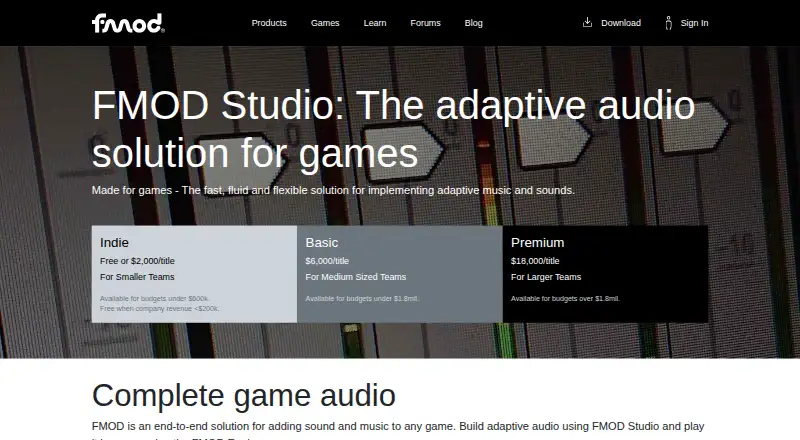
| Indie | Free | Development budget under $600k · free when company revenue is under $200k/year · lifetime distribution rights · all FMOD features and platforms · FMOD logo required · forum support · per game; free or $2,000/title |
| Basic | $6,000, paid once | Development budget between $600k and $1.8M · lifetime distribution rights · all FMOD features and platforms · FMOD logo required · 1 year of email support · per game |
| Premium | $18,000, paid once | Development budget over $1.8M · lifetime distribution rights · all FMOD features and platforms · FMOD logo required · 2 years of email support · per game |
The facts
Each one read from FMOD Studio's own pages, with the date it was checked.
What it does
- Audio design
- Its event editor supports instruments, effects, randomization, modulation, multitrack music, and automated effects.checked 29 Sep 2001
- Download access
- The download page asks users to sign in to view downloads.checked 29 Sep 2001
- Integrations
- FMOD Studio is ready to use with Unity and Unreal and can integrate with other engines through its API.checked 29 Sep 2001
- Live iteration
- Live Update lets users monitor levels and snapshots and hear changes on a connected game device in real time.checked 29 Sep 2001
- Mixer
- The mixer routes signals, applies DSP effects to event groups, and uses prioritized snapshots for dynamic mixing.checked 29 Sep 2001
- New features
- Studio 2.03 lists Multiband Dynamics, Spectral Sidechaining, Property Seek Speed, wet/dry/bypass controls on effects, and a Spectrum Analyzer.checked 29 Sep 2001
- Non-game licensing
- FMOD says non-game projects, including automotive, embedded systems, simulators, and hardware installations, require custom license pricing by contacting sales.checked 29 Sep 2001
- Privacy and security
- Firelight Technologies says it follows the Australian Privacy Principles and stores personal information in a manner that reasonably protects it from misuse, loss, unauthorized access, modification, or disclosure.checked 29 Sep 2001
- Profiler
- The built-in profiler can capture and simulate gameplay and inspect events, 3D positions, parameters, API calls, voice, levels, and CPU usage.checked 29 Sep 2001
- Programming APIs
- The product page says custom-engine integration can use the C++ or C# versions of the API.checked 29 Sep 2001
- Purpose
- FMOD Studio is an end-to-end solution for creating adaptive game audio and playing it in-game through the FMOD Engine.checked 29 Sep 2001
- Support
- FMOD lists free community forum support and email technical support for licensed users; licensing includes one year of email support with Basic and two years with Premium.checked 29 Sep 2001
- Supported authoring downloads
- FMOD's Unity integration tutorial directs users to download the FMOD Studio authoring tool for Windows or Mac.checked 29 Sep 2001
The company
- Headquarters
- Melbourne, Australiachecked 23 Sep 2001
- Team workflow
- The product page lists shared presets, integrated source control, and profiler sessions for communication with outsourced sound teams.checked 29 Sep 2001
The full review of FMOD Studio
FMOD Studio is a game-audio authoring tool paired with the FMOD Engine for in-game playback. It is best suited to audio teams building adaptive sound for Unity, Unreal, or a custom engine. Its main advantage is a workflow that spans sound design, mixing, profiling, and live iteration; the license is tied to each game’s development budget and, for the free tier, company revenue.
Overview
FMOD Studio connects audio creation to runtime behavior, so designers can shape how sound responds to gameplay rather than manage playback as a collection of fixed assets. Unity and Unreal integrations provide a direct route into those engines, while custom projects can use the C++ or C# API. That combination makes it a practical choice for teams that need audio designers and programmers to work against the same game audio system.
Its reach also includes spatial audio, interactive music, dialogue management, localization tools, and audio streaming. Firelight Technologies is headquartered in Melbourne, Australia, and says it follows the Australian Privacy Principles and takes reasonable steps to protect personal information.
FMOD Studio sits in Game Audio Middleware, where engine compatibility and licensing can be as consequential as authoring capabilities.
Key features
Authoring and mixing
The event editor supports instruments, effects, randomization, modulation, multitrack music, and automated effects. This range lets sound designers build variation and change over time into events and music. The mixer routes signals, applies DSP effects to event groups, and uses prioritized snapshots for dynamic mixing, giving teams a way to organize and change the overall sound as play conditions shift.
Profiling and iteration
The profiler can capture or simulate gameplay and inspect events, 3D positions, parameters, API calls, voice, levels, and CPU usage. That makes it useful for tracing how audio behaves in context and for checking its runtime footprint. Live Update lets users monitor levels and snapshots and hear changes on a connected game device in real time, shortening the loop between an authoring change and hearing it in the game.
Engine and team workflow
FMOD is ready to use with Unity and Unreal, and other engines can integrate through its API. Shared presets, integrated source control, and profiler sessions for communication with outsourced sound teams support collaboration, although custom-engine integration requires programming work.
Studio 2.03 adds Multiband Dynamics, Spectral Sidechaining, Property Seek Speed, wet/dry/bypass controls on effects, and a Spectrum Analyzer. These additions extend the available tools for shaping and analyzing sound.
Pricing
FMOD licenses are billed once per game, and each tier includes lifetime distribution rights, all FMOD features and platforms, and a required FMOD logo. The right tier depends on the project’s development budget; the Indie license also has a company-revenue condition.
- Indie: free, free or $2,000/title. For games with a development budget under $600k, it is free when company revenue is under $200k/year. It is the natural starting point for qualifying smaller studios, with forum support and no email-support term included.
- Basic: $6,000, paid once for development budgets between $600k and $1.8M. It suits projects above the Indie budget range and includes one year of email support.
- Premium: $18,000, paid once for development budgets over $1.8M. It preserves the same feature and platform scope while adding two years of email support.
All three tiers require the FMOD logo, so teams seeking distribution without that branding should weigh the license terms before committing. Free community forum support is available, while email technical support is for licensed users. Non-game uses such as automotive, embedded systems, simulators, and hardware installations require custom pricing through sales.
FMOD also offers a free trial. The authoring downloads are for Windows or Mac, and users must sign in to view downloads.
Platforms
The authoring software supports Linux, macOS, and Windows. Runtime targets include Windows, macOS, Linux, iOS, Android, tvOS, PS4, PS5, Xbox Series X|S, and Nintendo Switch. The broad runtime list is useful for cross-platform game projects, but authoring availability should not be confused with the platforms where a finished game can run.
Who it's for
FMOD Studio is a strong fit for game audio designers and development teams who need adaptive events, dynamic mixing, and a way to inspect and iterate on sound in gameplay. Unity and Unreal teams get ready-to-use integrations; teams using another engine can integrate with the C++ or C# API. Smaller studios should confirm both the under-$600k development budget and under-$200k annual company revenue conditions before treating Indie as free.
It is less suitable for non-game projects seeking a straightforward public tier, since those uses require custom license pricing. Teams that do not want to include the FMOD logo should also consider another licensing option.
Pros and cons
- Pro: Authoring, mixing, profiling, and live device iteration sit in one workflow, helping teams move from sound design to checking behavior in-game.
- Pro: Unity and Unreal support, custom-engine APIs, and a wide runtime platform range serve projects with varied engine and deployment needs.
- Pro: The Indie license includes all features and platforms with lifetime distribution rights for eligible projects, rather than restricting smaller teams to a reduced feature set.
- Con: The Indie free tier requires both a development budget under $600k and company revenue under $200k/year; a project outside those conditions may face a $2,000/title charge.
- Con: Every listed game tier requires the FMOD logo, and Basic and Premium carry substantial one-time per-game costs.
- Con: Non-game projects need custom pricing, making the game-focused tiers unsuitable for straightforward cost planning in those fields.
Alternatives
- Audiokinetic Wwise is another freemium game-audio option with a free plan and trial; its Indie tier is free for games with production budgets under $250K.
- Amplitude Audio SDK is worth considering for teams seeking a free, open-source option under Apache-2.0; its Amplitude Studio Free plan is for non-commercial use.
- Miles Sound System is a paid alternative with a trial and custom product licensing, including per-game and per-platform licensing options.
- Elias is a paid alternative whose Explorer Standard plan costs €5,850, paid once and covers PC/Mac and mobile for games with production budgets between €300k and €1.5M.
- Sound Bakery is a free, open-source option under the MIT license.
- irrKlang offers a free non-commercial plan and a paid hobbyist option for individuals, not companies.
- SoLoud is a free option that permits commercial use, modification, and redistribution under the ZLib/LibPNG license.
- Steam Audio SDK is available free to all developers, subject to its license agreement.
Verdict
Choose FMOD Studio if your game team needs a connected authoring, mixing, profiling, and live-iteration workflow across Unity, Unreal, or a custom engine. Its breadth and lifetime distribution rights make the eligible Indie tier especially compelling; look elsewhere if the required logo, budget-based per-game fees, or custom pricing for non-game projects do not fit your plans.
Alternatives to FMOD Studio
- 1

Unity Version Control
Free planWebAPILinuxmacOS8.1Free plan - 2
Audiokinetic Wwise
Free planAndroidiOSLinuxmacOS7.4$8,000, paid once - 3

Amplitude Audio SDK
Free planAndroidiOSLinuxmacOS6.8Free plan - 4

Elias
AndroidiOSmacOSWindows6.8€5,850, paid once - 5
irrKlang
Free planLinuxmacOSWindows6.8€65, paid once - 6
psai
Free planAndroidiOSAPILinux6.8Free plan