
MediaWiki
MediaWiki is free, server-based wiki software for collecting, organizing, and sharing knowledge.
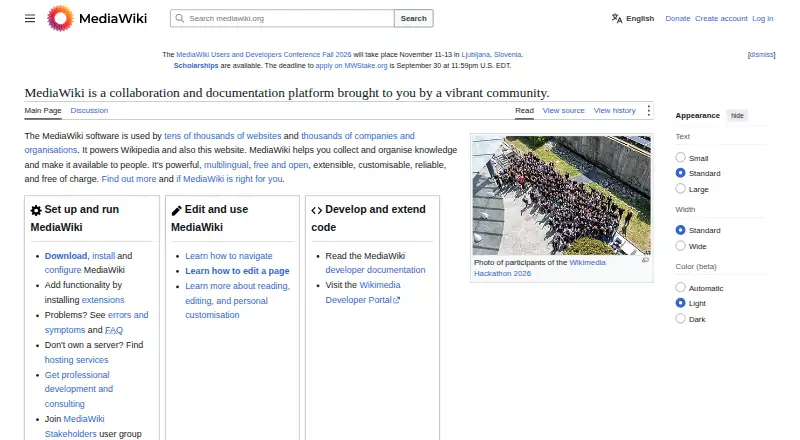
What MediaWiki is
MediaWiki is free, server-based wiki software for collecting, organizing, and sharing knowledge. Pages use wikitext, so contributors can edit without knowing HTML or CSS, and earlier versions remain available for reverting. Administrators can customize appearance and behavior with extensions, while caching supports large, high-traffic wikis. Its REST API provides HTTP access to content and functions such as search, page transformations, and page history, with JSON or HTML output. MediaWiki is self-hosted software under GNU GPL version 2 or later and is provided without warranty to the extent permitted by law. The latest stable version requires PHP 8.3.0 or later, a web server, and MariaDB 10.3.0+, MySQL 5.7.0+, PostgreSQL 10.0+, or SQLite 3.31.0+. Each release receives security updates for one year, and developers recommend following the low-traffic mediawiki-announce list. Third-party extensions may be unmaintained, vulnerable, version-incompatible, or unreliable when used together.
Good
- Free software under GNU GPL version 2 or later
- Earlier page versions can be restored
- REST API supports search and page history
- Extensions can change appearance and behavior
- Caching supports large wikis
Watch out
- Requires a web server, PHP, and a supported database
- Third-party extensions can be vulnerable or incompatible
- Provided without warranty to the extent permitted by law
Who it suits
MediaWiki suits people who can self-host a knowledge base and need collaborative editing, version history, or customization through extensions. It may not suit projects needing partial access restrictions or dedicated forum or blogging software.
Verdict
MediaWiki offers flexible, self-hosted wiki publishing with an API and page history. Plan for its server and database requirements, and assess extensions carefully.
Plans and prices
From MediaWiki's own pricing page, checked 3 Oct 2026.
| Plan | Price | What it gives you |
|---|---|---|
| MediaWiki | Free | Free software under GNU GPL version 2 or later · self-hosted software |
The facts
Each one read from MediaWiki's own pages, with the date it was checked.
What it does
- API
- The REST API provides HTTP access to wiki content and functions, including searching, transforming pages, and accessing page history.checked 3 Oct 2026
- API formats
- The REST API can return JSON or HTML and can expose extension-specific endpoints.checked 3 Oct 2026
- Audience fit
- The manual says MediaWiki may not suit wikis needing partial access restrictions, smaller sites constrained by disk or memory, or projects seeking dedicated forum or blogging software.checked 3 Oct 2026
- Content analytics
- Yeschecked 20 Sep 2026
- Custom domain
- Yeschecked 20 Sep 2026
- Customization
- Extensions let administrators customize MediaWiki's appearance and behavior, and developers can write or contribute extensions.checked 3 Oct 2026
- Editing
- Pages use wikitext, which lets users edit without knowing HTML or CSS, and previous page versions remain available for reverting edits.checked 3 Oct 2026
- Extension risk
- Third-party extensions may be unmaintained, vulnerable, incompatible with some MediaWiki versions, or unreliable together.checked 3 Oct 2026
- License and warranty
- MediaWiki is free software under GNU GPL version 2 or later, and the download page states that it is provided without warranty to the extent permitted by law.checked 3 Oct 2026
- Publishing audience
- bothchecked 20 Sep 2026
- Purpose
- MediaWiki is server-based wiki software for collecting, organizing, and sharing knowledge.checked 3 Oct 2026
- Requirements
- The latest stable version requires PHP 8.3.0 or later, a web server, and MariaDB 10.3.0+, MySQL 5.7.0+, PostgreSQL 10.0+, or SQLite 3.31.0+.checked 3 Oct 2026
- Scale
- MediaWiki was designed for high-traffic websites and supports caching for large wikis.checked 3 Oct 2026
- Security updates
- The developers recommend subscribing to the low-traffic mediawiki-announce list, and each release receives security updates for one year.checked 3 Oct 2026
- SSO support
- Yeschecked 20 Sep 2026
- Support
- The MediaWiki site directs users with questions to its community support desk and offers documentation, FAQs, and community communication channels.checked 3 Oct 2026
- Version history
- Yeschecked 20 Sep 2026
Money
- Free plan
- Yeschecked 20 Sep 2026
The company
- Headquarters
- San Francisco, California, United Stateschecked 28 Sep 2026
Where it runs
- Platform setup
- The installation requirements page describes software bundles such as XAMPP for Linux, Windows, and Mac, and MAMP for Windows and Mac.checked 3 Oct 2026
The full review of MediaWiki
Overview
MediaWiki is server-based software for publishing and maintaining a shared wiki. It is best suited to organizations and publishers able to operate their own hosting and willing to manage extensions. Its appeal is the combination of revision control, customization and API access; it is a poor fit when granular access restrictions or a managed, low-maintenance setup are essential.
Key features
Contributors edit pages in wikitext rather than HTML or CSS, and earlier versions can be restored. That keeps the editing model approachable for people who do not build web pages while giving teams a way to recover from unwanted changes.
Administrators can alter appearance and behavior through extensions, with the option for developers to create or contribute them. This makes MediaWiki adaptable, but extension choice carries ongoing risk: third-party add-ons may be unmaintained, vulnerable, incompatible with a particular version, or unreliable in combination.
The REST API exposes wiki content and functions over HTTP, including search, page transformations and page history. It can return JSON or HTML, and extensions can add endpoints. For high-traffic wikis, caching support and a design intended for large sites are meaningful advantages, though they do not remove the need to provide and maintain the server.
MediaWiki supports custom domains, single sign-on, content analytics and version history. The software is licensed under GNU GPL version 2 or later and carries no warranty to the extent permitted by law. Its developers recommend subscribing to the low-traffic mediawiki-announce list; each release receives security updates for one year.
Pricing
MediaWiki costs nothing. It is free software under GNU GPL version 2 or later, but self-hosted rather than a hosted service, so the organization must provide the infrastructure and administration. There is no free trial because the software itself is free.
The latest stable release requires PHP 8.3.0 or later, a web server, and MariaDB 10.3.0+, MySQL 5.7.0+, PostgreSQL 10.0+ or SQLite 3.31.0+. Those requirements make the price attractive to technically capable teams, but not necessarily the lower-effort choice for a small group without server expertise.
Platforms
MediaWiki is available for self-hosted use on Linux, macOS and Windows, with web access and an API. Installation guidance describes software bundles including XAMPP for Linux, Windows and Mac, and MAMP for Windows and Mac. Documentation, FAQs, community communication channels and a support desk give administrators places to seek help, but this remains community-oriented rather than a managed installation.
Who it's for
Choose MediaWiki for a knowledge project that needs a customizable, extensible wiki, revision recovery and programmatic access, especially when the team can run and secure its own server. The manual cautions against it for projects needing partial access restrictions, smaller sites constrained by disk or memory, or users who really need dedicated forum or blogging software. Those are substantial caveats: flexibility does not make it a universal publishing platform.
Pros and cons
- Pro: Wikitext editing and restorable page history support collaborative publishing without requiring contributors to know HTML or CSS.
- Pro: The REST API, including JSON and HTML responses and extension-specific endpoints, can support integrations and content workflows.
- Pro: Extension-based customization and caching support make it adaptable to large, high-traffic wikis.
- Con: Self-hosting requires a web server, recent PHP and a supported database, adding operational work beyond the zero software price.
- Con: Third-party extensions can introduce maintenance, security and compatibility problems.
- Con: Partial access restrictions and resource-constrained smaller sites are identified as poor fits.
Alternatives
Confluence is worth considering if a hosted-style freemium option suits better: its free plan is forever for 10 users and includes 2 GB file storage and three active whiteboards per user, with a free trial also offered.
PmWiki is another free, self-hosted PHP wiki option for readers comparing open-source choices. MoinMoin and Wiki.js are also free software options; Wiki.js is AGPL-licensed and self-hosted.
BookStack offers a no-cost self-hosted edition under the MIT license. Slab may suit a small group preferring a web-based freemium plan, but its free tier is capped at 10 users, 10 MB attachments, 90 days of version history and 30 days of usage analytics.
BlueSpice has a free distribution with business features including a visual editor, performance search, templates and PDF export. Docmost offers an open-source Community edition with real-time collaboration, spaces, full-text search, page history and restore, and public sharing.
Explore more options in Wiki Software, Knowledge Management Software and Knowledge base software.
Verdict
MediaWiki is a strong choice for teams that want a capable, extensible wiki and can take responsibility for hosting, updates and extension quality. Its price and revision-aware publishing are compelling; look elsewhere if you need partial access controls, modest-resource hosting or a turnkey service.
Alternatives to MediaWiki
- 1

Confluence
Free planAndroidiOSWebSelf-hosted9.0From $5.42 a month - 2

ProProfs Knowledge Base
Free planAndroidiOSWebAPI9.0From $0.99 a month - 3

Zendesk Guide
AndroidiOSWebAPI8.6From $19 a month - 4

Scalar
Free planOpen sourceWebAPILinuxmacOS8.6From $150 a month - 5

Mintlify
Free planWebAPILinuxmacOS8.5From $450 a month - 6

Lark
Free planAndroidiOSWebAPI8.5From $6 a month