
Ziplyne
Ziplyne combines digital adoption tools and test automation to guide users through enterprise applications and validate releases before shipping.
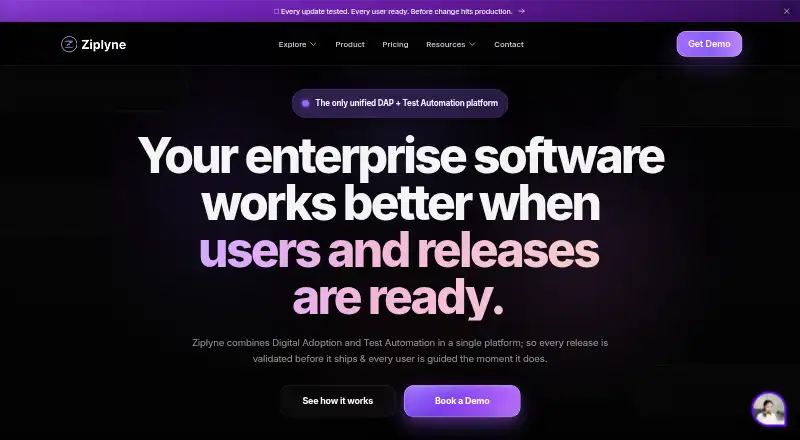
What Ziplyne is
Ziplyne combines digital adoption tools and test automation to guide users through enterprise applications and validate releases before shipping. Its DAP offers step-by-step in-app guidance, no-code onboarding and change communication flows, and adoption analytics. ZipRPA generates tests from process recordings, runs continuous regression tests, and can self-heal scripts when interface elements change. Tests can run across development, test, and production environments. The product is pre-tuned for Workday, Salesforce, ServiceNow, SAP, Coupa, Oracle, and Microsoft Dynamics, and can also run in browser-based internal apps and portals. Testing integrations include Jenkins, Azure DevOps, GitHub Actions, GitLab, and Bamboo, with REST API support for other pipeline systems. Ziplyne lists Tableau, Power BI, Looker, Snowflake, and BigQuery for BI export and data warehouse sync. It supports walkthroughs, no-code building, mobile apps, and localization, and is available on Android, iOS, web, as an extension, through an API, and as self-hosted software. The guided 14-day trial is not self-serve. There is no free plan; paid plans start at $500 a month.
Good
- Combines adoption guidance and test automation.
- Tests can be generated from process recordings.
- Supports several named enterprise applications.
- Offers a 14-day trial.
Watch out
- There is no free plan.
- Trial access is guided, not self-serve.
- Paid plans start at $500 a month.
- ISO 27001 is still in progress.
Who it suits
Ziplyne may suit enterprise application, QA, IT, HR, and training teams that need both in-app guidance and release testing. It also names system integrators and business leaders among its intended audiences.
Verdict
Ziplyne brings user guidance and regression testing into one platform, with listed integrations for testing and analytics. Its trial requires Customer Success guidance, and ongoing paid plans start at $500 a month.
Plans and prices
From Ziplyne's own pricing page, checked 9 Oct 2001.
| Plan | Price | What it gives you |
|---|---|---|
| Ziplyne POV | Free | 14 days free · Create 3 Guides · Unlimited Steps · 1 Application Domain · Customer Success Team support; not self-serve |
| ZCX | $500 a month | Based on SaaS MAUs · Ziplyne branding · Zips, modals, tooltips, pulses · Team licenses · 1 application domain · Guide analytics · Starting at $500/Month |
| ZEX | $1,000 a month | Per user/application/month · Includes everything in ZCX · Unlimited Guides · User Groups · Unlimited steps per Guide · Multiple Apps/Domains · Content Links · Validations · Guide Analytics · Starting at $1k/Month |
| ZCX | $6,000 a year | Based on SaaS MAUs · Ziplyne branding · Zips, modals, tooltips, pulses · Team licenses · 1 application domain · Guide analytics · Starting at $6k/Year |
| ZEX | $12,000 a year | Per user/application/year · Includes everything in ZCX · Unlimited Guides · User Groups · Unlimited steps per Guide · Multiple Apps/Domains · Content Links · Validations · Guide Analytics · Starting at $12k/Year |
The facts
Each one read from Ziplyne's own pages, with the date it was checked.
What it does
- Analytics integrations
- Ziplyne lists Tableau, Power BI, Looker, Snowflake, and BigQuery for BI export and data warehouse sync.checked 9 Oct 2001
- Deployment and data
- Ziplyne says application data and worker PII stay in the customer environment and offers optional on-premises and private-cloud deployment.checked 9 Oct 2001
- Pricing limits
- The POV is guided by Customer Success and is not self-serve; paid plan prices are labeled as starting prices, with ZCX based on SaaS monthly active users.checked 9 Oct 2001
- Product
- Ziplyne combines Digital Adoption and Test Automation in one platform to validate releases before shipping and guide users in enterprise applications.checked 9 Oct 2001
- Security certifications
- The site lists SOC 2 Type II, GDPR, HIPAA-ready deployments with a BAA available, and NIST AI RMF alignment; ISO 27001 is in progress.checked 9 Oct 2001
- Security controls
- Listed controls include SSO via SAML, OIDC, and OAuth, SCIM provisioning, role-based access control, customer-managed encryption keys, and US, EU, and APAC data residency.checked 9 Oct 2001
- Support
- Ziplyne lists [email protected] and US office hours of 8 am–5 pm EST; global office hours vary by time zone.checked 9 Oct 2001
- Test automation
- ZipRPA generates tests from process recordings, runs continuous regression tests, self-heals scripts when UI elements change, and supports deployment across development, test, and production environments.checked 9 Oct 2001
- Testing integrations
- ZipRPA lists Jenkins, Azure DevOps, GitHub Actions, GitLab, and Bamboo integrations, plus REST API support for other pipeline systems.checked 9 Oct 2001
- Who it serves
- The site describes solutions for system integrators, IT and application leaders, business leaders, HR and people operations, training teams, and QA teams.checked 9 Oct 2001
The company
- Founded
- 2017checked 28 Sep 2001
Where it runs
- In-app guidance
- Ziplyne DAP provides step-by-step in-app guidance, no-code onboarding and change communication flows, and analytics for adoption tracking.checked 9 Oct 2001
- Supported applications
- The product is pre-tuned for Workday, Salesforce, ServiceNow, SAP, Coupa, Oracle, and Microsoft Dynamics, and can run in browser-based internal apps and portals.checked 9 Oct 2001
The full review of Ziplyne
Ziplyne pairs in-app guidance with automated regression testing for organizations managing enterprise applications. It suits teams that need to support users and check releases across the same software estate. Its combined scope is the main draw; buyers should be ready for an enterprise-oriented product and a Customer Success-led trial.
Overview
Ziplyne brings its digital adoption platform together with ZipRPA, its test automation product. The guidance side helps teams create onboarding and change-communication flows without code, while ZipRPA turns recorded processes into tests and runs continuous regression checks. That combination can connect user enablement with release quality, but may be more than teams seeking only lightweight onboarding need.
ZipRPA can self-heal scripts when interface elements change and supports deployment across development, test, and production environments. For QA teams with recurring release checks, that reduces some maintenance work; the broader platform also gives IT and application leaders a shared tool for adoption and testing.
Key features
Guidance and application coverage
No-code guides, modals, tooltips, and pulses support onboarding and change communication, while analytics track adoption. Ziplyne is pre-tuned for Workday, Salesforce, ServiceNow, SAP, Coupa, Oracle, and Microsoft Dynamics, and can also run in browser-based internal apps and portals. This breadth is useful for organizations supporting several enterprise systems; a team focused on one narrow application may not need the full range.
Testing and integrations
ZipRPA generates tests from process recordings, runs continuous regression tests, and can self-heal scripts after UI changes. It integrates with Jenkins, Azure DevOps, GitHub Actions, GitLab, and Bamboo, with REST API support for other pipeline systems. This makes it relevant to QA teams that want release checks in their existing pipelines, though organizations without a test-automation need will get less from the combined platform.
Analytics, security, and deployment
BI and data warehouse integrations include Tableau, Power BI, Looker, Snowflake, and BigQuery. Listed security measures include SOC 2 Type II, GDPR, HIPAA-ready deployments with a BAA available, and NIST AI RMF alignment; ISO 27001 is in progress. SSO, SCIM provisioning, role-based access control, customer-managed encryption keys, and US, EU, and APAC data residency address enterprise administration requirements. Ziplyne says application data and worker PII stay in the customer environment, with optional on-premises and private-cloud deployment. That is a meaningful fit for organizations with deployment or data-handling constraints.
Pricing
Ziplyne is paid software with no free plan. Its 14-day Ziplyne POV is free, but it is guided by Customer Success rather than self-serve. It includes three guides, unlimited steps, one application domain, and Customer Success Team support. The short trial is useful for a focused evaluation, but teams wanting to explore independently may find the guided format restrictive.
ZCX starts at $500 a month, based on SaaS monthly active users. It includes team licenses, one application domain, Ziplyne branding, zips, modals, tooltips, pulses, and guide analytics. This is the entry paid option for teams that need guidance and analytics on one domain; the starting price and MAU basis make user volume an important budget consideration.
ZEX starts at $1,000 a month and is priced per user/application/month. It includes everything in ZCX, plus unlimited guides, user groups, unlimited steps per guide, multiple apps or domains, content links, validations, and guide analytics. The higher tier fits broader deployments that need multiple applications or more guide capacity; teams with a single domain and limited guidance needs may not need its additions. Both paid prices are starting prices, so actual cost depends on the stated pricing basis.
Platforms
Ziplyne supports Android, iOS, web, browser extension, API, and self-hosted deployments. Mobile app support and localization broaden its potential reach, while self-hosting and private-cloud options matter to organizations with tighter deployment requirements.
Who it's for
Ziplyne is aimed at system integrators, IT and application leaders, business leaders, HR and people operations, training teams, and QA teams. It is strongest for organizations that need both guided experiences in enterprise applications and repeatable release testing. A company looking only for a small set of help prompts, or QA tooling without adoption guidance, should compare more focused products.
Pros and cons
- Pros: Guidance and regression automation share one platform, connecting user adoption work with release validation.
- Pros: Pre-tuned coverage for major enterprise applications and integrations with common testing pipelines can reduce setup friction for teams using those systems.
- Pros: Self-healing tests, deployment flexibility, and enterprise security controls support complex operating environments.
- Cons: The 14-day trial is not self-serve and requires Customer Success guidance, limiting independent evaluation.
- Cons: Paid plans start at $500 a month, and ZCX pricing depends on SaaS monthly active users; smaller or single-purpose teams may find the commitment hard to justify.
- Cons: ZCX is limited to one application domain, so organizations needing multiple apps must consider the more expensive ZEX tier.
Alternatives
For a broader comparison, browse Digital Adoption Platforms.
- Whatfix is worth considering if a free plan matters alongside paid options; its platform support also spans desktop systems beyond Ziplyne's stated coverage.
- Stonly offers a freemium alternative with a Basic tier capped at 400 guide views per month, five published guides, one language, 100 steps per guide, and one team member.
- Candu has a free plan with overlays, three live experiences, and unlimited user licenses, making it an option for teams that can work within that smaller scope.
- Nexthink Adopt is another paid digital adoption option; its pricing requires contacting a Nexthink representative.
- VisualSP offers a free Adopt365 plan for Microsoft 365 web apps with predefined prompts and step-by-step answers in Chrome and Edge.
- Zoho Digital Adoption Platform has a free tier for one manager, one walkthrough, three interactive videos and guides, one web banner, and an unlimited Help Hub; its Standard plan costs $24 a month, billed monthly.
- Cornerstone Learning is a paid alternative with pricing that varies by organizational needs and size.
- WalkMe is a paid alternative for organizations seeking a digital adoption platform.
Verdict
Ziplyne is a strong fit for enterprise teams that want in-app guidance and regression testing tied together, particularly when they support several major business applications and need deployment or security controls. Its broad toolkit is the main reason to choose it. Look elsewhere if the priority is a self-serve trial, a free plan, or guidance alone at a lower entry cost.
Getting started
- Open the Ziplyne website
- Start the 14-day Ziplyne POV trial
- Work with the Customer Success team during the guided evaluation
- Choose ZCX or ZEX based on domains, guides, and user requirements
- Deploy through web, Android, iOS, extension, API, or self-hosted options
Limits worth knowing
The free POV lasts 14 days, allows three guides and one application domain, and is not self-serve. The $500/month ZCX plan includes one application domain and Ziplyne branding; ZEX starts at $1,000/month and is priced per user, application, and month.
Questions
Does Ziplyne have a free plan?
No. Ziplyne offers a 14-day free POV trial, while ongoing plans are paid.
What is the starting price?
Pricing starts at $500 per month. ZCX is based on SaaS monthly active users, while ZEX starts at $1,000 per month and is priced per user, application, and month.
Which applications does it support?
It is pre-tuned for Workday, Salesforce, ServiceNow, SAP, Coupa, Oracle, and Microsoft Dynamics, and can run in browser-based internal apps and portals.
Can Ziplyne be self-hosted?
Yes. It is available as self-hosted software and offers optional on-premises and private-cloud deployment.
What testing integrations are available?
Listed integrations include Jenkins, Azure DevOps, GitHub Actions, GitLab, and Bamboo, with REST API support for other pipeline systems.