
Candu
Candu is a web and extension platform for creating in-product onboarding, upgrade prompts, and announcements that follow a product’s visual design.
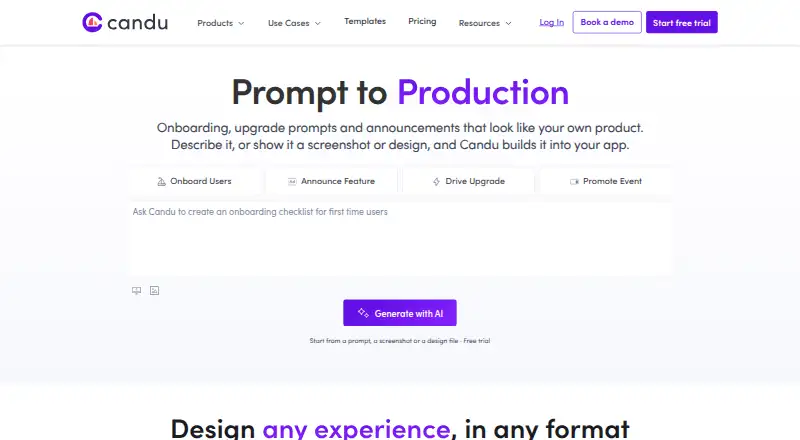
What Candu is
Candu is a web and extension platform for creating in-product onboarding, upgrade prompts, and announcements that follow a product’s visual design. It supports inline and overlay formats such as product tours, walkthroughs, checklists, homepages, banners, empty states, modals, forms, and hotspots. Its AI can generate in-product interface elements from a prompt, screenshot, or design; users can then review, edit, and publish them. The editor provides reusable components, audience segmentation, responsive layouts, CSS controls, and real-time publishing. Analytics cover users, content, engagement, and A/B testing. Starter adds integrations and webhooks, while Candu also describes connections with analytics providers. Launching requires placing a JavaScript snippet in the product header. Candu lists TLS 1.3 for data in transit, AES-256 encryption at rest, a SOC 2 Type II audit covering December 2023 through November 2024, and a 99.9% SLA. Data is stored in AWS eu-west-1 by default, PII is not required or actively collected, and data is deleted within 30 days after contract termination.
Good
- AI-generated in-product UI from prompts, screenshots, or designs
- Supports inline and overlay onboarding experiences
- Reusable components, segmentation, responsive design, and CSS controls
- Analytics include engagement, user, content, and A/B testing
- 99.9% SLA with fail-open SDK behavior
- Free plan includes unlimited user licenses
Watch out
- Mobile app support is unavailable
- Free plan allows overlays only and three live experiences
- Starter and Growth require annual billing
- Launching requires adding a JavaScript snippet to the product header
Who it suits
Candu suits growth product managers, designers, and developers responsible for onboarding, adoption, and product-led growth. It fits teams that need customizable in-product guidance, segmentation, analytics, and publishing controls on web products.
Verdict
Pick Candu if your team needs branded onboarding, prompts, tours, and announcements inside a web product. Its free tier is useful for limited overlay work, while inline experiences and several additional formats begin with Growth. Look elsewhere if mobile app support is essential.
Plans and prices
From Candu's own pricing page, checked 15 Oct 2026.
| Plan | Price | What it gives you |
|---|---|---|
| Free | Free | Overlays only · unlimited user licenses · 3 live experiences · modals, hotspots and product tours · advanced styling · segmentation · email and chat support · No credit card required |
| Starter | $199 a month | Overlays only · unlimited user licenses · unlimited modals, hotspots and tours · advanced styling · segmentation · analytics · integrations and webhooks · email and chat support · Paid annually |
| Growth | $799 a month | Overlay and inline experiences · unlimited inline experiences · banners, checklists, forms, empty states and homepages · goal tracking · RBAC · dedicated CSM and Slack support · Paid annually |
| Enterprise | Priced on request | A/B testing and experimentation · CMS and Collections · SSO · custom contract and SLAs · 10 service hours per quarter · premium support · volume discounts · Contact Candu |
The facts
Each one read from Candu's own pages, with the date it was checked.
The company
- 2025 company news
- Candu reported reaching profitability in 2025 and launching prompt-to-design, image generation and context-aware creation features.checked 15 Oct 2026
- Company profile
- LinkedIn lists Candu as privately held, founded in 2019, headquartered in Oakland, California, with 11–50 employees.checked 15 Oct 2026
- Headquarters
- Walnut, California, United Stateschecked 28 Sep 2026
What it does
- AI builder
- The AI beta can draft layouts and copy from prompts, screenshots, webpages and attachments, but it cannot yet create forms, flows, video embeds or conditional blocks.checked 15 Oct 2026
- AI creation
- Candu says its AI can build in-product UI from a prompt, screenshot or design and lets users review, edit and publish changes.checked 2 Oct 2026
- Analytics
- Candu offers user and content analytics, engagement measurement and A/B testing capabilities.checked 2 Oct 2026
- API and extensibility
- Developer documentation covers a JavaScript SDK, REST data API, signed identities, outgoing webhooks, SDK events and DOM APIs.checked 15 Oct 2026
- Audience
- Candu describes its intended users as growth product managers, designers and developers working on onboarding, product adoption and product-led growth.checked 2 Oct 2026
- Availability
- Candu states a 99.9% SLA and says its SDK fails open if its service is unreachable.checked 2 Oct 2026
- Customization
- The editor supports reusable components, user segmentation, real-time publishing, responsive design and CSS styling controls.checked 2 Oct 2026
- Data handling
- Candu says PII is not required, customer data can be exported as JSON within 30 days, and deletion requests are completed within 30 days.checked 15 Oct 2026
- Documentation depth
- The help center contains installation, editor, segmentation, publishing, analytics, troubleshooting, integrations, billing and AI-agent sections.checked 15 Oct 2026
- Experience components
- The product provides checklists, homepages, banners, empty states, modals, forms, surveys, tours and hotspots.checked 15 Oct 2026
- Experience formats
- It supports inline and overlay experiences including checklists, homepages, banners, empty states, modals, forms and hotspots.checked 2 Oct 2026
- Founding-year discrepancy
- A 2020 PR Newswire release says Candu was founded in 2018, while LinkedIn lists 2019.checked 15 Oct 2026
- Funding news (2020-12-10)
- TechCrunch reported a $5 million round led by Two Sigma Ventures, following roughly $1 million raised earlier.checked 15 Oct 2026
- Implementation
- Launching experiences requires adding Candu’s JavaScript snippet to the product header.checked 2 Oct 2026
- Installation
- All features require a JavaScript snippet in the site head, after which teams publish content through Candu without redeploying their application.checked 15 Oct 2026
- Installation limitation
- Using Google Tag Manager can cause content not to appear because ad blockers commonly block GTM, and customers may need CSP and domain allowlisting.checked 15 Oct 2026
- Integrations
- Documented integrations include Segment, PostHog, Databricks, RudderStack, Amplitude, HubSpot, Heap, Salesforce, Census, Appcues, Intercom, Pendo and WalkMe.checked 15 Oct 2026
- Legal entity
- The subscription agreement identifies the supplier as Candu, Inc., a Delaware corporation.checked 15 Oct 2026
- Licence
- The subscription agreement describes a proprietary hosted service, grants limited usage rights and retains Candu intellectual property.checked 15 Oct 2026
- Limit: Capterra performance and pricing
- Reviews mention a learning curve, slow browser refreshes, JavaScript selector setup and dissatisfaction from some AppSumo lifetime-deal buyers about later paid features.checked 15 Oct 2026
- Limit: G2 learning curve
- Reviewers mention that the many customization options can overwhelm new users and that segment cloning between environments is missing.checked 15 Oct 2026
The full review of Candu
Candu is a web-based platform for creating branded onboarding, adoption and upgrade guidance inside a product. It suits growth product managers, designers and developers who need targeted experiences across a web interface. The strongest case is a team that wants more than simple tours; teams needing mobile app support or inline content on a lower-cost plan should look elsewhere.
Overview
Candu combines in-product prompts with fuller guidance such as tours, walkthroughs and onboarding checklists. Experiences can be segmented by user, adjusted with responsive design and CSS controls, and published in real time. Reusable components help maintain a consistent product language across campaigns. The main implementation qualification is technical: the product must receive Candu’s JavaScript snippet in its header, so a developer is needed for launch even though the builder itself is no-code.
Its AI can generate in-product UI from a written prompt, screenshot or design. Because the resulting work can be reviewed and edited before publishing, the feature is best viewed as a production shortcut rather than automatic release control. Candu also supplies user and content analytics, engagement measurement and A/B testing. A/B testing is confined to Enterprise, limiting experimentation for smaller teams.
Key features
- Broad experience formats: Inline and overlay experiences cover checklists, homepages, banners, empty states, modals, forms and hotspots, as well as tours. This supports coordinated onboarding and upgrade messaging, but inline formats start only with Growth.
- Targeting and design control: Segmentation, reusable components, responsive behavior and CSS styling let teams tailor guidance to audiences while preserving their product’s visual system.
- AI-assisted creation: A prompt, screenshot or design can become a draft interface for review, editing and publication. That can reduce repetitive setup without removing editorial oversight.
- Measurement: User and content analytics and engagement metrics help teams judge whether guidance is being used. A/B testing is an Enterprise capability, not a lower-tier inclusion.
- Integrations: Starter includes integrations and webhooks, and Candu connects with analytics providers. These connections matter for teams that need product-guidance activity in a wider measurement workflow.
- Reliability and security: Candu states a 99.9% SLA, TLS 1.3 in transit, AES-256 encryption at rest and a SOC 2 Type II audit covering December 2023 through November 2024. Its SDK fails open if the service cannot be reached, reducing the risk that unavailable guidance blocks the product.
- Data handling: Customer data is stored in AWS eu-west-1 by default, Candu says it does not require or actively collect personally identifiable information, and it deletes data within 30 days of contract termination.
Pricing
Candu uses a freemium structure with a 14-day trial. The Free plan costs nothing and permits overlays only, three live experiences and unlimited user licenses. It is a sensible way to trial basic prompts, but the experience cap and lack of inline formats make it unsuitable for a broad onboarding program.
Starter costs $199 a month, billed annually. It remains overlay-only but removes limits on modals, hotspots and tours and adds segmentation, analytics, integrations and webhooks. This is the practical tier for a web product focused on targeted overlay guidance and willing to commit to annual billing.
Growth costs $799 a month, billed annually. It adds inline experiences, banners, checklists, forms, empty states and homepages, along with unlimited workspaces and goal tracking. A dedicated customer success manager and Slack support make it the better fit for multiple teams or a more operationally important adoption program, though the price is a substantial step up from Starter.
Enterprise has custom pricing. It adds A/B testing, a CMS, SSO, custom contracts and SLAs, 10 service hours per quarter, premium support and volume discounts. Those requirements justify a sales-led arrangement; smaller teams should not choose it solely for features already absent from the lower plans.
Platforms
Candu runs on the web and is delivered through a browser extension and JavaScript integration. It does not support mobile apps, so products whose primary onboarding surface is iOS or Android need another tool.
Who it's for
Candu is aimed at growth product managers, designers and developers working on onboarding, product adoption and product-led growth. Starter fits a focused web product using overlays; Growth fits organizations that need inline guidance, varied formats and several workspaces; Enterprise fits teams requiring SSO, formal service terms or advanced experimentation. It is a poor match for a mobile-first product or for a team that cannot add a header snippet.
Pros and cons
Pros
- Many guidance formats: The combination of tours, checklists, prompts and inline states covers more journeys than a tour-only utility.
- Strong brand control: Reusable components, segmentation, responsive design and CSS controls support product-specific presentation.
- Operational safeguards: A 99.9% SLA, fail-open SDK behavior and stated encryption standards reduce deployment risk.
- Useful support escalation: Growth includes a dedicated customer success manager and Slack channel.
Cons
- Lower tiers are overlay-only: Inline onboarding and several important formats require the $799 Growth plan.
- Annual commitment: Starter and Growth prices are billed annually, which raises the commitment for teams still validating demand.
- Developer setup remains necessary: The JavaScript header snippet prevents a completely non-technical rollout.
- No mobile apps: Candu cannot serve native iOS or Android onboarding.
- Testing is gated: A/B testing appears only in Enterprise.
Alternatives
Wakeline is the better choice when Android and iOS support matters, with web and extension coverage as well; its Free plan allows three flows, 1,000 monthly active users and one teammate, while Pro is $41.00 per month billed annually.
Clew suits teams wanting self-hosting, with a Free plan for one site, one seat and up to three published tours, plus a $14.99-per-month Pro plan.
Driver.js is a free option for unlimited projects and personal or commercial use, with Android, iOS and web platforms.
Guidez offers extension, web and API delivery; its free Hobby plan includes 100 MAU per month, one team member and one environment, while Pro costs $79.00 per month.
Tour Kit is a web-focused paid product whose free development and evaluation use requires a license for production.
Guida.js is a free, MIT-licensed web library of about 4.8kB minified and gzipped with no external dependencies.
Usertour is worth considering when open-source deployment matters: its MIT-licensed core is public and can be self-hosted with Docker, with Starter at $59.00 per month billed monthly.
Appcues is a paid alternative with Android, iOS, API, extension and web support; its Start plan covers up to 3,000 MAUs and 10 published experiences, with Grow beginning at 3,000 MAUs.
For broader comparisons, see User Onboarding Software, Digital Adoption Platforms and Product Adoption Software.
Verdict
Choose Candu when a web product needs branded, segmented onboarding and adoption guidance in several formats, and when Growth or Enterprise pricing is justified by inline content, workspaces or governance. Its design controls, analytics and fail-open delivery are compelling for product-led teams. Look elsewhere if mobile support, a lightweight implementation or low-cost inline experiences are non-negotiable.
Getting started
- Open the Candu website
- Choose the Free, Starter, Growth, or Enterprise plan
- Add Candu’s JavaScript snippet to your product header
- Create an experience with the editor or AI generation
- Configure components, segmentation, styling, and publishing
- Review analytics and engagement results
Limits worth knowing
The Free plan provides overlays only and allows three live experiences, although user licenses are unlimited. Starter is $199 a month billed annually and adds segmentation, analytics, integrations, and webhooks; inline experiences and several additional formats begin with Growth at $799 a month billed annually.
Questions
Does Candu have a free plan?
Yes. The Free plan costs nothing and includes overlays only, three live experiences, and unlimited user licenses.
Which platforms does Candu support?
Candu is available as a web platform and extension. Mobile app support is not available.
Does Candu support A/B testing?
Yes. A/B testing is listed among its analytics capabilities and is included in the Enterprise plan details.
How is Candu added to a product?
You launch experiences by adding Candu’s JavaScript snippet to the product header.
What support comes with the plans?
Free and Starter include email and chat support. Growth includes a dedicated customer success manager and Slack channel.
Alternatives to Candu
- 1

Helppier
AndroidiOSWebAPI7.7From $49 a month - 2

Wakeline
Free planAndroidiOSWebExtension7.5From $41 a month - 3

Chameleon
WebAPIExtension7.2From $279 a month - 4

Guidez
Free planWebAPIExtension7.2From $79 a month - 5

Inline Manual
WebAPIExtensionSelf-hosted7.2From $3 a month - 6
Userpilot
AndroidiOSWebAPI7.2From $299 a month