
vCluster Platform
vCluster Platform is a management plane for deploying, configuring, and operating tenant cluster fleets through a web UI, CLI, and API.
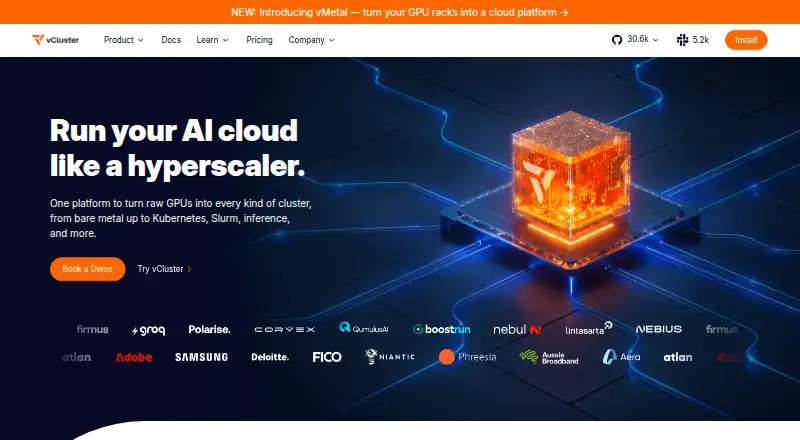
What vCluster Platform is
vCluster Platform is a management plane for deploying, configuring, and operating tenant cluster fleets through a web UI, CLI, and API. It can manage tenants across EKS, GKE, AKS, bare metal, and private cloud. The platform provides isolated tenant clusters and supports shared-node, dedicated-node, private-node, Auto Nodes, and Standalone tenancy models. vCluster Cloud hosts the management plane while host and virtual clusters remain in the customer's infrastructure; a self-hosted deployment runs the whole platform there. The free plan allows unlimited virtual clusters within a limit of 64 CPUs or 32 GPUs, and permits a maximum of one HA vCluster. The platform also lists cluster provisioning, multi-cluster management, policy enforcement, and upgrade management. Enterprise features include SSO, audit logging, zero-day vulnerability alerts, security review, and FIPS-compliant images. One isolation consideration is that shared nodes share the kernel, kubelet, node filesystem, scheduler, host network, CNI, CSI, and device plugins across tenants. The maker describes use by AI cloud providers, AI factories, and public and private cloud teams.
Good
- Manages tenants across EKS, GKE, AKS, and private cloud
- Supports multiple tenancy models
- Free plan permits unlimited virtual clusters within resource limits
- UI, CLI, and API access
Watch out
- Free plan is limited to 64 CPUs or 32 GPUs
- Free plan allows a maximum of one HA vCluster
- Shared nodes share infrastructure components across tenants
Who it suits
vCluster Platform suits cloud and infrastructure teams managing tenant cluster fleets across supported environments. Teams considering shared-node tenancy should account for the listed shared components.
Verdict
vCluster Platform offers several ways to manage and isolate tenant clusters, including hosted and self-hosted deployment. Review the free-plan resource limits and shared-node isolation caveat against your needs.
Plans and prices
From vCluster Platform's own pricing page, checked 14 Oct 2026.
| Plan | Price | What it gives you |
|---|---|---|
| Free | Free | Private or auto nodes · standalone mode · UI, CLI and CRDs · embedded etcd · unlimited virtual clusters up to 64 CPUs or 32 GPUs · maximum 1 HA vCluster |
| Open Source | Free | Shared or dedicated nodes · certified Kubernetes distribution · core resource sync · SQLite or self-managed etcd · Community Slack |
| Enterprise | Priced on request | SSO · quotas · auto sleep · multi-region and air-gapped deployment · external databases · enterprise integrations · support, SLAs and custom terms |
The facts
Each one read from vCluster Platform's own pages, with the date it was checked.
What it does
- API
- The management API is a Kubernetes API server exposing virtual management resources used by the UI and CLI, authenticated with platform access keys.checked 14 Oct 2026
- API limitation
- The management API serves only management.loft.sh resources and does not expose ordinary pods, services or namespaces directly.checked 14 Oct 2026
- Architecture options
- The public repository documents shared-node, dedicated-node, private-node and standalone architectures, with standalone requiring no control-plane cluster.checked 14 Oct 2026
- Auto delete
- Clusters can be deleted automatically after an idle threshold or according to a schedule.checked 14 Oct 2026
- Auto sleep
- Idle clusters can sleep manually, after an inactivity timeout or on a CRON schedule, and a later kubectl request can wake them automatically.checked 14 Oct 2026
- CLI downloads
- The vCluster CLI documentation lists downloads for Mac Intel/AMD, Mac Silicon/ARM, Linux AMD/ARM, and Windows.checked 2 Oct 2026
- Cloud support
- The platform can manage tenants across EKS, GKE, AKS, bare metal, and private cloud.checked 2 Oct 2026
- Deployment
- vCluster Cloud hosts the platform while host and virtual clusters remain in the customer's infrastructure; self-hosted deployment runs the entire platform in the customer's infrastructure.checked 2 Oct 2026
- Documentation depth
- The documentation includes installation, cloud-environment guides, API resources, administration, templates, integrations, troubleshooting and security hardening sections.checked 14 Oct 2026
- Funding
- Loft Labs announced a $4.6 million seed round on September 22, 2021, led by Fusion Fund with RTP Seed, Emergent Ventures and Berkeley SkyDeck participation.checked 14 Oct 2026
- Integrations
- The pricing feature list names Cluster API, Terraform, Rancher, Prometheus ServiceMonitor, Metrics Server, Argo CD, Vault, cert-manager, External Secrets Operator, KubeVirt and Istio integrations.checked 14 Oct 2026
- Isolation
- The platform provides isolated tenant clusters and offers shared-node, dedicated-node, private-node, Auto Nodes, and Standalone tenancy models.checked 2 Oct 2026
- Isolation caveat
- The security guide says shared nodes share the kernel, kubelet, node filesystem, scheduler, host network, CNI, CSI, and device plugins across tenants.checked 2 Oct 2026
- Latest release news
- The October 5, 2026 changelog entry announces Platform 4.12 and vCluster 0.37 with Stacks for reusable complete application environments and fleet operations.checked 14 Oct 2026
- Lifecycle automation
- Platform supports cluster creation, configuration, upgrades, access, sleep, wake and deletion through its UI, CLI and API.checked 14 Oct 2026
Where it runs
- CLI platforms
- Official installation instructions provide binaries or Homebrew installation for macOS Intel/AMD, macOS ARM, Linux AMD, Linux ARM and Windows PowerShell.checked 14 Oct 2026
The company
- Company
- The about page identifies the company as vCluster Labs and describes it as remote-first, but does not state its headquarters or founding year.checked 2 Oct 2026
- Company founding
- Gartner Peer Insights lists the company year founded as 2019.checked 14 Oct 2026
- Company headquarters
- LinkedIn lists the headquarters at 415 Mission Street, 37th Floor, San Francisco, California 94105.checked 14 Oct 2026
- Company size
- LinkedIn lists vCluster as a privately held software company with 51–200 employees and 112 visible employees.checked 14 Oct 2026
- Headquarters
- San Francisco, California, United Stateschecked 28 Sep 2026
- Independent company data
- Crunchbase lists San Francisco headquarters, 51–100 employees, eight investors and three funding rounds, with Khosla Ventures shown as a Series A lead.checked 14 Oct 2026
- Independent company listing
- Microsoft Marketplace identifies the maker as Loft Labs, Inc. and describes vCluster Enterprise as software for managing virtual Kubernetes clusters and reducing Kubernetes cost through multi-tenancy.checked 14 Oct 2026
Money
- Free-tier licensing
- The Free tier requires platform connectivity for license validation, while the OSS distribution works without a platform connection.checked 14 Oct 2026
The full review of vCluster Platform
Overview
vCluster Platform gives cloud and infrastructure teams a control plane for deploying and operating tenant Kubernetes clusters through a web UI, CLI, and API. It suits AI cloud providers and public or private cloud teams managing tenants across multiple environments. Its mix of tenancy and deployment options is useful, but shared-node isolation and the free plan’s capacity and high-availability caps deserve close scrutiny.
Key features
The platform can provision and manage clusters across EKS, GKE, AKS, bare metal, and private cloud, with multi-cluster management, policy enforcement, and upgrade management. Integrations include ClusterAPI, Terraform, Rancher, Prometheus Service Monitor, Argo CD, HashiCorp Vault, Cert Manager, External Secrets Operator, KubeVirt, and Istio. That range makes vCluster a fit for teams coordinating tenant services across existing Kubernetes infrastructure; it is less compelling for someone who only needs a local cluster tool.
Tenancy choices span shared-node, dedicated-node, private-node, Auto Nodes, and Standalone. Shared nodes can consolidate workloads, but tenants share the kernel, kubelet, node filesystem, scheduler, host network, CNI, CSI, and device plugins. Teams with security requirements that demand isolation of those components should choose a dedicated or private-node model instead of treating a virtual cluster as a separate host.
With vCluster Cloud, the platform is hosted while host and virtual clusters remain in the customer’s infrastructure. Self-hosted deployment keeps the whole platform there, giving teams a choice between hosted management and operating the control plane themselves. Enterprise security features include SSO, audit logging, zero-day vulnerability alerts, security review, and FIPS-compliant images, alongside enterprise support, SLAs, and custom terms.
Pricing
The Free plan costs nothing. It includes unlimited virtual clusters, Private and Auto Nodes, Standalone, and UI, CLI, and CRDs, but caps resources at 64 CPUs or 32 GPUs and allows a maximum of one HA vCluster. That is a practical starting point for evaluation or modest deployments, not an uncapped fleet simply because cluster count is unlimited. The free plan requires no credit card.
Open Source also costs nothing and offers shared or dedicated nodes, core resource sync, SQLite or self-managed etcd, and Community Slack. It gives up the Free plan’s stated Private and Auto Nodes, Standalone, and UI, CLI, and CRDs bundle, so it is a better match for users seeking the open-source core and willing to manage its data-store choice than for teams wanting the broader listed tenancy options.
Enterprise has custom pricing. It adds SSO, quotas, auto sleep, multi-region and air-gapped deployments, enterprise integrations, enterprise support, and SLAs. It is the relevant tier for organizations needing those controls or support commitments; evaluations of Enterprise features can be arranged as a guided trial through sales.
Platforms
vCluster Platform supports API, Linux, macOS, self-hosted, web, and Windows environments. CLI downloads cover Mac Intel/AMD, Mac Silicon/ARM, Linux AMD/ARM, and Windows. The hosted option keeps the platform managed while customer clusters stay in their own infrastructure; the self-hosted option places the platform there too.
Who it's for
AI cloud providers, AI factories, and public or private cloud teams managing tenant fleets across different Kubernetes environments are the clearest fit. Teams that need multi-cluster provisioning, policy enforcement, upgrades, and several tenancy models can use it as a common management plane. It is a poorer fit where shared-node component sharing conflicts with the security boundary required, or where a one-HA-vCluster and CPU/GPU ceiling makes the free plan too restrictive.
Pros and cons
- Pros: Supports EKS, GKE, AKS, bare metal, and private cloud, giving operators one platform for tenants across varied infrastructure.
- Pros: Offers hosted and self-hosted control-plane deployment, plus multiple tenancy models for different operating needs.
- Pros: The free plan has no virtual-cluster count limit and includes Private and Auto Nodes and Standalone, within its resource and HA caps.
- Cons: Shared-node tenants share core host components, including the kernel, kubelet, and host network, which may not meet stricter isolation requirements.
- Cons: Free capacity is limited to 64 CPUs or 32 GPUs and at most one HA vCluster.
- Cons: Enterprise pricing is custom, so teams needing enterprise controls must seek a sales-guided evaluation and terms.
Alternatives
Consider Kubermatic Kubernetes Platform if an Apache License 2.0 Community Edition is the priority. Portainer may suit teams seeking a no-time-limit Business Edition free tier for up to three nodes, with full features and no credit card. Choose Rancher if a 100% open-source Rancher platform experience with community support is the draw. KubeSphere is another free community-edition option, described as an enterprise-grade open-source Kubernetes container platform.
openCenter may fit builders and proof-of-concept projects looking for a self-supported community plan with GitOps, security policies, and observability. Kamaji is a free Apache 2.0 option. Consider Omni if a paid plan starting at $10 a month for up to 10 nodes and two users fits better. ACK One offers free registered-cluster, multi-cluster-management, and backup-center capabilities. For broader comparisons, see Kubernetes Management Platforms, Local Kubernetes Tools, and Container Management Software.
Verdict
vCluster Platform is a strong candidate for cloud teams that need to manage tenant-cluster fleets across mixed infrastructure and want a choice of hosted or self-hosted control plane. Its broad tenancy options and integrations are the main reasons to choose it. Look elsewhere if shared-node component sharing falls short of your isolation needs or the free plan’s capacity and single-HA-cluster ceiling cannot support your deployment.
Getting started
- Visit https://www.vcluster.com/.
- Choose vCluster Cloud, which hosts the platform, or a self-hosted deployment in your infrastructure.
- Start with the Free plan, which requires no credit card, or contact sales to arrange an Enterprise-feature evaluation trial.
- Use the web UI, CLI, or API to manage tenant clusters.
- Download the CLI for Mac Intel/AMD, Mac Silicon/ARM, Linux AMD/ARM, or Windows if using the CLI.
Limits worth knowing
The Free plan allows unlimited virtual clusters within 64 CPUs or 32 GPUs and a maximum of one HA vCluster. Enterprise features such as SSO, audit logging, and FIPS-compliant images are listed for Enterprise rather than the Free plan.
Questions
Is there a free plan?
Yes. The Free plan costs nothing and requires no credit card.
What are the Free plan limits?
It allows unlimited virtual clusters within a limit of 64 CPUs or 32 GPUs, and a maximum of one HA vCluster.
Which platforms and environments are supported?
Listed platforms are API, Linux, macOS, self-hosted, web, and Windows. Supported environments include EKS, GKE, AKS, bare metal, and private cloud.
Can I host the platform myself?
Yes. With self-hosted deployment, the entire platform runs in the customer's infrastructure. With vCluster Cloud, the platform is hosted while host and virtual clusters remain in the customer's infrastructure.
What does Enterprise include?
Listed Enterprise features include SSO, audit logging, zero-day vulnerability alerts, security review, and FIPS-compliant images. Enterprise plans also include support, SLAs, and custom terms; pricing is custom.
What integrations are listed?
Integrations include ClusterAPI, Terraform, Rancher, Prometheus Service Monitor, Argo CD, HashiCorp Vault, Cert Manager, External Secrets Operator, KubeVirt, and Istio.
Alternatives to vCluster Platform
- 1

srelens
Free planOpen sourceWebAPIExtensionLinux7.4Free plan - 2
Talos Linux
Free planAPILinuxmacOSSelf-hosted6.8From $1,000 a year - 3
Kunobi
Free planLinuxmacOSWindows6.7From $912 a month - 4
Rancher Desktop
Free planAPILinuxmacOSWindows6.7Free plan - 5
kind
Free planLinuxmacOSSelf-hostedWindows6.6Free plan - 6

Kubeterm
Free planAndroidiOSLinuxmacOS6.6Free plan