Rancher
Rancher is a Kubernetes management platform for operating multiple clusters and managing containerized workloads.
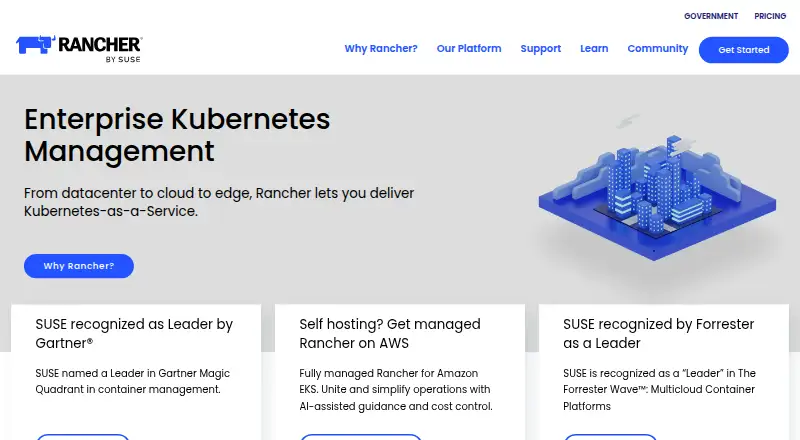
What Rancher is
Rancher is a Kubernetes management platform for operating multiple clusters and managing containerized workloads. It provides cluster provisioning and version management, as well as visibility, diagnostics, monitoring, alerting, and centralized audit features. Supported Kubernetes distributions include EKS, AKS, GKE, RKE, and K3s. Teams can apply consistent user access and security policies across managed clusters and connect external authentication providers such as Active Directory, GitHub, Azure AD, Okta, Google OAuth, and generic OIDC. Rancher can run kube-bench compliance scans that report results and remediation steps for failed tests. Documented integrations include Harvester, Longhorn, NeuVector, Kubewarden, Elemental, Fleet, SUSE Observability, and Rancher Desktop. The free Rancher edition is open source and includes community support; Rancher Prime editions include enterprise support. Prime editions also offer professional services and a trusted private container registry. Quick-start installation instructions call for a Linux host with at least 4 GB of memory and a supported Docker version. Rancher began in 2014 and became part of SUSE in 2020.
Good
- Free open-source edition
- Manages multiple Kubernetes clusters
- Supports EKS, AKS, GKE, RKE, and K3s
- Applies access and security policies across clusters
- Runs compliance scans with remediation steps
Watch out
- Quick-start requires a Linux host with at least 4 GB memory
- Installation requires a supported Docker version
- Free edition includes community support
Who it suits
Rancher suits teams managing multiple Kubernetes clusters and containerized workloads. The free edition offers community support, while Prime editions include enterprise support.
Verdict
Rancher provides cluster operations, access controls, authentication options, and compliance scanning in one Kubernetes management platform. The free edition is available, while enterprise support is part of Prime editions.
Plans and prices
From Rancher's own pricing page, checked 30 Sep 2026.
| Plan | Price | What it gives you |
|---|---|---|
| Rancher | Free | 100% open source · Full Rancher Platform Experience · Community Support |
| Rancher Prime | Priced on request | Full Rancher Platform Experience · Enterprise Support · Professional Services · Trusted private container registry |
| Rancher Prime Hosted | Priced on request | Expert-managed Rancher Prime control plane · Enterprise Support · Professional Services · Trusted private container registry |
The facts
Each one read from Rancher's own pages, with the date it was checked.
What it does
- Authentication
- Rancher supports external authentication providers including Active Directory, GitHub, Azure AD, Okta, Google OAuth, and generic OIDC.checked 30 Sep 2026
- Cluster operations
- Rancher provides cluster provisioning, version management, visibility and diagnostics, monitoring, alerting, and centralized audit.checked 30 Sep 2026
- Installation
- The quick-start instructions install Rancher on a Linux host with at least 4 GB of memory and a supported Docker version.checked 30 Sep 2026
- Integrations
- Rancher documents integrations including Harvester, Longhorn, NeuVector, Kubewarden, Elemental, Fleet, SUSE Observability, and Rancher Desktop.checked 30 Sep 2026
- Kubernetes support
- Rancher supports certified Kubernetes distributions, including EKS, AKS, GKE, RKE, and K3s.checked 30 Sep 2026
- Notable limit
- Rancher does not support concurrent active-session limits or session restrictions by geolocation out of the box.checked 30 Sep 2026
- Prime security
- Rancher Prime's Application Collection provides hardened images with signatures and SBOMs and is described as SLSA Level 3 compliant.checked 30 Sep 2026
- Purpose
- Rancher is a Kubernetes management platform for managing multiple clusters and providing tools for containerized workloads.checked 30 Sep 2026
- Security and policy
- Rancher can apply consistent user access and security policies across managed clusters.checked 30 Sep 2026
- Security assessment
- Rancher can run kube-bench compliance scans that report test results and remediation steps for failed tests.checked 30 Sep 2026
- Security disclosure
- Rancher supports responsible disclosure and publishes security advisories and CVEs for resolved product issues.checked 30 Sep 2026
- Support
- The free Rancher edition includes community support; Rancher Prime editions include enterprise support.checked 30 Sep 2026
The company
- Company history
- Rancher says it started in 2014 and became part of SUSE in 2020.checked 30 Sep 2026
- Founded
- 2014checked 23 Sep 2026
The full review of Rancher
Rancher is a management layer for Kubernetes clusters, rather than a Kubernetes distribution of its own. It is best suited to teams overseeing clusters across providers or environments. The free open-source edition covers the platform; enterprise support and services are reserved for Prime.
Overview
Rancher brings cluster provisioning, version management, monitoring, alerting, diagnostics, visibility, and centralized audit into one multi-cluster platform. It supports certified distributions including EKS, AKS, GKE, RKE, and K3s, with a hybrid deployment model for mixed environments. That breadth makes it useful when operational consistency matters across clusters, but it may be more machinery than a team needs for a single uncomplicated cluster.
The project began in 2014 and became part of SUSE in 2020. Rancher’s quick-start installation calls for a Linux host with at least 4 GB of memory and a supported Docker version, so the initial setup is not platform-agnostic.
Key features
Cluster operations
Centralized provisioning and version management sit alongside visibility, diagnostics, monitoring, alerting, and audit. Multi-cluster management, autoscaling, and rolling updates extend that operational scope. Together, these tools can reduce the need to handle every cluster as a separate operational environment, particularly for teams working across several Kubernetes distributions.
Access and security
Rancher can apply consistent user access and security policies across managed clusters, and it supports external identity providers including Active Directory, GitHub, Azure AD, Okta, Google OAuth, and generic OIDC. Its kube-bench compliance scans report test results and remediation steps for failed checks, giving teams a concrete starting point for addressing findings.
There is a notable access-control gap: Rancher does not provide concurrent active-session limits or geolocation-based session restrictions out of the box. Teams that require either control will need to account for that limitation rather than assume it is covered by the broader policy features. Rancher also supports responsible disclosure and publishes security advisories and CVEs for resolved issues.
Integrations and hardened images
Documented integrations include Harvester, Longhorn, NeuVector, Kubewarden, Elemental, Fleet, SUSE Observability, and Rancher Desktop. Rancher Prime’s Application Collection adds hardened images with signatures and software bills of materials, and is described as SLSA Level 3 compliant. Those images are relevant to organizations seeking a more controlled container supply chain; they are part of Prime, not the free edition.
Pricing
Rancher uses a freemium model. The Rancher plan costs nothing and is 100% open source, with the full Rancher platform experience and community support. It is the natural fit for teams comfortable relying on community support and managing the platform themselves.
Rancher Prime has custom pricing and includes the full platform, enterprise support, professional services, and a trusted private container registry. It suits organizations that need vendor-backed support or those additional services. Rancher Prime Hosted also has custom pricing; it adds an expert-managed Rancher Prime control plane alongside enterprise support, professional services, and the trusted private registry. That option is better suited to teams that want the control plane managed for them. The free plan remains the lower-cost choice, but it does not include Prime’s enterprise support, services, or registry.
Platforms
Rancher is available through API, Linux, self-hosted, and web platforms. Its hybrid deployment model and support for multiple Kubernetes distributions make it applicable across cloud and self-managed environments, while the Linux host and Docker requirement shapes the quick-start installation path.
Who it's for
Rancher is a strong candidate for platform and operations teams responsible for multiple Kubernetes clusters, especially when they need shared policy, centralized visibility, and support across distributions. The open-source plan can suit teams able to rely on community support. Organizations that want enterprise assistance or an expert-managed control plane should consider Prime. A single-cluster team, or one that depends on built-in session or geolocation restrictions, has a clearer reason to look elsewhere.
Pros and cons
- Pro: Cluster operations, audit, monitoring, and diagnostics are centralized across supported Kubernetes distributions, which is valuable for teams managing varied environments.
- Pro: The free plan includes the full platform experience and is 100% open source, so teams can use the core platform without a paid plan.
- Pro: External authentication options and cross-cluster policy controls support shared access management.
- Con: The free edition has community support; enterprise support and professional services require a Prime plan with custom pricing.
- Con: Quick-start installation requires a Linux host with at least 4 GB of memory and supported Docker, which limits how broadly that setup applies.
- Con: Concurrent-session limits and geolocation session restrictions are not built in, leaving a gap for teams that require them.
Alternatives
Kubermatic Kubernetes Platform is another free, open-source option, with a free Community Edition under the Apache License 2.0; consider it if that licensing and its broader listed platform support better fit your requirements.
vCluster Platform has a free plan and a free trial, and may suit readers looking for its virtual-cluster offer, which includes unlimited virtual clusters up to 64 CPUs or 32 GPUs and a maximum of one HA vCluster.
Portainer offers a free Business Edition tier for up to three nodes, with full features, no credit card, and no time limit; it is worth considering when that node cap fits your needs.
KubeSphere is a free, open-source community-edition Kubernetes container platform, making it an alternative for readers seeking that model.
ACK One offers free registered clusters, multi-cluster management, and a backup center, which may fit readers focused on those capabilities.
openCenter has a free Community plan for builders and proofs of concept, is self-supported, and includes GitOps, security policies, and observability; it may suit those use cases.
Palette is another option for readers comparing Kubernetes management software.
Gardener is a free option for readers comparing self-hosted Kubernetes management platforms.
For more options, browse Kubernetes Management Platforms, Container Orchestration Software, Cloud Orchestration Software, Container Management Software, Container Backup Software, and Container Development Environments.
Verdict
Choose Rancher if your team needs a free, full-featured platform for operating multiple Kubernetes clusters with centralized policy and security tooling. Its main advantage is the breadth of cross-cluster management; look elsewhere if built-in session restrictions are essential, or choose Prime if community support is not enough.
Alternatives to Rancher
- 1

Portainer
Free planOpen sourceAndroidiOSWebAPI8.6Free plan - 2

KubeSphere
Free planOpen sourceWebAPILinuxSelf-hosted8.1From $65 a month - 3

Omni
Free planWebAPILinuxmacOS7.7From $25 a month - 4

vCluster Platform
Free planOpen sourceWebAPILinuxmacOS7.7Free plan - 5

Kubermatic Kubernetes Platform
Free planWebAPILinuxmacOS6.8Free plan - 6
Cluster API
Free planAPILinuxmacOSSelf-hosted6.4Free plan