
KubeSphere
KubeSphere is a Kubernetes-based platform for managing cloud-native applications across clusters and infrastructure environments.
What KubeSphere is
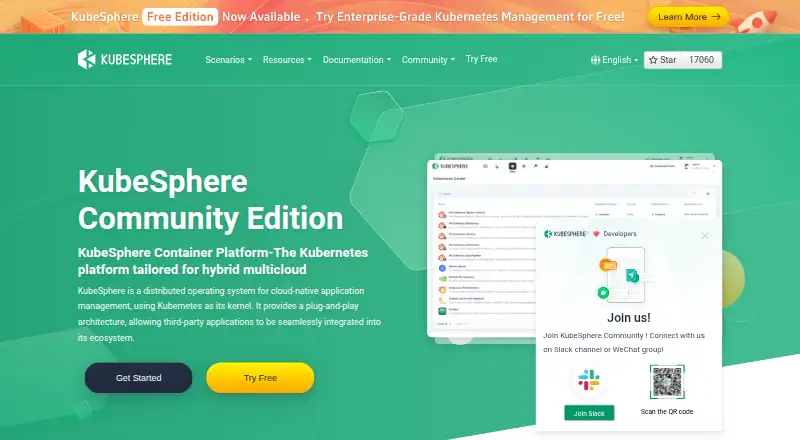
KubeSphere is a Kubernetes-based platform for managing cloud-native applications across clusters and infrastructure environments. Its Community Edition is an open-source container platform with a plug-in architecture for third-party applications and open-source tools. Teams can use multi-tenancy, multi-cluster management, monitoring, event and audit-log queries, tenant log collection, alerts, and notifications. Delivery capabilities include Jenkins-based CI/CD and automated Source-to-Image and Binary-to-Image workflows. The platform supports online or offline installation, one-click upgrades, cluster scaling, rolling updates, autoscaling, and policy controls. Its architecture includes a REST API backend with an API server and controller manager. Community Edition is self-managed and costs nothing, with free-forever availability. Enterprise adds features such as image security hardening, two-factor authentication, vulnerability fixes, and permission controls at platform, cluster, and application levels; its pricing is available by contacting sales. KubeSphere Enterprise is offered through subscription or private deployment.
Good
- Community Edition is open source and free forever.
- Supports multi-tenancy and multi-cluster management.
- Includes Jenkins-based CI/CD workflows.
- Supports online and offline installation.
- Offers rolling updates, autoscaling, and policy controls.
Watch out
- Community Edition is self-managed.
- Enterprise pricing requires contacting sales.
- Enterprise extensions are available by subscription.
Who it suits
KubeSphere suits infrastructure, development, and operations teams deploying applications on Kubernetes. Enterprise options may suit organizations that need multi-tenant permissions and professional technical support.
Verdict
KubeSphere combines Kubernetes application management with monitoring, delivery workflows, and multi-cluster capabilities. The free Community Edition is self-managed, while enterprise permissions and support are part of the separately priced Enterprise offering.
Plans and prices
From KubeSphere's own pricing page, checked 15 Oct 2026.
| Plan | Price | What it gives you |
|---|---|---|
| KubeSphere Backup Free | Free | 2 protected applications · 3-day retention · community support · 10 GB hosted repository · no resource templates · no database consistency protection |
| KubeSphere Community Edition | Free | multi-cluster management · RBAC and tenant isolation · observability · application lifecycle management · DevOps · 16 extensions · free forever |
| KubeSphere Backup Basic | $65 a month | 100 protected applications · 14-day retention · 8 x 5 support · 100 GB hosted repository · 3 resource templates · no database consistency protection · USD 65/month, 183/quarter, and 670/year |
| KubeSphere Backup Standard | $200 a month | 500 protected applications · 30-day retention · 8 x 5 support · 500 GB hosted repository · 10 resource templates · database consistency protection · USD 200/month, 564/quarter, and 2,064/year |
| KubeSphere Backup Enterprise | $340 a month | 1,500 protected applications · 90-day retention · 8 x 5 support · 1 TB hosted repository · unlimited resource templates · database consistency protection · USD 340/month, 958/quarter, and 3,508/year |
| KubeSphere Backup Exclusive | Priced on request | customizable protected applications · customizable retention · 24 x 7 support · customizable repository quota · unlimited resource templates · database consistency protection · Contact sales |
| KubeSphere Enterprise | Priced on request | On-demand subscription or private deployment · extensions available by subscription · contact sales for pricing |
The facts
Each one read from KubeSphere's own pages, with the date it was checked.
What it does
- API
- KubeSphere's architecture includes a REST API backend with an API server and controller manager.checked 3 Oct 2026
- Cluster management
- The platform provides centralized visual management and operations for multiple Kubernetes clusters across clouds and infrastructure.checked 15 Oct 2026
- Deployment
- The platform supports deployment on any infrastructure environment, online or offline installation, one-click upgrades and cluster scaling.checked 3 Oct 2026
- Developer extensibility
- The official site links extension-development documentation, and the project maintains extension samples plus the ksbuilder extension CLI in GitHub.checked 15 Oct 2026
- DevOps
- The DevOps extension supplies end-to-end workflows integrating mainstream continuous-integration and continuous-delivery tools.checked 15 Oct 2026
- Documentation depth
- The documentation includes quick starts, installation and upgrade procedures, air-gapped deployment, high availability, extensions, role management, DevOps pipelines, App Store, service mesh, federation, observability, FAQs, API reference, and release notes.checked 15 Oct 2026
- Enterprise deployment
- KubeSphere Enterprise is offered through on-demand subscription, private deployment and an all-in-one container machine delivery model.checked 3 Oct 2026
- Enterprise permissions
- KubeSphere Enterprise provides multi-tenant permission controls at platform, cluster and application levels.checked 3 Oct 2026
- Extensibility
- KubeSphere 4.x decouples DevOps, service mesh, observability, App Store, edge, networking, and storage functions into independently maintained extensions.checked 15 Oct 2026
- Funding and public status
- Crunchbase lists QingCloud as a Beijing-based public Series-D company with nine investors including Luminous Ventures and CICC, but hides the total funding amount.checked 15 Oct 2026
- Gateway
- KubeSphere Gateway supports ingress management, layer-7 load balancing, traffic routing, and gateway administration.checked 15 Oct 2026
- Independent adoption evidence
- A CNCF case study reports more than 15,000 KubeSphere GitHub stars, over 5 million downloads, and use in more than 100 countries.checked 15 Oct 2026
- Independent editorial assessment
- FAUN.dev scored KubeSphere 72/100, rating built-in add-ons and ease of use highest and pricing transparency lowest.checked 15 Oct 2026
- Integrations
- Official materials identify integrations or ecosystem collaboration with Jenkins, Grafana, Loki, Higress, KubeKey, OpenELB, KubeEye, Fluent Operator, and OpenFunction.checked 15 Oct 2026
- Intended users
- The product site describes benefits for infrastructure teams, developers, operations teams and end users deploying applications on Kubernetes.checked 3 Oct 2026
- Kubernetes compatibility
- KubeSphere v4.1.3 is tested with Kubernetes v1.21 through v1.30, while untested versions are not guaranteed compatible.checked 15 Oct 2026
- License
- KubeSphere 4.x and later use Apache License 2.0 with extra conditions requiring producer permission or a commercial licence for third-party commercial offerings, SaaS, or removing the product identity.checked 15 Oct 2026
- Lifecycle limitation
- The lifecycle policy says end-of-life versions receive no sales, upgrades, hotfixes, or support, and official artifacts may become inaccessible.checked 15 Oct 2026
Where it runs
- Application lifecycle
- Its application management layer handles Helm and Operator applications through a unified lifecycle abstraction.checked 15 Oct 2026
- App Store
- The App Store, powered by OpenPitrix, lets tenants add repositories and manage application submission, review, testing, release, upgrade, and removal.checked 15 Oct 2026
The company
- Company headquarters
- QingCloud's KubeSphere about page lists Beijing, China as headquarters, while LinkedIn lists KubeSphere headquarters as Hong Kong.checked 15 Oct 2026
- Company size
- LinkedIn lists KubeSphere as a privately held IT-services company with 51–200 employees.checked 15 Oct 2026
- Founded and ownership
- The company history records QingCloud's establishment in April 2012, while KubeSphere's about page says the platform has been developed since 2018.checked 15 Oct 2026
- Headquarters
- Beijing, Chinachecked 28 Sep 2026
The full review of KubeSphere
KubeSphere is a Kubernetes-based platform for managing cloud-native applications across clusters and infrastructure. It suits teams that want a self-managed control plane with monitoring and delivery workflows alongside Kubernetes operations. Its free Community Edition makes it a compelling starting point, but enterprise-grade permissions and support require a separate offering.
Overview
KubeSphere combines a distributed operating system for cloud-native applications with a plug-in architecture intended to accommodate third-party tools. It supports hybrid deployment, multi-tenancy, and multi-cluster management, which can help infrastructure and operations teams serve multiple projects without treating every cluster as an isolated environment.
Deployment flexibility is a notable strength: teams can install online or offline, scale clusters, and perform one-click upgrades. The trade-off is that the Community Edition is self-managed, so the organization remains responsible for operating its Kubernetes platform.
Key features
Operations and observability
Monitoring, alerting, notifications, event and audit-log queries, and tenant log collection bring several operational functions into the platform. That breadth is useful for teams managing multiple tenants, though it does not remove the work of running the underlying self-managed environment.
Delivery and integrations
KubeSphere provides CI/CD based on Jenkins and automated Source-to-Image and Binary-to-Image workflows. Its pluggable architecture is designed to integrate third-party applications and open-source tools; named ecosystem collaborators include Grafana, Loki, and Higress. This gives teams room to connect familiar components rather than relying on a single fixed toolset.
Cluster control and security
Multi-cluster management, autoscaling, rolling updates, and policy controls support day-to-day Kubernetes administration. The architecture also includes a REST API backend with an API server and controller manager. Enterprise adds image security hardening, two-factor authentication, and vulnerability fixes, as well as permission controls across platform, cluster, and application levels.
Pricing
KubeSphere Community Edition: free, free forever. It is a self-managed Kubernetes platform, best for teams prepared to operate their own environment and comfortable without Enterprise’s additional permissions and support.
KubeSphere Enterprise: custom pricing, offered through on-demand subscription or private deployment, with extensions available by subscription. It adds professional technical support and granular multi-tenant permissions. The Enterprise page describes a lightweight architecture that can run with 2 CPU cores and 4 GB of memory. Teams that need those enterprise capabilities should contact sales; the offering does not have a published fixed price.
Platforms
KubeSphere supports API, Linux, self-hosted, and web access. Its deployment options include online or offline installation, with cluster scaling and one-click upgrades for teams operating the platform.
Who it's for
KubeSphere is a strong fit for infrastructure, developer, and operations teams deploying applications on Kubernetes, especially where multiple tenants or clusters need coordinated management. It is less suitable for organizations seeking a turnkey, externally operated platform: the free Community Edition is self-managed, and enterprise permissions and support are part of the separately priced Enterprise offering.
Pros and cons
- Pros: Free, self-managed Community Edition gives teams a no-cost way to manage Kubernetes applications.
- Pros: Monitoring, tenant log collection, audit queries, and alerts bring useful operational visibility into a multi-tenant platform.
- Pros: Multi-cluster management, scaling, rolling updates, and hybrid deployment address several common platform operations needs.
- Cons: Community Edition is self-managed, so teams must take responsibility for operating the platform.
- Cons: Enterprise permissions, security additions, and professional support require a custom-priced Enterprise arrangement.
Alternatives
- Northflank is worth considering for teams looking for a freemium alternative with API, web, self-hosted, Linux, macOS, and Windows platforms; its free Sandbox includes 2 services, 1 database, 2 cron jobs, and always-on compute.
- KubeVela is another free, self-hosted Kubernetes control plane, with an Apache-2.0 license.
- Skyhook may suit teams looking for a freemium platform whose free plan supports up to 3 Git-connected users, 3 services, and 1 cluster.
- Opsera Unified DevOps Platform is a paid alternative with enterprise pricing based on users or pipelines, standard or custom legal terms, and email and priority support.
- HCL DevOps Loop is a paid alternative with Standard and Premium plans covering different combinations of DevOps capabilities.
- Atlassian Software Collection is a paid collection including Rovo Dev, DX, Pipelines, and Bitbucket.
- Oracle Cloud Infrastructure Container Registry is a freemium option with a free monthly allowance for its first 2 million invocations and 400,000 gigabyte memory-seconds.
- JFrog Artifactory offers a freemium model and free trial; its Pro plan starts at $50 a month, with monthly price scaling based on consumption.
Verdict
Choose KubeSphere if your team wants a free, self-managed Kubernetes platform that combines multi-cluster operations, monitoring, and delivery workflows. Its breadth and extensible design make it a strong fit for teams building their own cloud-native platform. Look elsewhere if you need a managed experience or want enterprise permissions and support without moving to a custom-priced offering.
Alternatives to KubeSphere
- 1

Google Kubernetes Engine
Free planWebAPILinuxSelf-hosted7.6Free plan - 2

HashiCorp Nomad
Free planWebAPILinuxmacOS7.3Free plan - 3

Oracle Cloud Infrastructure Container Registry
Free planWebAPILinux7.0Free plan - 4
MicroK8s
Free planLinuxmacOSSelf-hostedWindows6.9From $25 a year - 5

Kubermatic Kubernetes Platform
Free planWebAPILinuxmacOS6.8Free plan - 6

Docker Swarm
Free planAPILinuxSelf-hostedWindows6.6From $9 a month