
Google Kubernetes Engine
Google Kubernetes Engine is a managed environment for running containerized applications.
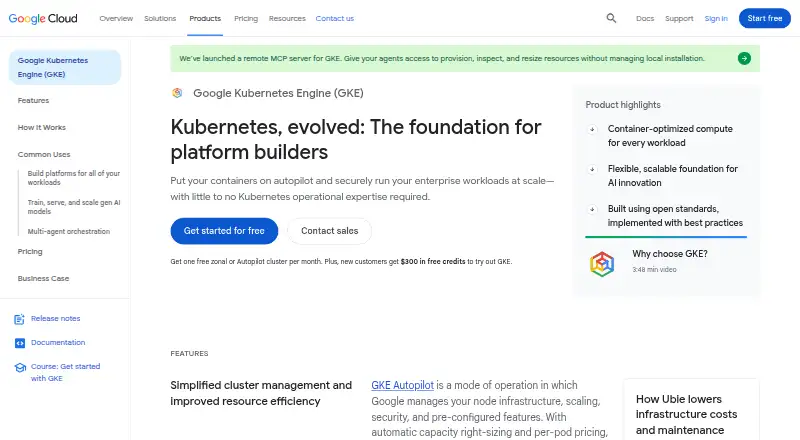
What Google Kubernetes Engine is
Google Kubernetes Engine is a managed environment for running containerized applications. It manages the Kubernetes control-plane life cycle for each cluster, from creation to deletion. With Autopilot, Google handles node infrastructure, provisioning, scaling, scheduling, and security features; users can choose to manage nodes themselves instead. Autopilot includes automatic capacity right-sizing and per-pod pricing. GKE supports GPU and TPU workloads and connects with AI Hypercomputer for machine learning and high-performance computing. The product page states support for clusters of up to 65,000 nodes. Security features include a dashboard for cluster misconfigurations and risks, agentless scanning for critical vulnerabilities, workload isolation through GKE Sandbox, and hardware-based encryption for data in use with Confidential GKE Nodes. Fleets and Teams help organize clusters and workloads across teams. GKE also supports conformant attached Kubernetes clusters and says applications can run unmodified on existing on-premises hardware or in public cloud. Windows Server node images and containers are unavailable in Autopilot. A cluster management fee is listed at $0.10 a month per cluster.
Good
- Manages the Kubernetes control-plane life cycle.
- Autopilot automates node provisioning and scaling.
- Supports GPU and TPU workloads.
- Includes workload isolation and security visibility tools.
Watch out
- Windows Server node images and containers are unavailable in Autopilot.
- A $0.10 a month cluster management fee is listed.
Who it suits
GKE suits teams running containerized applications, including platform builders and enterprise developer platforms. It is also presented for teams training and serving AI models, with a choice between Autopilot node management and managing nodes themselves.
Verdict
GKE provides managed Kubernetes clusters with automated and user-managed node options, plus tools for security and multi-cluster organization. Teams considering Autopilot should note its Windows workload limitation.
Plans and prices
From Google Kubernetes Engine's own pricing page, checked 21 Oct 2026.
| Plan | Price | What it gives you |
|---|---|---|
| Free tier | Free | $74.40 credit · applies to one zonal Standard or Autopilot cluster · unused credits do not roll over · monthly credits per billing account |
| Cluster management fee | $0.10 a month | Cluster life cycle management, autoscaling, cost visibility, infrastructure cost optimization, and multi-cluster management are included at no extra cost · per cluster per hour |
The facts
Each one read from Google Kubernetes Engine's own pages, with the date it was checked.
What it does
- Agent sandbox
- GKE Agent Sandbox uses gVisor kernel isolation to run untrusted agent code and tool calls in isolated sandboxes.checked 21 Oct 2026
- AI and accelerators
- GKE supports GPU and TPU workloads and integrates with AI Hypercomputer for machine learning and high-performance computing workloads.checked 28 Sep 2026
- AI and accelerator support
- GKE supports GPU and TPU workloads and clusters of up to 65,000 nodes for machine-learning and high-performance workloads.checked 21 Oct 2026
- Authentication
- Programmatic access supports Application Default Credentials, gcloud authentication, service-account impersonation, and REST authentication.checked 21 Oct 2026
- Autopilot
- Autopilot lets Google manage node infrastructure, scaling, security, and preconfigured features, with automatic capacity right-sizing and per-pod pricing.checked 28 Sep 2026
- Autopilot mode
- Autopilot has Google manage node infrastructure, scaling, security settings, scheduling, and release management.checked 21 Oct 2026
- Autoscaling
- GKE can automatically scale Pods and nodes, including node auto-provisioning in Standard mode and automatic node provisioning in Autopilot.checked 21 Oct 2026
- Availability SLA
- The pricing page lists 99.95% control-plane availability for Autopilot and regional Standard clusters, 99.5% for zonal Standard control planes, and 99.9% for Autopilot Pods across multiple zones.checked 21 Oct 2026
- CI/CD integrations
- Google documents integrated CI/CD options using Cloud Build, Cloud Deploy, and Artifact Registry.checked 21 Oct 2026
- Cluster scale
- The product page states that GKE supports clusters with up to 65,000 nodes.checked 28 Sep 2026
- Compliance
- Google Cloud states that its HIPAA support requires a Business Associate Agreement and customer configuration responsibility, and aligns covered services with ISO 27001, ISO 27017, ISO 27018, and SOC 2 controls.checked 21 Oct 2026
- Documentation depth
- The documentation covers fundamentals, cluster setup, cost optimization, storage, security, workload deployment, administration, observability, troubleshooting, networking, API reference, and release notes.checked 21 Oct 2026
- Fleet management
- Fleet-based team management, Connect Gateway, Config Sync, Policy Controller, and multi-cluster management are included capabilities.checked 21 Oct 2026
- Installation requirements
- Cluster access through kubectl requires installing kubectl and the gke-gcloud-auth-plugin through gcloud or external apt/yum package repositories.checked 21 Oct 2026
- Integrations
- The product page names Config Sync, Cloud Service Mesh, Fleets, and AI Hypercomputer among GKE integrations or related services.checked 28 Sep 2026
- Intended users
- Google describes GKE as a foundation for platform builders and enterprise developer platforms, as well as for teams training and serving AI models.checked 28 Sep 2026
- Licence
- GKE is a proprietary managed Google Cloud service, while the Kubernetes technology it manages is open source under the Apache License 2.0.checked 21 Oct 2026
- Limit: G2 reviewers
- Reviewers repeatedly report a steep Kubernetes learning curve, complex troubleshooting and networking, difficult cost prediction, YAML overhead, and upgrade or API compatibility issues.checked 21 Oct 2026
- Limit: Gartner reviewers
- A Gartner review says visibility, cost predictability, and debugging can become difficult at scale.checked 21 Oct 2026
- Limit: TrustRadius reviewers
- TrustRadius reviewers report no true zero scale, hidden networking details, limited container-native load-balancer types, persistent-storage and DNS friction, and hacks needed for some node-level settings.checked 21 Oct 2026
The company
- Company
- Google was founded in September 1998 and is headquartered in Mountain View, California.checked 28 Sep 2026
- Founded
- 1998checked 28 Sep 2026
- Headquarters
- Mountain View, California, USAchecked 28 Sep 2026
Money
- Control plane
- GKE manages each cluster’s Kubernetes control plane life cycle from creation to deletion.checked 28 Sep 2026
The full review of Google Kubernetes Engine
Overview
Google Kubernetes Engine is a managed Kubernetes service for running containerized applications. It suits platform teams, enterprise developer platforms, and teams training or serving AI models. Its strongest case is the choice between Google-managed operations and user-managed nodes, though Autopilot is not an option for Windows workloads.
GKE manages a cluster’s control plane from creation through deletion. With Autopilot, it can also provision, scale, and schedule nodes, right-size capacity, and apply preconfigured features; per-pod pricing is intended to align charges with workloads. Teams that need more direct infrastructure control can manage nodes themselves. The trade-off is a less hands-off operating model when choosing that route.
GKE supports clusters of up to 65,000 nodes, GPU and TPU workloads, and integration with AI Hypercomputer for machine learning and high-performance computing. Fleets and Teams help organize clusters, workloads, and resources across teams. It also supports conformant Kubernetes clusters attached to its management environment, and says applications can run unmodified on existing on-premises hardware or in public cloud.
Key features
Security and workload separation
A security dashboard surfaces cluster misconfigurations and risks, while agentless scanning checks for critical vulnerabilities. GKE Sandbox isolates workloads, and Confidential GKE Nodes provide hardware-based encryption for data in use. These features address distinct security concerns, but the dashboard and scanning provide visibility rather than removing the need to manage cluster risk.
Operations and recovery
Autoscaling and rolling updates support ongoing workload operations, while policy controls provide a way to govern deployments. GKE also supports persistent volume backup, scheduled backup frequency, custom retention, immutable backups, application consistency, and cross-cluster restore. Those recovery options matter to teams that need more than cluster orchestration alone.
Integrations and portability
Named integrations and related services include Config Sync, Cloud Service Mesh, Fleets, and AI Hypercomputer. The ability to attach conformant Kubernetes clusters and run applications unmodified across on-premises hardware or public cloud can help teams keep workloads portable, though it does not remove the work of managing their own nodes when they choose that mode.
Pricing
GKE is a paid, managed service with pricing from $9/mo. The Free tier is free, billed $74.40 in monthly credits per billing account; credits apply to zonal and Autopilot clusters. This is useful for trying eligible cluster types, but it is a credit allowance rather than an unlimited free tier.
The Cluster management fee is $0.10 a month, billed per cluster per hour. Cluster life cycle management, autoscaling, cost visibility, infrastructure cost optimization, and multi-cluster management are included at no extra cost. Teams comparing costs should account for the per-cluster fee and the distinction between credits and ongoing paid usage.
Platforms
GKE is a managed deployment with listed platforms of API, Linux, self-hosted, web, and Windows. Windows support has a specific boundary: Windows Server node images and containers are unavailable in Autopilot mode, so teams needing those workloads must choose a different operating mode.
Who it's for
GKE is a strong fit for platform builders and enterprises building developer platforms, particularly when control-plane management, multi-cluster organization, or large cluster scale is central. AI teams can use its GPU and TPU support and AI Hypercomputer integration for model training and serving.
It is less suitable for teams that require Windows containers while also wanting Autopilot’s managed node model. Teams that want full responsibility for nodes can choose user management, but give up Autopilot’s automated provisioning, scaling, and scheduling.
Pros and cons
- Operational choice: Autopilot manages node provisioning and scaling, while user-managed nodes preserve direct control for teams that need it.
- Broad workload scope: GPU and TPU support, AI Hypercomputer integration, and a stated ceiling of 65,000 nodes serve AI and large-scale cluster needs.
- Useful recovery and security controls: Scheduled, immutable backups with custom retention and cross-cluster restore complement vulnerability scanning, workload isolation, and encryption for data in use.
- Windows caveat: Autopilot cannot run Windows Server node images or containers, restricting that mode for Windows-dependent teams.
- Cost requires attention: The free tier is credit-based and the cluster management fee is billed per cluster per hour, so neither should be mistaken for unlimited no-cost operation.
Alternatives
For a Kubernetes backup-focused choice, Veeam Kasten for Kubernetes offers a free tier limited to 5 nodes and an Enterprise Trial covering 500 nodes for 60 days. Stash is another freemium container-backup option, with API and self-hosted platforms.
KubeSphere Backup may suit a reader seeking a free entry point for 2 protected applications, 3 days of retention, and a 10 GB hosted repository, or a paid Basic plan at $65 a month for 100 protected applications. Plakar is a freemium alternative for Linux, macOS, or Windows, with a free option for up to 500 GB of managed data and a Control Plane deployed on infrastructure the user owns.
Veeam Agent for Mac is a macOS-focused option whose free edition permits one backup job but not direct backup to object storage. Storware Backup & Recovery offers a free license without technical support and a 60-day trial. Vinchin Backup & Recovery has a permanent free edition for up to 3 virtual machines.
Bacula Enterprise is a paid alternative with annual subscription pricing based on secured endpoint count and support response time. For broader category comparisons, see Kubernetes Backup Software, Container Backup Software, and Container Orchestration Software.
Verdict
Choose Google Kubernetes Engine if you need managed Kubernetes control planes with a credible path from automated node operations to direct node control, particularly for multi-cluster platforms or AI workloads. Its scale, fleet organization, and security and recovery options make it a substantial platform choice. Look elsewhere if Windows containers must run in an automated Autopilot environment, or if a credit-based free tier and per-cluster management fee do not fit your cost model.
Getting started
- Visit the Google Kubernetes Engine website.
- Choose a supported platform: API, Linux, self-hosted, web, or Windows.
- Start with the free tier or begin a free trial.
- Select Autopilot or choose to manage nodes yourself.
Limits worth knowing
The free tier is listed as free and is billed as $74.40 in monthly credits per billing account; credits apply to zonal and Autopilot clusters. A separate cluster management fee is listed at $0.10 a month per cluster, billed per cluster per hour. Windows Server node images and containers are unavailable in Autopilot mode.
Questions
Does Google Kubernetes Engine have a free plan?
Yes. The Free tier is listed as free and billed as $74.40 in monthly credits per billing account. Credits apply to zonal and Autopilot clusters.
How much does GKE cost?
Paid usage is listed from 9 /mo. A Cluster management fee is listed at $0.10 a month per cluster, billed per cluster per hour.
Is there a free trial?
Yes, a free trial is listed.
Which platforms are listed?
The platforms are API, Linux, self-hosted, web, and Windows.
Can I run Windows Server nodes in Autopilot?
No. Windows Server node images and containers are unavailable in GKE Autopilot mode.
What services integrate with GKE?
Named integrations or related services include Config Sync, Cloud Service Mesh, Fleets, and AI Hypercomputer.
Alternatives to Google Kubernetes Engine
- 1

KubeSphere
Free planOpen sourceWebAPILinuxSelf-hosted8.1From $65 a month - 2

HashiCorp Nomad
Free planWebAPILinuxmacOS7.3Free plan - 3

Oracle Cloud Infrastructure Container Registry
Free planWebAPILinux7.0Free plan - 4
MicroK8s
Free planLinuxmacOSSelf-hostedWindows6.9From $25 a year - 5

Kubermatic Kubernetes Platform
Free planWebAPILinuxmacOS6.8Free plan - 6

Docker Swarm
Free planAPILinuxSelf-hostedWindows6.6From $9 a month