
HashiCorp Nomad
HashiCorp Nomad schedules and manages containers, binaries, and virtual machines across cloud, on-premises, and edge environments.
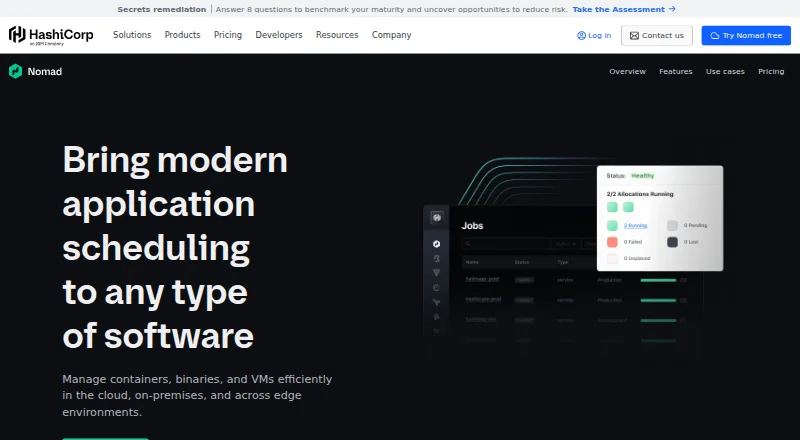
What HashiCorp Nomad is
HashiCorp Nomad schedules and manages containers, binaries, and virtual machines across cloud, on-premises, and edge environments. It can run containers, legacy applications, and batch jobs on the same infrastructure, including workloads on edge devices that may not remain connected to central cloud centers. Its Docker driver downloads containers, maps ports, and starts, monitors, and cleans them up. Nomad integrates with Consul for clustering, service discovery, service mesh, and dynamic configuration, and with Vault to retrieve workload secrets. Security mechanisms include mutual TLS, access control lists, namespaces, and Sentinel policies, though some multi-tenant features are Enterprise-only. It is self-hosted and available as a precompiled binary or package for Linux, Mac, and Windows, or can be built from source. HashiCorp says Nomad can scale to thousands of nodes in one cluster and span private data centers and multiple clouds. A free plan is available; Enterprise adds resource quotas, audit logging, multi-region deployments, and advanced server management.
Good
- Runs containers, legacy, and batch workloads together.
- Supports edge devices with intermittent connectivity.
- Integrates with Consul and Vault.
- Available for Linux, Mac, and Windows.
- Includes a free plan.
Watch out
- Some multi-tenant features require Enterprise.
- Enterprise and Flex prices are not listed.
Who it suits
Nomad suits teams that need to schedule mixed application workloads across self-hosted, cloud, on-premises, or edge infrastructure. It may also fit organizations using Consul or Vault integrations and Sentinel policy controls.
Verdict
Nomad covers workload scheduling across varied infrastructure, with integrations and security controls for operational needs. Teams should note that some multi-tenant capabilities are Enterprise-only, and Enterprise and Flex prices are not listed.
Plans and prices
From HashiCorp Nomad's own pricing page, checked 15 Sep 2026.
| Plan | Price | What it gives you |
|---|---|---|
| Nomad Enterprise | Priced on request | Resource quotas · Sentinel policies · Audit logging · Multi-region deployments · Advanced server management |
| Nomad Community Edition | Free | source-available · support through docs, forums, GitHub issues or IBM Support · Community Edition under Business Source License |
| Enterprise Self Managed | Priced on request | Contact sales · Customizable self-managed plan |
| Flex | Priced on request | Contact sales · Single- and multi-year plans with preferred pricing |
| Pay-as-You-Go | Priced on request | IBM HashiCorp Cloud Platform · Usage-based billing with no long-term commitment; $500 HCP credit |
The facts
Each one read from HashiCorp Nomad's own pages, with the date it was checked.
What it does
- Acquisition news
- IBM announced on April 24, 2024 an agreement to acquire HashiCorp for $35 per share in cash, valuing the deal at $6.4 billion.checked 15 Oct 2026
- API
- Its REST-style HTTP API controls nearly every agent function, uses /v1 routes and listens on port 4646 by default.checked 15 Oct 2026
- API security
- API requests can use X-Nomad-Token or Bearer ACL credentials, with TLS recommended when authentication is enabled.checked 15 Oct 2026
- Architecture
- Nomad runs as a single process with no external dependencies and supports Linux and Windows clients.checked 15 Oct 2026
- Consul integration
- Nomad integrates with Consul for automatic clustering, service registration and discovery, service mesh, and dynamic configuration.checked 28 Sep 2026
- Deployment
- Nomad is available as a precompiled binary or package for several operating systems, and can also be built from source.checked 28 Sep 2026
- Docker
- Nomad's Docker driver handles downloading containers, mapping ports, and starting, watching, and cleaning up containers.checked 28 Sep 2026
- Docker limitation
- Running Nomad clients inside Docker is not officially supported because clients need extensive host access; the image is intended for CLI pipelines and is not tested as an agent.checked 15 Oct 2026
- Documentation
- The documentation covers HCL job and agent specifications, Nomad Pack, autoscaling, federation, upgrades, Autopilot, Terraform provisioning and community task drivers.checked 15 Oct 2026
- Edge
- Nomad manages workloads on edge devices such as sensors or microcomputers that are not continuously connected to central cloud centers.checked 28 Sep 2026
- Edge support
- Device plugins let Nomad place workloads on specialized edge hardware within a shared hybrid cluster topology.checked 15 Oct 2026
- Enterprise features
- Nomad Enterprise adds resource quotas, Sentinel policies, audit logging, multi-region deployments, and advanced server management with Nomad Autopilot.checked 28 Sep 2026
- Installation
- Nomad is distributed as precompiled binaries, OS packages or source; official instructions cover Linux repositories, macOS Homebrew and manual downloads.checked 15 Oct 2026
- Integrations
- Nomad integrates with Terraform, Consul, Vault and Waypoint, and its catalog lists 86 integrations including task drivers, observability plugins, packs and autoscaler components.checked 15 Oct 2026
- Licence
- The repository identifies Nomad as BUSL-1.1 licensed, making it source-available rather than OSI open source; Enterprise files are excluded from the open-source licensing.checked 15 Oct 2026
- Limit: ingress and support
- Capterra reviewers report no embedded ingress, sparse tutorials or support and reliance on additional integrations.checked 15 Oct 2026
- Limit: Kubernetes comparison
- G2 reviewers say Nomad has fewer advanced capabilities and a smaller community than Kubernetes, with some reporting unclear documentation and setup complexity.checked 15 Oct 2026
- Limit: surrounding services
- TrustRadius reviewers report needing separate tools for secrets, service discovery and routing, and note limited service-mesh and tracing support.checked 15 Oct 2026
- Networking requirements
- Default ports are 4646 for HTTP, 4647 for RPC and 4648 for Serf WAN, plus dynamic ports 20,000–32,000.checked 15 Oct 2026
Where it runs
- App-store status
- The Apple App Store listing named HashiCorp Nomad Prep identifies itself as an unofficial independent study app, not a HashiCorp product, and has insufficient ratings to display.checked 15 Oct 2026
The company
- Company founding
- Mitchell Hashimoto and Armon Dadgar founded HashiCorp in 2012.checked 28 Sep 2026
- Company size and location
- LinkedIn lists HashiCorp as founded in 2012, headquartered in San Francisco and employing 1,001–5,000 people.checked 15 Oct 2026
- Founded
- 2012checked 28 Sep 2026
- Headquarters
- San Francisco, California, United Stateschecked 28 Sep 2026
The full review of HashiCorp Nomad
Overview
HashiCorp Nomad is a self-hosted scheduler for containers, binaries, and virtual machines across cloud, on-premises, and edge environments. It suits teams that want to run varied workloads on shared infrastructure, rather than limiting orchestration to containers. Its broad workload coverage and HashiCorp integrations are compelling; the trade-offs are self-managed operations and Enterprise-only multi-tenant capabilities.
Key features
One scheduler for varied workloads
Nomad can run containers alongside legacy and batch applications, as well as binaries and virtual machines. That breadth is useful when an organization is modernizing gradually or has workloads that do not fit a container-only approach. It can also manage edge workloads on devices such as sensors and microcomputers that may not stay connected to central cloud services. Teams seeking only a Kubernetes service mesh or API gateway may find these scheduling capabilities are not their primary need.
Container operations and service integrations
Its Docker driver downloads containers, maps ports, starts and monitors them, and cleans them up. Integration with Consul supports automatic clustering, service registration and discovery, service mesh, and dynamic configuration; Vault integration retrieves static and dynamic secrets for workloads. These connections make Nomad a stronger fit for teams already using those HashiCorp tools, though they also make its value more dependent on the surrounding stack.
Operations, scale, and policy
Nomad supports multi-cluster management, autoscaling, rolling updates, and policy controls. HashiCorp says a single cluster can scale to thousands of nodes and span private data centers and multiple clouds, including AWS, Azure, and Google Cloud. Security mechanisms include mutual TLS, access control lists, namespaces, and Sentinel policies. However, some multi-tenant features are reserved for Enterprise, a meaningful constraint for organizations that need stronger separation between teams.
Nomad is self-hosted, available as a precompiled binary or package for several operating systems, and can also be built from source. Installation instructions cover Linux, Mac, and Windows. This gives operators deployment flexibility but leaves the platform's operation with the organization.
Pricing
Nomad has a free plan, making it possible to start without a paid subscription. Enterprise Self Managed uses customizable plans with premium support and custom pricing, and is suited to organizations that need Enterprise features such as resource quotas, audit logging, multi-region deployments, and advanced server management through Nomad Autopilot. Flex offers multi-year plans, preferred pricing, and premium support included, also at custom pricing. The trade-off for lower-cost use is that Enterprise capabilities—including some multi-tenant features—are not part of the free offering.
Platforms
Nomad is available for Linux, macOS, and Windows, and supports API, web, and self-hosted access. Its self-hosted deployment model fits teams that want to run the scheduler within their own infrastructure. It can be deployed across private data centers and multiple clouds; that flexibility comes with the responsibility of managing the deployment.
Who it's for
Nomad is best for infrastructure teams coordinating containers and non-container workloads across cloud, data-center, and edge environments, especially when Consul or Vault is already part of their stack. It is less suitable for teams that require Enterprise-only multi-tenant controls but want to stay on the free plan, or for organizations that prefer not to operate a self-hosted scheduler.
Pros and cons
- Pros: Runs containers, legacy applications, batch work, binaries, and virtual machines on shared infrastructure, helping teams avoid splitting unlike workloads across separate schedulers.
- Pros: Consul and Vault integrations cover service discovery, service mesh, dynamic configuration, and workload secrets.
- Pros: Supports edge deployments and multi-cluster operations, with HashiCorp citing scale to thousands of nodes in one cluster.
- Cons: Self-hosting puts deployment and operational responsibility on the team using it.
- Cons: Some multi-tenant features are Enterprise-only, so the free plan may not fit organizations with more demanding separation needs.
Alternatives
If your priority is a service mesh rather than a general workload scheduler, Buoyant Enterprise for Linkerd offers a free open-source plan and a free trial; its stated production availability at any scale applies to companies with fewer than 50 employees. Kong Gateway is a better fit when you need an API gateway: its open-source gateway is free, while the page states no paid-plan limits. Kuma is an open-source control plane supporting Kubernetes, VMs, and bare metal. Istio is a free open-source service mesh. VMware Workstation Pro is a free option for 64-bit Intel or AMD Windows or Linux hosts, with no subscription or license key required. Flomesh Service Mesh is an open-source service mesh for Kubernetes. Linkerd is a free, Apache 2.0-licensed option that requires Kubernetes. Tencent TSF Mesh has a monthly, node-count-based Basic tier with a 20-node free allowance and a separate 21–50-node tier.
For category browsing, see Service Mesh Platforms, Public Key Infrastructure Software, Microsegmentation Software, Container Orchestration Software, Secrets Scanning Software, and Progressive Delivery Software.
Verdict
Choose Nomad if your team needs one self-hosted scheduler for mixed workloads across cloud, data centers, and edge, particularly alongside Consul and Vault. Its broad workload support is the central reason to choose it; look elsewhere if you need Enterprise-grade multi-tenant controls without an Enterprise plan or do not want to manage the scheduler yourself.
Alternatives to HashiCorp Nomad
- 1

KubeSphere
Free planOpen sourceWebAPILinuxSelf-hosted8.1From $65 a month - 2

Google Kubernetes Engine
Free planWebAPILinuxSelf-hosted7.6Free plan - 3

Oracle Cloud Infrastructure Container Registry
Free planWebAPILinux7.0Free plan - 4
MicroK8s
Free planLinuxmacOSSelf-hostedWindows6.9From $25 a year - 5

Kubermatic Kubernetes Platform
Free planWebAPILinuxmacOS6.8Free plan - 6

Docker Swarm
Free planAPILinuxSelf-hostedWindows6.6From $9 a month