
Gardener
Gardener automates the management and operation of Kubernetes clusters as a service.
What Gardener is
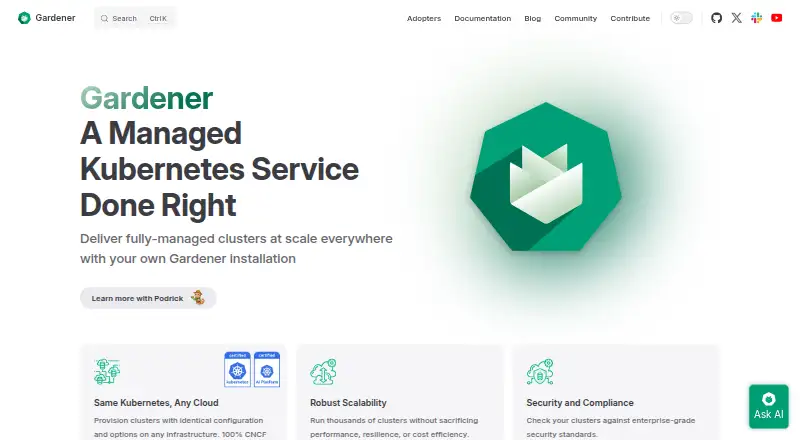
Gardener automates the management and operation of Kubernetes clusters as a service. A Gardener installation provides fully managed clusters at scale, but it needs an existing Kubernetes cluster to host its runtime components. It aims to provision clusters with identical configuration and options across infrastructure providers, including OpenStack, metal-stack, IronCore, STACKIT, AWS, Azure, Google Cloud, and Alibaba Cloud. The project says it can run thousands of clusters while maintaining performance, resilience, and cost efficiency. Operators can manage cluster lifecycles through a button or kubectl apply, with self-healing and autoscaling. Fleet controls support shared guardrails and let operators manage available Kubernetes and operating system versions. External controllers can add provider-specific functionality through Gardener’s extension architecture. The project mandates the DISA Security Technical Implementation Guide for Kubernetes and provides a compliance checker. Its report notes that some requirements are adjusted or skipped when they are not applicable or optimal for the environment. Regional placement restrictions are supported, but users must configure them for applicable requirements. Gardener is open source and neutrally governed under the NeoNephos Foundation; SAP BTP is identified as an adopter.
Good
- Supports cluster lifecycle management, self-healing, and autoscaling.
- Provides shared guardrails across clusters.
- Works across multiple listed infrastructure providers.
- Includes a DISA Kubernetes STIG compliance checker.
- Open source with neutral governance under NeoNephos Foundation.
Watch out
- Requires an existing Kubernetes cluster to host runtime components.
- Some DISA requirements are adjusted or skipped.
- Users must configure regional restrictions themselves.
Who it suits
Gardener suits operators managing Kubernetes clusters across infrastructure providers, especially those needing shared fleet controls, lifecycle automation, or policy enforcement. It requires an existing Kubernetes cluster for its runtime.
Verdict
Gardener is aimed at organizations operating Kubernetes clusters across providers and managing them as a fleet. Its hosting prerequisite and configuration responsibilities for regional restrictions are important considerations.
The facts
Each one read from Gardener's own pages, with the date it was checked.
What it does
- Cluster portability
- It provisions clusters with identical configuration and options across different infrastructure providers.checked 4 Oct 2026
- Configurable limits
- Operators can configure shoot cluster limits through CloudProfile resources, and configured limits are enforced for shoots using that profile.checked 4 Oct 2026
- Deployment model
- Gardener delivers fully managed clusters at scale through your own Gardener installation.checked 3 Oct 2026
- Deployment requirement
- A Gardener installation requires an existing Kubernetes cluster to host its runtime components.checked 4 Oct 2026
- Extensibility
- Gardener's extension architecture supports external controllers for vendor-specific functionality.checked 3 Oct 2026
- Extension architecture
- Gardener uses Kubernetes controller extensions to add infrastructure support and cluster capabilities while keeping provider-specific knowledge out of its core.checked 4 Oct 2026
- Fleet controls
- Operators can control the Kubernetes and operating system versions available to clusters and manage their lifecycle.checked 4 Oct 2026
- Governance
- The site says Gardener is built in the open and neutrally governed under the NeoNephos Foundation.checked 4 Oct 2026
- Infrastructure
- The homepage lists OpenStack, metal-stack, IronCore, STACKIT, AWS, Azure, Google Cloud, and Alibaba Cloud.checked 3 Oct 2026
- Infrastructure integrations
- The landing page lists OpenStack, metal-stack, IronCore, STACKIT, AWS, Azure, Google Cloud, and Alibaba Cloud.checked 4 Oct 2026
- Lifecycle
- Gardener supports cluster lifecycle management, self-healing, and autoscaling across the stack.checked 4 Oct 2026
- Lifecycle management
- The homepage says cluster lifecycle can be managed through a button or kubectl apply, with self-healing and auto-scaling capabilities.checked 3 Oct 2026
- Limit behavior
- The documented maximum node count is not a hard runtime limit and can be temporarily exceeded during worker pool updates or changes.checked 4 Oct 2026
- Purpose
- Gardener is a managed Kubernetes service framework for delivering fully managed clusters at scale through your own Gardener installation.checked 4 Oct 2026
- Regional controls
- Gardener supports regional placement restrictions, but users are responsible for configuring them to meet applicable regional requirements.checked 3 Oct 2026
- Scale
- The site says Gardener can run thousands of clusters while maintaining performance, resilience, and cost efficiency.checked 4 Oct 2026
- Security
- Gardener mandates the DISA Security Technical Implementation Guide for Kubernetes and provides adopters a compliance checker for demonstrating DISA Kubernetes STIG compliance.checked 3 Oct 2026
- Security caveat
- Gardener's compliance report says some DISA requirements are adjusted or skipped when they are not applicable or optimal for Gardener's environment.checked 4 Oct 2026
- Security guidance
- Gardener aims to follow DISA's Kubernetes Security Technical Implementation Guide and checks security-hardened shoot cluster configurations for every release.checked 4 Oct 2026
- Support
- The documentation directs users to community channels, GitHub Issues, and the Gardener community on Slack for assistance and questions.checked 4 Oct 2026
- Who uses it
- The adopter page identifies SAP BTP as using Gardener to deploy and manage Kubernetes clusters uniformly across infrastructures.checked 3 Oct 2026
Alternatives to Gardener
- 1

Portainer
Free planOpen sourceAndroidiOSWebAPI8.6Free plan - 2

KubeSphere
Free planOpen sourceWebAPILinuxSelf-hosted8.1From $65 a month - 3

Omni
Free planWebAPILinuxmacOS7.7From $25 a month - 4

vCluster Platform
Free planOpen sourceWebAPILinuxmacOS7.7Free plan - 5

Kubermatic Kubernetes Platform
Free planWebAPILinuxmacOS6.8Free plan - 6
Rancher
Free planWebAPILinuxSelf-hosted6.5Free plan