Cluster API
Cluster API is a free, open-source project that gives platform operators declarative tools to create, scale, upgrade, and destroy multiple Kubernetes-conform…
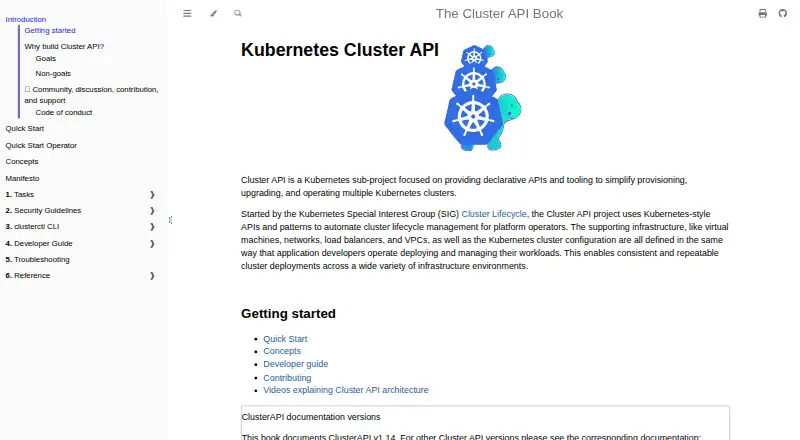
What Cluster API is
Cluster API is a free, open-source project that gives platform operators declarative tools to create, scale, upgrade, and destroy multiple Kubernetes-conformant clusters. It is designed for on-premises and cloud environments, with interchangeable provider implementations for infrastructure and other cluster components. The ecosystem includes providers for environments such as AWS, Azure, GCP, OpenStack, vSphere, and KubeVirt; kubeadm is the default bootstrap provider. A management cluster can use clusterctl or the Cluster API Operator to manage provider components. Getting started requires an existing Kubernetes cluster accessible through kubectl, and the quick start also lists kind, Docker, and Helm as common prerequisites. The project does not manage a single cluster spanning multiple infrastructure providers, nor clusters it did not provision. It is intended for platform operators, and the control plane is customer-managed. Cluster API supports its latest two minor releases, with each minor release supported for roughly 12 months including maintenance.
Good
- Supports creating, scaling, upgrading, and destroying clusters.
- Works across on-premises and cloud environments.
- Provider implementations are interchangeable.
- Offers clusterctl and Operator management paths.
Watch out
- Requires an existing Kubernetes cluster accessible through kubectl.
- Does not manage clusters it did not provision.
- Cannot manage one cluster spanning multiple infrastructure providers.
- Control plane management is customer-managed.
Who it suits
Cluster API is for platform operators who need declarative tools to manage the lifecycle of multiple Kubernetes clusters. It suits teams prepared to operate a management cluster and work with the provider ecosystem.
Verdict
Cluster API offers a provider-based approach to managing multiple Kubernetes cluster lifecycles. Its boundaries matter: it requires a management cluster and does not take over arbitrary existing clusters or span one cluster across providers.
Plans and prices
From Cluster API's own pricing page, checked 7 Oct 2026.
| Plan | Price | What it gives you |
|---|---|---|
| Cluster API | Free | Open-source Kubernetes project · provider components and infrastructure costs depend on the selected providers |
The facts
Each one read from Cluster API's own pages, with the date it was checked.
Money
- Bootstrap and control plane
- The provider ecosystem includes bootstrap and control plane implementations, with kubeadm built in.checked 7 Oct 2026
What it does
- Community support
- The project directs users to the Kubernetes Slack #cluster-api channel, the SIG Cluster Lifecycle Google Group, and weekly working-group meetings for questions and project updates.checked 7 Oct 2026
- Downloads
- The clusterctl CLI has documented downloads for Linux, macOS, and Windows, plus Homebrew installation for macOS and Linux.checked 7 Oct 2026
- GitOps
- The Cluster API Operator uses a declarative approach to manage providers and aims to support day-to-day workflows with GitOps.checked 7 Oct 2026
- Infrastructure
- It is designed to work across on-premises and cloud environments and can be extended with infrastructure providers such as AWS, Azure, and vSphere.checked 7 Oct 2026
- Installation
- The quick start offers clusterctl and the Cluster API Operator as installation paths; clusterctl fetches provider component YAML and installs it.checked 7 Oct 2026
- Integrations
- The quick start lists infrastructure providers including AWS, Azure, GCP, OpenStack, vSphere, and KubeVirt, among others.checked 7 Oct 2026
- Intended users
- The project describes its automation as intended for platform operators managing Kubernetes cluster lifecycles.checked 7 Oct 2026
- Lifecycle
- Its stated goals include creating, scaling, upgrading, and destroying Kubernetes-conformant clusters through a declarative API.checked 7 Oct 2026
- Lifecycle operations
- Its stated goals include creating, scaling, upgrading, and destroying Kubernetes-conformant clusters through a declarative API.checked 7 Oct 2026
- Management tools
- The quick start describes clusterctl and the Cluster API Operator as two paths for managing provider components in a management cluster.checked 7 Oct 2026
- Notable limit
- The project states that Cluster API does not manage a single cluster spanning multiple infrastructure providers or clusters that it did not provision.checked 7 Oct 2026
- Prerequisites
- Using Cluster API requires an existing Kubernetes cluster accessible through kubectl; the quick start also lists kind, Docker, and Helm as common prerequisites.checked 7 Oct 2026
- Production guidance
- The quick start recommends using a production management cluster with backup and disaster recovery policies and says kind is not designed for production.checked 7 Oct 2026
- Provider ecosystem
- The project lists infrastructure, bootstrap, control plane, IPAM, addon, and runtime extension providers, including AWS, Azure, GCP, OpenStack, and vSphere.checked 7 Oct 2026
- Provider model
- The project supports interchangeable provider implementations, with kubeadm as the default bootstrap provider.checked 7 Oct 2026
- Provider support responsibility
- Each provider is maintained by its respective team, and the project recommends reviewing provider documentation and doing due diligence before production use.checked 7 Oct 2026
- Purpose
- Cluster API provides declarative APIs and tooling to provision, upgrade, and operate multiple Kubernetes clusters.checked 7 Oct 2026
- Security
- The project’s user security guidance recommends auditing management and workload clusters, nodes, and cloud-provider activity, and using least-privilege credentials.checked 7 Oct 2026
- Support channels
- The project directs users to the Kubernetes Slack #cluster-api channel, the SIG Cluster Lifecycle Google Group, and weekly working group sessions for questions and news.checked 7 Oct 2026
- Support policy
- The project actively supports its latest two minor releases, while each minor release is supported for roughly 12 months including a maintenance period.checked 7 Oct 2026
The full review of Cluster API
Overview
Cluster API is a free, open-source project for automating the lifecycle of Kubernetes clusters across cloud and on-premises environments. It is aimed at platform operators who can run Kubernetes management infrastructure and choose the providers their environments need. Its appeal is declarative, multi-cluster lifecycle management; its scope is bounded to clusters it provisions.
Key features
Cluster API provides APIs and tooling to create, scale, upgrade, and destroy Kubernetes-conformant clusters. That gives platform teams a repeatable way to handle routine lifecycle changes across fleets, with multi-cluster provisioning and upgrade management built into the project’s scope. Control plane management remains customer-managed, so teams retain that responsibility rather than receiving a managed control plane.
The provider model is its main source of flexibility. Implementations cover infrastructure, bootstrap, control plane, IPAM, add-ons, and runtime extensions; kubeadm is the default bootstrap provider. Infrastructure environments include AWS, Azure, Azure Stack HCI, CloudStack, DigitalOcean, GCP, IBM Cloud, KubeVirt, Metal3, Nutanix, OCI, OpenStack, Outscale, Proxmox, vSphere, and VMware Cloud Director. This range can accommodate varied estates, but providers are maintained by their respective teams, making provider documentation and due diligence part of production planning.
Provider components can be installed with clusterctl, which retrieves and installs provider configuration, or managed through the Cluster API Operator. The Operator takes a declarative approach and is intended to support GitOps workflows. The quick start also names kind, Docker, and Helm among common prerequisites, in addition to an existing Kubernetes cluster accessible with kubectl. That management cluster is a real operational commitment: production guidance calls for backup and disaster recovery policies, and kind is explicitly not intended for production.
Security guidance calls for auditing management and workload clusters, nodes, and cloud-provider activity, and using least-privilege credentials. The project supports its latest two minor releases, with each minor release supported for roughly 12 months including a maintenance period. Questions and project updates are routed through Kubernetes Slack’s #cluster-api channel, the SIG Cluster Lifecycle Google Group, and weekly working-group sessions.
Pricing
Cluster API costs nothing. The project is open source, with no free trial because there is no paid entry tier to evaluate. That makes it a practical fit for teams able to operate the software themselves; provider components and infrastructure costs depend on the providers selected, so the project’s zero price does not remove the cost of running clusters.
There is one listed plan, Cluster API, at no cost. It includes the open-source Kubernetes project and its provider components; no seat or usage quota is stated. The trade-off is operational ownership: customers manage the control plane and the management cluster, while infrastructure costs vary by provider.
Platforms
Cluster API supports API, Linux, macOS, self-hosted, and Windows environments. The clusterctl CLI has documented downloads for Linux, macOS, and Windows, with Homebrew installation for macOS and Linux. Its self-hosted approach suits teams running their own Kubernetes management cluster rather than looking for a hosted service.
Who it's for
Cluster API is best for platform operators who need a consistent, declarative way to create and maintain multiple clusters across supported cloud and on-premises environments, and who are prepared to manage provider choices, credentials, and production operations. It is a poor fit for teams seeking to adopt clusters they did not provision: the project says it does not manage those clusters. It also cannot manage a single cluster spanning multiple infrastructure providers.
Pros and cons
- Broad provider model: Infrastructure and extension providers let operators adapt cluster lifecycle workflows to a wide range of environments.
- Declarative lifecycle coverage: Creating, scaling, upgrading, and destroying clusters through APIs supports repeatable fleet operations.
- Open-source price: The project itself is free, though selected providers and infrastructure can carry costs.
- Management cluster required: Teams must operate an existing Kubernetes cluster, and production use calls for backup and disaster recovery planning.
- Provider ownership is distributed: Each provider has its own maintainers, so the overall project does not replace provider-specific review.
- Limited adoption scope: It does not take over clusters it did not provision or combine providers within one cluster.
Alternatives
Compare Kubernetes Management Platforms if you want to review the wider category. For an open-source alternative with a Community Edition and a separate Enterprise Edition, consider Kubermatic Kubernetes Platform. vCluster Platform is another option, with a free plan and a free trial.
Portainer offers a free Business Edition tier for up to three nodes, with no credit card and no time limit. Clusternet is a free open-source alternative with no paid plans or usage limits stated. kOps is another free project.
KubeSphere describes its Community Edition as an enterprise-grade open-source Kubernetes container platform. openCenter has a free Community plan for builders and proofs of concept, is self-supported, and is developed and maintained by Rackspace Technology. Rancher offers a free, open-source platform experience with community support, with Rancher Prime as a separate option.
Verdict
Choose Cluster API if you operate a Kubernetes platform and want provider-based, declarative control over the lifecycle of multiple clusters, while accepting responsibility for the management cluster and provider stack. Its breadth and free open-source model are compelling for that audience. Look elsewhere if you need to bring existing clusters under management, span providers inside one cluster, or avoid running the control plane and management infrastructure yourself.
Getting started
- Prepare an existing Kubernetes cluster accessible through kubectl
- Install clusterctl or use the Cluster API Operator
- Install provider components for the chosen infrastructure and bootstrap providers
- Use kind, Docker, and Helm as common quick-start prerequisites
- Select a supported provider such as AWS, Azure, GCP, OpenStack, vSphere, or KubeVirt
- For production, use a management cluster with backup and disaster-recovery policies
Limits worth knowing
Cluster API does not manage a single cluster spanning multiple infrastructure providers or clusters it did not provision. The project recommends production management clusters with backup and disaster-recovery policies, while provider and infrastructure costs depend on selections.
Questions
What does Cluster API cost?
Cluster API is free and open source. Provider components and infrastructure costs depend on the providers selected.
Which platforms can run clusterctl?
Documented downloads are available for Linux, macOS, and Windows, with Homebrew installation for macOS and Linux.
What providers are supported?
The ecosystem lists AWS, Azure, GCP, OpenStack, vSphere, KubeVirt, and many other infrastructure environments, with kubeadm as the default bootstrap provider.
What is required before installation?
You need an existing Kubernetes cluster that kubectl can access; kind, Docker, and Helm are common prerequisites.
Who maintains each provider?
Each provider is maintained by its respective team, so the project recommends reviewing provider documentation and doing due diligence before production use.
Alternatives to Cluster API
- 1

Portainer
Free planOpen sourceAndroidiOSWebAPI8.6Free plan - 2

KubeSphere
Free planOpen sourceWebAPILinuxSelf-hosted8.1From $65 a month - 3

Omni
Free planWebAPILinuxmacOS7.7From $25 a month - 4

vCluster Platform
Free planOpen sourceWebAPILinuxmacOS7.7Free plan - 5

Kubermatic Kubernetes Platform
Free planWebAPILinuxmacOS6.8Free plan - 6
Rancher
Free planWebAPILinuxSelf-hosted6.5Free plan