kind
kind creates local Kubernetes clusters with Docker container nodes, primarily for Kubernetes testing and also for local development and CI.
What kind is
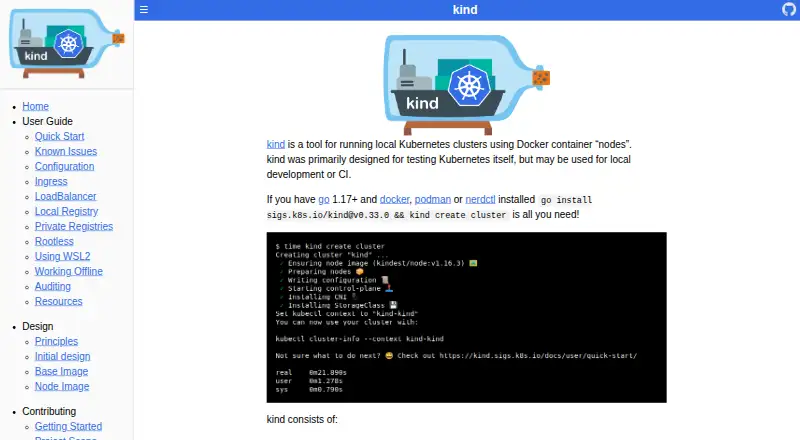
kind creates local Kubernetes clusters with Docker container nodes, primarily for Kubernetes testing and also for local development and CI. It bootstraps nodes with kubeadm and supports single- and multi-node configurations, including high-availability clusters. A configuration file can specify worker and control-plane nodes, port mappings, and Kubernetes versions. kind can build Kubernetes release builds from source or use pre-published builds, and it can use Docker, Podman, or nerdctl as its container provider. Users can load Docker images or an image archive into a cluster. Its documentation covers ingress and Gateway API setup with cloud-provider-kind, private registry workflows, and Kubernetes API audit logging. The project supports Linux, macOS, and Windows, though Windows containers are listed as unsupported or infeasible. Rootless providers are possible subject to provider and host requirements; documented restrictions include being unable to mount block storage and NFS. kind is free and open source under Apache-2.0, and the project describes itself as a work in progress.
Good
- Supports multi-node and high-availability clusters.
- Uses Docker, Podman, or nerdctl as node providers.
- Can load Docker images and image archives into clusters.
- Offers Linux, macOS, and Windows support.
- Free and open source under Apache-2.0.
Watch out
- Windows containers are unsupported or infeasible.
- Rootless use cannot mount block storage or NFS.
- The project describes itself as a work in progress.
- Not intended for Docker Compose workflows.
Who it suits
kind suits developers and teams who need local Kubernetes clusters for Kubernetes or application testing, development, CI, or Cluster API work. It is not intended as an alternative to Docker Compose.
Verdict
kind provides local Kubernetes clusters with configurable nodes and support for several container providers. Check its Windows-container and rootless-use restrictions against your setup.
Plans and prices
From kind's own pricing page, checked 9 Oct 2026.
| Plan | Price | What it gives you |
|---|---|---|
| kind | Free | Open-source tool; no paid plans or price stated |
The facts
Each one read from kind's own pages, with the date it was checked.
What it does
- Cluster configuration
- A configuration file can define multiple worker and control-plane nodes, port mappings, and Kubernetes versions.checked 9 Oct 2026
- Cluster features
- kind supports multi-node clusters, including high-availability clusters, and can build Kubernetes release builds from source.checked 9 Oct 2026
- Cluster setup
- kind bootstraps cluster nodes with kubeadm.checked 9 Oct 2026
- Conformance
- The project describes kind as a CNCF certified conformant Kubernetes installer.checked 9 Oct 2026
- Container providers
- kind can detect Docker, Podman, or nerdctl as its container provider.checked 9 Oct 2026
- Container runtimes
- kind can use Docker, Podman, or nerdctl as its node provider.checked 9 Oct 2026
- Image loading
- Users can load one or more Docker images or an image archive into a kind cluster.checked 9 Oct 2026
- Image workflow
- Users can load one or more Docker images or an image archive into a kind cluster.checked 9 Oct 2026
- Installation
- The project provides downloadable release binaries and source installation instructions; community-maintained packages are also listed.checked 9 Oct 2026
- Intended users
- Project priorities include supporting Kubernetes testing, Kubernetes application testing, and providing bootstrap clusters for Cluster API developers and users.checked 9 Oct 2026
- Kubernetes auditing
- The documentation explains how to enable Kubernetes API auditing on a kind cluster using an audit policy and log backend.checked 9 Oct 2026
- Kubernetes builds
- kind can build Kubernetes release builds from source and use pre-published builds.checked 9 Oct 2026
- License
- The kind GitHub repository identifies its license as Apache-2.0.checked 9 Oct 2026
- Multi-node
- kind supports multi-node clusters, including high availability configurations.checked 9 Oct 2026
- Networking
- The documentation covers configuring ingress and Gateway API with cloud-provider-kind, which natively supports both.checked 9 Oct 2026
- Private registries
- kind supports private registry workflows using Kubernetes imagePullSecrets, host-side image loading, or credentials mounted into nodes.checked 9 Oct 2026
- Project status
- The project describes kind as a work in progress and links to a 1.0 roadmap.checked 9 Oct 2026
- Purpose
- kind runs local Kubernetes clusters using Docker container nodes and is designed primarily for Kubernetes testing, with local development and CI as other uses.checked 9 Oct 2026
- Rootless limitations
- The documentation notes rootless restrictions including that block storage and NFS cannot be mounted.checked 9 Oct 2026
- Rootless support
- Rootless Docker, Podman, and nerdctl can be used as node providers, subject to provider and host requirements.checked 9 Oct 2026
- Scope limitation
- The project scope says kind is not intended to be an alternative to Docker Compose.checked 9 Oct 2026
- Security auditing
- The docs explain how to enable Kubernetes API audit logging on a kind cluster using an audit policy and log backend.checked 9 Oct 2026
- Support
- The project directs users to its Kubernetes Slack #kind channel, GitHub issue tracker, and SIG-Testing mailing list for help and issues.checked 9 Oct 2026
Where it runs
- Supported platforms
- The project lists Linux, macOS, and Windows support, with release binaries for Linux, macOS, and Windows.checked 9 Oct 2026
Getting started
- Visit https://kind.sigs.k8s.io/.
- Choose a downloadable release binary or follow the source installation instructions.
- Use a community-maintained package if appropriate.
- Configure a cluster, including nodes, port mappings, or Kubernetes versions as needed.
- Start a cluster using Docker, Podman, or nerdctl as its node provider.
Limits worth knowing
kind is free and has no paid plans. Rootless setups cannot mount block storage or NFS, and Windows containers are unsupported or infeasible.
Questions
How much does kind cost?
kind is free and open source. The listed plan is free, with no paid plans stated.
Which systems does kind support?
kind supports Linux, macOS, and Windows, with release binaries for those systems. Windows containers are unsupported or infeasible.
Which container providers can kind use?
It can detect Docker, Podman, or nerdctl as its container provider. Rootless use is possible subject to provider and host requirements.
Can kind run multi-node clusters?
Yes. It supports multi-node clusters, including high-availability configurations.
What license does kind use?
The kind GitHub repository identifies its license as Apache-2.0.
Alternatives to kind
- 1

Garden
Free planOpen sourceWebAPILinuxmacOS8.3From $50 a month - 2

DevPod
Free planOpen sourceLinuxmacOSSelf-hostedWindows7.4Free plan - 3

Docker Desktop
Free planWebLinuxmacOSWindows7.2From $9 a month - 4

OrbStack
Free planAPImacOS7.2From $8 a month - 5

Testcontainers Desktop
Free planWebAPILinuxmacOS7.2Free plan - 6
Kool
Free planWebLinuxmacOSWindows7.1From $49 a month