
Kubeterm
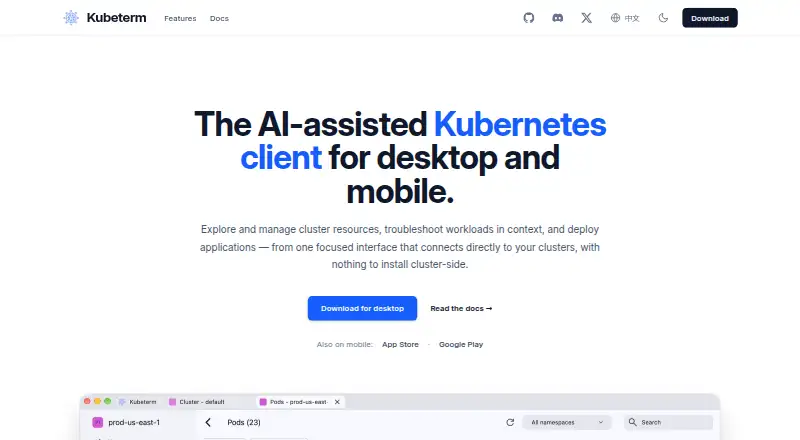
Kubeterm is an AI-assisted Kubernetes client for exploring cluster resources, troubleshooting workloads, and deploying applications.
What Kubeterm is
Kubeterm is an AI-assisted Kubernetes client for exploring cluster resources, troubleshooting workloads, and deploying applications. It runs on your device and connects to the Kubernetes API, with no cluster-side installation required. You can browse standard resources and CRDs, edit resource YAML, and view live or Prometheus-backed historical metrics. Troubleshooting tools include log streaming, a container terminal, pod file browsing, port forwarding, and ephemeral debug containers. Native access is documented for AWS EKS, Google GKE, Azure AKS, DigitalOcean, and OIDC providers such as Okta, Auth0, and Keycloak. Its AI chat accepts your API keys for OpenAI, Anthropic, Google Gemini, and DeepSeek; permissions are configurable and default to read-only. The Applications section manages Helm releases and displays Argo CD applications and Flux CD resources. Desktop builds for macOS, Windows, and Linux are free, with no account, trial, or feature gates. iOS and Android versions are paid subscriptions, with pricing listed in app stores.
Good
- Connects directly to Kubernetes API from the device.
- No cluster-side installation is required.
- Includes log, terminal, and pod-file troubleshooting tools.
- Desktop builds have no account or feature gates.
- AI tool permissions default to read-only.
Watch out
- iOS and Android versions require a paid subscription.
- Mobile pricing is listed in app stores.
- AI chat requires user-provided API keys.
Who it suits
Kubeterm suits Kubernetes users who want a local client for resource management and workload troubleshooting. Its desktop builds are free, while mobile users should check app store pricing for the subscription.
Verdict
Kubeterm brings resource browsing, troubleshooting, and deployment features into a local client, with integrations for cloud clusters and AI providers. Desktop use is free; mobile access is subscription-based.
Plans and prices
From Kubeterm's own pricing page, checked 2 Oct 2026.
| Plan | Price | What it gives you |
|---|---|---|
| Desktop | Free | macOS, Windows, and Linux · no account, trial period, or feature gates |
The facts
Each one read from Kubeterm's own pages, with the date it was checked.
What it does
- AI controls
- AI tool permissions are configurable, and the documented default policy is read-only.checked 2 Oct 2026
- AI integrations
- The built-in AI chat supports user-provided API keys for OpenAI, Anthropic, Google Gemini, and DeepSeek.checked 2 Oct 2026
- Cloud integrations
- Native cluster access is documented for AWS EKS, Google GKE, Azure AKS, DigitalOcean, and OIDC providers including Okta, Auth0, and Keycloak.checked 2 Oct 2026
- Credential security
- The security documentation says cluster credentials and configuration stay on the device, and credentials are stored using platform secure storage or local encrypted storage options.checked 2 Oct 2026
- Desktop availability
- The desktop download page lists macOS, Windows, and Linux builds and says they require no account, trial, or feature gates.checked 2 Oct 2026
- Local operation
- The app runs on the user's device and connects directly to the Kubernetes API without a cluster-side installation.checked 2 Oct 2026
- Mobile
- Kubeterm is available for iOS and Android as a paid subscription, with current pricing listed in the app store listings.checked 2 Oct 2026
- Privacy
- The privacy policy says the app may process account, device, and usage information, and was last updated November 15, 2023.checked 2 Oct 2026
- Purpose
- Kubeterm is an AI-assisted Kubernetes client for exploring and managing cluster resources, troubleshooting workloads, and deploying applications.checked 2 Oct 2026
- Resource management
- It supports browsing standard resources and CRDs, editing resource YAML, and viewing live or Prometheus-backed historical metrics.checked 2 Oct 2026
- Troubleshooting
- Troubleshooting tools include workload log streaming, a container terminal, pod file browsing, port forwarding, and ephemeral debug containers.checked 2 Oct 2026
Where it runs
- Application integrations
- The Applications section supports Helm release management and displays Argo CD applications and Flux CD resources from the cluster API.checked 2 Oct 2026
The full review of Kubeterm
Overview
Kubeterm is a desktop and mobile client for people who manage Kubernetes clusters and want resource controls, troubleshooting tools, and AI assistance in one interface. Its strongest case is for operators who prefer working from a local app rather than installing a management component into each cluster.
It connects directly from the user's device to the Kubernetes API. That keeps the workflow local, while its broad resource and diagnostic tools make it more than a basic cluster viewer.
Key features
Resource browsing covers standard Kubernetes objects and custom resource definitions, with YAML editing and live metrics. Prometheus-backed historical metrics add useful context when a current reading is not enough to understand a workload. For troubleshooting, Kubeterm can stream workload logs, open a container terminal, browse pod files, forward ports, and launch ephemeral debug containers. This is a substantial set of investigation tools for a client, though the product's value will depend on whether its interface suits the reader's day-to-day cluster work.
For application workflows, the Applications section supports Helm release management and displays Argo CD applications and Flux CD resources surfaced through the cluster API. Native access supports AWS EKS, Google GKE, Azure AKS, DigitalOcean, and OIDC providers including Okta, Auth0, and Keycloak, making it relevant to teams using those environments.
The AI chat accepts user-provided keys for OpenAI, Anthropic, Google Gemini, and DeepSeek. Configurable tool permissions provide control over what the AI can do; the documented default is read-only, a sensible starting point for users who want assistance without granting write access by default. Users must bring their own provider credentials.
Kubeterm says cluster credentials and configuration remain on the device, stored through platform secure storage or local encrypted storage options. Its privacy policy also says the app may process account, device, and usage information. That distinction matters to users assessing operational security: local cluster credentials do not mean the product processes no user information.
Pricing
The desktop plan costs nothing on macOS, Windows, and Linux, with no account, trial period, or feature gates. That makes desktop use straightforward for individuals evaluating the client and avoids a subscription barrier for routine desktop access.
Mobile access on iOS and Android is subscription-based, with pricing shown in the app store listings. There is no free trial. The subscription is the main trade-off for readers who want to manage clusters from a phone or tablet; desktop users do not need to pay to unlock features.
Platforms
Kubeterm has a graphical interface and builds for macOS, Windows, and Linux, as well as iOS and Android apps. Desktop downloads require no account, trial, or feature gates. Mobile availability is paid, so the platform choice also determines whether access is free or subscription-based.
Who it's for
Kubeterm suits Kubernetes operators who want one local client for resource editing, metrics, workload diagnosis, and common application workflows, especially those using its documented cloud or OIDC integrations. Its free desktop plan also makes it practical for individuals who want a capable client without a recurring desktop fee. It is less compelling for readers who need a free mobile app or who do not want to supply their own AI-provider API key.
Pros and cons
- Pros: Broad troubleshooting tools, from streaming logs to ephemeral debug containers, reduce the need to switch between separate cluster-inspection utilities.
- Pros: Helm, Argo CD, and Flux visibility brings application-management context into the same client as resource browsing.
- Pros: Free desktop access has no account requirement or feature gates, and cluster credentials stay on the device.
- Cons: iOS and Android access requires a paid subscription, unlike desktop access.
- Cons: AI chat requires the user's own provider API key, so it adds setup and may entail provider-side costs.
- Cons: The privacy policy allows processing of account, device, and usage information, which may not suit users seeking minimal data processing.
Alternatives
Browse local Kubernetes tools if you want to compare this category more broadly.
Rancher Desktop is another free desktop option, with builds for Linux, macOS, and Windows. Choose it when that alternative's desktop focus better matches your needs.
Kunobi has a free plan that supports up to three clusters at once, community support, and no account requirement, plus a free trial. Choose it if that cluster cap and trial suit your evaluation better than Kubeterm's feature-gated-free desktop model.
srelens is a free, open-source MIT-licensed option with no paid tier, account, or license key. Choose it if those licensing and access terms are a priority.
vCluster Platform offers a free plan with unlimited virtual clusters up to 64 CPUs or 32 GPUs and a maximum of one HA vCluster. Choose it when virtual-cluster capacity is the central requirement.
Colima is a free, MIT-licensed container runtime for macOS and Linux. Choose it for that runtime use case rather than Kubeterm's Kubernetes client workflow.
Talos Linux has a free, open-source option with community support. Choose it when that operating-system offering is a closer fit.
ctlptl is a free Apache-2.0-licensed option with no paid plans or usage limits stated. Choose it if those terms make it a better fit.
Kube Inspector is free and open source, with no paid tier, account, or sign-in. Choose it if those access terms are more important than Kubeterm's integrated feature set.
Verdict
Kubeterm is a strong choice for Kubernetes users who want a free desktop client that combines resource editing, serious workload troubleshooting, and Helm and GitOps visibility, with optional AI assistance. Its local operation and breadth of integrations are the main reasons to choose it. Look elsewhere if free mobile access, built-in AI without separate API credentials, or a different specialized Kubernetes workflow matters more.
Getting started
- Visit the Kubeterm website.
- Choose a desktop build for macOS, Windows, or Linux, or use the iOS or Android version.
- Install or open the app on your device.
- Connect directly to the Kubernetes API using a supported cluster access option.
- If using AI chat, provide an API key for a supported provider.
Limits worth knowing
The desktop plan is free at no cost and has no trial period or feature gates. iOS and Android use paid subscriptions, with current prices listed in app stores.
Questions
Is Kubeterm free?
The macOS, Windows, and Linux desktop plan is free. iOS and Android are available as paid subscriptions.
Which platforms does it support?
Kubeterm supports macOS, Windows, Linux, iOS, and Android.
Does it need to be installed in a Kubernetes cluster?
No. It runs on your device and connects directly to the Kubernetes API.
Which AI providers can I use?
AI chat supports user-provided API keys for OpenAI, Anthropic, Google Gemini, and DeepSeek.
Which cluster access options are documented?
Native access is documented for AWS EKS, Google GKE, Azure AKS, DigitalOcean, and OIDC providers including Okta, Auth0, and Keycloak.
Alternatives to Kubeterm
- 1

vCluster Platform
Free planOpen sourceWebAPILinuxmacOS7.7Free plan - 2

srelens
Free planOpen sourceWebAPIExtensionLinux7.4Free plan - 3
Talos Linux
Free planAPILinuxmacOSSelf-hosted6.8From $1,000 a year - 4
Kunobi
Free planLinuxmacOSWindows6.7From $912 a month - 5
Rancher Desktop
Free planAPILinuxmacOSWindows6.7Free plan - 6
kind
Free planLinuxmacOSSelf-hostedWindows6.6Free plan