Colima
Colima provides container runtimes on macOS and Linux with minimal setup.
What Colima is
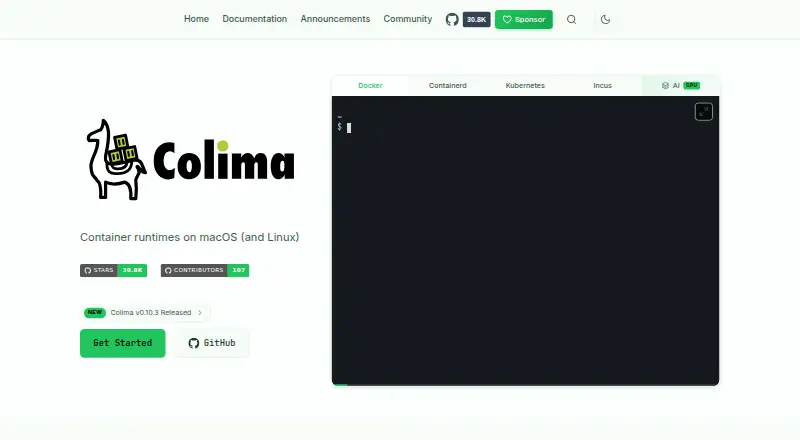
Colima provides container runtimes on macOS and Linux with minimal setup. It supports Docker, containerd, Kubernetes, and Incus; Docker compatibility lets existing Docker workflows and tools work without changes. Users can run a local, single-node k3s Kubernetes cluster with one command, and containerd users can use nerdctl for a Docker-like command-line experience. Colima also supports multiple isolated instances with different configurations, and users can allocate CPU, memory, and disk resources. Its documentation covers GPU-accelerated AI workloads on Apple Silicon using the Krunkit VM type, with Docker AI Registry and HuggingFace listed as model sources; Ramalama also supports the Ollama registry. These workloads require Apple Silicon, macOS 13 or newer, and Krunkit, and at least 8 GB of RAM is recommended. AI containers are isolated from the host filesystem, other containers, and network access unless network access is explicitly enabled. Colima is free and MIT licensed, with community support through GitHub channels and CNCF Slack.
Good
- Supports Docker, containerd, Kubernetes, and Incus.
- Can start a local k3s cluster with one command.
- Allows resource allocation for instances.
- Supports multiple isolated configurations.
- Open source under the MIT License.
Watch out
- Available on macOS and Linux, not Windows.
- Incus virtual machines require m3 or newer Apple Silicon.
- GPU-accelerated AI workloads require macOS 13 or newer.
Who it suits
Colima suits developers on macOS or Linux who need local container runtimes, Kubernetes, or isolated instances. Its documented GPU-accelerated AI workloads are aimed at users with qualifying Apple Silicon devices.
Verdict
Colima combines several container runtime options with local Kubernetes and configurable instances. Some capabilities, including GPU-accelerated AI workloads and Incus virtual machines, have specific Apple Silicon requirements.
Plans and prices
From Colima's own pricing page, checked 3 Oct 2026.
| Plan | Price | What it gives you |
|---|---|---|
| Colima | Free | Container runtimes on macOS and Linux · MIT licensed open-source project |
The facts
Each one read from Colima's own pages, with the date it was checked.
What it does
- AI isolation
- The AI documentation says containers are isolated from the host filesystem, other containers, and network access unless network access is explicitly enabled.checked 3 Oct 2026
- AI model registries
- Its documented model runners support Docker AI Registry and HuggingFace, while Ramalama also supports the Ollama registry.checked 3 Oct 2026
- AI model sources
- Its documented model runners support Docker AI Registry and HuggingFace, while Ramalama also supports Ollama registries.checked 3 Oct 2026
- AI requirements
- GPU-accelerated AI workloads require Apple Silicon, macOS 13 or newer, and Krunkit; the guide recommends at least 8 GB of RAM.checked 3 Oct 2026
- AI workloads
- Colima supports GPU-accelerated AI workloads on Apple Silicon using the Krunkit VM type.checked 3 Oct 2026
- Containerd
- Colima supports the containerd runtime and nerdctl for a Docker-like command-line experience.checked 3 Oct 2026
- Default VM
- The project README states that a default Colima VM has 2 CPUs, 2 GiB memory, and 100 GiB storage.checked 3 Oct 2026
- Docker
- Colima provides Docker compatibility so existing Docker workflows and tools can be used without changes.checked 3 Oct 2026
- Docker compatibility
- The maker says Colima is fully Docker compatible and existing Docker workflows and tools work without changes.checked 3 Oct 2026
- Incus
- Colima supports Incus for running system containers and virtual machines.checked 3 Oct 2026
- Installation
- The installation guide provides macOS and Linux installation options, including Homebrew and manual installation.checked 3 Oct 2026
- Isolation
- The AI workloads documentation says containers are isolated from the host filesystem, other containers, and network access unless network access is explicitly enabled.checked 3 Oct 2026
- Kubernetes
- Colima can start a local k3s Kubernetes cluster with a single command.checked 3 Oct 2026
- License
- Colima is released under the MIT License.checked 3 Oct 2026
- License and support
- Colima is an independent open-source project released under the MIT License, with community support through GitHub Discussions and Issues.checked 3 Oct 2026
- Lightweight
- Colima runs with sensible defaults intended to avoid burdening the CPU.checked 3 Oct 2026
- Notable limitation
- Running virtual machines through Incus is supported only on m3 or newer Apple Silicon devices.checked 3 Oct 2026
- Profiles
- Colima supports multiple isolated instances with different configurations running simultaneously.checked 3 Oct 2026
- Purpose
- Colima provides container runtimes on macOS and Linux with minimal setup.checked 3 Oct 2026
- Resource controls
- Users can allocate CPU, memory, and disk resources to Colima instances.checked 3 Oct 2026
- Runtimes
- It supports Docker, containerd, Kubernetes, and Incus runtimes.checked 3 Oct 2026
- Support
- The project lists GitHub Discussions, GitHub Issues, announcements, and a #colima channel in CNCF Slack as community channels.checked 3 Oct 2026
Alternatives to Colima
- 1

Docker Desktop
Free planWebLinuxmacOSWindows7.2From $9 a month - 2

OrbStack
Free planAPImacOS7.2From $8 a month - 3

LXD
Free planWebAPILinuxSelf-hosted7.0From $25 a year - 4
Incus
Free planAPILinuxmacOSSelf-hosted6.8Free plan - 5
Apptainer
Free planAPILinuxmacOSSelf-hosted6.7Free plan - 6
Rancher Desktop
Free planAPILinuxmacOSWindows6.7Free plan