Apptainer
Apptainer is a free container platform for creating and running portable, reproducible workloads, with a focus on shared systems and high-performance computi…
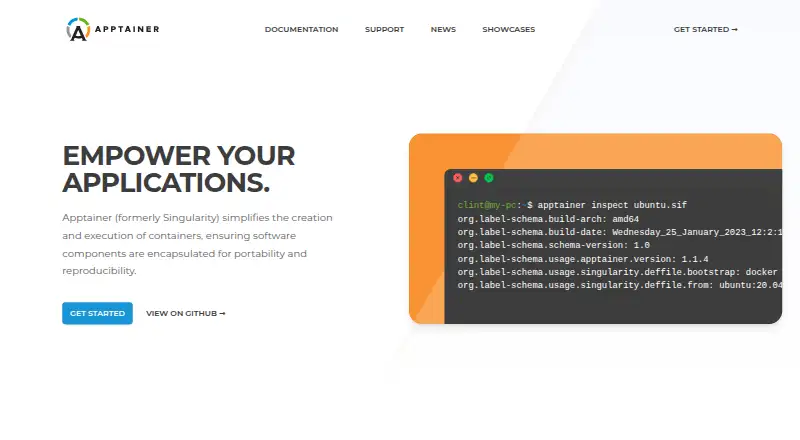
What Apptainer is
Apptainer is a free container platform for creating and running portable, reproducible workloads, with a focus on shared systems and high-performance computing. It packages containers as immutable, single-file Singularity Image Format (SIF) images for transport and sharing. SIF images can be signed and verified with PGP keys, PEM keys or X.509 certificates, and encrypted containers can run without writing decrypted contents to disk. By default, users do not gain extra host privileges inside a container. Apptainer imports containers from OCI registries and aims to support pulling, running and building most Docker Hub containers without changes. It can expose host resources including GPUs, high-speed networks and parallel filesystems, with support for NVIDIA CUDA, AMD ROCm, Intel Gaudi and OCI Container Device Interface accelerators. Apptainer requires Linux; Windows and macOS need a Linux virtual machine, and Windows is also listed via WSL2. Root access is not required when user namespaces are available. Full functionality requires kernel support for FUSE and unprivileged user namespaces.
Good
- Free plan for container use.
- Immutable, single-file SIF images.
- Encrypted containers can run without disk decryption.
- Supports major accelerator types and host resources.
- Root access unnecessary when user namespaces are available.
Watch out
- Requires a Linux system to run.
- Windows and macOS need a Linux virtual machine.
- Full functionality needs FUSE and unprivileged user namespaces.
- Some features require additional software.
Who it suits
It suits users running complex applications on shared HPC clusters, including researchers and teams in academia or industry. It also fits people who need portable containers and host resource access without default privilege escalation.
Verdict
Apptainer focuses on portable containers for shared systems and HPC, with SIF images, host-resource access and security controls. Check the Linux and kernel requirements before choosing it.
Plans and prices
From Apptainer's own pricing page, checked 2 Oct 2026.
| Plan | Price | What it gives you |
|---|---|---|
| Apptainer | Free | Open-source container platform · commercial support available through partners |
The facts
Each one read from Apptainer's own pages, with the date it was checked.
What it does
- Container format
- Apptainer produces immutable single-file Singularity Image Format (SIF) images.checked 1 Oct 2026
- Docker compatibility
- Apptainer can import containers from OCI registries and aims to support pulling, running, and building most Docker Hub containers without changes.checked 2 Oct 2026
- Encryption
- Apptainer supports encrypted containers that can run without decrypting contents to disk.checked 1 Oct 2026
- Governance
- Apptainer is hosted by the Linux Foundation and was formerly known as Singularity.checked 1 Oct 2026
- GPU support
- Apptainer supports NVIDIA CUDA, AMD ROCm, Intel Gaudi, and OCI Container Device Interface accelerators.checked 1 Oct 2026
- Host integration
- The project emphasizes integration with host resources, including GPUs, high-speed networks, and parallel filesystems.checked 2 Oct 2026
- Installation requirement
- A Linux system is required to run Apptainer, and root access is unnecessary when user namespaces are available.checked 1 Oct 2026
- OCI compatibility
- Apptainer can import containers from OCI registries and aims for compatibility with Docker containers.checked 1 Oct 2026
- Primary users
- Apptainer is designed for shared systems and high-performance computing environments.checked 1 Oct 2026
- Project steward
- The project site says Apptainer is established as a Series of LF Projects LLC.checked 2 Oct 2026
- Purpose
- Apptainer creates and runs containers that package software for portability and reproducibility.checked 2 Oct 2026
- Secrets integration
- Apptainer can encrypt containers and integrate with Vault and other secret-management platforms.checked 2 Oct 2026
- Security model
- By default, users retain the same identity inside the container and cannot gain additional host privileges.checked 2 Oct 2026
- Security reporting
- The Technical Steering Committee manages project security, and the policy directs vulnerability reports through private contact with the project.checked 2 Oct 2026
- Security response
- The Apptainer Technical Steering Committee accepts vulnerability reports at [email protected] and documents vulnerabilities through CVEs.checked 1 Oct 2026
- Signatures and encryption
- Apptainer supports cryptographic signatures, immutable container images, and in-memory decryption.checked 2 Oct 2026
- Signing
- SIF images support cryptographic signing and verification with PGP keys, PEM keys, or X.509 certificates.checked 1 Oct 2026
- Single-file format
- Containers use the single-file SIF format, which is designed to be transported and shared.checked 2 Oct 2026
- Support
- Free support resources include Slack, a mailing list, and GitHub, while commercial support and services are offered through CIQ.checked 2 Oct 2026
- Target users
- The project was created for complex applications on HPC clusters and is used across academia and industry.checked 2 Oct 2026
Where it runs
- Linux requirement
- Apptainer can be installed on modern Linux distributions, while Windows and macOS require a Linux virtual machine to run it.checked 2 Oct 2026
- Linux requirements
- Full functionality requires kernel support for FUSE and unprivileged user namespaces; some features require additional software such as BuildKit or IPFS.checked 2 Oct 2026
The full review of Apptainer
Apptainer is a free container platform for creating and running portable workloads, particularly on shared compute systems. It is best suited to research and operations teams working in HPC, rather than people looking for a desktop-first container workflow. Its SIF images and host-resource access fit cluster work well, but running it requires Linux.
Overview
Apptainer packages containers as immutable, single-file SIF images designed to travel between systems. That makes it a practical choice for sharing workloads where reproducibility matters. The project, formerly known as Singularity, is hosted by the Linux Foundation and established as a Series of LF Projects LLC.
It can import containers from OCI registries and aims to pull, run, and build most Docker Hub containers without changes. This may ease migration for teams with existing Docker images, although compatibility is an aim rather than a guarantee.
Key features
Portable images and security
SIF images support signing and verification with PGP keys, PEM keys, or X.509 certificates, giving teams a way to check image integrity when sharing workloads. Encrypted containers can run without decrypting their contents to disk; Apptainer can also integrate with Vault and other secret-management platforms. These are meaningful safeguards for sensitive workloads, though they do not remove the need to manage access and credentials.
Users keep the same identity inside and outside a container and do not gain extra host privileges by default. That security model suits shared systems where administrators need to limit privilege escalation. It is not a substitute for reviewing the permissions and configuration of a deployment.
Cluster resources and accelerators
Apptainer provides access to host resources such as GPUs, high-speed networks, and parallel filesystems by default. It supports NVIDIA CUDA, AMD ROCm, Intel Gaudi, and OCI Container Device Interface accelerators. That makes it a strong fit for HPC workloads that need cluster hardware and storage, rather than a runtime focused on isolating applications from host resources.
Root access is unnecessary when user namespaces are available, and rootless operation is supported. Full functionality depends on Linux kernel support for FUSE and unprivileged user namespaces; some features also need extra software such as BuildKit or IPFS. Those prerequisites are worth checking against cluster policy before adopting it.
Pricing
Apptainer costs nothing. The free plan is an open-source container platform, with commercial support available through partners. There are no paid plan tiers in the stated offering; teams needing commercial assistance can look to that partner support, while the project also has community channels through Slack, Google Groups, and GitHub.
Platforms
Apptainer runs on Linux, including through WSL2 on Windows and a Linux virtual machine on macOS. Windows and macOS are therefore ways to host a Linux environment, not native runtime targets. A Linux system is required, so teams seeking a native desktop container experience on those platforms should consider another tool.
The project’s Technical Steering Committee accepts vulnerability reports privately at [email protected] and documents vulnerabilities through CVEs. This gives users a stated route for reporting security issues.
Who it's for
Apptainer is aimed at teams running complex applications on shared HPC clusters, including academic and industry users. Its portable images, accelerator support, and default access to cluster resources make it especially relevant where workloads must move between systems without losing access to host capabilities. It is less suitable for users who need native Windows or macOS execution or a desktop-oriented container workflow.
Pros and cons
- Pros: Immutable, single-file SIF images are built for transport and sharing, supporting reproducible workloads across systems.
- Pros: Signing, verification, encryption, and secret-management integration provide useful controls for distributed or sensitive workloads.
- Pros: Broad accelerator support and access to high-speed networks and parallel filesystems suit HPC environments.
- Cons: Linux is required; Windows and macOS users must run a Linux VM or use WSL2 on Windows.
- Cons: Full functionality relies on specific kernel support, and some features require additional software.
- Cons: Docker compatibility is a stated aim, not a guarantee that every image or workflow will work unchanged.
Alternatives
Docker Desktop is worth considering for readers who want a freemium option across Linux, macOS, Windows, and the web. Its Personal plan costs nothing, while Pro is $9 a month; Apptainer is the more natural fit for shared HPC systems and SIF-based workloads.
Incus is another free option across Linux, macOS, Windows, API, and self-hosted environments, with an Apache 2 license. Rancher Desktop is a free desktop application for Linux, macOS, and Windows, and may suit users seeking that platform mix instead.
Finch is free across Linux, macOS, and Windows, with no licensing tiers or commercial agreements required. LXD offers a free open-source plan with KVM-based virtual machines, system containers, and self-hosted deployment for users who need those capabilities.
Colima is a free MIT-licensed project for container runtimes on macOS and Linux. crun is a free OCI container runtime available as source builds and release binaries, while Podman provides free container, pod, and image management along with Podman Desktop.
Browse more options in Container Runtime Software and Container Engines.
Verdict
Choose Apptainer if your team runs complex workloads on shared Linux or HPC systems and values portable SIF images, accelerator access, and privilege controls. Look elsewhere if you need native Windows or macOS execution or a desktop-led workflow; its Linux requirement is the clearest limit on its reach.
Getting started
- Visit the Apptainer website
- Use a modern Linux distribution, or prepare a Linux virtual machine for Windows or macOS
- Check that the system supports FUSE and unprivileged user namespaces for full functionality
- Install Apptainer on Linux; root access is unnecessary when user namespaces are available
- Use Slack, Google Groups, or GitHub for community support
Limits worth knowing
Apptainer is free, but it requires Linux to run. Full functionality needs kernel support for FUSE and unprivileged user namespaces, and some features require additional software such as BuildKit or IPFS.
Questions
How much does Apptainer cost?
The Apptainer plan is free. It is an open-source container platform, with commercial support available through partners.
Which operating systems can run Apptainer?
Linux is required. Windows is supported via WSL2 or a Linux virtual machine, while macOS requires a Linux virtual machine.
Is Apptainer open source?
Yes. Apptainer is an open-source container platform hosted by the Linux Foundation.
Can Apptainer run Docker containers?
It imports containers from OCI registries and aims to support pulling, running, and building most Docker Hub containers without changes.
Does Apptainer support GPUs?
Yes. It supports NVIDIA CUDA, AMD ROCm, Intel Gaudi, and OCI Container Device Interface accelerators.
Alternatives to Apptainer
- 1

LXD
Free planWebAPILinuxSelf-hosted7.0From $25 a year - 2
BuildKit
Free planAPILinuxmacOSSelf-hosted6.8Free plan - 3
Incus
Free planAPILinuxmacOSSelf-hosted6.8Free plan - 4
crun
Free planLinuxSelf-hosted6.5Free plan - 5

Buildah
Free planAPILinuxSelf-hosted6.4Free plan - 6

Podman
Free planAPILinuxmacOSSelf-hosted6.4Free plan