PDWare ResourceFirst
PDWare ResourceFirst is enterprise portfolio and resource capacity planning software for organizations aligning project demand with available skills and staff.
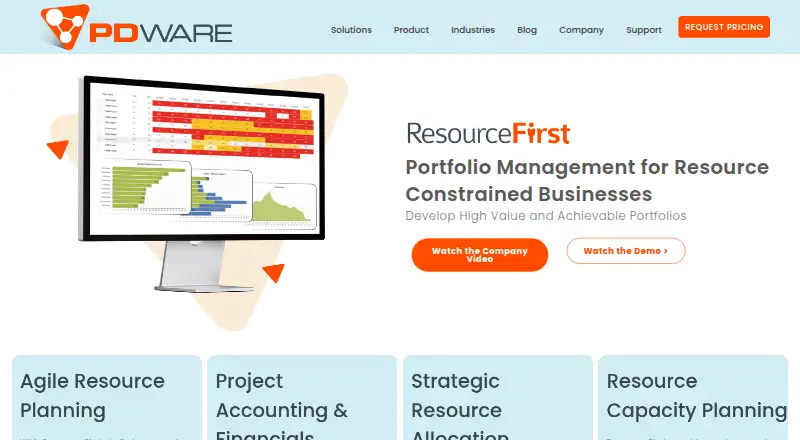
What PDWare ResourceFirst is
PDWare ResourceFirst is enterprise portfolio and resource capacity planning software for organizations aligning project demand with available skills and staff. It models prioritized demand against capacity across portfolios, teams and time, with shortfall and utilization views. Its Waterline method prioritizes work that fits within a capacity line and defers work that does not. Scenario planning compares portfolio alternatives against shared constraints before headcount or budget commitments, and approved changes can be posted back to the current plan. The platform supports project and resource planning, labor and financial forecasts, project ranking, roadmaps, swimlanes and reports by project, resource, financial or skill data. Financial features include cost of capacity, unused capacity, cost centers, chargeback and budget planning. Integrations listed include SAP, Oracle Financials, Workday, Snowflake, Microsoft Project, Smartsheet, Jira, Excel and Oracle Time & Labor. Deployment options are cloud SaaS on Microsoft Azure and a thin-client on-premise solution. Pricing is on request; licensing depends on planning-group size and user types, with workgroup packages for 50 and 100 users and enterprise licensing.
Good
- Models demand against capacity across portfolios, teams and time.
- Compares alternative portfolios before budget or headcount commitments.
- Supports Excel import and export in grid views.
- Offers cloud SaaS and thin-client on-premise deployment.
Watch out
- Pricing is available only by request.
- Level-1 implementation typically takes 4–6 weeks.
- Licensing depends on planning-group size and user types.
Who it suits
ResourceFirst is aimed at PMO directors, R&D and engineering leaders, and operations and finance leaders. It may suit organizations with significant project labor costs and constrained resource talent that need portfolio and capacity planning.
Verdict
ResourceFirst connects capacity planning, portfolio prioritization and financial forecasting, with scenario comparison and multiple integrations. Organizations considering it will need to request pricing and weigh its licensing structure and implementation timeline.
The facts
Each one read from PDWare ResourceFirst's own pages, with the date it was checked.
What it does
- Access controls
- ResourceFirst uses user rights and organizational structures to control which objects and features users can view, modify, or administer.checked 9 Oct 2026
- Analysis
- ResourceFirst includes labor and financial waterlines, project ranking and score analysis, roadmaps, swimlanes, and project, resource, financial, and skill pivot reports.checked 9 Oct 2026
- API and data entry
- PDWare describes an open architecture with a secure full API and grid-style data entry with Excel import and export.checked 9 Oct 2026
- Data exchange
- ResourceFirst supports Excel import and export from its grid views for resource, project, assignment, asset, and scenario data.checked 9 Oct 2026
- Deployment
- ResourceFirst is offered as cloud SaaS on Microsoft Azure and as a thin-client on-premise solution.checked 9 Oct 2026
- Financial features
- The platform includes cost of capacity, demand and unused capacity, cost centers, chargeback, and Waterline budget planning.checked 9 Oct 2026
- Implementation
- PDWare says Level-1 implementation typically takes 4–6 weeks.checked 9 Oct 2026
- Integrations
- PDWare lists SAP, Oracle Financials, Workday, Snowflake, Microsoft Project, Smartsheet, Jira, Excel, and Oracle Time & Labor as integrations.checked 9 Oct 2026
- Licensing
- PDWare says licensing depends on planning-group size and user types, with workgroup packages for 50 and 100 users and enterprise licensing; it directs buyers to sales for pricing.checked 9 Oct 2026
- Pilot
- PDWare says many organizations start with a pilot using their own data before committing to a long-term subscription.checked 9 Oct 2026
- Portfolio prioritization
- Its Waterline method funds work that clears the capacity line and defers work that does not.checked 9 Oct 2026
- Pricing
- PDWare directs visitors to request pricing and says its team can review pricing and onboarding options; the opened pages do not state a price.checked 9 Oct 2026
- Product documentation
- The maker's documentation page lists ResourceFirst version 9 guides for resources, projects, assignments, scenarios, time tracking, financials, and administration.checked 9 Oct 2026
- Purpose
- ResourceFirst is a cloud-based project and portfolio planning tool that aligns resource capacity with demand to help organizations plan achievable portfolios.checked 9 Oct 2026
- Security
- PDWare says it uses SSO (SAML/LDAP), encryption in transit and at rest, network controls, and regular audits; qualified prospects and users may request SOC 2 certification details.checked 9 Oct 2026
- Support
- PDWare describes a staffed support desk where human staff handle tickets through resolution.checked 9 Oct 2026
- Users
- PDWare identifies executives, PMOs, and portfolio leaders in organizations with significant project labor costs and constrained resource talent as primary users.checked 9 Oct 2026
- What it does
- PDWare describes ResourceFirst as enterprise portfolio and resource capacity planning software for prioritizing projects, modeling skilled resource demand, comparing scenarios, and building deliverable portfolios.checked 9 Oct 2026
- Who it is for
- PDWare identifies PMO directors, R&D and engineering leaders, and operations and finance leaders as primary users.checked 9 Oct 2026
Money
- Capacity planning
- The platform models prioritized skill demand against real capacity across portfolios, teams, and time, with shortfall and utilization views.checked 9 Oct 2026
- Planning
- The platform supports project and resource planning, labor and financial forecasts, and oversight as priorities, schedules, demand, and staff capacity change.checked 9 Oct 2026
- Scenario planning
- Scenario planning compares alternative portfolios against the same constraint set before headcount or budget is committed.checked 9 Oct 2026
The company
- Headquarters
- New York City, New York, United Stateschecked 28 Sep 2026
Where it runs
- Scenarios
- Scenarios let users plan project and assignment forecasts separately from the current plan, then post approved changes back to it.checked 9 Oct 2026
The full review of PDWare ResourceFirst
Overview
PDWare ResourceFirst is enterprise portfolio and resource-capacity planning software for organizations balancing specialist skills, project demand, and budgets. It suits PMO directors, engineering and R&D leaders, operations, finance, executives, and portfolio teams with substantial project labor costs. Its central advantage is making portfolio choices against measurable capacity; custom pricing, enterprise licensing, and implementation work make it a poor match for a small team wanting an inexpensive self-serve tool.
Key features
ResourceFirst models prioritized skill demand against actual capacity across portfolios, teams, and time. Shortfall and utilization views show where requested work exceeds available people or where capacity is sitting unused. The Waterline method places funding behind work that clears the capacity line and defers work that does not, giving portfolio leaders a concrete rule for turning rankings into an achievable delivery plan.
Scenario planning compares alternative portfolios against the same constraints before headcount or budget is committed. Project and assignment forecasts can be developed separately from the current plan, then approved changes can be posted back. That separation is valuable for testing trade-offs without disturbing the operating plan, especially when several funding or staffing options are under consideration.
Financial controls cover cost of capacity, demand and unused capacity, cost centers, chargeback, and Waterline budget planning. Labor and financial waterlines, project ranking and score analysis, roadmaps, swimlanes, and pivot reports for projects, resources, finances, and skills support both executive review and detailed analysis. Project intake, budget tracking, and executive reporting are included, so the product reaches from incoming work through portfolio oversight.
An open architecture provides a secure full API, while grid-style entry supports Excel import and export for resource, project, assignment, asset, and scenario data. Listed integrations include SAP, Oracle Financials, Workday, Snowflake, Microsoft Project, Smartsheet, Jira, Excel, and Oracle Time & Labor. User rights and organizational structures control which objects and functions each person can view, change, or administer.
Deployment is either cloud SaaS on Microsoft Azure or a thin-client on-premise installation. PDWare describes SSO through SAML or LDAP, encryption in transit and at rest, network controls, and regular audits; qualified prospects and users may request SOC 2 certification details. A staffed support desk handles tickets through resolution. Level-1 implementation typically takes 4–6 weeks, and a pilot using an organization’s own data is a sensible way to validate the model before a long subscription.
Pricing
ResourceFirst uses paid, custom pricing. PDWare directs buyers to request a quote and review onboarding options with its team; there is no published price or stated free plan. Licensing depends on planning-group size and user types, with workgroup packages for 50 or 100 users and enterprise licensing. Those structures fit organizations that can budget for a formal rollout, but they offer neither a transparent entry price nor a small-team tier for quick comparison.
The documentation set covers ResourceFirst version 9 resources, projects, assignments, scenarios, time tracking, financials, and administration. Prospective customers should use the pilot and pricing discussion to establish the required user mix, implementation scope, and ongoing subscription terms.
Platforms
ResourceFirst is offered on Android, iOS, Linux, macOS, Windows, and the web, with API and extension support. Buyers can choose Azure SaaS or a thin-client on-premise deployment, making it workable for organizations with cloud or self-hosting requirements.
Who it's for
This is a strong fit for PMOs and portfolio leaders that must rank work against scarce skills, for R&D and engineering groups coordinating specialist demand, and for operations or finance leaders tying labor forecasts to budgets and chargeback. Executives benefit from waterlines, score analysis, roadmaps, and reporting when portfolio decisions need a financial and capacity rationale.
It is not the natural choice for a small team needing a low-cost project tracker, a published monthly price, or a lightweight setup with no planning-group administration.
Pros and cons
Pros
- Capacity-led prioritization: Waterlines connect funding decisions to real skill and staffing limits instead of ranking projects in isolation.
- Useful what-if planning: Separate scenarios let leaders compare portfolios before changing the live plan or committing budget.
- Broad financial scope: Cost of capacity, unused-capacity analysis, cost centers, chargeback, and budget waterlines support finance-grade portfolio decisions.
- Enterprise connectivity: The API, Excel exchange, and integrations with ERP, HR, work-management, and data platforms reduce dependence on manual re-entry.
- Flexible governance: Azure SaaS, on-premise deployment, SSO, encryption, network controls, audits, and granular rights address controlled environments.
Cons
- Opaque cost of entry: Pricing is on request, and licensing is organized around 50-user, 100-user, or enterprise workgroups rather than a published small-team plan.
- Implementation commitment: Even Level-1 implementation typically takes 4–6 weeks, so it is not an instant deployment.
- Data discipline required: Capacity-based decisions are only as dependable as the demand, skill, and availability data entered into the system.
Alternatives
Choose Planforge when a freemium route matters: its Free plan supports up to four users on cloud with no time limit and no credit card, while paid options include Lean at €4,500 a month.
Nimble is the better starting point for a small group wanting a free tier for 10 users and 10 projects, with paid plans offering unlimited users and projects.
Project Insight suits small and midsize businesses seeking a free-forever three-user plan or a Pro plan at $9 a month.
Pick Rillsoft Project for Linux, Windows, web, or self-hosted deployment with a single-user Light license at €357 a month.
Tempo Portfolio Manager is an option for teams that can work within a free tier of 10 members, three projects, and 300 tasks, or Essentials at $15 a month.
FoxPlan offers freemium portfolio planning, including a free three-user tier and self-hosted or web access.
ITM Platform is worth considering when unlimited team members, timesheets, task-progress reports, documentation, collaboration, and an Agile panel are the priority in its free Team Member plan.
TeamAlloc is an alternative for accredited universities and public research institutions seeking a free plan with unlimited resources, users, projects, and scenarios.
For a broader category comparison, see Project Portfolio Management Software.
Verdict
Choose ResourceFirst if your organization needs portfolio decisions grounded in constrained skills, capacity, and financial forecasts, and can support a structured implementation and enterprise licensing conversation. Look elsewhere if you need transparent pricing, a genuinely small-team free tier, or a lightweight project-planning tool that can be adopted without a formal data and governance model.
Getting started
- Open the PDWare website
- Request pricing and onboarding options from PDWare
- Choose Azure cloud SaaS or the thin-client on-premise deployment
- Consider a pilot using your organization’s own data
- Connect listed systems or use Excel import and export
Limits worth knowing
Pricing and licensing depend on planning-group size and user types, including workgroup packages for 50 and 100 users and enterprise licensing. Level-1 implementation typically takes 4–6 weeks.
Questions
How is ResourceFirst priced?
PDWare provides pricing on request. Licensing depends on planning-group size and user types, with workgroup and enterprise options.
What deployment options are available?
ResourceFirst is offered as cloud SaaS on Microsoft Azure or as a thin-client on-premise solution.
Which integrations are listed?
Integrations include SAP, Oracle Financials, Workday, Snowflake, Microsoft Project, Smartsheet, Jira, Excel, and Oracle Time & Labor.
Does it support Excel exchange?
Yes. Grid views support Excel import and export for resource, project, assignment, asset, and scenario data.
Who is ResourceFirst for?
PDWare identifies executives, PMOs, portfolio leaders, PMO directors, R&D and engineering leaders, and operations and finance leaders as primary users.
Is there a pilot option?
Yes. PDWare says many organizations begin with a pilot using their own data before a long-term subscription.
Alternatives to PDWare ResourceFirst
- 1

Planforge
Free planAndroidiOSWebAPI8.2From €4,500 a month - 2

Nimble
Free planAndroidiOSWebAPI7.9From $8.99 a month - 3
Rillsoft Project
AndroidWebAPILinux7.7 - 4

Oracle Primavera Cloud
AndroidiOSWebAPI7.6 - 5

OnePlan
AndroidiOSWeb7.5From $120 a year - 6

Celoxis
AndroidiOSWebAPI7.2From $10 a month